State-Specific Legal Language for Med Spas
Side-by-side legal wording for med spas in CA, TX, FL, NY, IL, and IN covering ownership, supervision, exams, consent, telehealth, and records.


If you use one med spa template in all 6 states, you can miss state rules fast. I see the same pattern across California, Texas, Florida, New York, Illinois, and Indiana: the treatment may look the same, but the legal wording for ownership, supervision, exams, consent, telehealth, and records does not.
Here’s the short version:
- California is strict on PC/MSO separation, patient-specific orders, and who can perform the Good Faith Exam
- Texas leans on delegation orders, PAA rules, physician posting rules, and added limits on elective IV therapy
- Florida allows more flexibility on ownership, but puts pressure on medical director supervision, practitioner disclosure, and record ownership
- New York is tough on CPOM, entity naming, fee-splitting, and provider identity disclosures
- Illinois draws a sharp line between medical procedures and cosmetic services, especially for lasers
- Indiana now has its own med spa framework, including the title Responsible Practitioner, registration rules, and on-site presence terms
A few points stand out right away:
- In these states, the first exam usually must be done by an MD, DO, NP, or PA
- RNs are often barred from doing that first exam
- Telehealth wording changes by state, and Indiana is the strict outlier
- Entity language changes too: PC, PLLC, PA, Health Care Clinic, MSO, MSA, and now Responsible Practitioner
- Costs can stack up fast for multi-state groups, with medical director fees often ranging from $3,000 to $8,000 per month per location
If I were reviewing med spa forms, I’d check 5 things first:
- Who owns the clinical entity
- Who is allowed to examine the patient first
- What supervision term the state expects
- What the consent must say about the provider and procedure
- What state-specific privacy, record, and notice language must appear
Quick Comparison
| State | Ownership wording | Exam wording | Supervision wording | Standout rule |
|---|---|---|---|---|
| California | PC + MSO | Good Faith Exam | Standardized Procedures | Patient-Specific Orders; RN cannot do GFE |
| Texas | PA or PLLC + MSO | Initial evaluation/delegation exam | Standing Delegation Orders, PAAs | Physician posting rules; IV therapy limit |
| Florida | Health Care Clinic or exemption | Initial assessment | Day-to-day supervision; standing orders | Medical director is records owner |
| New York | PC/PLLC/registered LLP + MSO | Pre-procedure medical consultation | Written physician orders | “Spa” in entity name can trigger issues |
| Illinois | PC or PLLC | Initial in-person exam | Delegation Protocols | Ablative vs. non-ablative laser rules differ |
| Indiana | Physician-led entity + MSO | GFE / initial consultation | Regular on-site presence | Responsible Practitioner title and registration |
So the big takeaway is simple: med spa compliance is not just about what treatment you offer. It’s also about using the right words in the right state. I’d treat every consent form, intake form, standing order, telehealth note, and policy as state-based, not national-by-default.
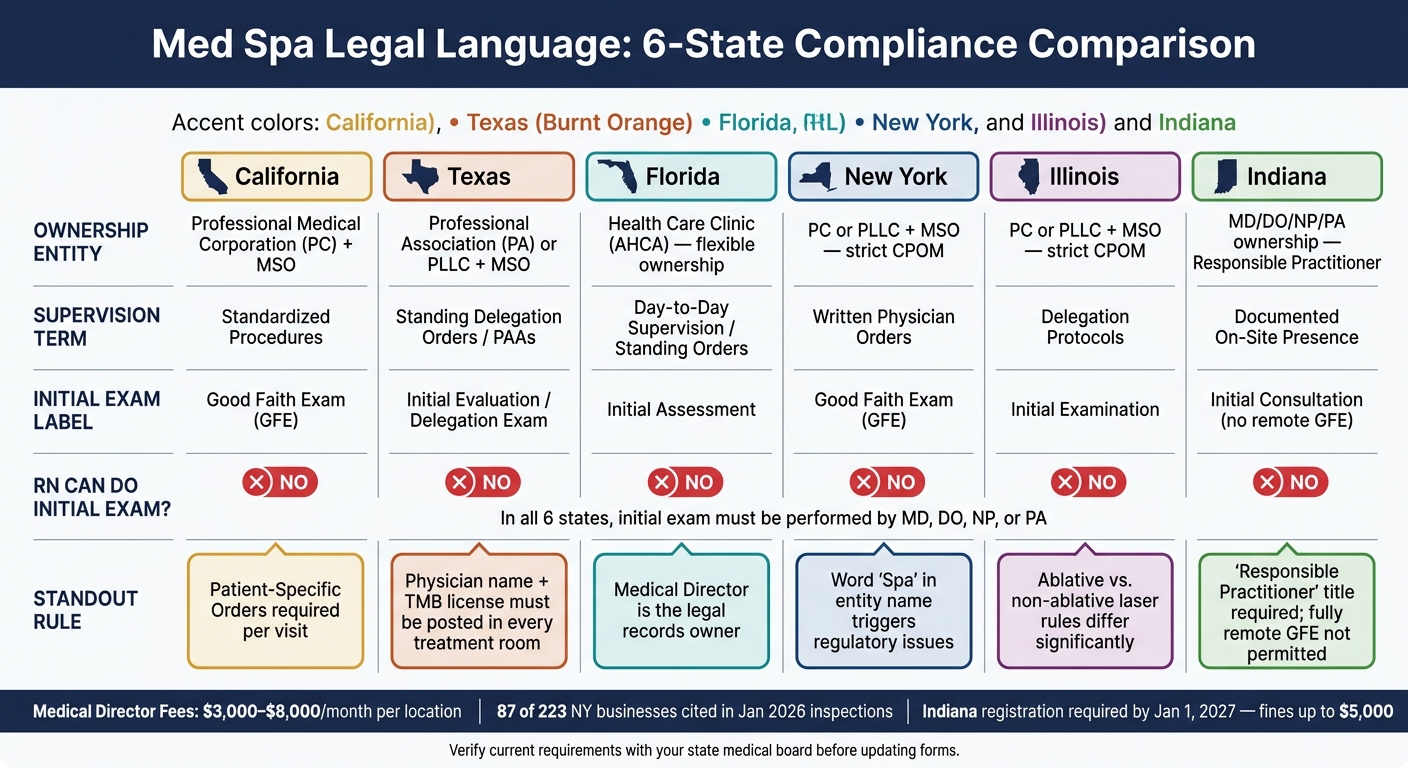
Med Spa Legal Language by State: 6-State Compliance Comparison
1. California
California takes a strict approach to med spa paperwork. The main idea is simple: control matters. Who owns the practice, who orders treatment, who documents care, and who holds the records all need to be spelled out the right way.
Ownership and Entity Terms
California's Corporate Practice of Medicine (CPOM) doctrine says clinical med spas must operate through a Professional Medical Corporation (PC). Licensed physicians - MDs or DOs - must own at least 51% of the shares.
If a nonphysician is involved on the business side, that person usually works through a Management Services Organization (MSO). The MSO can own equipment, run payroll, and handle admin work. But it can't make clinical calls.
The agreement between the MSO and the PC is the Management Services Agreement (MSA). Under SB 351, effective January 1, 2026, an MSA cannot give the MSO control over billing choices that depend on clinical judgment. It also cannot give the MSO the power to hire or fire clinical staff for reasons tied to competency.
That split between the PC and MSO doesn't just shape ownership. It also affects who can authorize care and who can put that care in the chart.
Supervision and Delegation Language
California requires a Patient-Specific Order (PSO) for each patient encounter. Broad standing orders don't match California's rules here.
Before an RN can treat a patient, a physician, NP, or PA must perform and document a Good Faith Exam (GFE). That applies to injections and similar services. California also makes one point very clear: RNs cannot perform the GFE.
When RNs give injections or use lasers, they must work under written Standardized Procedures created under Business and Professions Code § 2725 and 16 CCR § 1474. For laser and IPL treatments, a physician must be "immediately available" by phone or electronic means during the procedure.
In plain English, the digital chart, consent forms, and delegation documents should all point to the same people. If Dr. Smith did the exam and an RN gave the treatment under Standardized Procedures, those names should show up where they belong.
Consent and Patient Disclosure Wording
Consent forms should identify the exact prescriber - MD, DO, NP, or PA - who performed the GFE.
If the med spa uses a business name instead of the physician owner's own name, the practice must get a Fictitious Name Permit (FNP) from the Medical Board of California through Form FNP-001. Marketing materials must also show either the supervising physician's name or the practice's FNP.
That may sound like a small paperwork detail, but California does not treat it as small.
Privacy, Records, and Telehealth Terminology
The same PC/MSO divide applies to records. California med spas must follow both federal HIPAA rules and the state's Confidentiality of Medical Information Act (CMIA), which can be stricter when protected health information is involved. Medical records must be owned and maintained by the PC, not the MSO.
Telehealth GFEs are allowed, but the documentation should state that the process complies with B&P § 2290.5. The standard of care also has to match an in-person exam.
And if the business itself changes hands, the paperwork doesn't stop at patient files. For change-of-control events, include a 90-day written OHCA notice under AB 1415, effective January 1, 2026.
| Area | Required Term or Document | Legal Reference |
|---|---|---|
| Clinical entity | Professional Medical Corporation (PC) | Cal. Corp. Code § 13401.5(a) |
| Business entity | Management Services Organization (MSO) | California CPOM doctrine |
| Per-patient authorization | Patient-Specific Order (PSO) | B&P § 2052 |
| Initial patient review | Good Faith Exam (GFE) | B&P § 2052; § 2290.5 |
| RN delegation framework | Standardized Procedures | B&P § 2725; 16 CCR § 1474 |
| Practice name registration | Fictitious Name Permit (FNP) | MBC Form FNP-001 |
| State privacy law | Confidentiality of Medical Information Act (CMIA) | California Civil Code § 56 |
| Transaction notice | 90-Day OHCA Notice | AB 1415 |
sbb-itb-02f5876
2. Texas
Texas uses different wording than California, and that change shows up most in entity setup and delegation.
In Texas, neuromodulators, fillers, lasers, and medical microneedling are treated as the practice of medicine under TMB Rule 169.28.
Ownership and Entity Terms
The medical side should operate through a physician-owned Professional Association (PA) or Professional Limited Liability Company (PLLC). The nonclinical side should sit in an MSO, with the relationship spelled out in a Management Services Agreement (MSA).
That split matters on paper and in public-facing materials. Patient forms and website copy should clearly name the Medical Director or Delegating Physician because that person carries legal responsibility for medical treatments and clinical oversight.
Supervision and Delegation Language
Texas allows delegated clinical work through Standing Delegation Orders, Standing Medical Orders, Protocols, and Prescriptive Authority Agreements (PAAs).
Here’s the plain-English version:
- Standing Delegation Orders are for named delegates
- Standing Medical Orders apply to classes of delegates
- PAAs are used for APRN and PA prescribing
There’s also a rule change worth flagging. Under HB 3749, known as Jenifer's Law, effective September 1, 2025, elective IV therapy must be performed by an RN or higher.
Consent and Patient Disclosure Wording
Texas is pretty direct about what patients need to see. Every public area and treatment room must post the delegating physician’s full name, TMB license number, and complaint notice. Staff badges must also show each worker’s name and credential.
Privacy, Records, and Telehealth Terminology
Recordkeeping should include the lot number and manufacturer of each injectable. For remote orders involving injectables, Texas requires a physician-patient relationship first.
Texas uses its own set of terms for ownership, delegation, and prescribing. Even so, the pressure point is the same: your med spa documents need to match the law at every step.
| Term/Document | Legal Function |
|---|---|
| Professional Association (PA) / PLLC | Physician-owned entity providing medical services |
| Management Services Agreement (MSA) | Contract between the MSO and physician-owned entity |
| Standing Delegation Order | Written authorization for a specific named delegate |
| Prescriptive Authority Agreement (PAA) | Required for APRNs/PAs to prescribe medications |
| Jenifer's Law (HB 3749) | Limits elective IV therapy to RNs or higher |
| TMB Complaint Notice | Required posting in every public area and treatment room |
3. Florida
Florida allows nonphysician ownership. But clinical decisions still have to stay with a physician. In practice, Florida paperwork leans more on supervision, practitioner disclosure, and records ownership than on entity setup by itself.
Ownership and Entity Terms
Some Florida med spas operate as a Health Care Clinic under the Florida Health Care Clinic Act (Chapter 400, Part X, Fla. Stat.). If the practice is fully physician-owned, a statutory exemption under § 400.9905 may apply. That exemption should be documented and kept ready in case of an AHCA inspection.
When a nonphysician is involved on the ownership side, many operators use a Management Services Organization (MSO) with a Management Services Agreement (MSA) to run the business functions. The medical director must be a Florida-licensed MD or DO. Management pay should use an FMV flat-fee model, not a percentage of medical revenue.
In Florida, wording around ownership isn’t just legal housekeeping. It affects who can supervise care, who can delegate tasks, and who can sign records.
Supervision and Delegation Language
Florida law requires "day-to-day supervision" by the medical director. That means real oversight, not a name on paper and nothing more. Florida also looks closely at "ghost" medical directors who serve as figureheads without actual involvement.
ARNPs work under written collaborative agreements and set protocols. RNs act under physician standing orders. PAs work under a supervisory relationship that must be filed with the Board of Medicine within 30 days after the agreement starts or ends.
For laser or light-based hair removal, "direct supervision" is required, which means the physician must be on-site. LPNs generally cannot administer injectables in Florida.
Consent and Patient Disclosure Wording
Florida consent forms should cover informed choice, treatment alternatives, itemized billing, and a Choice of Practitioner form before the first exam. That form should identify each practitioner’s license type. Florida disclosure forms also need to state the supervising practitioner type.
Privacy, Records, and Telehealth Terminology
Under Chapter 456, the medical director is the "records owner" and must make sure patient records are kept properly and remain available. Any "serious adverse event" has to be reported to the Board of Medicine within 5 business days.
Florida uses "electronic-communications" telehealth language for remote diagnostic and treatment services under § 458.3255. Providers treating Florida residents from a distance must hold a Florida license unless a narrow exception applies. The same thread runs through both the record-owner rule and telehealth wording: the medical director’s role carries real responsibility.
Use these terms the same way across forms, notices, and chart templates.
The table below isolates the exact Florida phrases that should appear in core documents.
| Document Type | Required Florida Language | Reference |
|---|---|---|
| Supervision Agreement | "Day-to-day supervision", "Standing orders", "Direct supervision and control" | Rule 59A-33.008; § 458.303 |
| Patient Disclosure | "Informed choice", "Itemized patient billing", "Treatment alternatives", "Choice of Practitioner" | § 458.301; § 458.323; § 458.324 |
| Privacy/Records | "Records owner", "Chapter 456 compliance", "Serious adverse event" | Chapter 456 |
| Telehealth Consent | "Electronic-communications treatment services", "Practitioner/Patient location" | § 458.3255 |
Reading about the problem? See how Prospyr solves it in one platform.
Book a Demo4. New York
New York takes a hard line on med spas. Like Florida, it leans on supervision and disclosure. But New York is tougher on ownership and naming. And the state doesn't treat these rules like fine print.
In January 2026, the New York Department of State (NYDOS) issued a statewide alert after inspecting 223 businesses and citing 87 for violations, including the unlawful practice of medicine. That pressure shows up in the exact words used for entity names, consent forms, and telehealth records.
Ownership and Entity Terms
New York's Corporate Practice of Medicine (CPOM) doctrine is strict: only licensed physicians, either an MD or DO, can own a med spa. The practice must be set up as a Professional Corporation (PC), a Professional Limited Liability Company (PLLC), or a Registered Limited Liability Partnership. Before opening, the entity must get a Certificate of Authorization from the New York State Education Department (NYSED).
One rule trips people up all the time: NYDOS treats the word "spa" in a PC or PLLC name as a red flag.
Non-physician investors can still join the business side through a Management Services Organization (MSO). But the Management Services Agreement (MSA) has to use fixed, reasonable fees. Not a share of revenue. New York's anti-fee-splitting rules ban compensation tied to the volume or value of business.
Supervision and Delegation Language
The medical director must be a New York-licensed MD or DO who is actively involved in the practice. OPMC looks closely at nominal or "ghost" director setups. If the physician is only there on paper, that's a problem.
RNs may give injections and perform laser treatments, but only under written physician orders or standing protocols. They cannot perform the initial Good Faith Exam or prescribe.
Nurse Practitioners who have completed 3,600 hours of qualifying practice may work without a formal collaborative agreement. Even so, they still cannot serve as the legal medical director of a med spa. PAs must work within their board-approved scope under physician supervision.
Consent and Patient Disclosure Wording
New York wants the chart to show who did what, and whether the patient was told the right things up front.
Require a pre-procedure medical consultation by an MD, NP, or PA. Document the practitioner's credentials, procedure-specific experience, and how adverse outcomes will be handled. NYDOS also recommends clear signage telling patients which services the facility is not licensed to provide.
Privacy, Records, and Telehealth Terminology
The same strict approach carries over to records and remote care. New York adds state privacy rules on top of HIPAA. Telehealth records must show the patient's location at the time of service, and New York-licensed providers cannot prescribe to out-of-state patients without separate licensure.
| Document Type | Required New York Language | Reference |
|---|---|---|
| Legal Entity Name | Must use a PC, PLLC, or registered LLP; PC/PLLC names must not include "spa" | NYDOS; NYSED |
| MSO Agreement | Fixed, reasonable fees; no revenue-based compensation or fee-splitting | |
| Consent Form | Pre-procedure medical consultation by an MD, NP, or PA; practitioner credentials disclosed | NYDOS |
| Nursing Protocols | Written physician orders required for RN administration of injectables | |
| Telehealth Intake | Patient's physical location in New York confirmed at the time of service |
5. Illinois
Illinois expects med spa documents to draw a clear line between medical practice language and cosmetic service language. That matters most for lasers, delegation, and how staff are identified. In December 2024, the Illinois Department of Financial and Professional Regulation (IDFPR) made this point plain: laser treatments are part of the practice of medicine, not cosmetology or esthetics.
Ownership and Entity Terms
On the medical side, an Illinois med spa should use a Professional Corporation (PC) or Professional Limited Liability Company (PLLC). That entity must be owned by a licensed physician or by an APRN with Full Practice Authority (FPA), as allowed under Illinois ownership rules.
The wording here matters more than it may seem. Use PC or PLLC ownership language, and keep clinical authority with the medical entity. The MSO should handle administrative work only. That setup affects how consents are written, how delegation protocols are framed, and how chart entries are described.
Supervision and Delegation Language
Illinois uses procedure-specific supervision rules, which means the wording should match the type of laser treatment being done.
- Ablative laser treatments require an initial in-person exam and on-site physician supervision.
- Non-ablative laser procedures also require an initial in-person exam, but the exam may be done by the physician or an APRN. After that, the physician may be available by phone or electronic means.
RNs may perform delegated medical procedures only under written Delegation Protocols. Those protocols must spell out the tasks, training, and supervision rules tied to the delegated work.
There’s another point Illinois is strict about: staff should not present themselves as estheticians when they are performing delegated medical tasks. If someone is doing delegated medical work, label that person as a delegated assistant, not an esthetician. The same procedure-specific wording should carry across consent forms, staff protocols, and EMR templates.
Consent and Patient Disclosure Wording
Illinois also has direct rules on patient-facing disclosures. Health care professionals must wear name tags during patient encounters that clearly state their license type. Offices must also display a visible notice listing the license types of the professionals providing services.
Consent forms should separate ablative from non-ablative procedures because the physician presence rules are not the same. For non-ablative treatments where an APRN performed the initial exam, the consent should say that a physician is available by telephone or electronic means.
Privacy, Records, and Telehealth Terminology
Use records language that complies with HIPAA and the Cures Act. Telehealth wording should stay limited to non-ablative procedures, and only after the required in-person exam has already taken place.
| Document Type | Required Illinois Language | Reference |
|---|---|---|
| Legal Entity Name | Professional Corporation (PC) or Professional Limited Liability Company (PLLC); owned by a physician or APRN with FPA | |
| MSO Agreement | All clinical medical decisions reserved for the medical entity | |
| Laser Consent (Ablative) | Initial in-person exam required; physician on-site during procedure | |
| Laser Consent (Non-Ablative) | Physician or APRN initial in-person exam; physician available by phone or electronic means | |
| Staff Identification | Name tags and office notices must display the specific license type | |
| Delegation Protocol | Written protocol specifying tasks, training, and supervision for delegated medical staff |
Illinois is a good example of how fast med spa wording can change once a state treats lasers, delegation, and supervision as medical practice issues. Indiana uses different supervision terms, so Illinois templates should not be copied over as-is.
6. Indiana
Indiana is in the middle of a major rule change. Senate Bill 282 (SB 282), signed on March 5, 2026, and effective July 1, 2026, sets up a dedicated legal framework for med spas. Starting January 1, 2027, med spas must register with the Medical Licensing Board of Indiana. If a business operates without registration, it can face a fine of up to $5,000.
This matters for your documents right now. Indiana now uses its own statutory terms, so generic med spa language won’t cut it. Your templates should use Indiana-specific titles and supervision wording.
Ownership and Entity Terms
Indiana bars the corporate practice of medicine. That means only a licensed physician can own a medical practice or med spa. The medical entity should be formed as a PC or PLLC, while the MSO should stay in its lane and handle only nonclinical administrative work under an MSA. Indiana does allow an MSO structure, but the physician-owned medical entity must keep control over clinical care.
One wording change stands out: SB 282 introduces "Responsible Practitioner". That title should replace "Medical Director" in internal policies and public-facing documents. The Responsible Practitioner must be registered with the Medical Licensing Board of Indiana. Indiana also limits the use of the initials "M.D." to licensed physicians.
Use Responsible Practitioner the same way across:
- formation documents
- consent forms
- websites and other public materials
Supervision and Delegation Language
SB 282 sets the supervision standard. The responsible practitioner must maintain regular on-site presence at the facility so services are performed in line with legal requirements. Your policies should say that clearly, and they should also require that this on-site presence be documented.
Indiana also uses specific delegation terms. The "delegating physician" is the doctor who oversees medical acts performed by others. NPs work under a Collaborative Practice Agreement, and PAs work under a Physician Practice Agreement.
Don’t use broad labels like "aesthetic services" in these agreements. Indiana expects the paperwork to name each allowed procedure. Under Indiana law, the practice of medicine includes injectables, fillers, laser treatments, and microneedling beyond a depth of 0.8 mm. So if those are being offered, they should be listed by name in delegation agreements, protocols, and EMR templates.
Consent and Patient Disclosure Wording
Before treatment, a prescriber must complete a Good Faith Exam (GFE). In Indiana, that prescriber can be an MD, DO, NP, or PA. RNs are plainly barred from doing this initial assessment. So your intake and consent forms need to match the role of the prescriber who actually performed the exam.
Patient intake forms should name the Responsible Practitioner and include that person’s credentials, which lines up with the public registry rule. Consent forms should also be procedure-specific. A single blanket consent for everything is too broad.
Marketing and advertising need care too. They should state practitioners' qualifications and disclose material risks so the practice does not make misleading claims.
Privacy, Records, and Telehealth Terminology
Indiana's Data Privacy Law took effect on January 1, 2026. That adds a state law layer on top of HIPAA, so your records language should refer to both. There’s also a reporting rule for adverse events: the law requires notice to the Medical Licensing Board within 15 days of any serious adverse event.
Be careful with telehealth wording. You should not describe fully remote GFEs as compliant. Indiana expects on-site practitioner oversight, so a fully remote GFE is not the standard. Services must be performed only at a registered office location. Mobile or home-visit treatments are barred unless that location is separately registered.
Put these terms in the same form across intake, consent, supervision, and recordkeeping documents. If one form says Responsible Practitioner and another still says Medical Director, that mismatch can create problems fast.
| Document Type | Required Indiana Language | Reference |
|---|---|---|
| Clinical Overseer Title | Responsible Practitioner (physician, NP, or PA); publicly registered | |
| Supervision Standard | Regular on-site presence; documented schedule required | |
| NP Agreement | Collaborative Practice Agreement; must enumerate specific procedures | |
| PA Agreement | Physician Practice Agreement; must enumerate specific procedures | |
| GFE Protocol | Prescriber only (MD, DO, NP, PA); RNs explicitly excluded | |
| Adverse Event Reporting | Board notification within 15 days of serious adverse event | |
| Data Privacy | Indiana Data Privacy Law (effective Jan. 1, 2026) plus HIPAA |
The next section compares these terms across all six states.
How Legal Language Compares Across States
The sections above break down each state's rules on its own. Here, the goal is simpler: pull out the wording differences that matter most across all six states.
At a high level, these states follow the same core compliance ideas. But the legal terms you use can shift from one state to the next, and those shifts matter in day-to-day documents.
Ownership and entity terms across the six states
California, New York, Illinois, and Texas follow stricter CPOM-style ownership rules than Florida and Indiana. California requires a Professional Medical Corporation (PC). New York and Illinois use a PC or PLLC. Texas uses a Professional Association (PA) or PLLC. Florida allows non-physician ownership through Health Care Clinic registration under AHCA. Indiana allows ownership by MDs, DOs, NPs, and PAs, with the Responsible Practitioner keeping clinical control.
That choice of entity doesn't just sit on paper. It affects how you word MSAs, consent forms, and public disclosures.
Supervision and delegation terms by state
This is where the language starts to spread out more. California uses Standardized Procedures. Texas uses Standing Delegation Orders, Standing Medical Orders, Protocols, and PAAs. Florida relies on Standing Orders with day-to-day supervision. New York requires Written Physician Orders. Illinois uses Delegation Protocols. Indiana requires documented on-site presence by the Responsible Practitioner.
The level of supervision changes too. California, Florida, New York, and Illinois require direct supervision for RN injectors. Texas and Indiana allow general supervision in many aesthetic settings, which means the physician must be reachable but does not have to be physically present. That detail should be stated plainly in protocols and delegation agreements.
Consent and disclosure language patterns
All six states require informed consent that covers risks, benefits, and alternatives. After that, each state adds its own layer.
New York has strict provider identity rules. Florida ties some disclosures to office-based surgery classifications I, II, and III. Illinois consent forms must separate the practice of medicine from cosmetology services. Texas requires the delegating physician's name and TMB license number to be posted in patient areas.
The Good Faith Exam requirement shows up in almost every state, but the label changes:
- California and New York use Good Faith Exam
- Texas uses Initial Evaluation or Delegation Exam
- Florida uses Initial Assessment
- Illinois uses Initial Examination
- Indiana uses Initial Consultation
In all six states, the exam must be done by an MD, DO, NP, or PA.
Privacy, records, telehealth, and exam terminology
Every state builds on top of HIPAA, but each one adds its own set of rules. California adds the CMIA. Texas adds the Texas Medical Records Privacy Act and TMB Rule 169.28. Florida points to AHCA standards. New York keeps its own state PHI protections. Illinois follows IDFPR standards. Indiana uses the HIPAA baseline plus its own Data Privacy Law, which takes effect January 1, 2026.
Telehealth wording needs close attention too. Most states allow a GFE by telehealth if it meets the state standard of care. Indiana is the outlier here because it does not allow fully remote GFEs. The same term should appear across intake forms, consent documents, and EMR templates so the paperwork doesn't drift.
Master comparison table: legal language by state
The table below puts the main wording differences side by side.
| Legal Language Area | California | Texas | Florida | New York | Illinois | Indiana |
|---|---|---|---|---|---|---|
| Ownership Language | Professional Medical Corporation (PC); strict CPOM | Professional Association (PA) or PLLC; strict CPOM | Health Care Clinic (AHCA registration); flexible ownership | PC or PLLC; strict CPOM | PC or PLLC; strict CPOM | MD/DO/NP/PA ownership permitted; Responsible Practitioner holds clinical control |
| Supervision Terms | Standardized Procedures; direct supervision for RNs | Standing Delegation Orders; Standing Medical Orders; Protocols; PAAs | Standing Orders; day-to-day supervision | Written Physician Orders; direct supervision for RNs | Delegation Protocols; direct supervision for RNs | Documented on-site presence by Responsible Practitioner |
| Consent Content Requirements | Risks, benefits, alternatives; GFE prescriber identified | Delegating physician name and TMB license number posted | Office-based surgery level disclosures (I, II, III) | Strict provider identity rules | Practice of medicine vs. cosmetology distinguished | Procedure-specific consent; Responsible Practitioner named |
| Privacy Terms | HIPAA + CMIA | HIPAA + Texas Medical Records Privacy Act + TMB Rule 169.28 | HIPAA + AHCA standards | HIPAA + NY state PHI protections | HIPAA + IDFPR standards | HIPAA + Indiana Data Privacy Law (eff. Jan. 1, 2026) |
| GFE / Telehealth Wording | Good Faith Exam; telehealth permitted under B&P § 2290.5 | Initial Evaluation or Delegation Exam | Initial Assessment | Good Faith Evaluation | Initial Examination | Initial Consultation; fully remote GFE not permitted |
| Notice Terms | CMIA disclosure; Fictitious Name Permit if applicable | DSHS/TMB posting requirements | AHCA standards; records owner disclosure | OPMC standards; NYDOS provider identity notice | IDFPR license-type display requirements | Medical Licensing Board registration; adverse event notice within 15 days |
Pros and Cons of State-Specific Legal Language
Benefits of using state-specific forms and policies
The comparison above shows what changes. This section gets into why those changes matter day to day.
State-specific documentation does one job better than a generic template: it lines up your paperwork with the rules your state board will look at. And that matters, because each state uses its own supervision language. Your forms need to match that language exactly.
Using state-specific wording can also lower scope-of-practice risk. If your consent forms, delegation agreements, and internal policies use the right terms, you’re in a better spot if your work is ever reviewed. Malpractice insurers expect providers to stay within their legal scope, and state-specific documentation often becomes the paper trail that helps show they did.
The most common breakdown is a scope-of-practice mismatch. That happens when staff perform tasks the state does not allow. In a board review, supervision logs and protocol records can be some of your strongest proof. The catch? Every state rule change can trigger another round of review.
Drawbacks of maintaining multiple state versions
The biggest downside is simple: time and money.
If you operate in more than one state, you usually need separate legal review, training, and update cycles for each jurisdiction.
Version control is another pain point. State boards change their rules often, and old forms can create risk fast once those rules shift.
Training gets messy too. A team in one state needs to know that state’s delegation framework. A team somewhere else needs to follow a different supervision standard. Those ideas are not interchangeable, and teaching staff across locations takes time, follow-up, and close oversight.
Single-state practices vs. multi-state operators
For single-state practices, the decision is much easier. You put money into one set of legally reviewed, state-specific forms, and that set supports the whole operation. Version control is easier to manage, staff training stays focused, and compliance risk stays tied to one board’s rules.
Multi-state operators have a tougher path. The usual answer is a standardized core plus state-specific addenda for CPOM, supervision, and delegation. The mistake many expanding groups make is assuming a compliance setup from one state will carry over into another. It won’t. A model that works in Florida may not satisfy Texas or New York rules.
There’s also a staffing issue tied to this. Medical directors must be licensed in each state where they oversee care. That affects both documentation and cost, since medical director fees often run $3,000 to $8,000 per month per location, or 25% to 40% of procedure revenue.
Comparison table: pros, cons, and best-fit use cases
| Approach | Pros | Cons | Best-Fit Use Case |
|---|---|---|---|
| Fully State-Specific | Maximum compliance accuracy; matches local board expectations; clearer for staff to follow | High upfront legal cost; difficult to scale across states | Single-state practices; operators in high-enforcement states (CA, NY, TX) |
| Standardized National Template | Lowest administrative cost; consistent training across locations | High regulatory risk; misses state-specific scope rules | Not suitable for medical procedures |
| Hybrid (Core + State Addenda) | Balances scalability with compliance; keeps HIPAA/OSHA standards consistent across locations | Requires strong version control and legal oversight for each new state | Multi-state operators expanding into three or more jurisdictions |
Conclusion
After looking at all six states, the takeaway is pretty plain: one treatment can call for six different sets of legal wording. Ownership rules, supervision standards, delegation rules, consent language, and privacy requirements all change based on where your practice operates. And those changes aren't small.
They shape every form, policy, and template your team uses. So template review isn't just admin work. It's part of compliance.
The day-to-day takeaway is simple: keep state-specific language up to date across every patient-facing and internal document. Audit each patient-facing and internal document against current state guidance on a recurring schedule. Verify current requirements with your state medical board before updating forms and policies. Digital intake forms and EMR templates need the same level of care - a form that was correct when your practice opened may no longer match what your state board expects today. Prospyr supports HIPAA-compliant digital intake and EMR updates, which can help keep those templates current as requirements shift.
Legal language in this industry isn't a one-time setup. It's an ongoing part of running a compliant practice, and getting it right, state by state, is what keeps your documentation defensible when it matters most.
FAQs
Which documents should be state-specific first?
Start with the core legal and day-to-day documents that decide whether you can operate in your state. Put business structure, ownership agreements, and supervision protocols first.
From there, adjust patient consent forms, documentation rules, and treatment delegation tables to match state law. These documents spell out what staff can do and how much physician oversight is required. Always check them against current state medical board guidance.
Can one medical director oversee multiple states?
Yes, but only if the medical director holds an active, unrestricted license in each state where the med spa operates.
They also need to make sure their supervision and clinical governance match that state’s rules, since laws vary by jurisdiction.
When do telehealth exams qualify for med spa treatment?
It depends on state-specific medical board rules because there’s no single federal standard.
In many states, a virtual exam can satisfy the required pre-service good faith exam. But the rules change from state to state.
The main differences usually come down to a few things:
- whether the exam must be synchronous, like a live video visit
- whether asynchronous models are allowed
- who is allowed to perform the exam
- how much physician oversight is required
That means a setup that works in one state may not meet the rules in another.