Avoiding Ambiguity in Medical Consent Forms
Make consent forms clear: use plain language, better layout, accurate translations, teach-back, and digital tools to lower legal risk.
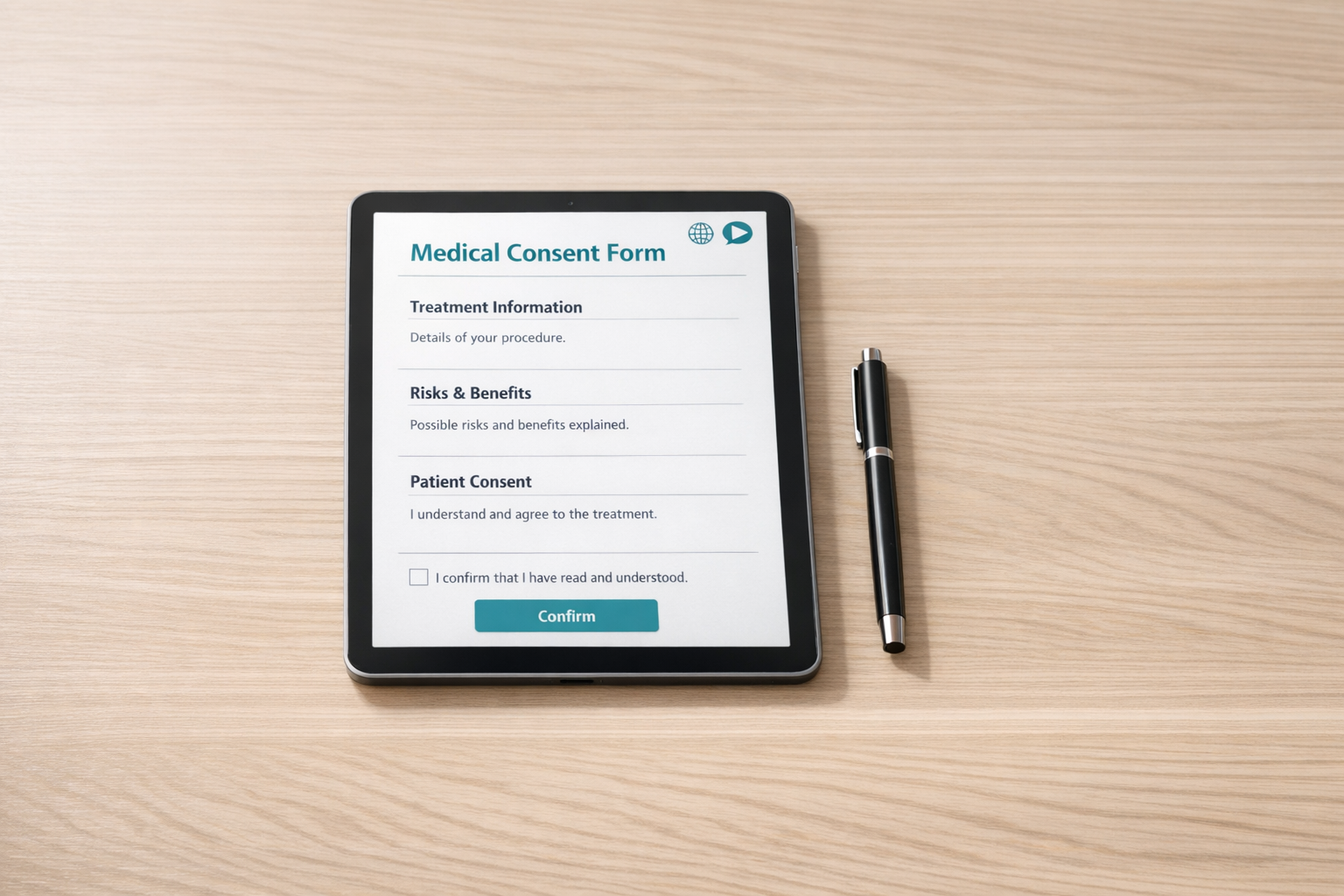

Medical consent forms are often too complex for patients to understand, undermining their purpose. Research shows that most forms require a college-level education, while the average U.S. adult reads at an 8th-grade level. This gap leads to confusion, ethical concerns, and even legal risks.
Here’s what you need to know:
- Overly technical language and dense formatting make forms hard to read.
- Legal risks arise when forms fail to meet plain-language standards like those required by HIPAA.
- Patients struggle to understand risks, benefits, and alternatives, which compromises informed consent.
- Solutions include using simple language, better layouts, and tools like digital consent forms to ensure clarity and compliance.
The key takeaway? Simplify consent forms to improve patient understanding, reduce legal risks, and build trust.
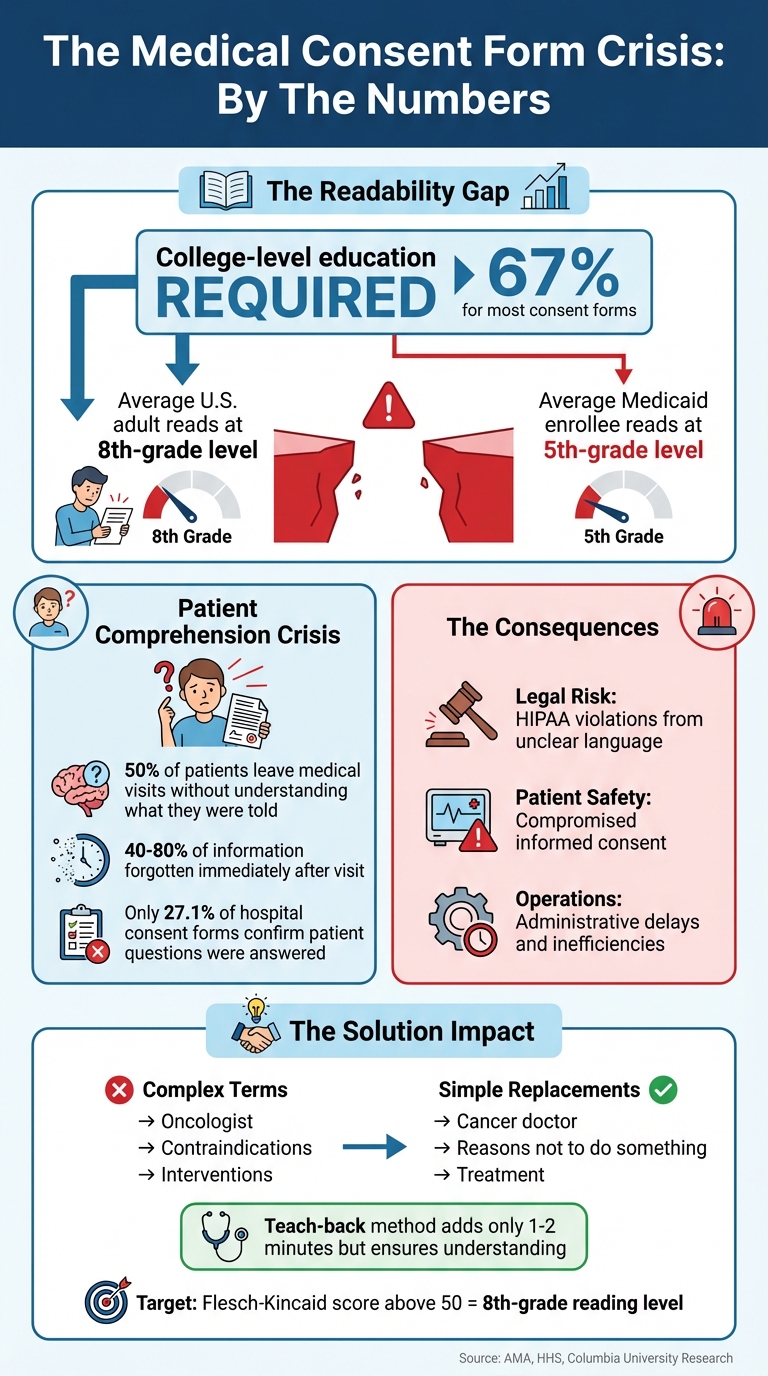
Medical Consent Form Readability Statistics and Impact
Risks of Unclear Language in Medical Consent Forms
When medical consent forms are written ambiguously, they can lead to legal challenges, patient confusion, and operational inefficiencies. These issues not only increase liability but also hinder effective communication and create administrative headaches.
Legal Liability and Malpractice Claims
The Department of Health and Human Services (HHS) mandates that HIPAA authorization forms be written in plain language. Using overly technical or confusing language can violate federal standards, potentially invalidating the consent and blocking the legal exchange of Protected Health Information (PHI).
Healthie, a healthcare compliance resource, emphasizes:
The overarching requirement for every single release form is that the communications must be written in plain language; this means that when describing how a patient's health information will be used, HIPAA compliant forms must be in basic, easy-to-understand language, free of too much technical or medical jargon.
Clear and straightforward consent forms protect medical practices from regulatory penalties and ensure a solid legal basis for patient care. Without valid consent, practices risk compliance breaches that jeopardize security and patient trust.
But legal risks are only part of the problem. Poorly written forms also compromise patient understanding.
Patient Comprehension Problems
When consent forms are filled with medical jargon, they can alienate patients who lack the literacy needed to understand them. According to the American Medical Association, this communication gap undermines informed decision-making. For example, while many consent forms are written at a college reading level, the average Medicaid enrollee reads at a 5th-grade level. This mismatch prevents patients from fully grasping the risks and benefits of their care.
This issue has ethical consequences, as emphasized by researchers from institutions like Columbia University and the University of Michigan:
Effective and ethical informed consent practices are crucial to protection of patient autonomy and shared decision making.
For patients dealing with serious diagnoses like cancer, complex language only adds to their stress, making it harder to process critical treatment details. Overly dense text can lead to confusion or misinterpretation, defeating the purpose of informed consent.
Administrative Burdens for Medical Practices
Vague or poorly structured consent forms also create operational headaches for healthcare providers. Without standardized, clear templates, staff often waste time crafting suitable language or obtaining approvals from Institutional Review Boards (IRBs), delaying patient care and straining resources.
Alexander Kuhn, a Protocol Navigator at Frederick National Laboratory for Cancer Research, highlights this pressure:
At one time or another, all roles in all phases of research experience pressure to do more with less.
Inconsistent terminology across staff can further complicate workflows, increasing oversight demands and requiring manual reviews that divert attention from patient care. For practices with tight budgets, these inefficiencies make it even harder to maintain smooth operations while ensuring informed consent is properly obtained.
sbb-itb-02f5876
Reading about the problem? See how Prospyr solves it in one platform.
Book a DemoCommon Causes of Unclear Consent Forms
Figuring out why consent forms often confuse patients can help healthcare providers tackle the main issues. Three common problems frequently make these forms harder to understand.
Medical Terminology and Technical Language
One big issue is the use of complex medical jargon, like "contraindications" or "interventions", which can leave patients scratching their heads. The American Medical Association points out that "medspeak" can shut down effective communication with patients.
The problem is that technical language often pushes the reading level of these forms far above what most adults in the U.S. can easily understand. Experts from Columbia University, University of Chicago, University of Illinois at Chicago, and the University of Michigan stress that "effective and ethical informed consent practices are crucial to protection of patient autonomy and shared decision making". For instance, using terms like "simulation" instead of "practice setup used to plan treatment" or "oncologist" instead of "cancer doctor" can make it hard for patients to fully grasp their care options.
But it's not just the language - how the forms are designed adds to the confusion.
Long Forms with Poor Formatting
The way consent forms are structured and laid out also plays a huge role in whether patients can understand them. In U.S. hospitals, these forms vary wildly in length, with some for invasive procedures requiring a reading level equivalent to a third-year college student.
Dense blocks of text, tiny fonts, and a lack of clear headers make it tough for patients to find the information they need. Jeffrey T. Kirchner, D.O., explains that "significant variability exists in both readability and content of consent forms... the majority of consent forms require at least a 12th-grade reading level and are too complex for the average person to fully understand".
The problem isn't just how long these forms are - it's also about how the information is buried. When crucial details about risks or procedures are hidden in walls of text, patients often miss what matters most. A study even found that only 27.1% of hospital consent forms specifically stated that the patient's questions had been answered.
Translation Problems and Cultural Barriers
For non-English-speaking patients, poorly translated consent forms add another layer of confusion. Automated translation tools often fail to capture the subtle meanings of medical terms, leading to errors that make understanding even harder. Since many medical and legal terms don't directly translate into other languages, these forms need careful localization rather than word-for-word translations.
The Wolfestone Group highlights: "Informed consent is not just about signing a form - it is about clearly comprehending it. Simply signing a form without understanding it is not informed consent". Unfortunately, many patients sign forms they don't fully understand, often because they trust their doctor, which raises ethical concerns.
Cultural differences also come into play. Words like "placebo", "data sharing", or "withdrawal from study" can mean different things depending on someone's background. As aiaTranslations explains, "a translation that mirrors the source text too rigidly may be accurate on paper but difficult to understand in practice".
How to Write Clearer Medical Consent Forms
Creating medical consent forms that are easy for patients to understand, while still meeting legal standards, requires a thoughtful approach. Here are some practical strategies to achieve this balance.
Use Simple, Everyday Language
Swap out complex medical jargon for plain, everyday words. For instance, use "cancer doctor" instead of "oncologist" or "reasons not to do something" instead of "contraindications." Research shows that even small changes in wording can make a big difference in how easily people can read and understand the text. Keep sentences short, use active voice, and clearly state who is responsible for each action. For example, write "We will send you results" instead of "Results will be sent".
Visual aids can also make a huge difference. Medical illustrations, icons, or diagrams can help explain procedures. To communicate risks, tools like shaded scales that compare risks to everyday activities (like driving) or body maps showing where side effects might occur are especially effective. A great example is an informed consent toolkit developed in February 2026 by a team supporting the National Institute of Allergy and Infectious Diseases (NIAID). Led by Alexander Kuhn and a group of medical writers, the toolkit included over 200 images and 250 icons, significantly improving readability and earning praise from Institutional Review Board reviewers.
Beyond simplifying language, the way the form is organized plays a major role in making it easier to understand.
Simplify Form Layout and Organization
The structure of a consent form is just as important as the words themselves. Shorter forms are easier to understand. Focus on the most important information, use clear headings, bold key sections, and leave plenty of white space to make the form more visually accessible.
When explaining timelines or procedures, opt for simple charts or graphics instead of dense tables. A two-part structure - starting with an "information sheet" followed by a "consent certificate" - can make the form easier to navigate. Before finalizing, run the form through the Flesch-Kincaid readability tool to ensure it scores above 50 and aligns with an 8th-grade reading level. This is crucial, as about 50% of U.S. adults cannot read at an 8th-grade level.
Here’s a quick guide to simplifying complex terms:
| Complex Term | Simple Replacement |
|---|---|
| Alternative/Alternate | Other or Possible |
| Oncologist/Oncology | Cancer doctor |
| Simulation | Practice setup used to plan treatment |
| Contraindications | Reasons not to do something |
| Interventions | Treatment |
| Recurrence | Comes back |
Provide Accurate Translations for All Languages
For non-English speakers, rely on professional translators to ensure accuracy and clarity. Automated translation tools often miss the subtle meanings of medical terms. It’s important to focus on localization - adapting the text to fit the cultural and linguistic context - rather than just translating word for word. As aiaTranslations explains:
a translation that mirrors the source text too rigidly may be accurate on paper but difficult to understand in practice.
Terms like "placebo", "data sharing", or "withdrawal from study" need special attention to ensure they make sense in different cultural contexts. Always test translations with native speakers to confirm they are clear and culturally appropriate.
Verify Patient Understanding with Teach-Back
Even the clearest consent form won’t help if patients don’t fully grasp what they’re agreeing to. That’s where the teach-back method comes in. Instead of asking, "Do you understand?" - which often leads to a polite but unhelpful "yes" - ask patients to explain the information back to you in their own words. For example, you might say, "Can you explain this procedure in your own words to ensure everything is clear?" .
This method, endorsed by organizations like the American Academy of Family Physicians and The Joint Commission, shifts the responsibility to the provider to ensure clear communication. Healthcare attorney Jeana Singleton highlights the importance of this approach:
It's too easy for patients to just say yes, but it's possible they're too embarrassed to admit they didn't catch it.
Teach-back typically adds just one to two minutes to a patient interaction but can make a big difference. Studies show that about 50% of patients leave medical visits without understanding what they were told, and they forget between 40% and 80% of the information immediately after.
If a patient’s explanation reveals confusion, rephrase the information and ask them to explain it again. For procedures that involve physical actions, have patients demonstrate the steps. Focus on the most important details, like medication instructions or key risks, rather than overwhelming them with every minor point.
Using Digital Tools for Better Consent Forms
Switching from paper to digital consent forms can solve many of the common issues tied to clarity and compliance. Prospyr’s digital forms are designed to reduce confusion and align with legal standards.
Digital Forms Improve Clarity and Compliance
Prospyr provides customizable, read-only digital templates that highlight key risks and streamline the overall design. Unlike paper forms, which can be altered, these digital forms are locked to maintain their legal validity. Using merge tags like {{ first_name }}, {{ dob }}, and {{ practice_name }}, the system automatically fills in patient-specific details, cutting down on errors from manual entry.
For practices serving diverse populations, Prospyr supports manual translations into Spanish and French, ensuring patients receive accurate information in their preferred language. Features like required checkboxes and radio buttons ensure patients acknowledge specific risks clearly. As the Practice Help Center explains:
Consent forms are essential legal documents that ensure patients are fully informed and acknowledge risks, treatments, or policies before proceeding with care.
These tools also set the stage for automated risk summaries and effective version control.
Automated Risk Summaries and Version Control
Prospyr links consent forms to specific service codes, and its Action Center flags missing signatures while managing document versions. This ensures that generic forms aren’t mistakenly used for specialized procedures.
Custom tags, such as {{ Tooth_Number }}, can be added to capture precise patient details. When updates are needed, existing templates can be duplicated to create new versions with clear, descriptive titles. A preview mode allows staff to test the formatting and automated fields before finalizing forms for patient use.
Better Patient Communication with Prospyr
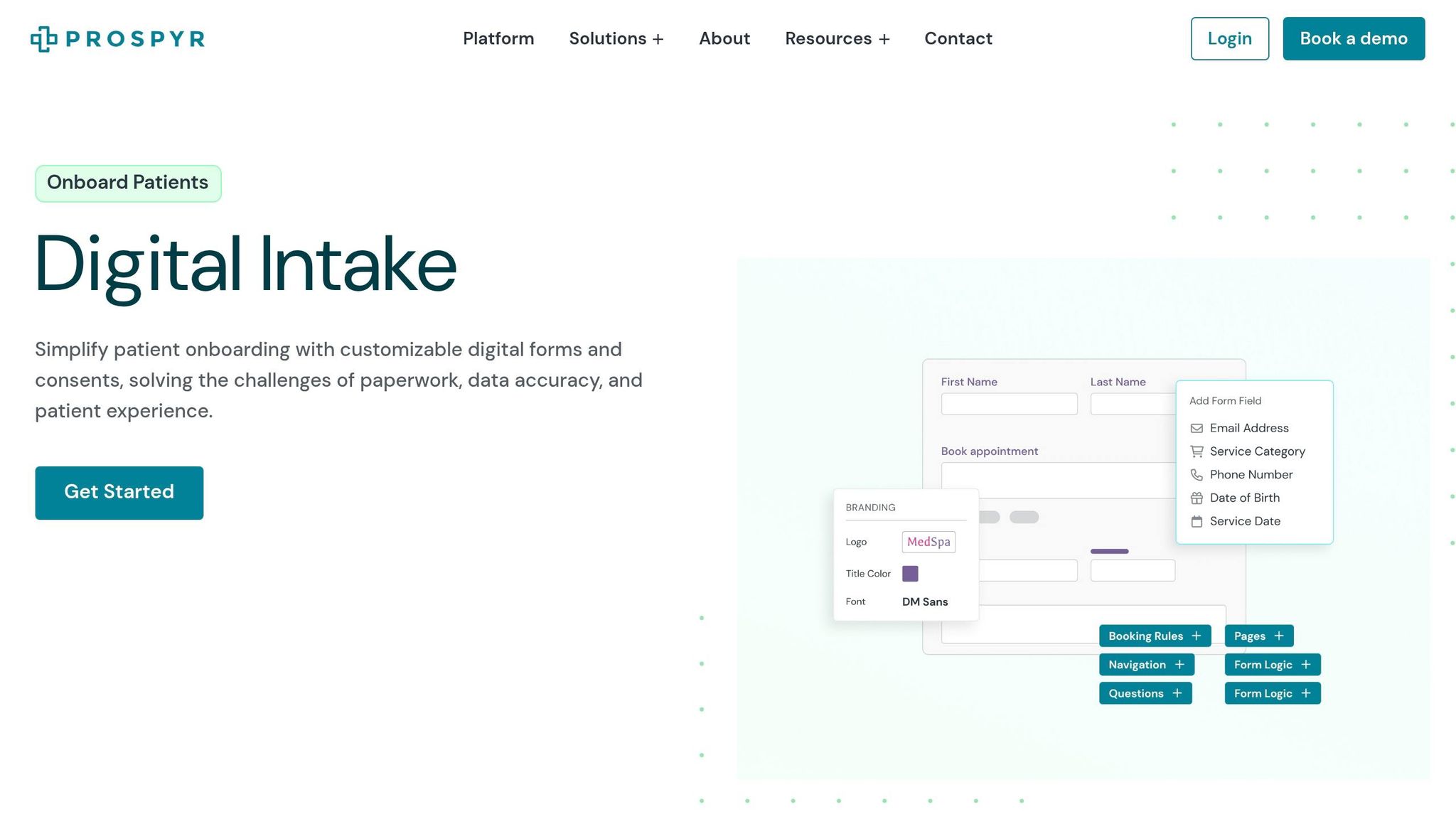
Digital tools like Prospyr go beyond simplifying documentation - they also improve patient communication. Through the Patient Portal, patients can complete forms on their own devices before appointments, giving them time to review technical terms at their own pace. This reduces wait times and confusion during visits.
The platform’s 2-Way SMS feature offers patients a direct way to ask questions about their consent forms before arriving at the clinic. All patient data remains HIPAA-compliant, reducing risks tied to lost or incomplete paperwork. Additionally, the digital intake process integrates seamlessly with other clinical tools, such as Telehealth and Media Archives, ensuring consent forms are part of a larger system designed to improve communication, understanding, and compliance.
Conclusion
When consent forms are unclear, they can lead to legal risks, poor decision-making, and operational headaches. Overly technical language often undermines their main purpose - ensuring patients understand their choices and enabling collaborative decision-making with their healthcare providers.
The solution? Simplicity and clarity. Swapping out terms like "oncologist" for "cancer doctor" or "contraindicated" for "reasons not to do something" can make a big difference. As regulations increasingly emphasize clear communication, healthcare providers must find ways to translate medical jargon into language patients can easily grasp. This is key to maintaining both trust and regulatory compliance.
Technology offers practical tools to address these challenges. Platforms like Prospyr provide customizable templates, automated field population, and version control to ensure HIPAA compliance while reducing errors. Their Patient Portal lets patients review forms at their convenience, cutting down on confusion and wait times. Meanwhile, features like 2-Way SMS give patients an easy way to ask questions and gain clarity before stepping into the clinic.
As researchers from Columbia University, the University of Chicago, and the University of Michigan emphasize:
Effective and ethical informed consent practices are crucial to protection of patient autonomy and shared decision making.
FAQs
What reading level should a medical consent form target?
Medical consent forms should be written so that they’re easy for most people to understand - ideally at or below an eighth-grade reading level. This helps ensure patients can clearly grasp the information and make informed choices about their healthcare.
How can clinics prove patients actually understood the consent?
Clinics can ensure patients fully understand consent forms by using plain, straightforward language and confirming comprehension. Techniques like the teach-back method, where patients rephrase the information in their own words, are particularly effective. Another approach is obtaining signed acknowledgments that confirm understanding. Prioritizing clear communication and steering clear of vague or confusing language helps promote informed decisions and minimizes potential misunderstandings.
Which digital consent form features reduce HIPAA and legal risk?
Key elements that reduce HIPAA and legal risks in digital consent forms include:
- Automated audit trails to track access and changes.
- Standardized data entry to minimize errors and inconsistencies.
- Strong encryption to secure sensitive information.
- Robust access controls to limit unauthorized access.
- Secure storage to protect data integrity.
- Firewalls to prevent unauthorized network access.
Other protective measures, such as intrusion detection systems and ongoing staff training, are also essential for maintaining compliance and safeguarding patient information.