Checklist for Air Quality Compliance in Clinics
Step-by-step checklist to ensure clinic ventilation, monitoring, filtration, respiratory protection, and documentation for air quality compliance and audit readiness.
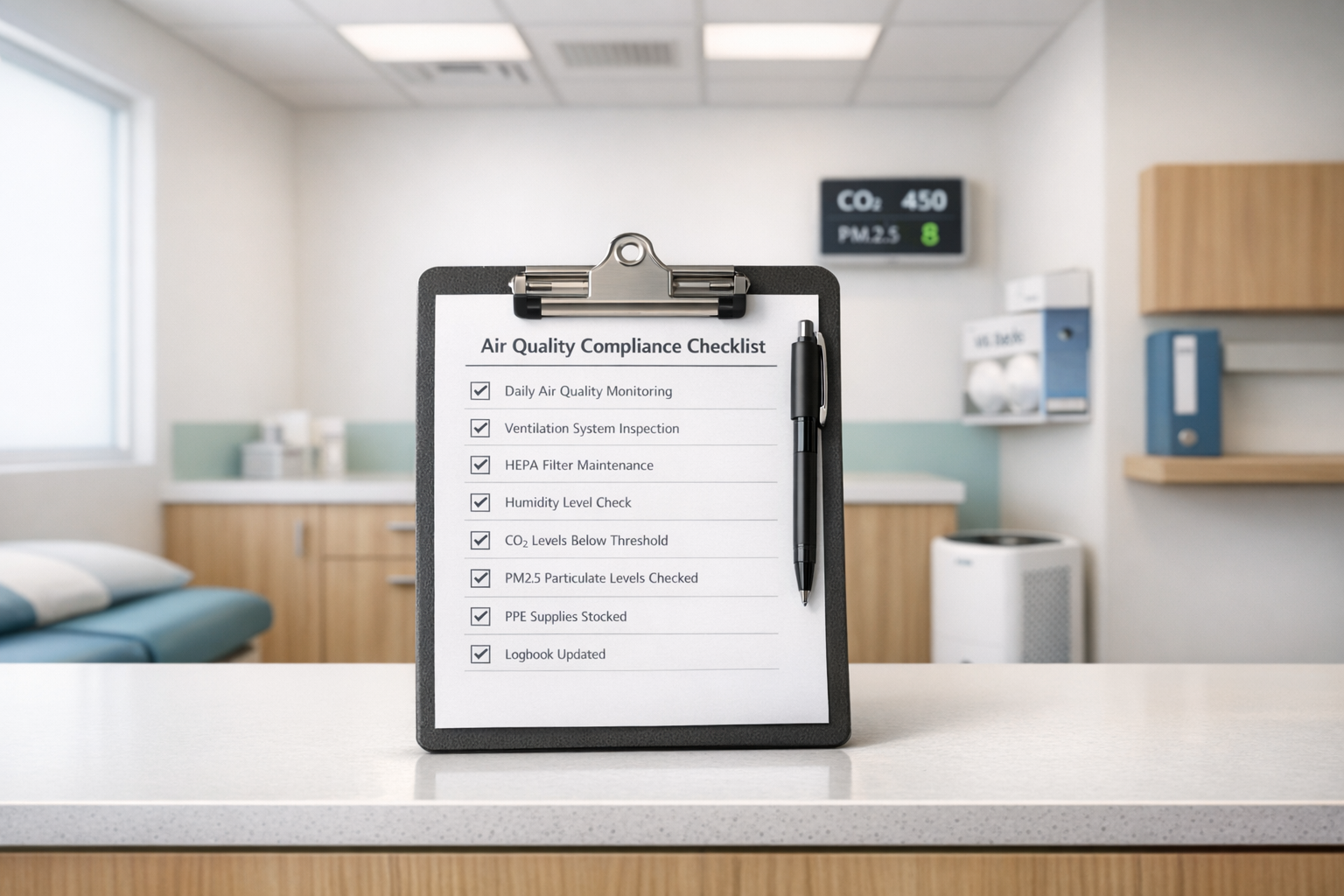

Maintaining proper air quality in clinics is critical for patient safety, regulatory compliance, and financial health. Poor air quality can lead to serious healthcare-associated infections, costing lives and billions annually. This guide provides actionable steps to meet air quality standards, reduce risks, and avoid costly fines.
Key highlights:
- Ventilation: Follow ASHRAE and NFPA standards for air changes, pressure differentials, and filter maintenance. For example, operating rooms need 20 air changes per hour with MERV 16 filters.
- Monitoring: Track temperature (68°F–76°F), humidity (30%–60%), and CO₂ levels (<1,000 ppm) using continuous monitoring systems.
- Hazard Control: Address clinic-specific risks like airborne pathogens, VOCs, and mold. Use HEPA filters and proper ventilation to mitigate hazards.
- Documentation: Keep detailed records of HVAC maintenance, air quality metrics, and staff training to ensure audit readiness.
- Respiratory Protection: Implement OSHA-compliant protocols, including medical evaluations, fit testing, and written plans.
Ventilation Systems Inspection
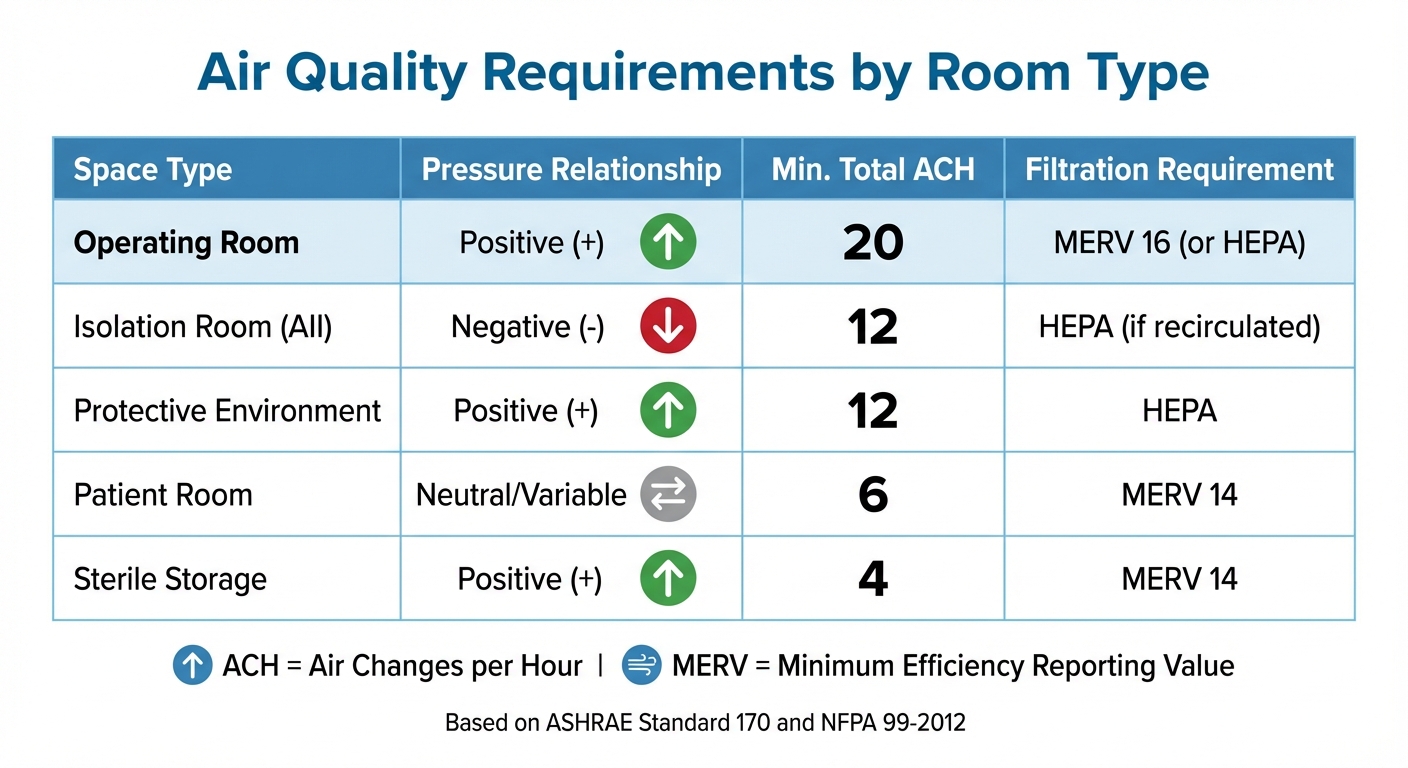
Clinic Air Quality Standards by Room Type: ACH, Pressure, and Filtration Requirements
Regular inspections of HVAC systems are essential to ensure proper air delivery, maintain pressure balance, and control contaminants. These checks not only align with OSHA standards but also safeguard vulnerable patients.
Evaluate HVAC System Performance
Begin by confirming that your HVAC system complies with ASHRAE Standard 170 and NFPA 99-2012 guidelines. These standards specify the necessary air exchange rates for different spaces. For example, operating rooms must have 20 total air changes per hour, with at least 4 of those being outdoor air. Airborne infection isolation rooms, on the other hand, require a minimum of 12 air changes per hour.
To verify airflow rates and pressure relationships in critical spaces like isolation and procedure rooms, use tools such as continuous electronic monitoring, annual test and balance (TAB) evaluations, and daily visual checks with smoke tubes or flutter strips. Spaces requiring pressurization should maintain a minimum pressure differential of 0.01 inches water gauge.
Create a ventilation management plan in collaboration with engineering, infection prevention, and clinical leadership. This plan should include a detailed inventory of clinic spaces, their intended uses, and specific ventilation requirements. This document will serve as your "source of truth" during inspections.
Once the system's performance is validated, the next step is to ensure proper filter maintenance.
Filter Maintenance and Operation
The 2021 update to ASHRAE 170 raised the bar for filter requirements in operating rooms, increasing the standard from MERV 14 to MERV 16. Additionally, HEPA filters are now required at air terminal devices for high-risk procedures like orthopedic surgeries, transplants, neurosurgery, and burn treatments.
Filters should be replaced based on a risk-based schedule. In Category 1 areas, where filter failure could have life-threatening consequences, frequent maintenance is critical. Continuous monitoring of pressure differentials helps detect filter loading before it impacts air exchange rates. Keep meticulous records of filter replacement dates, specifications, and any corrective actions to ensure compliance during surveys.
To prevent unauthorized changes that could lead to violations, lock temperature and humidity settings within the Building Automation System.
After confirming filter compliance, the final step is to verify airflow in critical areas.
Check Airflow in Key Areas
Operating rooms and procedure rooms with sterile fields demand the highest priority. Ensure the primary supply diffuser array delivers unidirectional downward airflow with an average velocity of 25 to 35 cfm per square foot over the surgical zone.
For infection control rooms, daily checks using visual indicators are necessary. Airborne infection isolation rooms must maintain negative pressure with at least 12 air changes per hour, while protective environment rooms require positive pressure with 12 air changes per hour and HEPA filtration. Support spaces, such as sterile storage areas, need positive pressure with 4 air changes per hour, and patient rooms should maintain 6 air changes per hour. Laboratories and areas handling hazardous gases must demonstrate proper containment measures.
| Space Type | Pressure Relationship | Min. Total ACH | Filtration Requirement |
|---|---|---|---|
| Operating Room | Positive (+) | 20 | MERV 16 (or HEPA) |
| Isolation Room (AII) | Negative (-) | 12 | HEPA (if recirculated) |
| Protective Environment | Positive (+) | 12 | HEPA |
| Patient Room | Neutral/Variable | 6 | MERV 14 |
| Sterile Storage | Positive (+) | 4 | MERV 14 |
Color-coded ventilation maps are a practical tool for identifying required pressure and airflow directions for every room. These maps make it easier for technicians to spot and address compliance issues. Adhering to these airflow standards plays a key role in reducing infection risks.
sbb-itb-02f5876
Indoor Air Quality Monitoring
Keeping the air clean in your clinic isn't just about having good ventilation systems - it’s about actively tracking the air quality to ensure the health and safety of both patients and staff. Regular monitoring works hand-in-hand with ventilation system checks, helping you spot issues before they turn into health complaints or regulatory troubles. Did you know that 52% of indoor air quality complaints are tied to inadequate ventilation? That’s why monitoring isn’t just a nice-to-have - it’s a must-have.
Track Temperature, Humidity, and CO2 Levels
For general areas, aim to keep temperatures between 68°F and 76°F, while labs should stay slightly cooler at 68°F to 73°F. Humidity levels are also crucial - stick to a range of 30% to 60% to avoid mold and respiratory issues. Carbon dioxide (CO2) levels are a key marker of air quality. If CO2 levels exceed 1,000 ppm, it’s a red flag that fresh air exchange isn’t adequate, which could lead to a buildup of other contaminants.
Using continuous monitoring tools like the TSI AirAssure™ series can provide round-the-clock tracking of these metrics. Unlike occasional spot-checks, these systems offer a more proactive approach. Plus, wireless sensor networks make installation easier without disrupting clinical operations. ASHRAE advises keeping indoor CO2 levels no more than 700 ppm above outdoor air levels.
Test for Airborne Contaminants
Once you’ve got the basics like temperature, humidity, and CO2 under control, it’s time to dig deeper into airborne contaminants. Start by conducting regular walkthroughs to catch visible issues like mold, water damage, or dust buildup. Keep a detailed inventory of chemicals used in your clinic, from cleaning supplies to specific medical substances like ethylene oxide or formaldehyde, so you can pinpoint potential sources of emissions. Remember, indoor air often contains more pollutants than outdoor air, so controlling these sources is essential.
For a thorough assessment, use continuous monitoring systems to track real-time levels of VOCs (volatile organic compounds) and particulate matter (PM2.5/PM10). For hazards like radon, dangerous gases, or airborne pathogens that standard sensors might not detect, consider hiring professionals for specialized indoor air quality (IAQ) evaluations. And don’t forget - mold can start growing on wet surfaces within as little as 24 to 48 hours.
Address Clinic-Specific Hazards
Once you’ve established a baseline for your air quality, focus on the specific risks tied to your clinic’s operations. Different medical services come with different air quality challenges. For example, formaldehyde vapors are common in tissue workstations, while anesthetic gases and ethylene oxide are concerns in certain procedures. Biological hazards like pathogens, mold, and allergens, as well as physical hazards such as dust or particles from construction, also need attention.
To maintain safe air, ensure a steady flow of fresh air while expelling used air - never recycle lab air. Use MERV 13 or higher filters for general spaces, and consider specialized filters for specific contaminants: permanganate filters for formaldehyde, carbon filters for VOCs, and HEPA/ULPA filters for pathogens. A simple strip-of-paper test can help verify that fume hoods are working properly, but professional inspections should also be scheduled annually.
"I’ve been in some labs where the filters haven’t been changed in five years. They’re not filtering anything out anymore - and people wonder why they aren’t feeling well."
- Ken Roy, PhD, National Science Teaching Association
For activities like painting or floor sealing, schedule them during off-hours and isolate the area with local exhaust ventilation to minimize exposure. And keep this in mind: OSHA fines for air quality violations can go up to $16,550 per incident, with willful violations reaching $165,514. Staying ahead of air quality hazards isn’t just about safety - it’s also about protecting your bottom line.
Reading about the problem? See how Prospyr solves it in one platform.
Book a DemoRespiratory Protection Program
After conducting thorough air quality monitoring, a targeted respiratory protection program is essential to shield your staff from identified hazards. OSHA takes respiratory protection seriously - it ranked as the 4th most frequently cited standard in fiscal year 2024, with 2,470 violations, climbing from 7th place the previous year. Penalties are steep, reaching up to $16,550 for serious violations and as much as $165,514 for willful or repeated offenses. This program works hand-in-hand with your broader air quality initiatives to safeguard both employees and patients.
Conduct Hazard Assessments
Start by documenting all airborne risks present in your clinic. Review Safety Data Sheets and assess exposures during clinical tasks, including biological hazards (like bacteria and viruses) and chemical hazards (such as fumes, mists, gases, or vapors from disinfectants and sterilants). Before turning to respirators, apply the hierarchy of controls - seek out solutions like elimination, substitution, engineering controls, or administrative controls. If these measures still leave risks, consider hiring a Certified Industrial Hygienist to conduct air sampling and measure contaminant levels accurately. Once hazards are identified, you can move forward with implementing a comprehensive respirator protocol.
Implement Respirator Protocols
OSHA has a strict order of steps: medical evaluation, fit testing, and then training. Skipping these steps can lead to violations - failing to medically clear employees before respirator use accounted for 508 citations in FY 2024. Medical evaluations, typically starting at $17 per test, must be performed by a Physician or Licensed Healthcare Professional to ensure that employees can safely wear a respirator.
After medical clearance, conduct annual fit testing for all tight-fitting respirators using OSHA-approved methods. Employees should be clean-shaven in the sealing area during both fit testing and respirator use. Each time a respirator is used, staff must perform positive and negative pressure seal checks to ensure a proper fit. Use only NIOSH-certified respirators that align with the identified hazards and required Assigned Protection Factor (APF). Remember: N95 respirators filter out particulates but do not protect against gases, vapors, or chemical fumes. Document these steps in a formal program to ensure consistency and compliance.
Create Written Procedures
OSHA requires a written, worksite-specific respiratory protection program. Assign a qualified program administrator to manage the program and assess its effectiveness. The written plan should cover respirator selection, medical evaluations, fit testing, protocols for day-to-day and emergency use, maintenance schedules, and procedures for ensuring breathing air quality for atmosphere-supplying respirators. It should also include training requirements and program evaluations.
"In any workplace where respirators are necessary to protect the health of the employee or whenever respirators are required by the employer, the employer shall establish and implement a written respiratory protection program with worksite-specific procedures."
- OSHA 1910.134(c)
Include a data-driven schedule for replacing gas and vapor cartridges to prevent contaminant breakthrough. Outline how respirators will be cleaned, disinfected, stored, inspected, repaired, and disposed of. Keep digital records of medical clearance results, fit test outcomes, and training logs - these must be retained for the duration of employment and made available for OSHA audits. Finally, review and update your written program annually or whenever workplace conditions change, such as the introduction of new chemicals or procedures.
Employee Training and Recordkeeping
Effective training is key to maintaining air quality standards every day. Employees should understand how to identify various air contaminants, including biological contaminants (like mold, bacteria, and viruses), chemical pollutants (such as cleaning agents, pesticides, and VOCs), and particulate matter (dust and smoke). They also need to recognize symptoms of poor indoor air quality - things like headaches, fatigue, fever, coughing, and shortness of breath - that often improve once they leave the workplace. Clear reporting protocols are equally important, ensuring staff know exactly how to report indoor air quality (IAQ) issues immediately. This approach, combined with diligent recordkeeping, helps maintain compliance and accountability.
Train Staff on Air Quality Protocols
Building on the findings from hazard assessments, train your team to identify risks and act swiftly. Training should cover:
- Recognizing air quality hazards
- Proper use of personal protective equipment (PPE)
- Reporting symptoms or concerns related to air quality
Tailor these sessions to the specific risks identified in your facility. For example, if respirators are required, demonstrate proper usage and how to perform seal checks for a secure fit.
Maintain Monitoring and Compliance Records
Good recordkeeping is essential, especially for OSHA inspections. Here’s what you should know:
- Employee exposure records: Keep these for 30 years.
- Medical records: Retain them for the duration of employment plus an additional 30 years.
Automated monitoring systems can simplify this process, offering digital records that are often more reliable than manual logs. Use a secure cloud-based system to store critical documents like:
- Real-time monitoring data
- HVAC maintenance logs
- IAQ complaint forms
- Incident logs
- Chemical inventories
- Training certifications
If your clinic includes specialized areas, like isolation or procedure rooms, maintain daily records verifying airflow direction and pressure relationships. Automated systems can also send alerts when air quality parameters exceed safe thresholds, and these alerts should be logged as part of your compliance records.
Consider tools like Prospyr (https://prospyrmed.com) to streamline recordkeeping and ensure your documentation stays audit-ready.
Post OSHA Notices and Injury Logs
Make sure to display the "OSHA Job Safety and Health: It's the Law" poster in a visible location. You can download it for free in English, Spanish, or other languages from the OSHA website.
Check your exemption status using your NAICS code. Most physician offices, dental practices, and outpatient care centers are exempt from routine injury recordkeeping. If your clinic is not exempt, you’ll need to post OSHA Form 300A, summarizing work-related injuries and illnesses, every year from February 1 to April 30 in a prominent spot.
Additionally, all employers are required to report:
- Work-related fatalities within 8 hours
- Inpatient hospitalizations, amputations, or loss of an eye within 24 hours
Employees also have the legal right to request copies of their own medical and exposure records.
Compliance Audit and Documentation Checklist
Having solid monitoring and training protocols is a great start, but a well-organized compliance checklist is what ensures everything is documented and verifiable. This checklist becomes the backbone of proving air quality compliance. According to recent CMS surveys, "care in safe setting" citations were the most common deficiency, with 317 incidents reported. The key to passing these audits often boils down to one thing: documentation. If you can’t prove compliance when asked, it’s as good as failing.
Develop a Compliance Checklist
Your checklist should be detailed and cover every critical parameter. For example, it should include:
- Operating room ACH: ≥20 air changes per hour, with at least 4 outdoor air changes
- Isolation room pressure: ≥–0.01 inches water column
- CO₂ levels: <1,000 ppm
- Temperature: 68°F–76°F
- Relative humidity: 30%–60%
- Filter efficiency: MERV 13 for general areas; MERV 16 or HEPA for high-risk zones
Additionally, don’t forget maintenance items, like ensuring drain pans have an appropriate slope (1:20 to 1:80 to avoid standing water) and keeping logs for at least three years.
Incorporate into Routine Walkthroughs
To make compliance efforts seamless, integrate air quality checks into your current HVAC preventive maintenance routines. During these walkthroughs, focus on:
- Checking pressure indicators (like ball-in-tube or digital manometers)
- Looking for standing water or microbial growth on HVAC components
- Verifying proper operation of outdoor air dampers
High-risk areas such as operating rooms, pharmacies, and laboratories should be top priorities since their temperature and humidity demands are the strictest. Moisture inspections are also critical - mold can start growing on wet surfaces in as little as 24 to 48 hours. After each walkthrough, ensure all corrective actions are documented to confirm compliance.
Centralize Documentation
All compliance records should be stored in a secure, centralized system that’s easy to access, especially during surprise audits. This repository should include:
- Timestamped readings
- Corrective action logs
- Calibration certificates
- Training records
Take Hazel Hawkins Memorial Hospital, for example. They enhanced their compliance efforts by using a wireless environmental monitoring system that provided instant, timestamped data.
"The gap between 'conditions were probably fine' and 'we can prove conditions were fine' determines survey outcomes." - Envigilance
For a streamlined solution, consider using Prospyr's (https://prospyrmed.com) HIPAA-compliant tools. These tools not only centralize your compliance records but also integrate seamlessly with practice management documentation, keeping you audit-ready at all times.
Conclusion
Maintaining air quality compliance is an ongoing responsibility that hinges on three essential components: continuous monitoring, staff training, and detailed documentation. These elements work together to support the proactive measures outlined in our checklist. Each year, approximately 687,000 healthcare-associated infections occur in U.S. acute care hospitals, with direct costs estimated between $28 billion and $45 billion. Many of these infections can be avoided with proper air quality management and ventilation.
The risks tied to poor air quality are substantial - not just for patients and staff but also for a facility's financial health. For instance, invasive aspergillosis outbreaks caused by contaminated ventilation systems have fatality rates exceeding 57% among immunocompromised patients. Additionally, OSHA violations for willful non-compliance can result in fines as high as $165,514 per incident.
To mitigate these risks, a strong compliance strategy should emphasize prevention over reaction. Key steps include maintaining CO₂ levels below 1,000 ppm, keeping indoor temperatures between 68°F and 76°F, and ensuring relative humidity stays within the 30% to 50% range to inhibit microbial growth. Moisture control is equally critical, as mold can form on wet materials within just 24 to 48 hours.
Automated monitoring systems can close the loopholes left by manual recordkeeping. These systems provide timestamped data that regulators require during audits, enabling clinics to generate 90-day compliance reports in minutes instead of sifting through incomplete logs. For facilities seeking to simplify this process, Prospyr's (https://prospyrmed.com) HIPAA-compliant platform offers a centralized solution. It integrates compliance documentation with practice management tools, ensuring all records are audit-ready and securely stored in one place.
FAQs
Which rooms in my clinic must be positive or negative pressure?
Rooms that need positive pressure include operating rooms, delivery rooms, trauma rooms, newborn intensive care units, laser eye surgery rooms, protective environment rooms, pharmacies, and sterile storage areas. On the other hand, negative pressure is essential for spaces like endoscopy rooms, bronchoscopy rooms, central sterile supply decontamination areas, and specific isolation rooms to help manage airborne contaminants.
How often should we test and balance (TAB) our HVAC system?
Testing and balancing (TAB) of HVAC systems in healthcare facilities is essential and should be conducted at least every three years. For critical areas, these evaluations should be unannounced to ensure adherence to standards like ASHRAE 170 and the requirements of the Joint Commission. Routine TAB checks are crucial for maintaining proper ventilation and air quality, which directly contribute to a safe environment for both patients and staff.
What documentation will inspectors ask for during an air-quality audit?
Inspectors often ask for records like Indoor Air Quality (IAQ) management plans, HVAC system maintenance logs, calibration and testing reports, balancing records, and inventories of pollutant sources and control measures. Keeping these documents current is key to showing compliance during an audit.