Checklist for Texas Med Spa Insurance Compliance
Insurance and documentation checklist for Texas med spas: professional liability, tail coverage, cyber risk, vendor BAAs, and record-keeping.


Running a med spa in Texas comes with strict insurance and regulatory requirements. Non-compliance can lead to fines, lawsuits, or even license suspension. Here’s a quick breakdown of what you need to know to stay compliant:
- Professional Liability Insurance: Covers treatment errors and complications. Ensure all procedures and staff roles are included. Texas prohibits coverage for punitive damages and requires a "consent to settle" clause for physician policies.
- Tail Coverage: Claims-made policies must offer a 30-day automatic reporting period and an option for extended coverage.
- General Liability and Property Insurance: Protects against non-medical risks like slip-and-fall injuries or equipment damage. Look for bundled policies like a Business Owner’s Policy (BOP) for cost efficiency.
- Product Liability: Covers risks from faulty products, including injectables and equipment. Ensure coverage for all treatments and maintain vendor agreements.
- Regulatory Compliance: Keep detailed records of staff credentials, treatment protocols, and patient consent forms. Texas law mandates a 90-day notice for cancellations or premium increases.
- Cyber Liability Insurance: Essential for protecting electronic patient records and avoiding HIPAA fines.
Pro Tip: Platforms like Prospyr can simplify compliance by automating tracking, alerts, and documentation.
Staying ahead of these requirements is key to safeguarding your practice from legal and financial risks.
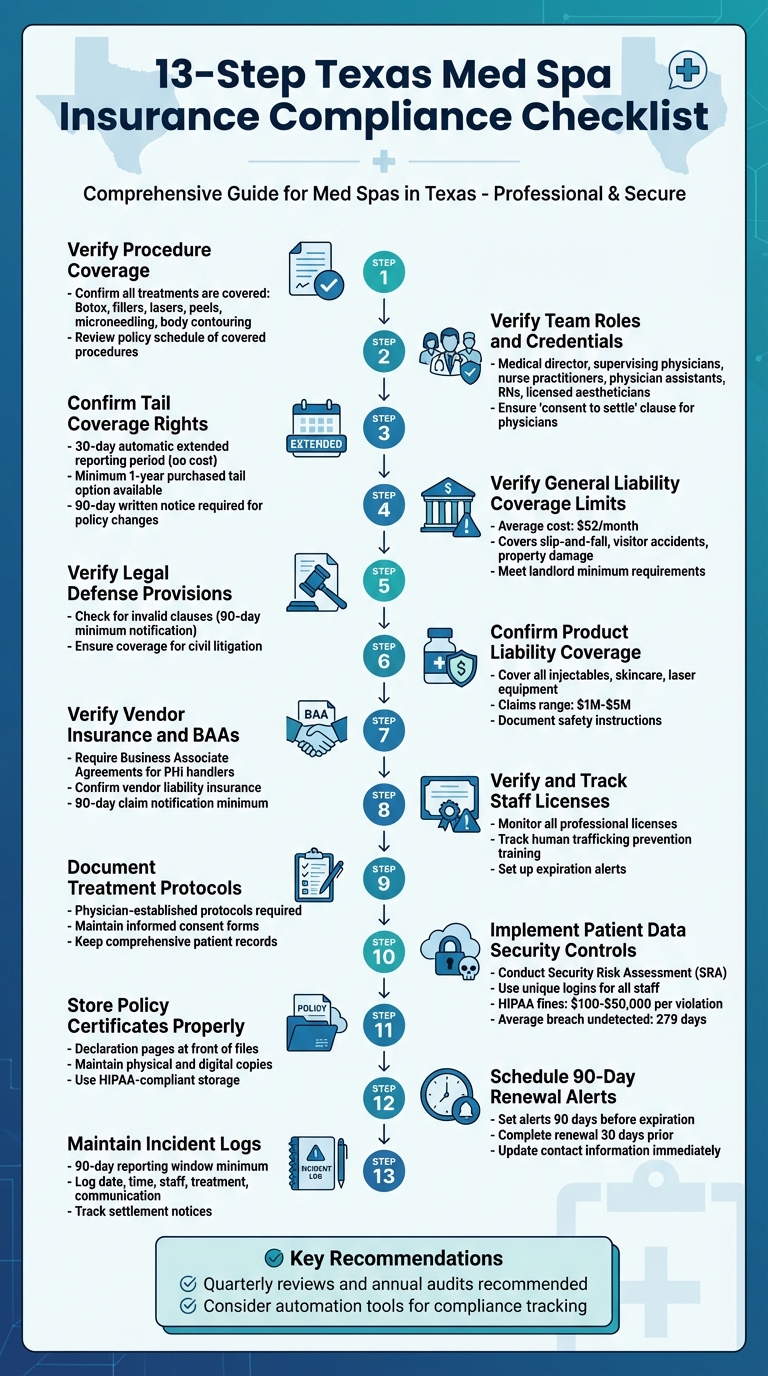
13-Step Texas Med Spa Insurance Compliance Checklist
Professional Liability Insurance Requirements
Professional liability insurance, often referred to as malpractice insurance, is essential for protecting your med spa against claims of treatment errors, complications, or alleged negligence. In Texas, these policies must adhere to specific state regulations that extend beyond standard coverage.
Coverage for Medical and Aesthetic Procedures
Step 1: Verify procedure coverage. Ensure your policy includes all the treatments your med spa offers, such as Botox, dermal fillers, laser treatments, chemical peels, microneedling, and body contouring. Carefully review the policy's schedule of covered procedures to confirm nothing is excluded. If you're adding new services, confirm coverage with your insurer beforehand.
Texas law prohibits coverage for punitive damages under §1901.252 of the Texas Insurance Code. To mitigate risks, it's crucial to have sufficient coverage limits and implement strong risk management practices.
Staff-Specific Coverage
Step 2: Verify team roles and credentials. Beyond treatment coverage, ensure your policy clearly defines the roles of every team member, including the medical director, supervising physicians, nurse practitioners, physician assistants, registered nurses, and licensed aestheticians. Any discrepancies between listed roles and actual responsibilities can lead to coverage gaps. Update your insurer promptly if job titles or duties change.
For individual physicians, Texas law requires a "consent to settle" clause in their policies. This provision ensures the insurance company cannot settle a malpractice claim without the physician's approval. If your medical director has their own policy, confirm that this clause is included.
Documentation and Tail Coverage
Step 3: Confirm tail coverage rights. Maintaining accurate documentation is essential for continuous coverage and minimizing risk. For claims-made policies, Texas law mandates that the declaration page clearly disclose the coverage terms. These policies only cover incidents reported during the active policy period, making tail coverage a critical safeguard.
Texas law provides an automatic 30-day extended reporting period at no additional cost. Insurers must also offer at least 30 days to purchase an extended reporting endorsement (tail coverage) with a minimum term of one year and an unlimited duration option. This coverage is especially important when switching insurers, closing your practice, or when a provider leaves your team. Review your policy documents to ensure these tail coverage provisions are explicitly outlined.
Additionally, your insurer is required to provide 90 days' written notice before increasing premiums, canceling, or non-renewing your policy - except in cases of non-payment or license revocation. Keep track of these deadlines to allow sufficient time to secure alternative coverage if necessary.
| Requirement Type | Texas Statutory Standard | Reference |
|---|---|---|
| Punitive Damages | Coverage prohibited for physicians and healthcare providers | §1901.252, Insurance Code |
| Cancellation Notice | 90-day written notice (except for non-payment or loss of license) | §1901.253, Insurance Code |
| Automatic Tail Coverage | 30-day extended reporting period | Chapter 2301, Insurance Code |
| Purchased Tail Duration | Minimum 1 year; unlimited option must be available | Chapter 2301, Insurance Code |
| Consent to Settle | Mandatory for individual physician policies | §§542.151 - 542.154, Insurance Code |
sbb-itb-02f5876
General Liability and Property Coverage
General liability and property coverage provide essential protection for the non-medical risks that come with running a business. These policies fill the gaps left by malpractice insurance, addressing everyday risks that could impact your practice.
Bodily Injury and Property Damage Coverage
Step 4: Verify general liability coverage limits. General liability insurance typically covers incidents like slip-and-fall injuries, visitor accidents, and damage to third-party property. On average, this type of coverage costs around $52 per month, making it an affordable safeguard against potential lawsuits. Before signing a lease, ensure your policy meets the minimum coverage requirements set by Texas landlords.
In addition to covering bodily injury claims, these policies often include legal defense costs, settlements, and judgments. For businesses in Texas, legal disputes frequently stem from civil litigation, such as breach of contract or employer-employee conflicts. Your policy should cover these scenarios, which can arise from interactions with clients, vendors, or staff. After confirming adequate coverage limits, take a closer look at the legal defense provisions to ensure you're fully protected against unexpected claims.
Legal Defense and Incident Costs
Step 5: Verify legal defense provisions. Texas law offers specific protections regarding claims. For example, under Texas Civil Practice & Remedies Code §16.071, any contract requiring claim notification in less than 90 days is void. Check your policy for any invalid clauses that could undermine your coverage in these situations.
Property coverage considerations. Property insurance is crucial for protecting expensive equipment and assets. For instance, a single laser machine can cost anywhere from $50,000 to $200,000, so it's important to have replacement cost coverage. Your property policy should include coverage for:
- Business personal property such as lasers, IPL devices, and treatment beds
- Inventory like injectables and medical-grade skincare
- Tenant improvements made to your leased space
A Business Owner's Policy (BOP) can be a smart choice, as it bundles liability and property coverage into one package. Costing between $1,500 and $4,000 annually, it’s often more economical than purchasing separate policies. Be sure to include business interruption coverage, which can help recover lost income if your practice is forced to close temporarily due to events like fires, water damage, or natural disasters.
Reading about the problem? See how Prospyr solves it in one platform.
Book a DemoProduct Liability and Vendor Coverage
Med spas face potential risks tied to the products and equipment they use. Even if your business didn’t manufacture a product, you can still be held responsible for injuries or damages it causes. Product liability insurance is designed to cover compensation for personal injuries or property damage resulting from faulty products your business supplies. For example, a single adverse reaction - whether from an injectable or a malfunctioning laser - can lead to claims ranging from $1 million to $5 million.
Product-Specific Liability Policies
Step 6: Confirm product liability coverage for all treatments. Your policy should explicitly cover you as a supplier for any product you brand, repair, or modify, even if the manufacturer is unknown or no longer in business. This is especially important for injectables, medical-grade skincare products, and laser equipment.
To reduce liability, document safety instructions for every product. Providing patients with clear warnings about potential misuse or side effects can protect your practice. Additionally, keep detailed quality control records to show that any product issues existed before they reached your business. If your policy operates on a "claims-made" basis rather than an "occurrence" basis, make sure this distinction is highlighted on the declaration page. Under Texas law, you are entitled to a 30-day automatic extended reporting period and the option to purchase an endorsement for an additional reporting period of at least one year. After confirming product coverage, shift your focus to vendor agreements.
Vendor Contracts and BAAs
Step 7: Verify vendor insurance and Business Associate Agreements (BAAs). Before entering into a partnership, ask vendors key questions like: "Will you sign a BAA?" and "What security certifications support your processes?". If a vendor refuses to sign a BAA, it’s a major warning sign that they might not comply with HIPAA regulations.
"If a vendor handles PHI and refuses to sign a BAA, you cannot use them for services involving PHI." – SmartSMSSolutions
Not every vendor requires a BAA, so it's essential to evaluate each case individually. For example, vendors such as EHR/EMR providers, billing companies, cloud storage services, and telehealth platforms - those who handle, store, or transmit Protected Health Information (PHI) - must sign BAAs. On the other hand, vendors with incidental contact, like equipment repair technicians or janitorial staff, typically don’t need BAAs, but their contracts should still include confidentiality clauses.
Vendor agreements should also address product safety, quality control, and the process for returning defective goods. In Texas, contracts must specify Texas as the governing law and allow at least 90 days for claim notification. Any clause requiring less than 90 days is invalid under Texas Civil Practice & Remedies Code §16.071. Verify that vendors maintain their own liability insurance and ensure their policies align with Texas standards. If your practice qualifies as a "large risk" - with insured property values of $5 million or more, or gross revenues exceeding $10 million - you may be exempt from certain prior approval filing requirements. These vendor evaluations are a key part of managing overall risk and staying compliant with Texas med spa insurance regulations.
Regulatory Compliance Documentation
Keeping detailed documentation isn’t just about meeting insurance requirements - it’s also a safeguard against regulatory fines and even the suspension of your med spa’s license. In Texas, both the Texas Medical Board (TMB) and the Texas Department of Licensing and Regulation (TDLR) conduct surprise inspections. That means you need to have updated records ready to go at all times, ensuring both your legal compliance and insurance coverage are intact.
Staff Credential Verification
In addition to maintaining policies and procedures, it’s essential to confirm that all staff credentials are valid and up to date. Step 8: Verify and track all staff licenses and mandatory training. This includes individual licenses for cosmetologists, massage therapists, and medical professionals, as well as business and facility licenses. Texas law specifically requires healthcare practitioners to complete a human trafficking prevention course as part of their license renewal process.
To stay on top of this, review training records regularly to confirm that every healthcare provider on your team has completed the required course. A tracking system can help you monitor license expiration dates and continuing education requirements, reducing the risk of lapses that could affect your liability insurance.
Treatment Protocols and Consent Forms
Step 9: Document all treatment protocols and secure compliant informed consent. All medical protocols must be established by a licensed physician medical director to align with Texas Medical Board regulations.
"Providers must thoroughly explain the procedure, benefits, risks, and alternatives and obtain written informed consent from the patient. Informed consent documentation should be readily accessible in patient records." – Weitz Morgan
Maintain a comprehensive record of consultations, treatments, consent forms, and post-procedure instructions. When delegating tasks to non-physicians, use written agreements to ensure legal protection and compliance with regulations. Regularly update protocols and hold training sessions to keep your team informed about the latest safety standards and Texas laws. Additionally, if you plan to use patient testimonials or before-and-after photos for marketing purposes, make sure to get explicit consent to meet HIPAA requirements.
HIPAA and Patient Privacy Compliance
Protecting patient data is just as important as procedural documentation. Step 10: Implement operational controls for patient data security. During audits, the Office for Civil Rights (OCR) doesn’t just look at policies - they examine operational evidence like access logs and incident response records. Statistics show the average healthcare breach goes undetected for 279 days, and 58% of these breaches are caused by internal actors. HIPAA violations can result in fines ranging from $100 to $50,000 per violation, with annual caps of $1.5 million per violation category.
To safeguard electronic Protected Health Information (ePHI), map every touchpoint where data is handled, including staff emails, personal devices, SaaS platforms, and even paper forms. Assign unique logins to each staff member to maintain accountability and create a clear audit trail. Avoid standard texting for patient communication; instead, use secure, HIPAA-compliant messaging systems.
Conduct a Security Risk Assessment (SRA) aligned with the NIST Cybersecurity Framework to address vulnerabilities and meet §164.308(a) requirements. Continuous monitoring is essential as staff, vendors, and workflows evolve. If your practice uses tools like Prospyr for patient management, verify its HIPAA compliance and ensure all staff training is routinely tracked and documented. These steps are not just about regulatory compliance - they’re also vital for maintaining your insurance coverage.
Insurance Documentation and Record-Keeping
Keeping your insurance records organized is essential for staying compliant with Texas regulations and protecting your med spa during audits or claims.
Policy Certificate Storage
Step 11: Store policy certificates with declaration pages at the front of each file. Texas law requires that claims-made policies prominently display critical disclosures in bold on the first page. By placing declaration pages upfront, you’ll ensure quick access during inspections or claims reviews.
If your policy includes a choice of law provision, verify that it designates Texas law. Under Article 21.42 of the Insurance Code, Texas law must govern when such provisions are present. Maintain both physical and digital copies of these documents. If any files contain patient or staff information, store digital versions in a HIPAA-compliant digital intake system to safeguard sensitive data.
Renewal Tracking and Alerts
After organizing your certificates, Step 12: Schedule alerts 90 days prior to policy expiration. Texas insurers are required to give at least 90 days' written notice before increasing premiums, canceling, or non-renewing professional liability insurance for healthcare providers. Set up an alert system to ensure you complete the renewal process at least 30 days before the policy expires, and monitor the mandatory 90-day advance notifications from insurers.
Make sure your contact details are current with the Texas Department of Insurance. If your business name, address, or email changes, update this information immediately - renewal invoices are sent via email, and missing them could lead to a coverage lapse. If you use a practice management platform like Prospyr, take advantage of its task management features to automate reminders and keep all policy expiration dates on a centralized calendar.
| Requirement/Action | Deadline/Timeline | Penalty for Non-Compliance |
|---|---|---|
| License Renewal | Before midnight on expiration date | $25 late fee |
| Continuing Education (CE) | 24 hours every two years | $50 fine per missing hour |
Incident Reporting and Claims History
Lastly, Step 13: Maintain detailed incident logs with a 90-day reporting window. Texas law invalidates any contract clause requiring notification of a claim in less than 90 days. Your internal protocols should reflect this standard to ensure compliance and safeguard your rights.
"A contract stipulation that requires a claimant to give notice of a claim for damages as a condition precedent to the right to sue on the contract is not valid unless the stipulation is reasonable. A stipulation that requires notification within less than 90 days is void." – Texas Civil Practice & Remedies §16.071
For each incident, log the date, time, staff involved, treatment provided, and any patient communication. Keep records of all settlement notices from your insurer, as Texas law mandates insurers notify policyholders of settlements under casualty policies. A well-maintained claims history not only simplifies the claims process but also helps identify trends and improve safety measures over time.
Coverage Gaps and Additional Policies
Even if your Texas med spa has professional liability, general liability, and property insurance, there could still be areas where you're financially vulnerable. Standard policies often leave out risks like data breaches, regulatory fines, or business interruptions. These gaps can lead to significant expenses if not addressed. Collaborating with brokers experienced in medical aesthetics can help pinpoint these vulnerabilities before they turn into major issues.
Cyber Liability Insurance
Once your primary coverages are in place, it's time to consider risks that are becoming more common. If your med spa handles electronic patient records, uses cloud-based systems, or processes credit card payments, cyber liability insurance is crucial. Standard malpractice and general liability policies don’t cover electronic data breaches or the fines tied to them. For example, the U.S. Department of Health and Human Services notes that "HIPAA penalties range from $141 to $2,134,831 per violation category per year". Cyber liability insurance typically costs between $1,000 and $2,000 annually, making it a smart safeguard against these risks.
Workers' Compensation and Business Interruption Insurance
Employee-related risks and operational disruptions are other areas to consider. While Texas doesn’t require private employers to carry workers' compensation, having it can protect you from direct lawsuits over workplace injuries like needlesticks or chemical exposures. Annual premiums for this coverage generally range from $2,000 to $5,000, but it can save you from costly legal battles.
Additionally, review your Business Owner’s Policy (BOP) to see if it includes business interruption insurance. This coverage compensates for lost income if your med spa has to temporarily shut down due to events like fires, water damage, or equipment failures. If your BOP doesn’t include it, you can add it separately. For added peace of mind, a Commercial Umbrella policy - costing $500 to $1,500 annually - can provide an extra $1 million to $5 million in liability coverage. This is especially important since a single malpractice lawsuit could easily exceed $500,000 in combined legal and settlement costs.
Conclusion
Running a Texas med spa requires careful attention to compliance, including managing professional liability, general liability, product coverage, regulatory documentation, and record-keeping. Overlooking any of these areas can leave your practice vulnerable to financial and legal risks.
Quarterly reviews and annual audits are essential for staying ahead of regulatory changes. Relying on manual tracking for certificates, renewal dates, consent forms, and incident reports can increase the chance of errors and missed deadlines.
Using practice management platforms simplifies compliance by consolidating records into a HIPAA-compliant system. For example, Prospyr offers tools like automated renewal alerts, practice analytics to identify coverage gaps, and AI-driven note creation for storing protocols and consents. One success story involves New Life Cosmetic Surgery, led by Dr. Daniel Lee, which saw a 50% boost in revenue and a 40% rise in appointments after switching to Prospyr’s unified platform. A dedicated system like this ensures all compliance elements work together efficiently.
Start implementing your compliance checklist today. Conduct regular reviews, assign key compliance responsibilities, and automate tracking to safeguard your practice, your patients, and your financial future.
FAQs
What insurance limits should my Texas med spa carry?
Comprehensive insurance coverage is essential for med spas operating in Texas, even though specific insurance limits aren't explicitly defined. Key policies to consider include malpractice insurance, general liability, property insurance, cyber liability, and, in some cases, workers' compensation - particularly if you have employees or offer certain high-risk services.
To ensure your coverage matches your unique risks and aligns with state requirements, it's wise to consult an experienced insurance broker. Costs for med spa insurance typically fall between $8,000 and $20,000 per year, but the exact limits and premiums depend on the specific details of your practice.
Do I need tail coverage if I change insurers or providers?
Whether or not you need tail coverage depends largely on your insurance policy and personal circumstances. Tail coverage is often advised when you're changing insurers or providers, particularly for malpractice insurance, as it safeguards you against claims made after your original policy has expired. To determine if tail coverage is essential for your situation, it's a good idea to consult with your current or prospective insurance carrier, as the need for it can vary based on individual factors.
Which vendors must sign a HIPAA BAA for my med spa?
Vendors that need to sign a HIPAA Business Associate Agreement (BAA) are those who handle protected health information (PHI) on your behalf. This includes companies providing services such as patient data management, medical billing, electronic health records (EHR), and secure communication tools. Examples include practice management platforms and EHR providers. Essentially, any vendor that accesses, stores, or processes PHI must sign a BAA to ensure both compliance and the security of sensitive data.