Common Cash Flow Mistakes in Med Spas
Use weekly 13-week forecasts, control deferred revenue, trim inventory and align payroll to prevent cash shortages in med spas.


A med spa can show profit and still run short on cash. In most cases, the problem comes from 3 things: spending prepaid money too soon, trusting the bank balance instead of a forecast, and letting inventory, payroll, or discounts eat up cash before bills are due.
If I had to sum up the article in plain English, it would be this:
- Revenue is not cash you can spend
- Package, membership, and gift card sales create work you still owe
- A weekly 13-week cash forecast helps spot tight weeks early
- Inventory, payroll, leases, and discounts can drain cash fast
- Taxes, processor delays, and annual bills can catch you off guard
- Cash control works best when I review it every week, not once a month
A few numbers make the point clear:
- A spa can report $15,000 in monthly profit and still have only $3,000 in free cash
- Payroll should often stay around 25% to 35% of revenue
- Inventory on hand should often stay under 15% to 20% of monthly revenue
- Gift cards and prepaid services should not be treated like fully earned income
- A reserve of 2 to 3 months of expenses can help cover slow periods and tax hits
Here’s the short version: if you want steadier cash flow, I’d watch timing, deferred revenue, inventory, labor costs, discounting, and weekly cash commitments in one place.
The rest of the piece explains where med spas slip up and what to check each week to avoid a cash squeeze.
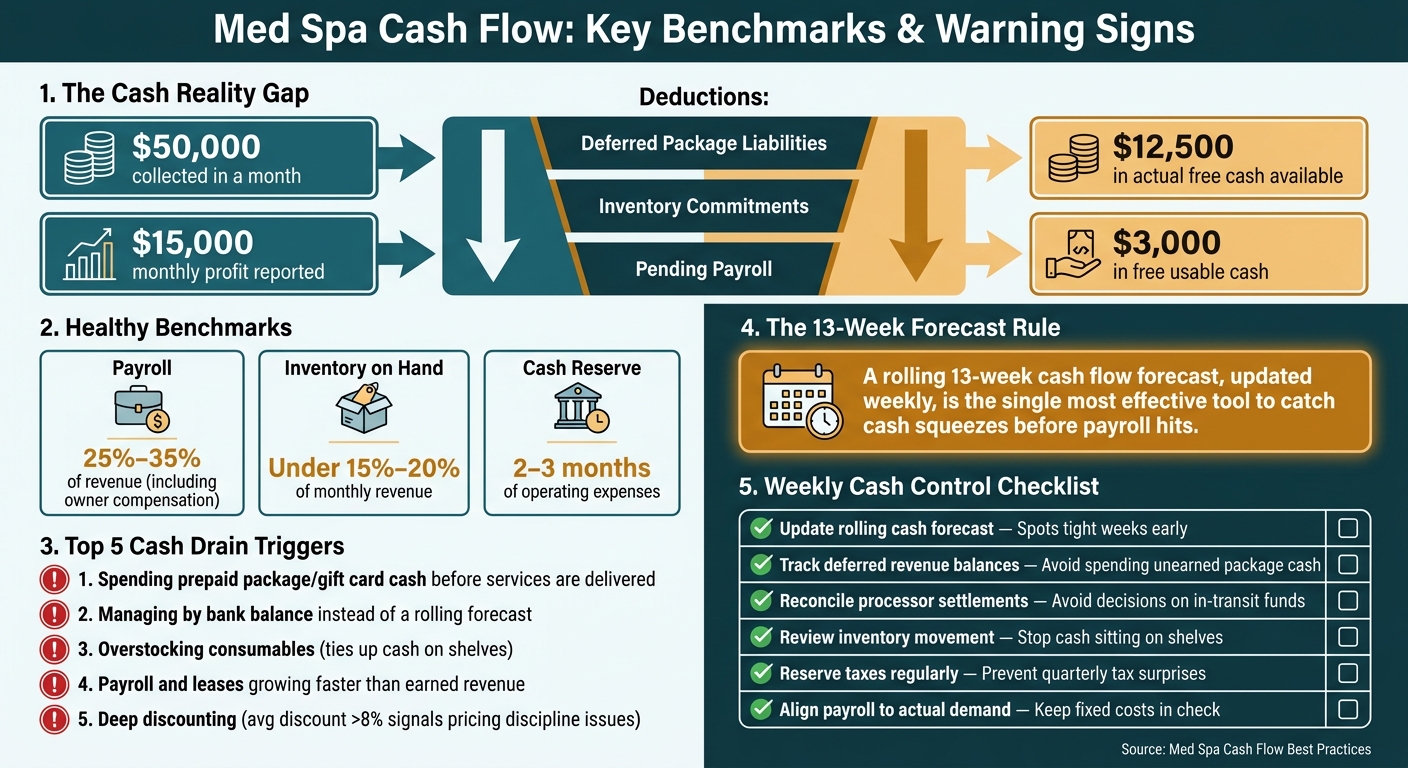
Med Spa Cash Flow: Key Benchmarks & Warning Signs
Mistakes That Distort Your Cash Position
These mistakes usually happen when you look at the wrong number at the wrong moment.
Treating Revenue, Profit, and Cash Flow as the Same Number
The issue comes down to timing. Cash can show up before a service is earned, or after bills are already due.
Revenue shows sales that were performed. Profit shows what’s left after expenses. Cash flow shows what you can use to pay bills right now.
A med spa that sells $15,000 in packages with 60% redeemed in the same month can overstate profit by about $6,000 if deferred revenue isn’t tracked the right way. That kind of gap can leave you short on cash fast. A 13-week rolling cash flow forecast, updated every week, is one of the most practical ways to catch this early.
The same timing problem shows up when prepaid cash gets spent before the related services are delivered.
Spending Prepaid Package, Membership, and Gift Card Cash Too Early
When a client buys a package for $2,400, the money hits your bank account right away. But under standard accounting rules, that money stays on the balance sheet as a liability - deferred revenue - until each session is delivered.
"The $2,400 sits on your balance sheet as deferred revenue: a liability, not spendable profit." - Ward Advisory
A lot of practices use that cash too soon on rent, payroll, or other bills. Then the client comes back for treatment, and the spa still has to pay for labor and supplies without new cash coming in. That’s where things start to get tight.
A simple fix is to keep unearned cash in a separate account and move it into operations only as treatments are completed. For gift cards, it also makes sense to assume at least 80% of open balances will be redeemed and keep a matching reserve.
Even a strong-looking bank account can cover up bills you’ve already committed to.
Managing by Bank Balance Instead of a Forecast
Your bank balance tells you how much cash is there today. It does not tell you what’s about to come out.
Three-paycheck months, quarterly taxes, annual insurance, and device maintenance can all create a squeeze, even when the account looks healthy.
For example, a practice bringing in $50,000 per month can still finish the month with $3,000 or less in cash that’s actually free to use once deferred revenue, inventory commitments, and settlement timing are included. Weekly cash reviews, along with a rolling 30- to 90-day forecast, make it much easier to spot trouble before payroll or taxes hit.
sbb-itb-02f5876
Reading about the problem? See how Prospyr solves it in one platform.
Book a DemoDay-to-Day Mistakes That Drain Cash
Even with a forecast, cash can still slip away in the day-to-day. A lot of the damage comes from routine choices people make every week without stopping to look closely.
Overstocking Consumables or Running Into Stockouts
Every vial or syringe sitting unused on a shelf is cash you can't use somewhere else. Bulk discounts often sound good, but they usually don't make up for money tied up in slow-moving inventory. Carrying multiple brands and SKUs also pushes up minimum stock levels and working capital needs. A simple benchmark helps here: total inventory on hand should stay under 15% to 20% of monthly revenue.
Overstocking locks up cash. Stockouts create a different problem: they waste provider time and can cost you sales.
The fix isn't fancy. Set firm minimum and maximum quantities for each SKU based on actual usage data. Put one person in charge of purchasing so accountability is clear. And review any product that hasn't moved in 90 days before you reorder it.
The same kind of discipline matters with labor and leases too.
Letting Fixed Costs and Payroll Grow Faster Than Demand
Hiring staff or signing equipment leases adds bills that keep coming even when bookings slow down. Lease a laser for $2,500 per month over 60 months, and you're taking on a $150,000 commitment. That payment is due whether the device is fully booked or barely used.
Healthy med spa payroll runs between 25% and 35% of revenue, including owner compensation. Trouble starts when payroll grows based on prepaid sales instead of earned revenue. That's when month-to-month cash pressure tends to show up. A solid trigger is to add providers only when current staff hit 75% to 80% utilization.
It also helps to track fixed costs as a share of monthly revenue, not just as dollar amounts. Watch:
- Payroll percentage
- Rent percentage
- Debt obligations
That view makes it much easier to see when fixed costs are growing faster than the business can support.
Pricing errors can drain cash just as fast as inventory errors.
Discounting Too Deeply and Not Measuring Marketing Payback
Flash sales may fill the calendar, but they also cut margin. You can book more visits and still bring in less cash per appointment. If your average discount goes above 8% of standard pricing across all transactions, that's a sign pricing discipline may be slipping. Heavy discounting can also teach patients to wait for the next deal instead of booking at full price.
Embedded marketing creates another timing problem. Ad bills usually come due within 30 days, while revenue tied to those campaigns may not be earned for six months. If you're only checking the bank balance, that gap is easy to miss.
Track promo payback in real time. That way, you can tell whether a campaign is helping cash flow or just filling open slots.
How to Fix Cash Flow Problems With Better Systems and Controls
Build a Simple Cash Flow Control System
The fix starts with a simple weekly control system that tracks timing, not just sales.
Use a rolling 13-week cash flow forecast to map weekly inflows against outflows for the next 13 weeks.
Then put three basic controls in place:
- Run membership and package payment batches 48 to 72 hours before payroll so the 1–3 business day merchant settlement delay doesn’t leave you short.
- Ask suppliers for Net-45 or Net-60 terms so outflows line up better with your collection cycle.
- Keep a dedicated cash reserve that covers 2 to 3 months of operating expenses to help absorb seasonal dips and slower weeks.
This is where many owners get squeezed. Sales may look fine on paper, but if cash lands late and payroll hits first, the numbers can turn on you fast.
Use Integrated Data to Monitor Collections, Memberships, and Liabilities
Once the forecast is up and running, the next step is seeing what cash is actually available.
A simple cash summary pulls that into one view. Start with total collected cash, then subtract deferred liabilities, inventory commitments, and pending payroll to show actual free cash. That math matters more than the bank balance by itself.
For example, a med spa collecting $50,000 in a month may only have $12,500 in actual free cash after deferred package liabilities, inventory commitments, and pending payroll are subtracted. That gap is where owners get into trouble. Deferred revenue, payroll, and inventory commitments shape usable cash, not the account balance alone.
Prospyr combines scheduling, payment processing, membership management, and analytics in one HIPAA-compliant system, which makes cash and deferred revenue easier to track.
Conclusion: Key Cash Flow Habits Every Med Spa Should Follow
Strong cash flow comes down to weekly discipline.
The fix is simple: turn cash controls into weekly habits. Revenue is not the same as cash. And prepaid sales sit on your books as liabilities until the service is actually delivered.
Use this weekly checklist:
| Weekly habit | Why it matters |
|---|---|
| Update rolling cash forecast | Shows tight weeks before they hit |
| Track deferred revenue balances | Helps you avoid spending package and membership cash you haven’t earned yet |
| Reconcile processor settlements | Keeps you from making decisions based on money that’s still in transit |
| Review inventory movement and expirations | Stops cash from sitting on shelves |
| Reserve taxes regularly | Cuts down on quarterly tax surprises |
| Align payroll to actual demand | Keeps fixed costs from outrunning collections |
Weekly review - not monthly bookkeeping - is what catches cash problems early enough to do something about them. That’s how med spas keep payroll covered, avoid getting blindsided by quarterly tax bills, and stay steady through slow seasons or softer weeks.
FAQs
How do I know how much cash is safe to spend?
Start by separating your bank balance from the cash you can actually spend. A healthy balance can look comforting, but part of that money may be tied up in deferred revenue from prepaid packages or memberships you haven’t earned yet.
Set aside 2–3 months of operating expenses as a reserve. Then subtract near-term liabilities like payroll, inventory commitments, and future service obligations. That gives you a clearer picture of what’s left.
Review cash flow every week. It’s one of the simplest ways to spot a shortfall before it turns into a problem.
What should I include in a 13-week cash flow forecast?
Track expected cash in and cash out every week so you can catch gaps before they turn into problems.
Your forecast should include projected revenue, seasonal slowdowns, provider availability, fixed costs, payroll timing, and items that don't sit neatly on the P&L, like loan payments and equipment leases.
It should also reflect deferred revenue from prepaid packages, memberships, and gift cards, along with inventory commitments. That way, the rolling forecast helps you prepare for larger upcoming expenses and keep enough cash in reserve.
When does prepaid package revenue become earned?
Prepaid packages are deferred revenue. That means they sit on your books as a liability, not earned revenue, when the client pays.
You earn that revenue only when you deliver the service.
So the accounting flow is simple:
- Record the full upfront payment as a liability on your balance sheet
- Move the proportional amount into earned revenue as each session is completed
In plain English: you haven’t earned the money just because it hit your account. You earn it piece by piece, as you provide each session.