Ultimate Guide to Med Spa Revenue Analysis
Analyze med spa KPIs, use real-time analytics, optimize memberships and high-margin treatments, and streamline operations to boost profitability.

Running a med spa without analyzing revenue is like driving blindfolded - you might move forward, but you won’t know if you’re heading in the right direction. Revenue analysis helps you identify what’s profitable, where to cut costs, and how to grow effectively. Here's what you need to know:
- Key Metrics to Track: Profit margin, average revenue per client, capacity utilization rate, and rebooking rates.
- Tools to Use: Real-time analytics platforms like Prospyr can simplify tracking and decision-making.
- Revenue Growth Strategies: Focus on memberships, high-margin treatments like injectables, and improving efficiency through better scheduling and inventory management.
Key Revenue Metrics for Med Spas
Essential Med Spa Revenue Metrics and Benchmarks
Tracking the right metrics is what separates med spas that grow strategically from those that simply stay busy. The goal isn’t to get lost in endless data - it’s to focus on a few key numbers that show where your revenue comes from, where it’s going, and how to increase it. These metrics fall into three main categories: financial performance, client retention, and sales effectiveness.
Financial Performance Metrics
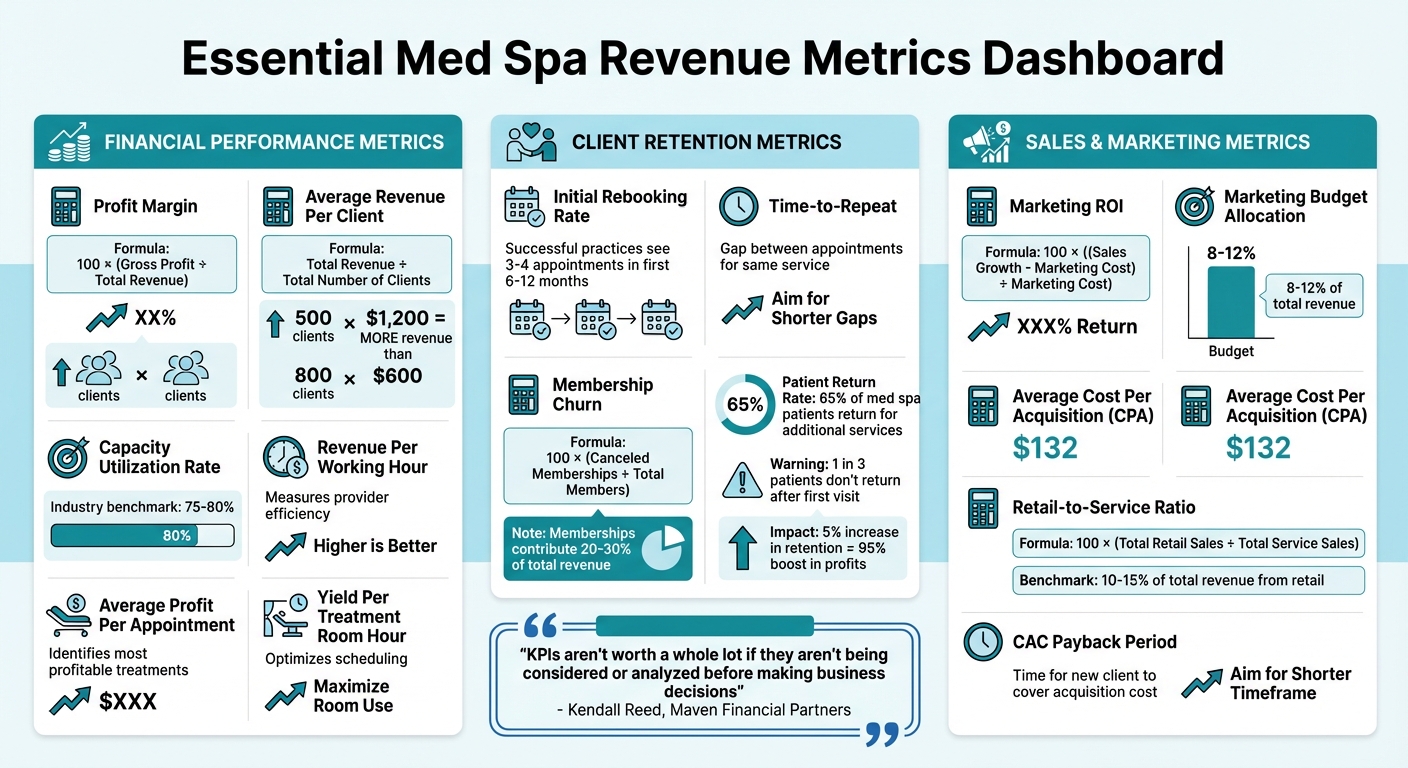
Your profit margin is the starting point. Calculated as 100 × (Gross Profit ÷ Total Revenue), it gives you a quick snapshot of your financial health. But to dig deeper, you’ll want to identify where your profits are actually coming from. For instance, average revenue per client (Total Revenue ÷ Total Number of Clients) shifts your attention from sheer appointment numbers to the value each client brings. Imagine this: 500 clients spending $1,200 each will generate more revenue - and with lower marketing and overhead costs - than 800 clients spending $600.
Another key metric is revenue per working hour, which shows how much each provider earns per hour. This helps you assess operational efficiency and spot opportunities for coaching, like improving treatment selection or upselling. Similarly, the capacity utilization rate - the percentage of booked hours compared to total available hours - reveals whether your team is overworked or underused. Industry benchmarks suggest the sweet spot is between 75% and 80%. Kendall Reed from Maven Financial Partners emphasizes: "KPIs are an extremely important part of understanding any business. They aren't worth a whole lot if they aren't being considered or analyzed before making business decisions".
To fine-tune your profitability, track average profit per appointment and yield per treatment room hour. These metrics can highlight which treatments are most profitable and help you optimize your scheduling. Together, these financial insights provide the foundation for understanding client behavior and retention patterns.
Client Retention Metrics
While financial metrics show how efficiently your med spa operates, client retention metrics reveal how well you’re building loyalty and satisfaction. Start with the initial rebooking rate - the percentage of new clients who schedule a second appointment. A strong first-time experience often leads to repeat visits, with successful practices seeing new clients book 3-4 appointments within their first 6-12 months. Another useful metric is time-to-repeat, which measures the gap between appointments for the same service. This can help you refine automated reminders and identify clients who may need a nudge to return.
For med spas with membership programs, membership churn (100 × (Canceled Memberships ÷ Total Members)) is a key indicator. Memberships can contribute 20-30% of total revenue, but only if you keep members engaged. Monthly churn tracking is essential - spikes often signal issues like declining service quality or billing problems that need immediate attention.
Sales and Marketing Metrics
Sales and marketing metrics provide insights into how effectively your med spa attracts and retains profitable clients. Start with marketing ROI (100 × ((Sales Growth - Marketing Cost) ÷ Marketing Cost)), which measures whether your marketing dollars are delivering results. Most successful med spas allocate 8-12% of their total revenue to marketing, and the average cost per acquisition (CPA) is around $132. As CorralData puts it, "Marketing becomes costly when it fails to deliver results. These metrics keep you focused on what actually fills the schedule with profitable, loyal clients".
Another useful metric is the retail-to-service ratio (100 × (Total Retail Sales ÷ Total Service Sales)). This measures how much of your revenue comes from retail products, with successful med spas typically generating 10-15% of their total revenue from retail. Tracking this by provider can help you identify who excels at educating clients about products - and who could use more training. Finally, keep an eye on the CAC payback period, which shows how long it takes a new client to cover their acquisition cost. A shorter payback period means your marketing efforts are more efficient, freeing up cash flow for reinvestment.
sbb-itb-02f5876
Reading about the problem? See how Prospyr solves it in one platform.
Book a DemoTools for Revenue Analysis and Practice Analytics
Relying on manual reporting can be a major roadblock. Hours spent exporting data and piecing together spreadsheets often mean by the time you spot a revenue dip, you've already lost valuable time to act. Practices that grow consistently rely on real-time visibility into their data - not just revenue figures but also the metrics that influence it, like patient retention, schedule efficiency, and inventory trends. Tools that interpret data in real time go beyond tracking - they help you act faster and smarter.
Real-Time Analytics Features
Top-tier analytics platforms don't just report numbers - they explain why those numbers exist and guide you on what to do next. Look for tools that break down revenue streams and cost centers, helping you pinpoint which services are driving profits. Real-time insights into provider-specific rebooking rates and schedule utilization can reveal profitable treatments and highlight underused resources.
Predictive analytics take it a step further, forecasting appointment volumes up to 90 days ahead. This allows practices to adjust staffing proactively, ensuring steady cash flow. Real-time inventory tracking also plays a key role, helping reduce overstocking while avoiding stock shortages. As the PatientNow Team emphasizes:
"They're identifying profitable service lines before others notice the opportunity"
Practices that embrace these tools are positioning themselves for long-term success.
Prospyr Practice Analytics Integration
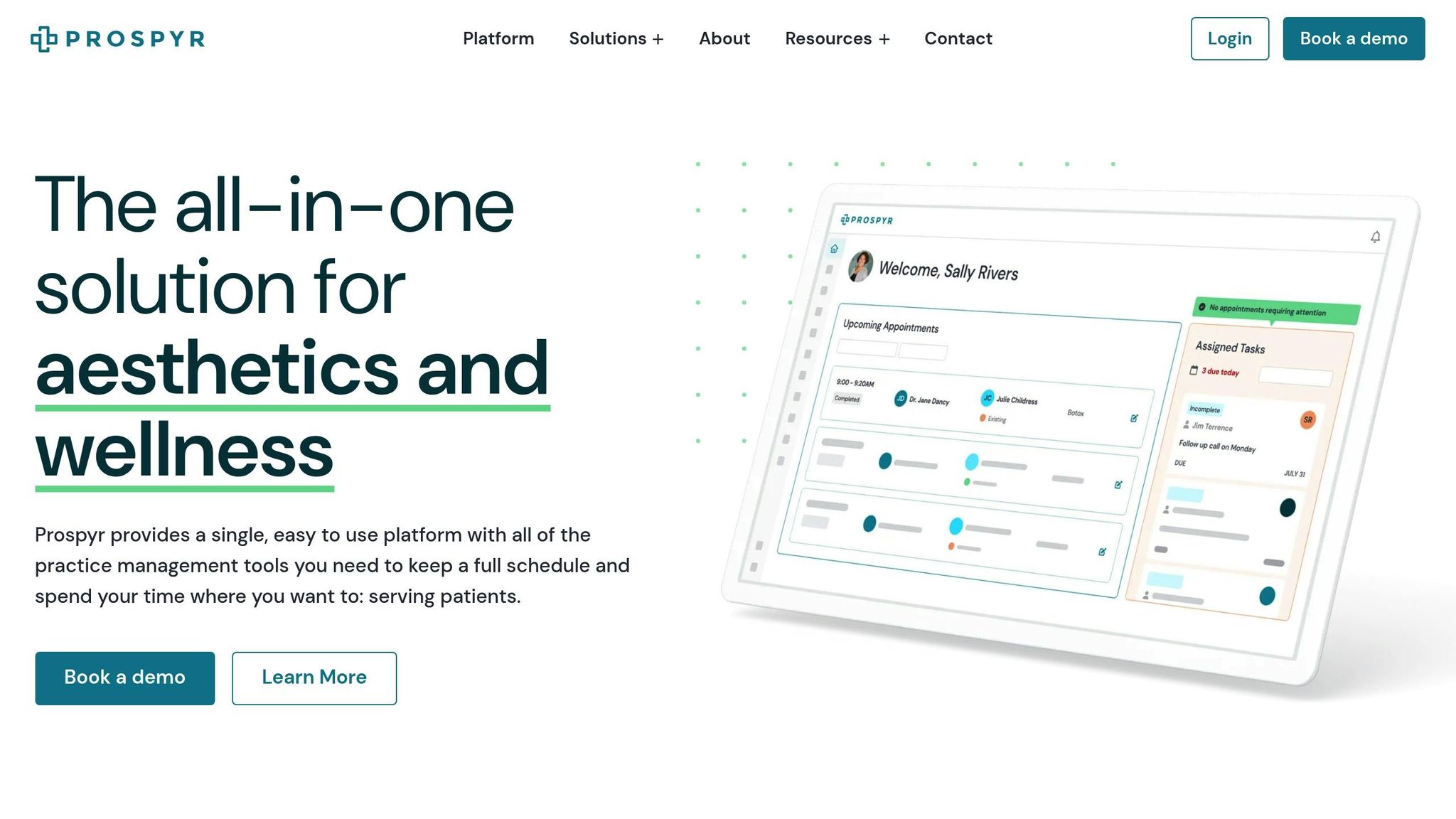
Prospyr takes real-time analytics to the next level by integrating data across all operational systems. It provides insights into profit margins, client retention, and marketing ROI - all within a HIPAA-compliant platform. This is especially critical as new HHS HIPAA penalties come into effect on January 28, 2026. By combining CRM, EMR, payment processing, and scheduling into one system, Prospyr eliminates the inefficiencies of manual reporting and ensures that revenue analytics cover the entire patient journey.
Dr. Daniel Lee, founder of New Life Cosmetic Surgery, saw firsthand how effective Prospyr can be. After switching from four separate software solutions to Prospyr in 2024-2025, his practice experienced a 50% increase in total revenue and a 40% boost in appointments booked. Reflecting on this transformation, Dr. Lee shared:
"We've seen a 50% increase in revenue and a 40% increase in appointments booked since switching away from using several different point solutions to running our practice on Prospyr"
Another example comes from SOM Aesthetics, led by Dr. Saami Khalifian and Dr. Jess Shisler. Using Prospyr's analytics and growth tools, they hit their launch sales targets 21x faster than expected. Within two days, they generated $40,000 in sales, and by their second month, they exceeded $100,000 in monthly revenue.
Prospyr also empowers teams through role-based permissions, giving everyone from front desk staff to providers access to analytics that track personal and team performance. This transparency helps align individual efforts with broader practice goals. With such comprehensive, real-time insights, med spa owners can confidently implement the revenue strategies outlined in this guide.
Strategies to Increase Med Spa Revenue
Growing revenue in a med spa requires a thoughtful combination of memberships, high-margin services, and efficient operations. The most successful med spas take a proactive approach, using real-time data to inform decisions. Instead of relying solely on attracting new clients, they focus on creating a sustainable model through recurring income, profitable treatments, and streamlined processes.
Optimizing Membership and Recurring Revenue
Membership programs are a game-changer for med spas, turning occasional visitors into loyal, repeat clients. With about 65% of med spa patients returning for additional services, retaining customers is crucial. However, one in three patients doesn’t come back after their first visit, making retention a key driver of growth. Even a 5% increase in retention can boost profits by as much as 95%.
The structure of your membership program plays a vital role in its success. Many med spas opt for tier-based models, offering two to four levels of membership. Others design memberships around specific goals, like "clear skin" or "weight loss". The simpler the program, the better. As Sarah Eberle from RepeatMD points out:
"If your program is difficult to understand, patients may struggle to see its value or identify which option makes the most sense for them. As a result, they may never sign up."
For example, a straightforward three-tier membership might look like this:
- Silver: $99/month, includes a signature facial and 10% off other services
- Gold: $199/month, includes a Hydrafacial and 15% off other services
- Platinum: $249/month, includes a deluxe DiamondGlow facial and 20% off everything else
Shorter initial commitments, like three- or six-month plans, can lower the barrier to entry compared to annual contracts.
Retention requires ongoing effort. Keep a close eye on churn rates and personalize your engagement strategies. Small touches, like sending birthday texts or celebrating milestones (e.g., a client’s 10th visit), can make a big difference. The first 30 days are especially crucial - welcome messages should guide new members on how to maximize their benefits right away. As Maja Muzhdeka, a med spa consultant, emphasizes:
"Membership churn is one of the biggest threats to a med spa's long-term growth and one of the least talked about."
Automating renewals through your practice management software ensures steady cash flow, while exit surveys can help identify why members cancel and uncover trends related to pricing or service quality. Tools like Prospyr simplify membership management by automating billing, tracking churn metrics, and providing actionable insights.
Focusing on High-Margin Treatments and Retail
Not all treatments are created equal when it comes to profitability. The average med spa operates with profit margins between 20% and 25%. High-margin treatments, such as body contouring, injectables, and laser procedures, stand out because they combine premium pricing with relatively low costs. To maximize profits, analyze profit per appointment by factoring in supply, labor, and overhead costs.
Here’s a snapshot of high-margin services:
| Service Category | Profit Potential | Key Profitability Driver |
|---|---|---|
| Body Contouring | Very High | High session prices; clients often treat multiple areas |
| Injectables (Botox/Fillers) | High | High demand; repeat treatments every few months |
| Laser Hair Removal | High | Requires multiple sessions; long-lasting equipment |
| Laser Skin Rejuvenation | High | High session prices; versatile equipment |
| Microneedling | Medium to High | Low consumable costs; easy upselling opportunities |
Retail sales are another avenue for boosting revenue. Membership perks often encourage clients to spend more - up to 35% more per visit - especially when discounts are offered on medical-grade skincare products. Focus on products that clients can’t easily find elsewhere, such as formulations that complement their treatments. Train your team to make product recommendations naturally, enhancing the retail-to-service ratio without feeling pushy.
Improving Operational Efficiency
Efficient operations ensure that revenue gains aren’t lost to unnecessary expenses. Poor inventory management, for instance, can quietly erode profits. Overstocking $2,000 worth of skincare products might lead to $600 in losses if 30% expires before being sold. Cloud-based inventory tracking can help you avoid overstocking and stockouts while saving time - manual inventory checks can take up to four hours per month. As Optimantra highlights:
"The biggest mistake med spa owners make is treating inventory management as a low-priority task when it's actually a core function of your operations."
Labor costs also deserve attention. Monitor employee utilization rates (hours booked versus hours worked) to spot inefficiencies or training gaps. Cross-training staff to handle multiple roles allows you to adjust schedules based on demand, avoiding overstaffing during slow periods. Additionally, calculate revenue per treatment room hour to ensure low-margin treatments aren’t crowding out more profitable bookings.
Consolidating technology can further streamline operations. Using separate systems for scheduling, payments, and client management creates redundant costs and inefficiencies. Platforms like Prospyr unify these functions into a single, HIPAA-compliant system, reducing expenses and saving staff time.
Small operational tweaks can add up. Automated SMS and email reminders reduce no-shows, while requiring deposits for high-value treatments minimizes last-minute cancellations. Review fixed costs annually - like lease agreements and vendor contracts - to ensure you’re not overpaying. For regulatory requirements, telehealth platforms can speed up Good Faith Exams, freeing providers to focus on treatments that generate revenue. As Shanalie Wijesinghe from Boulevard puts it:
"Increasing profit isn't just about bringing in more - it's also about spending smarter."
Conclusion: Using Revenue Analysis to Grow Your Med Spa
Revenue analysis can reshape how med spas operate by turning raw data into actionable strategies. By pinpointing what drives revenue and addressing operational bottlenecks, practices can make smarter decisions to improve profitability. With real-time analytics, you can quickly respond to revenue dips, redirect marketing budgets toward the most effective channels, and refine your service offerings based on actual performance metrics.
But it’s not just about the numbers - revenue analysis also plays a vital role in enhancing client satisfaction. It reveals which services foster loyalty and helps streamline operations in ways that improve the overall patient experience. For instance, reducing wait times, ensuring popular retail items are always in stock, and aligning staffing levels with demand are practical steps that data can guide. A unified data system makes these adjustments more seamless, emphasizing the importance of choosing a platform that consolidates these insights.
Prospyr is one such solution, combining scheduling, inventory management, billing, and marketing into a single HIPAA-compliant platform. By integrating analytics across all aspects of your operations, Prospyr provides a complete view of your med spa’s health - no need to juggle multiple systems. This streamlined approach not only saves time but also supports consistent, measurable growth.
"This data-driven approach transforms challenges into opportunities for growth, ensuring a competitive edge in the aesthetic practice marketplace." – Prospyr
FAQs
Which 3 metrics should I track first?
Tracking the right metrics is essential for understanding and improving your med spa's performance. Three key metrics to keep an eye on are:
- Client Retention Rate: This measures how well you're keeping existing clients coming back for treatments. A high retention rate often indicates satisfied customers and strong loyalty.
- Revenue Per Treatment: This helps you understand the profitability of each service you offer. By analyzing this, you can identify which treatments bring in the most income and adjust your offerings accordingly.
- New Client Acquisition Rate: This metric shows how effective your marketing efforts are at bringing in fresh clients. Growing this number means expanding your customer base and increasing potential revenue.
Focusing on these metrics gives you a clear picture of your med spa's growth, profitability, and marketing success, enabling you to make smarter business decisions.
How often should I review revenue KPIs?
Revenue KPIs need to be reviewed every month to keep a close eye on your financial performance. These regular check-ins are essential for spotting trends, tackling potential problems before they escalate, and ensuring your med spa stays aligned with its financial objectives.
How do I reduce membership churn fast?
To cut down on membership churn fast, zero in on personalized perks, exclusive offers, and loyalty rewards that make members feel valued. Consider rolling out targeted promotions, such as renewal discounts or referral bonuses, to keep members engaged and motivated to stay. These efforts can go a long way in building a more loyal and committed customer base.