Florida Data Privacy Laws: Impact on EMR Systems
Overview of Florida's EMR data-localization law, provider duties, penalties for noncompliance, and why U.S./Canada-hosted EMRs minimize legal risk.


Florida's updated data privacy laws demand that healthcare providers ensure patient data stored in Electronic Medical Record (EMR) systems remains within the United States, its territories, or Canada. This requirement, effective July 1, 2023, under Florida Statute 408.051, applies to all providers, including non-HIPAA-regulated professionals like acupuncturists and massage therapists. Non-compliance can result in severe penalties, including felony charges, license revocation, and legal liabilities.
Here’s what you need to know:
- Data Storage Rules: Patient data cannot be stored on servers outside the U.S., its territories, or Canada.
- Provider Responsibility: Compliance is the provider's responsibility, not the vendor's. Affidavits confirming adherence must be submitted during licensing.
- Penalties for Violations: Violations may lead to disciplinary action, perjury charges, and fines up to $50,000 per incident.
- Localized EMR Systems: Platforms like Prospyr simplify compliance by ensuring data storage meets Florida’s legal requirements while also adhering to HIPAA standards.
For Florida healthcare providers, choosing a compliant EMR system is not just a recommendation - it’s a legal necessity.
1. Prospyr
Data Localization Compliance
Prospyr ensures all patient data is stored securely within the United States, its territories, or Canada, meeting Florida's data localization requirements under SB 264. This means all patient information stays within approved regions, reducing the risk of non-compliance for aesthetics and wellness clinics operating in Florida. The platform's architecture supports the secure handling of qualified electronic health records, which include any systems that allow information to be electronically accessed, retrieved, or transmitted. Prospyr’s approach adds an extra layer of security for clinics, aligning with Florida's regulations while maintaining a strong focus on patient data protection.
HIPAA Compliance
Prospyr doesn’t just stop at data localization - it also fully adheres to HIPAA standards. Patient data is encrypted both during transmission and while stored, ensuring the security of protected health information (PHI) from the moment it’s captured to when it’s used for treatments or payments. By addressing both federal HIPAA guidelines and Florida’s specific privacy laws, Prospyr takes the hassle out of compliance, allowing healthcare providers to focus on their patients rather than regulatory complexities.
Operational Efficiency
Prospyr combines its compliance measures with a suite of tools designed to streamline practice management. From CRM/EMR integration to digital intake forms and automated communication tools, everything operates within the same secure infrastructure. Whether it’s managing memberships, marketing, scheduling, or clinical records, Prospyr’s unified system supports Florida’s data localization laws while enhancing day-to-day operations. Features like real-time analytics and task management offer better visibility into practice performance, all without sacrificing security or compliance.
sbb-itb-02f5876
Reading about the problem? See how Prospyr solves it in one platform.
Book a Demo2. Non-localized EMR Systems
Data Localization Compliance
Starting July 1, 2023, Florida Statute 408.051 requires that all offsite patient data must be stored within the continental United States, its territories, or Canada. This law puts the responsibility squarely on healthcare providers to ensure compliance. They must verify where their vendors store data, update their Business Associate Agreements, and submit affidavits under penalty of perjury when applying for or renewing their licenses with the Florida Agency for Health Care Administration (AHCA).
Some vendors, like those using Amazon Web Services, offer options to store data in specific U.S. or Canadian regions. However, these features demand careful setup and constant monitoring. For systems relying on international cloud infrastructures, this adds another layer of complexity.
Security Features
Meeting storage requirements is just one part of the equation - security is another significant challenge. A key issue is the distinction between where data is stored and who can access it. For example, there’s legal ambiguity around whether offshore IT contractors can access data stored on U.S.-based servers.
Manish Jain of MBW explains:
"Contractors and vendors located outside of the U.S. should not store health records but do not appear to be prohibited from accessing the records (with appropriate safeguards pursuant to HIPAA)."
This gray area increases risks for healthcare providers, who must meticulously document their compliance efforts. Multi-state providers face even more hurdles if they can't isolate Florida patient data from broader offshore storage practices , requiring advanced data analytics to track and segment records by jurisdiction.
Operational Efficiency
Complying with Florida's data storage rules isn't just about security and location - it also impacts day-to-day operations. Providers need to audit their vendors’ primary servers, backups, and disaster recovery systems to ensure they meet the law's requirements. This also extends to third-party services like call centers, digital intake platforms, and transcription providers, adding to the workload.
These audits and contract reviews demand significant time and resources, making compliance a heavy operational burden. For healthcare providers, this highlights the need to select solutions specifically designed to align with Florida's stringent regulations.
Advantages and Disadvantages
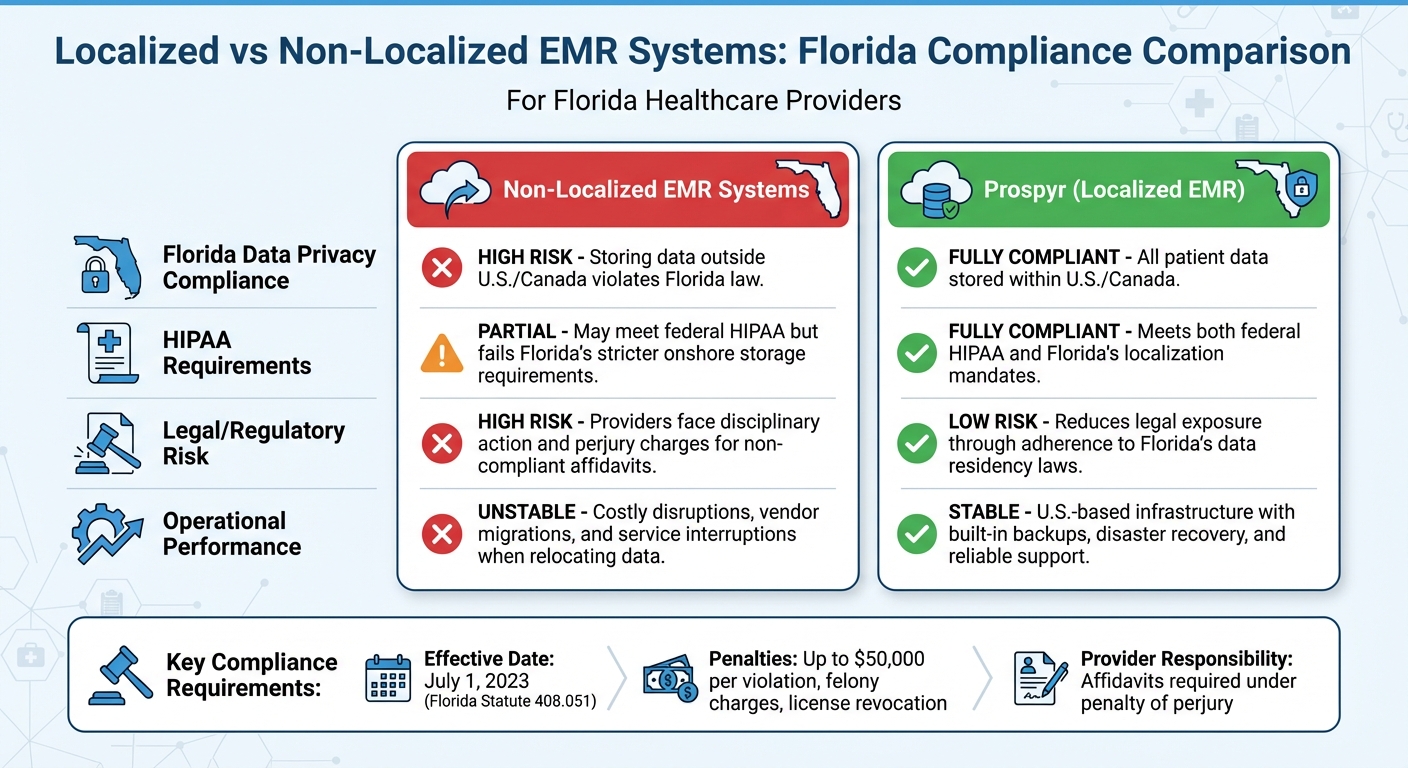
Localized vs Non-Localized EMR Systems Compliance Comparison for Florida Healthcare Providers
Healthcare providers in Florida must decide between localized and non-localized EMR systems. This decision significantly impacts compliance with Florida's stringent data privacy laws, federal HIPAA standards, and the overall operational stability of their practices. Here's a breakdown of how these systems compare on key factors:
| Feature | Non-localized EMR Systems | Prospyr (Localized EMR) |
|---|---|---|
| Florida Data Privacy Compliance | High risk; storing data outside the U.S. or Canada violates Florida law. | Fully compliant; ensures all patient data is stored within the U.S. or Canada. |
| HIPAA Requirements | May meet federal HIPAA standards but often fail Florida’s stricter onshore storage requirements. | Complies with both federal HIPAA rules and Florida's specific localization mandates. |
| Legal/Regulatory Risk | Providers risk disciplinary action and even perjury charges for non-compliant affidavits. | Reduces legal exposure by adhering to Florida's data residency and documentation laws. |
| Operational Performance | Prone to costly disruptions, including vendor migrations and service interruptions, when forced to relocate data under new laws. | Offers a stable U.S.-based infrastructure with built-in backups, disaster recovery, and reliable support. |
The risks for providers using non-localized systems are clear. These systems often fail to meet Florida's stringent requirements, exposing providers to legal and operational vulnerabilities. Andrew Schatzberg of Valant emphasizes the seriousness of these risks:
"The law requires an affidavit attesting to compliance under penalty of perjury, and the law is broadly written to include cloud computing, subcontractors, and other third parties."
Even data stored domestically can become non-compliant if accessed by offshore services. Localized systems like Prospyr eliminate this uncertainty by ensuring all operations remain within approved jurisdictions. Additionally, Florida's requirement for IT incident reporting within 24 hours highlights the importance of a system designed specifically for the state's legal framework. These factors make localized systems a safer and more reliable choice for Florida providers.
Conclusion
Florida's data privacy laws have reshaped how healthcare providers choose their EMR systems. Non-compliance can lead to severe consequences, including felony charges for acting as a foreign agent, license revocation, and civil penalties of up to $50,000 per violation.
Healthcare providers must also submit affidavits during license applications and renewals, under penalty of perjury, confirming compliance with Florida's stringent data storage requirements. Providing false information in these affidavits could result in perjury charges, potentially leading to license denial or revocation.
Given these legal and operational challenges, selecting the right EMR system is more than just a technical decision - it’s a critical strategic move. For Florida providers, opting for a localized EMR system like Prospyr minimizes compliance risks. Prospyr ensures data storage within approved jurisdictions, maintains built-in HIPAA compliance, and aligns its infrastructure with Florida’s legal requirements. This allows providers to concentrate on patient care instead of wrestling with regulatory complexities. With its U.S.-based operations, Prospyr guarantees that all aspects of data handling - storage, backups, and disaster recovery - adhere to Florida's laws without requiring constant monitoring from providers.
Ultimately, choosing a compliant EMR system is not just a smart choice - it’s a legal requirement for healthcare providers operating in Florida.
FAQs
Does Florida’s EMR data-location rule apply to my practice?
If your practice uses certified electronic health record (EHR) technology, Florida's EMR data-location rule is something you need to follow. This rule mandates that all patient data stored in offsite environments must be physically kept within the United States, its territories, or Canada. The purpose is to ensure compliance with state laws regarding data privacy and security.
How can I verify where my EMR stores backups and disaster-recovery data?
To ensure proper handling of your EMR backups and disaster-recovery data, verify that the storage locations are physically within the United States, its territories, or Canada. Florida law requires this, even for data stored through third-party or cloud services. Reach out to your provider to confirm their compliance with these legal requirements, ensuring your data remains secure and managed appropriately.
What should I document before signing the AHCA compliance affidavit?
Before signing the AHCA compliance affidavit, make sure to verify that all patient data stored in offsite locations - whether physical or virtual - is kept within the continental U.S., its territories, or Canada. Additionally, confirm that your electronic health record (EHR) system is certified and adheres to the necessary standards. These steps are crucial for meeting the Florida Agency for Health Care Administration’s requirements and protecting patient information securely.