HIPAA Encryption Standards: What Clinics Must Know
HIPAA encryption explained for clinics: AES for data at rest, TLS 1.2+ for transit, key management, BAAs, risk assessments, and common mistakes to avoid.

HIPAA encryption standards are crucial for protecting patient data and avoiding costly breaches. Clinics must secure electronic protected health information (ePHI) both during storage ("at rest") and transfer ("in transit"). Encryption isn't optional - it’s an "addressable" requirement under HIPAA, meaning clinics must either implement it or document why an alternative approach is used.
Key takeaways:
- Encryption scrambles data to prevent unauthorized access.
- Proper encryption offers "Safe Harbor", exempting clinics from breach notification requirements.
- Use AES (128-bit or higher) for stored data and TLS 1.2+ for data in transit.
- Regularly update encryption protocols to meet NIST standards.
Failing to encrypt can lead to fines up to $1.5 million per year. To stay compliant, conduct risk assessments, secure email and messaging platforms, and ensure your systems use validated encryption methods.
What Is PHI and Why Encryption Is Required
What Is PHI?
Protected Health Information (PHI) refers to any health-related information that can identify an individual and is handled by a covered entity, like your clinic, or its business partners. This includes details about a patient's medical history, current health conditions, treatments received, and payment records.
"Protected health information (PHI) is all individually identifiable health information in any form, electronic or non-electronic, that is held or transmitted by a covered entity (health plan, healthcare clearinghouse, or healthcare provider)." - John Verhovshek, MA, CPC, AAPC
PHI can exist in any form, whether it's digital (ePHI) or physical files. For aesthetic clinics, this includes patient names, treatment documentation, photos taken before and after procedures, and payment data. HIPAA outlines 18 specific identifiers that classify health information as "identifiable." These include names, birthdates, phone numbers, Social Security numbers, and medical record numbers.
How Encryption Protects PHI
Encryption ensures that patient data is converted into an unreadable format, keeping it secure even if devices are stolen or login details are compromised. Without the decryption key, the data remains inaccessible.
"Protected health information (PHI) is rendered unusable, unreadable, or indecipherable to unauthorized individuals if... Electronic PHI has been encrypted as specified in the HIPAA Security Rule." - HHS.gov
Clinics must safeguard ePHI in two critical states: "at rest" (when stored on devices like servers, computers, or smartphones) and "in transit" (when being transferred via email, cloud services, or networks). Encryption is essential in both scenarios to maintain confidentiality - ensuring no unauthorized person can access the data - and integrity, which guarantees the data hasn’t been tampered with. Up next, we’ll discuss the specific encryption measures clinics need to adopt to protect PHI effectively in these two states.
HIPAA Encryption Requirements for Clinics
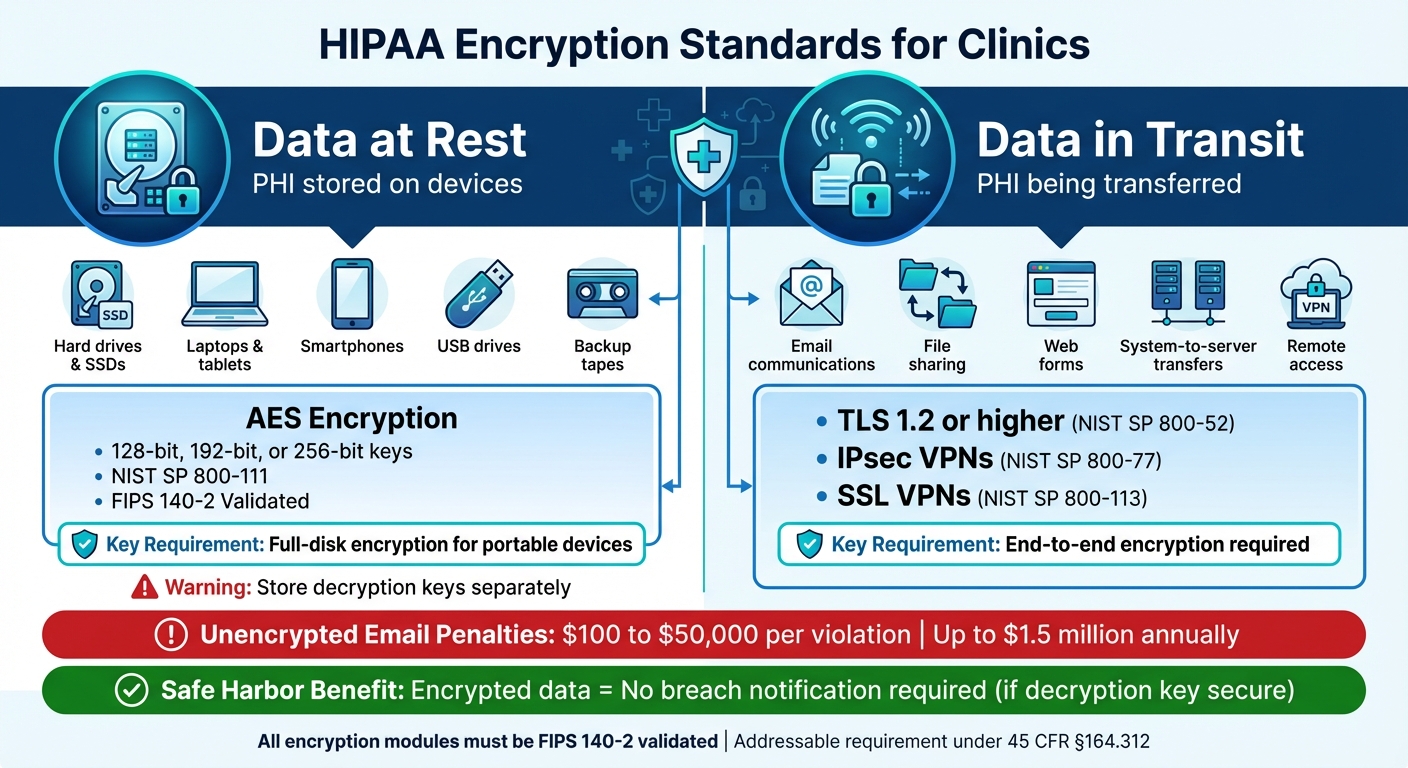
HIPAA Encryption Standards: Data at Rest vs Data in Transit Requirements
Under the HIPAA Security Rule (45 CFR §164.312), encryption is categorized as an "addressable" specification. Clinics are required to implement encryption when it's deemed reasonable or document an alternative that achieves the same level of security. The rule doesn’t dictate specific brands or products but aligns with standards set by the National Institute of Standards and Technology (NIST).
Encrypting Protected Health Information (PHI) according to Department of Health and Human Services (HHS)-approved standards offers a "safe harbor." If an encrypted device is lost but the decryption key remains secure, clinics may avoid breach notification requirements. On the other hand, failing to encrypt - even if access controls are compromised - could trigger mandatory notifications, leading to penalties and reputational harm. This applies to all formats of data, making it critical to secure both stored and transmitted PHI.
Encrypting Data at Rest
Data at rest refers to PHI stored on devices such as hard drives, SSDs, laptops, tablets, smartphones, USB drives, and backup tapes. To safeguard this data, clinics should adhere to NIST SP 800-111 guidelines, using AES encryption with 128, 192, or 256-bit keys.
For portable devices, full-disk encryption is a must. Decryption keys should always be stored separately from the encrypted data.
"To avoid a breach of the confidential process or key, these decryption tools should be stored on a device or at a location separate from the data they are used to encrypt or decrypt."
– HHS.gov
Encrypting Data in Transit
Data in transit includes PHI being transferred via email, file sharing, web forms, or communication between clinic systems and external servers. To ensure security, use TLS 1.2 or higher as outlined in NIST SP 800-52. For remote access or staff working from home, VPNs based on IPsec (NIST SP 800-77) or SSL (NIST SP 800-113) are recommended.
Sending PHI through unencrypted email services can result in severe penalties, ranging from $100 to $50,000 per violation. Depending on the severity, annual penalties can reach up to $1.5 million.
Approved Encryption Algorithms and Protocols
The table below outlines approved encryption standards for protecting PHI:
| Data State | Approved Standards & Protocols | Relevant NIST Publication |
|---|---|---|
| Data at Rest | AES-128, AES-192, AES-256 | NIST SP 800-111 |
| Data in Transit | TLS 1.2 or higher | NIST SP 800-52 |
| Data in Transit | IPsec VPNs | NIST SP 800-77 |
| Data in Transit | SSL VPNs | NIST SP 800-113 |
| General Validation | FIPS 140-2 Validated Modules | FIPS 140-2 |
FIPS 140-2 validated cryptographic modules are considered compliant. When selecting practice management software or EMR systems, confirm through vendor documentation that encryption modules meet this standard.
"Encryption means the use of an algorithmic process to transform data into a form in which there is a low probability of assigning meaning without use of a confidential process or key."
– 45 CFR 164.304
Reading about the problem? See how Prospyr solves it in one platform.
Book a DemoHow to Implement Encryption in Your Clinic
To protect patient data effectively, encryption should be applied across all areas of your practice. Start by conducting a risk assessment to identify where Protected Health Information (PHI) is stored and how it’s transmitted. The HHS Security Risk Assessment (SRA) Tool is a helpful resource tailored for small and medium-sized practices, offering a structured way to spot vulnerabilities. After identifying these risks, evaluate your systems to ensure your encryption measures align with HIPAA standards.
EMR Systems and Practice Software
First, confirm that your Electronic Medical Record (EMR) system complies with encryption standards. Look for vendors that use AES (128-bit or higher) for data at rest and TLS 1.2 or newer for data in transit. Additionally, ensure the encryption modules are FIPS 140-2 validated - this federal standard confirms the cryptographic technology meets government-approved security benchmarks.
Signing a Business Associate Agreement (BAA) with your EMR vendor is critical. Without one, you could face liability for breaches caused by the vendor. Verify that the vendor’s encryption meets both HIPAA and NIST standards. Specifically, ensure the system:
- Encrypts stored data with AES (128-bit or higher).
- Uses TLS 1.2+ for encrypting data in transit.
- Employs FIPS 140-2 validated encryption modules.
- Includes safeguards like unique user IDs, automatic log-offs, and audit controls.
Keep detailed records of all security policies and assessments for at least six years from their creation or last use. Once your core systems are secure, apply similar encryption protocols to email and messaging platforms.
Email and Messaging Platforms
Avoid using free consumer email services for handling PHI. Instead, choose enterprise-grade platforms like Microsoft 365 or Google Workspace. These services offer the necessary security configurations and will sign a BAA to ensure HIPAA compliance. Confirm that your email provider supports end-to-end encryption for both message content and attachments, using AES 192-bit or 256-bit encryption algorithms.
For secure communication, use messaging portals that require user authentication to access encrypted PHI. This approach keeps PHI stored securely on a server rather than transmitting it across multiple networks where it could be intercepted. Combine encryption with integrity controls to prevent unauthorized changes to the data. Enable audit controls to create a permanent record of all emails sent and received. This documentation not only satisfies HIPAA requirements but also provides proof of compliance if needed.
Consumer messaging apps should not be used for PHI, even if they claim to use encryption. These apps often lack essential features like audit trails, integrity controls, and robust authentication mechanisms, all of which are required under HIPAA.
sbb-itb-02f5876
How Prospyr Ensures HIPAA-Compliant Encryption
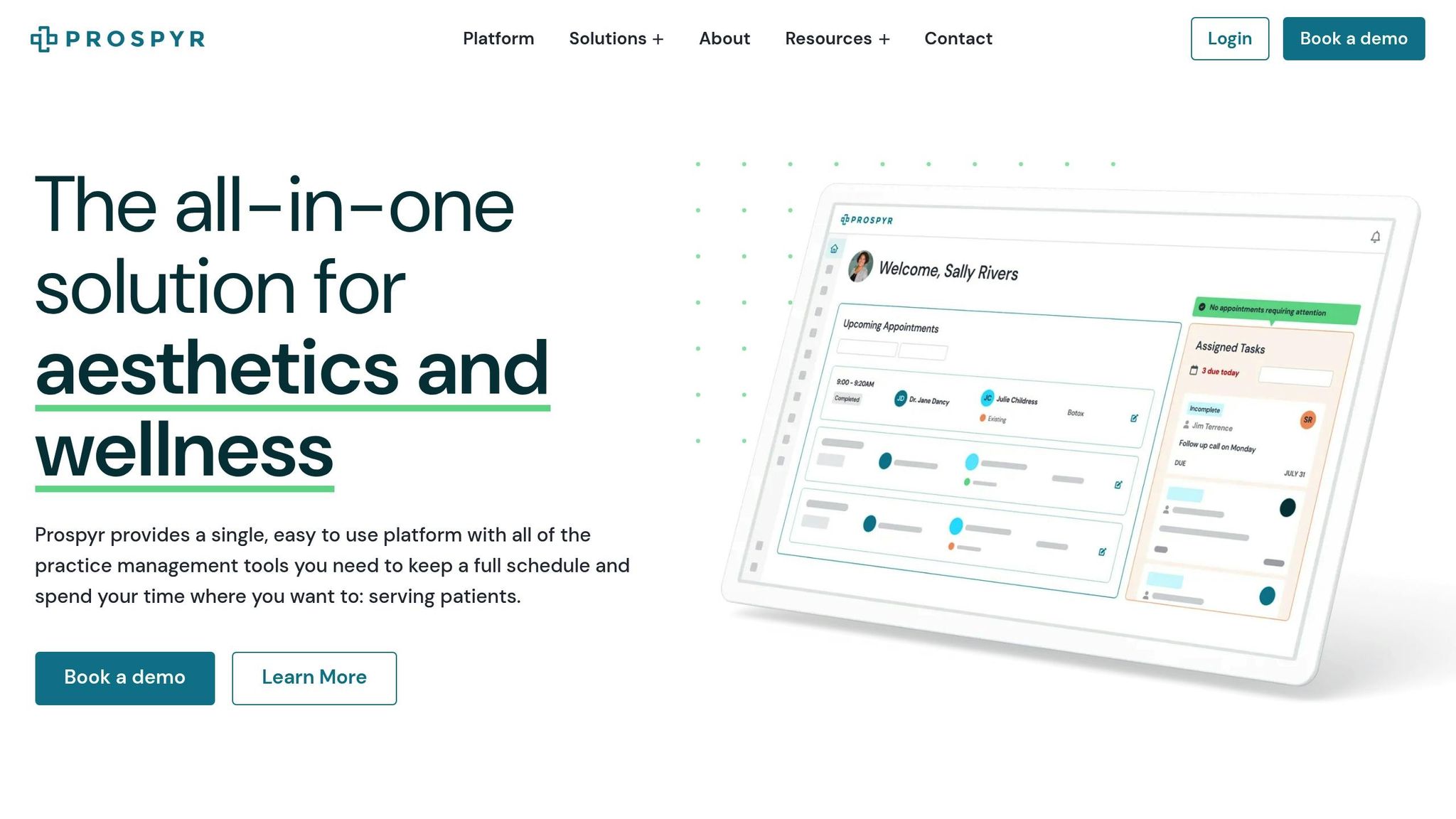
Prospyr is designed with HIPAA compliance at its core, offering enterprise-level encryption to protect patient data seamlessly. It takes care of complex security requirements, allowing healthcare providers to concentrate on patient care. Here's a closer look at how Prospyr handles HIPAA-compliant encryption.
Prospyr's Data Protection Features
Prospyr uses AES-256 encryption to secure all Protected Health Information (PHI), going beyond the minimum 128-bit standard. For data at rest, it adheres to NIST Special Publication 800-111, while data in transit is safeguarded with TLS 1.2 or higher protocols.
Encryption is applied across all touchpoints where PHI is processed. This includes CRM/EMR data, digital intake forms, payment details, and email or SMS communications. Prospyr ensures that decryption keys are stored separately from encrypted data, making unauthorized access virtually useless by rendering stolen data unreadable. This strategy aligns with HIPAA's safe harbor provisions.
As a Business Associate under HIPAA, Prospyr signs a Business Associate Agreement (BAA) with every clinic, guaranteeing the protection of electronic PHI and prompt reporting of any security incidents. Additional technical safeguards include unique user identifiers, automatic log-offs, and audit controls that keep a detailed record of system activity.
Simplified Compliance Through Prospyr
Beyond encryption, Prospyr simplifies compliance by integrating multiple practice management tools into a single HIPAA-compliant platform. This eliminates the hassle of juggling multiple vendor agreements or conducting separate security assessments. From scheduling and patient communications to payment processing and medical records management, everything operates under one secure framework that meets federal standards.
This unified approach also addresses common compliance gaps that arise when using disconnected systems. Prospyr ensures secure email and payment processing while maintaining HIPAA-required records for at least six years. This means your team doesn’t have to worry about additional record-keeping efforts, as the platform handles it all seamlessly.
Common Encryption Mistakes and How to Avoid Them
HIPAA's encryption requirements are clear, but clinics often stumble into common pitfalls that result in breaches, hefty fines, and a loss of patient trust. Recognizing these frequent errors can help you steer clear of the same issues.
Unencrypted Email Communications
One of the biggest and most expensive errors clinics make is sending patient information through unencrypted email. This misstep can trigger breach notifications to affected individuals, the HHS Secretary, and even the media if the breach involves over 500 records.
In 2024 alone, the OCR resolved 22 enforcement actions, resulting in penalties totaling $9.9 million. Many of these cases stemmed from email security failures. For instance, Dr. Steven Porter faced a $100,000 fine for neglecting to perform a risk analysis and document security measures.
"The financial penalty is just the beginning. What really impacts small practices is the ongoing oversight and documentation burden. I've seen solo practitioners spend 10-15 hours per quarter just on compliance reporting for years after a settlement." - Margaret Hales, J.D., CEO of ET&C Group LLC
To avoid this, use encrypted email platforms that offer a signed Business Associate Agreement (BAA) and support Transport Layer Security (TLS) or other NIST-approved encryption methods. Replace unsecured web forms with encrypted options, and never request patients to send sensitive data through standard email. Studies show that 60% of small practice fines could be avoided or minimized by adopting basic email security measures like encryption and multi-factor authentication.
Now let’s look at how outdated encryption protocols can put your clinic at risk.
Outdated Encryption Protocols
Another common vulnerability arises when clinics fail to update their encryption standards. Sticking with outdated encryption leaves systems exposed to modern threats. HIPAA mandates regular technical and non-technical evaluations to ensure security measures comply with the Security Rule. Yet, many practices set up encryption once and never revisit it, creating potential weak points.
"Healthcare organizations should choose industry-standard, well-vetted encryption methods that are currently considered secure and cannot be easily broken by malicious actors." - calHIPAA
The January 2026 OCR Cybersecurity Newsletter emphasizes "System Hardening" as essential for safeguarding electronic PHI. This includes disabling unnecessary services and upgrading outdated protocols. Legacy systems, in particular, often rely on encryption methods that no longer meet modern standards.
To strengthen your clinic's defenses, ensure encryption for data in motion is FIPS 140-2 validated. Tools like the HHS Security Risk Assessment (SRA) Tool can help small and medium-sized practices identify and address gaps in their encryption protocols.
| Mistake | Solution |
|---|---|
| Sending PHI via standard, unencrypted email | Use secure patient portals or encrypted email services; obtain explicit patient consent if using unencrypted channels |
| Using default or weak decryption keys | Store decryption keys separately from encrypted data and restrict access to authorized personnel |
| Failing to update encryption standards | Regularly consult NIST Special Publications to ensure protocols remain up-to-date |
| Assuming cloud storage is automatically compliant | Confirm that your cloud provider signs a BAA and uses encryption for data at rest |
Key Takeaways
Encrypting ePHI (electronic protected health information) following HHS standards offers your clinic a "safe harbor" from breach notification requirements. This means you won’t need to notify patients, media outlets, or federal authorities about a breach within the usual 60-day window if the data is properly encrypted.
It’s important to understand the difference between data at rest and data in transit. For data at rest, use AES encryption with a minimum 128-bit key, which is considered an industry standard. For data in transit, adopt TLS protocols that align with NIST guidelines. Additionally, always store decryption keys separately from the encrypted data to avoid creating a single point of failure. These steps are critical for maintaining secure and compliant operations.
"A major goal of the Security Rule is to protect the security of individuals' ePHI while allowing regulated entities to adopt new technologies that improve the quality and efficiency of health care." – HHS.gov
Prospyr simplifies the process by automating 256-bit AES encryption for all database objects and metadata. Decryption is restricted to authorized users only. The system also handles cryptographic keys through robust processes, including regular master key rotation. With a Business Associate Agreement and HIPAA-compliant email encryption, Prospyr takes care of the technical challenges, so you can focus entirely on patient care.
FAQs
What happens if clinics don’t follow HIPAA encryption standards?
Failing to meet HIPAA encryption standards can leave clinics vulnerable to data breaches, putting sensitive patient information at risk. If a breach occurs, clinics may need to notify both affected patients and the Department of Health and Human Services (HHS). This process can harm a clinic’s reputation and weaken the trust patients place in their care.
Beyond reputational damage, non-compliance comes with financial risks. Clinics could face steep fines and legal penalties, which vary based on the severity of the violation. Implementing proper encryption safeguards not only helps avoid these outcomes but also reinforces the clinic’s commitment to patient care and professionalism.
What steps can clinics take to ensure their encryption meets HIPAA and NIST standards?
Clinics can maintain compliance with HIPAA and NIST standards by consistently reviewing the latest recommendations from the National Institute of Standards and Technology (NIST). For example, staying informed about updates in resources like NIST SP 800-66r2 is essential, as it provides guidance on protecting sensitive health information.
To align with these standards, clinics should adopt modern encryption protocols that rely on up-to-date cryptographic algorithms. Key steps include conducting regular system audits, replacing outdated encryption methods, and ensuring that all data - whether in transit or stored - is properly encrypted. Partnering with IT professionals who are well-versed in NIST guidelines can further strengthen your clinic’s security measures and help safeguard patient information effectively.
Why should decryption keys always be stored separately from encrypted data?
Keeping decryption keys separate from encrypted data is a smart way to protect sensitive information. Why? Because even if someone manages to access the encrypted data, it’s useless without the keys. This extra step makes it much harder for unauthorized individuals to compromise your data, lowering the chances of a breach.
This method isn’t just about good security practices - it’s also vital for HIPAA compliance. By doing this, you’re adding an extra layer of protection to your clinic’s data management, helping ensure patient privacy stays intact.