How Reviews Impact Local SEO Rankings
How online reviews affect clinic local SEO—volume, recency, ratings, responses, and cross-platform consistency that boost visibility and patient trust.
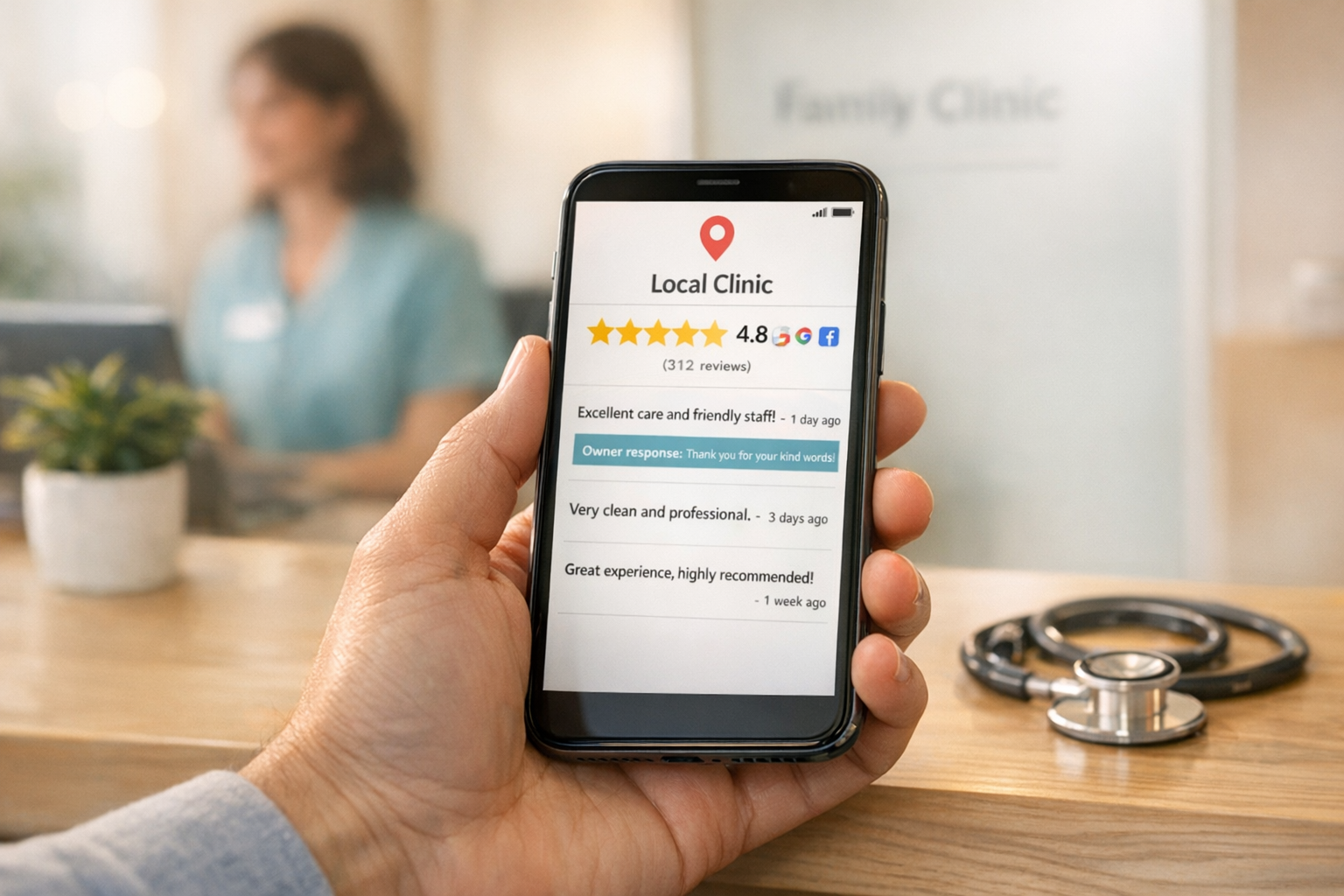

When it comes to improving your clinic's local SEO rankings, online reviews are one of the most impactful tools. They influence approximately 20%–25% of Google’s Local Pack rankings and directly affect whether potential patients choose your business. Here’s what you need to know:
- Review Volume and Recency: Clinics with a steady flow of new reviews rank higher. Reviews written within the last 30 days carry the most weight, while older reviews lose relevance.
- Star Ratings: An average rating between 4.5 and 4.9 stars is ideal. A perfect 5.0 rating can seem suspicious to Google.
- Responses Matter: Engaging with reviews - positive and negative - boosts trust and signals to Google that your clinic is active and reliable.
- Multiple Platforms: While Google Reviews are critical, reviews on Yelp, Healthgrades, and other platforms also strengthen your online presence. Consistency across platforms is key.
Quick stats:
- 73% of patients rely on reviews to choose a provider.
- Clinics in the top 3 Local Pack positions see a 156% increase in booking inquiries.
- 89% of consumers prefer businesses that respond to reviews.
To succeed, focus on collecting consistent, recent reviews, engaging with patient feedback, and maintaining high ratings across all platforms. Reviews are not just about rankings - they’re about building trust and attracting patients.
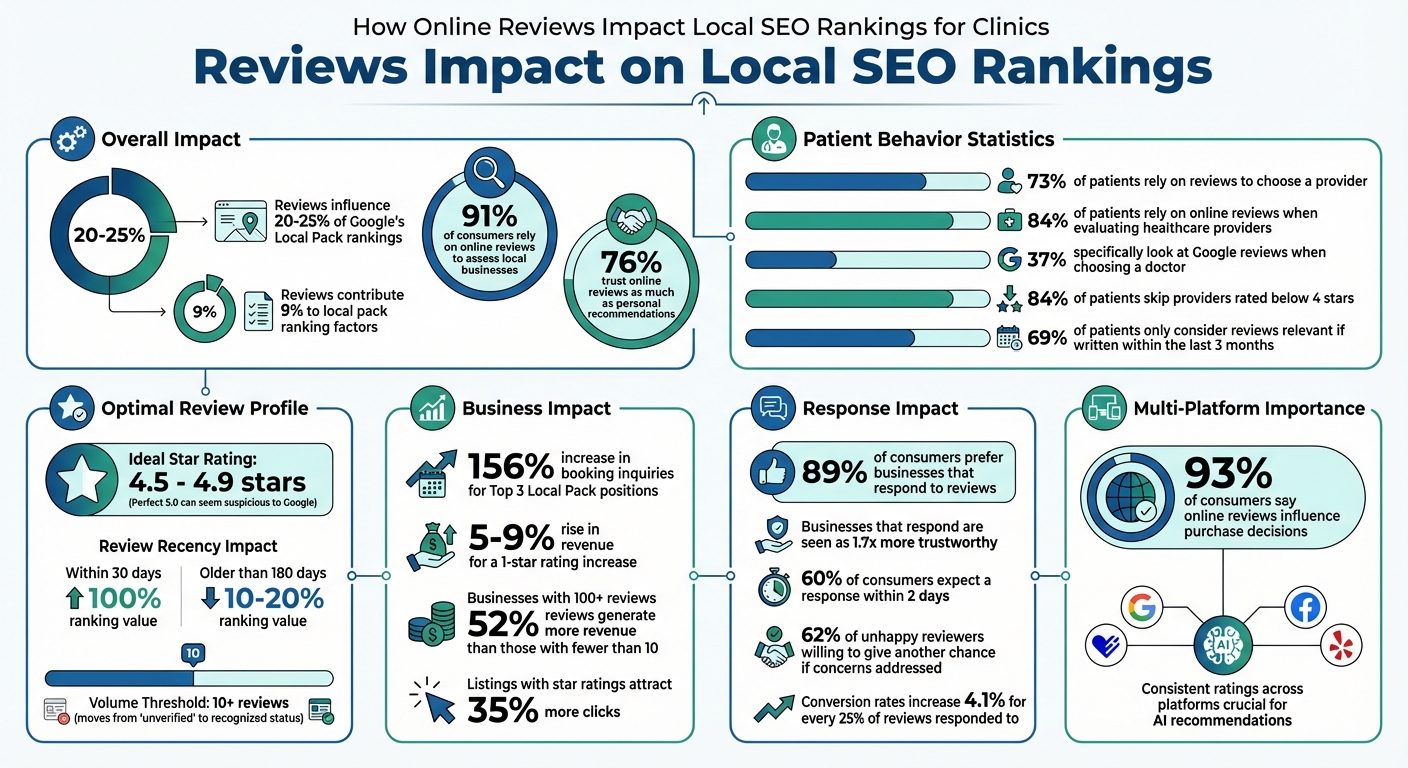
How Online Reviews Impact Local SEO Rankings for Clinics
How Google Reviews Affect Local Search Rankings
Google Reviews play a major role in local search rankings, influencing roughly 20%–25% of Map Pack results. For aesthetic clinics, which fall under Google's "high-trust" category, reviews act as crucial evidence for the algorithm to confirm a provider's legitimacy and safety. For instance, when someone searches for "lip filler near me", Google evaluates your review profile to determine if your clinic deserves a top spot in the map listings.
Not all review metrics are created equal. Among them, review velocity - how frequently your clinic receives new reviews - is the most important factor Google considers. A clinic with 75 reviews and a steady flow of 3 new reviews per month is likely to outrank another with 150 reviews but no recent activity. Consistent growth in reviews signals to Google that your business is active and worth recommending. Let’s break down how review volume, star ratings, and recency affect your rankings.
Review Volume and Star Ratings
While star ratings matter, review volume is more strongly linked to top rankings once your average rating surpasses 4.1. Listings with star ratings attract 35% more clicks than those without. Crossing the 10-review threshold moves your clinic from "unverified" status to recognized, often resulting in a rankings boost.
The sweet spot for ratings falls between 4.5 and 4.9 stars. Surprisingly, a perfect 5.0 rating can sometimes trigger Google's fraud detection system, as it may seem unnatural. Additionally, a 1-star increase in your rating can lead to a 5% to 9% rise in revenue. However, the key to success lies in maintaining a natural mix of feedback while steadily gaining new reviews. Top-performing local listings typically show at least 4.1 stars and consistent monthly review growth. Steady accumulation of reviews is essential for improving your clinic's visibility.
Why Recent Reviews Matter for Rankings
Beyond volume, the recency of reviews is a critical factor in signaling ongoing activity to Google. Older reviews lose their weight over time - a 5-star review from two years ago carries far less influence than a recent 4-star review. Reviews written within the last 30 days hold their full ranking value, while those older than 180 days retain only 10% to 20% of their impact. This highlights Google's preference for businesses that show current demand and activity. As Adam Collins aptly puts it:
"Google is not ranking the past. It is recommending the present".
The data supports this: 73% of consumers focus only on reviews from the past month. Clinics that generate 3 to 5 new reviews each month often rank 40% to 60% higher than competitors with stagnant review activity. For aesthetic clinics, a steady influx of fresh patient feedback signals to Google that you're actively treating patients and delivering results. Streamlining this process with digital intake forms can help capture feedback immediately after treatment. A clinic with 50 recent reviews will typically outrank one with 500 older reviews. Google's algorithm prioritizes current activity over past reputation.
sbb-itb-02f5876
Reading about the problem? See how Prospyr solves it in one platform.
Book a DemoResponding to Reviews: Building Trust and Better Rankings
When you respond to reviews, you're doing more than just engaging with patients - you’re also showing Google that your clinic is well-managed and reliable. This matters because review signals, including how you respond to feedback, influence about 16% of the factors that determine your ranking in the Google Local Pack. Essentially, review responses tell both potential patients and search engines that your clinic is actively managed and prioritizes patient care.
Consider this: 89% of consumers are more likely to choose a business that responds to reviews, and businesses that reply to feedback are seen as 1.7 times more trustworthy. Trust is everything in the aesthetic clinic world, making this kind of engagement a potential deal-breaker. Plus, responding pays off - conversion rates can increase by an average of 4.1% for every 25% of reviews you respond to.
Timing is also key. 60% of consumers expect a response within two days, and meeting this expectation signals to Google that your profile is being actively managed. Even negative reviews offer an opportunity: 62% of unhappy reviewers are willing to give your clinic another chance if their concerns are addressed effectively. As Moz explains:
"A negative review is not the end of the world, but that it is, in fact, the last chance the business will likely be given to make amends and win back the customer".
Now, let’s break down how to craft responses that not only build trust but also improve your local SEO.
How to Write Effective Review Responses
Skip the generic "Thank you for your feedback" and aim for something more personal. If a patient mentions a specific treatment, like Botox, reference it directly in your response. This shows attentiveness and gives Google valuable context to better match your clinic with search queries.
Respond promptly - ideally within 24 to 48 hours - to show both patients and search engines that you’re on top of things. Address reviewers by name and reference details from their feedback to avoid sounding impersonal. For negative reviews, use a structured approach:
- Start with a sincere apology and take responsibility.
- Offer a specific solution or way to make things right.
- Provide a direct offline contact (like a phone number or email) to resolve the issue privately.
This approach not only reassures the reviewer but also shows others that your clinic handles concerns professionally.
For positive reviews, express gratitude and reinforce the specific points the patient praised. Keep it genuine and avoid turning your response into a sales pitch. Instead, focus on building a sense of community and strengthening loyalty. A quick note for aesthetic clinics: only mention specific treatments if the patient brought them up first. Never introduce new clinical details in public responses to stay HIPAA-compliant.
Using Review Responses to Improve SEO
Your review responses do more than build trust - they also work as searchable, indexed text that Google uses to understand your clinic’s services and location. By naturally including service-related keywords (like "dermal fillers" or "skin rejuvenation") and location-specific terms (like "our clinic in downtown Chicago"), you help Google match your business to relevant local searches.
For maximum SEO impact, structure your responses in two parts. First, acknowledge the patient’s feedback and mention the service they received. Second, reinforce your location by referencing your neighborhood or city. For example: "We’re thrilled you loved your microneedling results, Sarah! Our team at our downtown Portland clinic takes pride in delivering natural-looking skin rejuvenation." This approach improves both your "Prominence" and "Relevance", two critical pillars of local SEO.
By staying active in your review responses, you also keep your profile fresh with new user-generated content, something Google values as a sign of ongoing activity. As ReviewsBlender aptly puts it:
"Ignoring your reviews is like throwing away free SEO juice".
Reviews Across Multiple Platforms and Local SEO
Google Reviews are essential for improving your local rankings, but don’t underestimate the impact of reviews on platforms like Yelp and Healthgrades. These reviews add to your clinic’s overall credibility and help establish a stronger online presence. Google measures "prominence" by examining how much information is available about your business across the internet. Reviews on multiple platforms signal that your clinic is established and trustworthy.
Here’s a compelling fact: 93% of consumers say online reviews influence their purchase decisions. Platforms like Yelp have high domain authority and often rank well in search results, giving your clinic extra visibility - even if users don’t visit your website. For aesthetic clinics, reviews on niche platforms like Healthgrades provide a level of trust that general sites can’t match.
AI tools like ChatGPT and Google AI Overviews now pull data from platforms like Google Business Profiles and Yelp to create local recommendations. However, inconsistent ratings across platforms can hurt your visibility. For instance, if your clinic has stellar reviews on Google but poor ratings on Yelp, AI models may flag this as a "data conflict" and exclude your clinic from recommendations. RatesOnTap explains:
"If you have 4.9 stars on Google but 2.5 on Yelp, the AI detects a conflict and may exclude you entirely. It would rather recommend a business with a consistent 4.3 everywhere than risk a business with wildly different ratings".
This highlights the importance of maintaining consistent and strong reviews across all platforms. Up next, we’ll explore why ensuring uniform business information and diversifying your review strategy are critical for local SEO success.
Why Consistent Business Information Matters
Accurate and consistent business details are just as important as reviews. Your clinic’s Name, Address, and Phone number (NAP) need to match exactly across all platforms - Google, Yelp, Healthgrades, and any other directories. Inconsistencies can confuse search engines, causing them to treat different listings as separate entities, which weakens your online authority.
Voice assistants like Siri, Alexa, and Google Assistant rely on multiple directories for their data. If your information isn’t consistent, they may provide outdated or incorrect details to potential patients. Even small differences - like using "Street" on one platform and "St." on another - can create confusion. Standardizing your NAP format is critical.
Beyond helping search engines, consistent data supports Google's E-E-A-T (Experience, Expertise, Authoritativeness, and Trustworthiness) guidelines. Reviews from various platforms act as third-party validations, reinforcing your clinic’s legitimacy. To maintain this consistency, it’s a good idea to audit your business information every three to six months, especially after changes like relocations or updated hours. Once your data is consistent, you can focus on expanding your review reach.
Getting Reviews on Multiple Platforms
Building a diverse review profile strengthens your online presence. Consider creating a "Leave a Review" page on your website with direct links to platforms like Google, Yelp, and Healthgrades. Use QR codes on business cards, at checkout, or in post-treatment instructions to make it easy for patients to leave feedback.
Timing is everything. Sending review requests via email or SMS within 24 hours of an appointment can significantly increase response rates - sometimes by three to four times. While Google should remain a priority, shifting focus periodically to platforms like Yelp can help you maintain a balanced reputation.
Avoid using in-office devices for reviews, as multiple submissions from the same IP address can trigger spam filters and lead to deletions. Instead, send personalized follow-up messages with links to preferred review sites. Automating these requests through embedded marketing tools ensures consistency without manual effort. Finally, don’t just focus on Google - responding to reviews on all platforms shows that your clinic values patient feedback. This level of engagement not only improves your local rankings but also reassures new patients that their opinions matter.
How Prospyr Simplifies Review Management
Managing reviews effectively is a critical part of maintaining a strong online presence, and Prospyr makes this process much easier by centralizing and automating it.
For busy aesthetic clinics, Prospyr offers an all-in-one platform that combines practice management with reputation management tools tailored specifically for aesthetics and wellness practices. Instead of juggling multiple systems, clinics can use Prospyr’s dashboard to monitor patient feedback, respond to reviews, and automate follow-ups - all while staying HIPAA-compliant.
Under its "Raise Awareness" tools, Prospyr focuses on strengthening your brand image and building trust with patients. Considering that 84% of patients rely on online reviews when evaluating healthcare providers and 37% specifically look at Google reviews when choosing a doctor, having a streamlined system to manage feedback is essential. Let’s dive into how Prospyr’s tools simplify review collection and response.
Automated Review Collection and Responses
Prospyr automates the process of requesting reviews, sending follow-up messages within 24–48 hours after an appointment - when the experience is still fresh in the patient’s mind. This timing is crucial because 69% of patients only consider reviews relevant if they’re written within the last three months. By keeping reviews recent and consistent, Prospyr helps ensure your clinic stays visible and relevant to Google’s algorithms.
The platform also enables quick responses to reviews from a centralized dashboard. This is key because 56% of potential customers are more likely to view a business positively when they see thoughtful and active responses to reviews. With Prospyr, you can respond promptly across multiple platforms, saving time and showing patients that their feedback matters. This approach not only boosts patient satisfaction but also strengthens your clinic’s local SEO performance.
In a real-world example, SOM Aesthetics used Prospyr’s tools to launch their clinic and surpassed their sales targets 21 times faster than expected, earning over $100,000 in monthly revenue within just two months. Dr. Saami Khalifian, Founder and CEO of SOM Aesthetics, shared:
"Prospyr has helped us launch SOM Aesthetics like a rocketship. Their powerful platform and helpful support have enabled us to exceed our financial targets while delivering an unmatched experience for our patients".
Improving SEO with Prospyr's Review Tools
Prospyr’s automated review tools not only save time but also enhance search engine rankings.
By helping clinics reach the 10-review threshold - a critical factor for Google’s entity recognition system - Prospyr ensures your clinic maintains the volume and freshness of reviews that Google prioritizes in local search rankings. The centralized system makes it easy to manage responses and maintain consistent engagement with patient feedback.
The benefits go beyond just collecting reviews. Dr. Daniel Lee, founder of New Life Cosmetic Surgery, saw a 50% increase in revenue and a 40% jump in appointments booked after transitioning his practice operations - including reputation management - to Prospyr, eliminating the need for four separate tools. He noted:
"We've seen a 50% increase in revenue and a 40% increase in appointments booked since switching away from using several different point solutions to running our practice on Prospyr".
Since 84% of patients skip providers rated below four stars, Prospyr’s tools help clinics maintain high ratings by ensuring every piece of feedback is addressed - whether it’s resolving concerns or thanking happy patients. Plus, with built-in HIPAA compliance, Prospyr supports your clinic’s privacy standards while optimizing your online reputation.
Conclusion
Reviews play a key role in achieving success with local SEO. They contribute about 9% to local pack ranking factors, helping Google’s algorithms determine a clinic’s credibility and the safety of its services.
To thrive in today’s SEO landscape, clinics need to build trust with both search engines and potential patients. With 91% of consumers relying on online reviews to assess local businesses and 76% trusting them as much as personal recommendations, reviews are not just a nice-to-have - they’re essential. Plus, the numbers don’t lie: businesses with over 100 reviews generate 52% more revenue on average than those with fewer than 10.
Managing reviews effectively means more than just collecting high ratings. It requires a steady flow of new feedback, quick responses within 24 to 48 hours, and consistent engagement across platforms. This approach signals to both search algorithms and patients that your clinic is active, attentive, and committed to delivering excellent care.
FAQs
How many new reviews should my clinic aim for each month?
Your clinic should strive to collect at least 16 new reviews each month to improve local SEO rankings. Studies indicate that increasing your reviews from just 3 to 16 can make a big difference in your visibility within the map pack, making it easier for potential patients to find and choose your clinic.
What should I do if my clinic gets a negative review?
If your clinic gets a negative review, it’s crucial to handle it with care to safeguard your reputation and even strengthen your local SEO. Start by staying calm - taking a moment to assess the feedback objectively can help you craft a thoughtful response. Reply promptly, thanking the reviewer for their input and acknowledging their concerns. Avoid getting defensive, as that can escalate the situation.
Responding publicly demonstrates your dedication to patient satisfaction and can foster trust with current and potential patients. Plus, managing reviews professionally contributes to maintaining a strong online reputation, which can positively impact your local search rankings.
How can I ask for reviews without violating HIPAA?
When asking for reviews while staying HIPAA-compliant, it’s crucial to avoid mentioning any Protected Health Information (PHI). Stick to neutral, automated email or text prompts that don’t reference specific treatments, visits, or conditions. Make sure your staff avoids encouraging patients to discuss their procedures or outcomes in reviews. Additionally, never acknowledge someone’s patient status when responding to their feedback. By keeping requests broad and general, you can respect privacy while still encouraging valuable input.