HIPAA vs. FTC: Ad Compliance Rules
Compare HIPAA and FTC ad rules for aesthetics clinics: PHI consent, truthful claims, data sharing, and breach obligations.

When advertising for aesthetics clinics, you need to comply with two key regulations: HIPAA and the FTC Act. HIPAA safeguards Protected Health Information (PHI) and applies to healthcare providers and their associates. The FTC Act, on the other hand, ensures advertising is truthful and applies broadly to all businesses, including non-HIPAA entities handling health-related data. Here's what you need to know:
- HIPAA: Requires written patient authorization before using PHI (e.g., names, photos, IP addresses) for marketing. Strict rules apply to how patient information is collected, shared, and disclosed.
- FTC Act: Prohibits deceptive advertising and mandates that health claims be backed by scientific evidence. Consent is required before sharing sensitive health data for ads.
- Overlap: Both require clear consent and transparency, but HIPAA focuses on privacy, while the FTC emphasizes truth in advertising.
Failing to comply can lead to fines, lawsuits, and reputational damage. Recent enforcement actions against companies like BetterHelp and GoodRx highlight the importance of adhering to these regulations.
Quick Tip: Regularly audit your marketing practices, use HIPAA-compliant tools, and train staff to handle patient data securely.
HIPAA Requirements for Paid Advertising
When running paid ads for your aesthetics clinic, it's not just about following FTC rules - you also need to align your strategy with HIPAA guidelines. HIPAA places strict limits on the use of patient data, and understanding what qualifies as Protected Health Information (PHI) is key to staying compliant. Missteps can lead to hefty penalties, so knowing when and how to get proper authorization is non-negotiable.
What Counts as PHI in Advertising
PHI includes a wide range of data that can identify a patient, whether directly or indirectly. Here's a breakdown of what you need to watch out for:
- Direct identifiers: Names, email addresses, phone numbers, and home addresses.
- Visual identifiers: Full-face photos, before-and-after images, or unique features like tattoos, scars, and birthmarks. Even cropped images can pose risks if they include distinctive details, metadata, or recognizable backgrounds.
- Digital identifiers: Information like IP addresses, device IDs, and referral URLs becomes PHI when linked to health services, such as a visit to a page about Botox treatments.
- Clinical and interaction data: Details like appointment dates, treatment plans, procedure types, or chat transcripts.
- Financial information: Payment links, invoices, or insurance/payment statuses tied to aesthetic treatments.
Here’s how these categories might appear in your advertising efforts:
| PHI Category | Examples in Aesthetics Advertising |
|---|---|
| Direct Identifiers | Name, Email, Phone Number, Home Address |
| Visual Identifiers | Full-face photos, Tattoos, Scars, Birthmarks, Before/After images |
| Digital Identifiers | IP Address, Device ID, Page Path (e.g., /coolsculpting-results) |
| Clinical Data | Procedure type, Appointment date, Treatment history, Chat transcripts |
| Financial Data | Payment links, Invoices, Insurance/Payment status |
Getting Written Patient Authorization
Before using any PHI for marketing, you need a signed HIPAA authorization form. This document must clearly outline:
- Who is authorized to disclose the information.
- What specific information will be used or shared.
- Who will receive the information.
- The purpose of the disclosure (e.g., "social media advertising").
- When the authorization expires (e.g., "end of the 2026 campaign").
Be as specific as possible. For instance, if you're using before-and-after photos of facial filler treatments, state exactly where the images will appear (e.g., Instagram, Facebook, your website). If your clinic receives financial compensation from a third party to promote a product, this must also be disclosed in the form.
Patients must be informed of their right to revoke authorization at any time, and the form should explain that once PHI is made public, it may no longer be protected under HIPAA if third parties re-disclose it. Additionally, authorization cannot be a condition for receiving treatment or payment. To stay organized, maintain a centralized system for storing signed authorizations, tracking expiration dates, and ensuring all marketing materials are re-approved before reuse.
Using Patient Data Without Consent
There are limited situations where you can use patient data without explicit consent, but the guidelines are strict:
- De-identified data: You can use fully de-identified information, but be cautious - unique features in images can still re-identify individuals.
- Treatment-related communications: If you're communicating about treatments without any third-party financial involvement, consent isn’t required. However, once you promote a product or service or accept payment to send a message, it becomes marketing and requires stricter compliance.
- General brand awareness campaigns: Broad ads, like billboards or general online campaigns, that don’t use patient lists, specific records, or tracking technologies tied to PHI, typically don’t require authorization.
- Face-to-face recommendations and small promotional gifts: These don’t usually need formal HIPAA marketing authorization.
For added protection, audit tracking technologies like pixels on sensitive pages, such as digital intake and booking forms or patient portals. Instead of behavioral targeting based on patient care data, consider using contextual targeting to ensure compliance.
sbb-itb-02f5876
FTC Act Requirements for Paid Advertising
While HIPAA zeroes in on protecting patient data, the FTC ensures honesty and transparency in advertising practices. For aesthetics clinics, the FTC's rules apply whether or not you're a HIPAA-covered entity or use telehealth services. Misleading claims or mishandling health-related data can lead to hefty fines and severe damage to your reputation. Here’s a closer look at how the FTC oversees ad claims, data disclosures, and breach notifications.
Preventing Misleading Advertising
Under Section 5 of the FTC Act, "unfair or deceptive acts or practices" are strictly prohibited. The standard is especially high for health-related claims. Importantly, a claim doesn’t have to be outright false to violate these rules. Even technically accurate statements can cross the line if they're framed misleadingly, omit crucial details, or create a false impression. The FTC evaluates the overall "net impression" of an ad, considering visuals, headlines, and copy - not just the fine print. For instance, burying a disclaimer at the bottom of an ad won’t protect you if the headline itself misleads consumers.
Health claims must be supported by solid clinical evidence, typically from well-conducted human studies. Testimonials or before-and-after photos also require clear disclaimers about typical results, especially if the outcomes shown are uncommon. Additionally, any material relationships - like payments to endorsers - must be disclosed. For example, if you claim a laser treatment "reverses aging at the cellular level", you’ll need robust clinical data to back it up. Without FDA approval for such claims, this could be seen as promoting an unapproved drug. Instead, stick to safer language like "supports natural collagen production."
Violations can be costly. The FTC can impose civil penalties of up to $51,744 per violation for breaches of trade regulation rules, such as the Endorsement Guides. On top of that, states like California, New York, and Florida have their own consumer protection laws, allowing patients to sue clinics directly for deceptive advertising.
Clear Disclosure of Data Collection and Use
Beyond ad claims, the FTC requires transparency in how businesses handle consumer data. The agency takes a broad view of "health information", which includes more than just medical records. Data like browsing history (e.g., visiting a CoolSculpting page), location data (e.g., checking into a clinic), or purchase records (e.g., skincare products bought) can all fall into this category.
"Representations to consumers must be consistent with your practices and clear and conspicuous." - Federal Trade Commission
Before sharing sensitive health data with third parties, you must obtain clear, affirmative consent. This consent must be specific and separate from your general terms and conditions. Key details about data usage can’t be hidden in lengthy privacy policies or terms of use. Disclosures should be easy to spot and understand, using appropriate size, color, and graphics.
Recent enforcement actions underscore the importance of compliance. In February 2023, the FTC settled with GoodRx over allegations it shared users' health information with platforms like Facebook and Google without proper consent, despite privacy promises. The settlement included a $1.5 million fine and a permanent ban on disclosing health data for advertising. Similarly, in March 2023, BetterHelp, Inc. faced FTC action for sharing user data to create "look-alike" advertising audiences. The proposed settlement required BetterHelp to refund up to $7.8 million to consumers and secure explicit consent for future disclosures.
To stay compliant, review your tracking tools - like pixels on appointment booking forms or patient portals - to ensure they aren’t sharing sensitive health data against your privacy policies. Use contracts to restrict how third-party advertisers handle any shared data, ensuring it’s not used for unrelated research or ad optimization.
Health Breach Notification Rule
The FTC's Health Breach Notification Rule (HBNR) applies to non-HIPAA entities, such as health apps, web-based tools, and wellness platforms. If your clinic uses third-party software or platforms that fall outside HIPAA’s scope, this rule might apply to you. Under the HBNR, a breach doesn’t just mean a cyber-attack - it includes any unauthorized disclosure of identifiable health information.
"If you use behind-the-scenes tracking technologies that share consumers' sensitive health data in contradiction of your privacy promises, that's a violation of the FTC Act." - Federal Trade Commission
For breaches affecting 500 or more individuals, you’re required to notify consumers, the FTC, and the media. Violating the HBNR can result in civil penalties of up to $53,088 per violation. This applies regardless of whether your business is covered by HIPAA, underscoring the FTC’s wide-reaching authority.
To minimize risks, conduct regular audits of your data flows to pinpoint what health information is being collected, where it’s coming from, and which third-party tools it’s being shared with. Train both marketing and clinical staff on privacy best practices, and ensure consent mechanisms are clear and separate from broader terms and conditions.
Reading about the problem? See how Prospyr solves it in one platform.
Book a DemoHIPAA vs. FTC: Side-by-Side Comparison
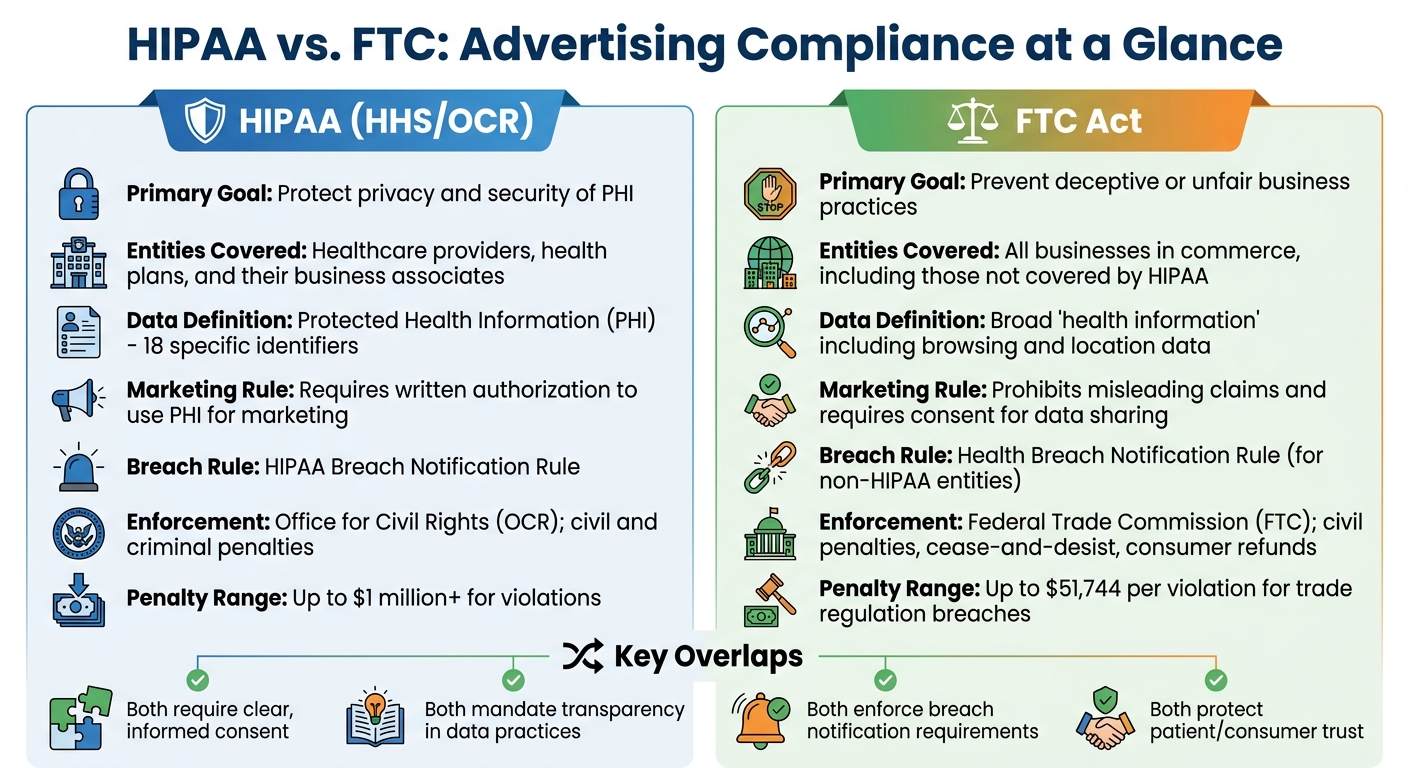
HIPAA vs FTC Advertising Compliance Requirements Comparison
HIPAA is all about safeguarding Protected Health Information (PHI), while the FTC focuses on preventing deceptive advertising and unfair data practices. Both frameworks aim to protect patient data, but their approaches differ. HIPAA zeroes in on the privacy and security of specific patient information, while the FTC broadly covers all businesses to ensure fair and truthful practices.
Comparison Table: HIPAA vs. FTC
| Feature | HIPAA (HHS/OCR) | FTC Act |
|---|---|---|
| Primary Goal | Protect privacy and security of PHI. | Prevent deceptive or unfair business practices. |
| Entities Covered | Healthcare providers, health plans, and their business associates. | All businesses in commerce, including those not covered by HIPAA. |
| Data Definition | Protected Health Information (PHI) - 18 specific identifiers. | Broad "health information" including browsing and location data. |
| Marketing Rule | Requires written authorization to use PHI for marketing. | Prohibits misleading claims and requires consent for data sharing. |
| Breach Rule | HIPAA Breach Notification Rule. | Health Breach Notification Rule (for non-HIPAA entities). |
| Enforcement | Office for Civil Rights (OCR); civil and criminal penalties. | Federal Trade Commission (FTC); civil penalties, cease-and-desist, consumer refunds. |
This table highlights the key differences and overlaps, helping you understand how each regulation applies to your marketing and data practices.
Where the Rules Overlap and Differ
Both HIPAA and the FTC require clear, informed consent, but their scope differs. HIPAA focuses on 18 specific identifiers, such as names, medical records, and full-face photos. The FTC takes a broader approach, treating information like browsing history (e.g., visiting a CoolSculpting page), location data (e.g., checking into a clinic), and purchase records (e.g., buying skincare products through lead capture forms) as health-related data.
The two frameworks also diverge in their focus. HIPAA governs privacy in advertising, such as ensuring patient photos or testimonials are used appropriately. On the other hand, the FTC emphasizes the accuracy of claims, requiring evidence for statements like "permanent results" or "pain-free procedures."
Breach notification rules are another area where the frameworks overlap but differ in application. HIPAA's Breach Notification Rule kicks in when unsecured PHI is accessed or disclosed without authorization. The FTC's Health Breach Notification Rule applies to non-HIPAA entities and includes unauthorized sharing of user data - such as a company disclosing user information to advertising platforms without consent.
For aesthetics clinics, especially those using embedded marketing tools, understanding and adhering to both HIPAA and FTC rules is essential. These frameworks ensure that your advertising is not only secure but also transparent and trustworthy.
How to Comply with Both Regulations
Meeting HIPAA and FTC Requirements Together
To meet both HIPAA and FTC standards, your authorization forms need to cover all the bases. HIPAA requires written patient consent before using their information for marketing purposes. Meanwhile, the FTC insists that these requests must not be deceptive or misleading. As the Federal Trade Commission explains:
"If you're covered by HIPAA and the information surrounding your HIPAA authorization is deceptive or misleading... that's a violation of the FTC Act".
Your forms should clearly outline who will receive the data, the purpose of its use, expiration details, and any financial relationships involved. Avoid hiding these details in your Privacy Policy; they must be clearly visible and easy to understand. Additionally, participation in marketing should never be tied to receiving treatment.
Using HIPAA-Compliant Platforms
Beyond proper authorization, leveraging the right technology can make compliance easier. HIPAA-compliant platforms are designed to centralize patient data management while incorporating safeguards to prevent accidental violations. For example, platforms like Prospyr offer features like:
- Secure management of Business Associate Agreements (BAAs) with marketing vendors
- Storage and tracking of patient authorization forms with version control
- Encrypted communication channels to replace insecure email exchanges
These tools help reduce human error - an important factor, as HIPAA violations can result in fines ranging from $100 to $50,000 per record. By using such platforms, practices can personalize marketing efforts and segmentation without risking manual errors that could compromise patient data. Pairing these tools with thorough staff training creates a strong compliance framework.
Training Staff and Reducing Risk
Every team member, from front desk staff to marketing personnel, must understand what qualifies as protected health information (PHI) in a digital setting. Data like IP addresses, device IDs, and page paths become PHI when linked to health services. Training should be part of the onboarding process for new hires and updated every two years or whenever regulations change.
Consider forming a compliance committee tasked with staying informed about regulatory updates and organizing regular training sessions. Implement a formal review process to ensure all advertising claims are backed by scientific evidence before launching campaigns. Make sure staff are trained to handle PHI securely, using encrypted portals for patient communications.
Lastly, document everything. Keep records of data maps, risk assessments, BAAs, and training logs. These documents demonstrate "good faith" efforts toward compliance in case of regulatory scrutiny. By aligning your staff's practices with digital compliance requirements, your clinic can maintain both regulatory adherence and advertising credibility.
Steps to Achieve Ad Compliance
Achieving ad compliance involves aligning HIPAA's safeguards for Protected Health Information (PHI) with the FTC's standards for truthful advertising. Below are actionable steps to help you assess your current practices, secure your data management, and prepare for potential breaches.
Review Your Current Marketing
Start by auditing all active campaigns - this includes social media ads, email newsletters, website content, and paid search. Ensure that none of your claims are unsubstantiated and verify that tracking tools like pixels, SDKs, or tags are not inadvertently sharing PHI. According to the FTC, all health-related claims must be backed by "competent and reliable scientific evidence". Replace absolute claims with more realistic, evidence-supported statements, and include disclaimers like "results may vary" when necessary.
Document each claim by linking it to specific clinical studies in a substantiation file. This file will serve as your evidence should regulators question your advertising practices. Once your claims are validated and data flows are mapped, centralize your management processes to enhance security.
Use Secure Data Management Platforms
Centralizing patient data on a HIPAA-compliant platform, such as Prospyr, can simplify compliance. These platforms provide secure management of Business Associate Agreements (BAAs), version-controlled storage for patient authorization forms, and encrypted communication channels. They also ensure that marketing staff only access the data necessary for their roles, adhering to the "minimum necessary" standard and reducing exposure risks.
Ensure that all intake forms are transmitted via HTTPS encryption and hosted on platforms that sign BAAs to safeguard patient information. Additionally, implement privacy-focused analytics tools, such as server-side tracking or IP masking, to prevent identifiable data from being shared with third-party ad platforms.
Track and Address Data Breaches
Even with a secure setup, being prepared for breaches is essential to maintaining compliance. Establish clear incident protocols that include escalation paths, takedown procedures, and immediate remediation steps when a breach is detected. Under HIPAA, covered entities must notify affected individuals, the Secretary of Health and Human Services via the OCR breach portal, and, in some cases, the media when breaches of unsecured PHI occur. Similarly, the FTC's Health Breach Notification Rule mandates timely notifications for non-HIPAA entities.
Regular audits are key. Review your web pages, tracking pixels, and data workflows to document where data originates (e.g., websites, forms, or electronic health records), where it travels (e.g., CRM systems or ad platforms), and who has access to it. Enforce strict data retention policies to limit how long patient information is kept for marketing purposes and restrict who can access it.
Conclusion
Aesthetics clinics face strict requirements under both HIPAA and the FTC Act. HIPAA mandates obtaining written patient consent before using protected health information (PHI), such as IP addresses, device identifiers, or before-and-after photos. Meanwhile, the FTC requires that advertising claims are backed by evidence, avoiding exaggeration or unclear data practices.
The financial risks are considerable. HIPAA violations can lead to penalties exceeding $1 million, while the FTC imposes civil penalties of up to $43,792 for each violation. Recent cases have resulted in fines reaching millions of dollars, emphasizing the importance of compliance. Beyond avoiding fines, adherence to these regulations is key to building patient trust and ensuring sustainable business growth.
Successfully navigating these rules means aligning HIPAA's data protection standards with the FTC's truth-in-advertising principles. When patients feel confident their information is safe and your marketing sets realistic expectations, they’re more likely to schedule appointments and recommend your services. As Onspire Health Marketing explains:
"By adhering to HIPAA guidelines, truth-in-advertising principles, and professional ethics, you'll build a reputation as a trustworthy, patient-focused provider. This reputation, in turn, becomes one of your most valuable marketing assets".
To maintain compliance and foster trust, start by auditing your marketing efforts, securing Business Associate Agreements with vendors, and training your team on healthcare marketing standards. Consider using HIPAA-compliant platforms like Prospyr to centralize patient data and ensure tracking technologies don’t unintentionally expose PHI. Regularly review your data flows, consent forms, and advertising claims to stay compliant with evolving regulations and protect patient confidence.
FAQs
Do my ads need HIPAA authorization if I use tracking pixels?
No, HIPAA authorization isn't necessary to use tracking pixels in ads. However, if these pixels gather protected health information (PHI), they must adhere to HIPAA's privacy requirements. The Office for Civil Rights (OCR) has made it clear that when these technologies handle PHI, they fall under HIPAA regulations.
What proof does the FTC expect for aesthetic treatment claims?
The FTC mandates that any claims regarding aesthetic treatments must be supported by competent and reliable evidence. This means businesses need to back their statements with clinical studies or solid scientific data. The goal is to ensure the claims are accurate and not misleading. Additionally, the supporting materials must prove that the claims meet established regulatory guidelines.
When does FTC breach notification apply to my clinic?
If your clinic gathers, uses, or shares consumer health information through health apps, connected devices, or other services not covered by HIPAA, the FTC's breach notification rule applies. In the event of a breach involving unsecured, individually identifiable health data, you're required to notify both the FTC and the individuals affected. This rule is in place to promote transparency and hold organizations accountable for safeguarding sensitive health information.