HR Compliance for Multi-State Practices
Guide to federal vs. state HR rules, licensing, recordkeeping, and tech tools for multi-state healthcare practices.


Navigating HR compliance across multiple states can be tricky. Here’s what you need to know:
- State-Specific Laws: Employment laws vary by state, covering wages, leave, licensing, and training.
- Employee Location Matters: Compliance is based on where employees work, not where your business is based.
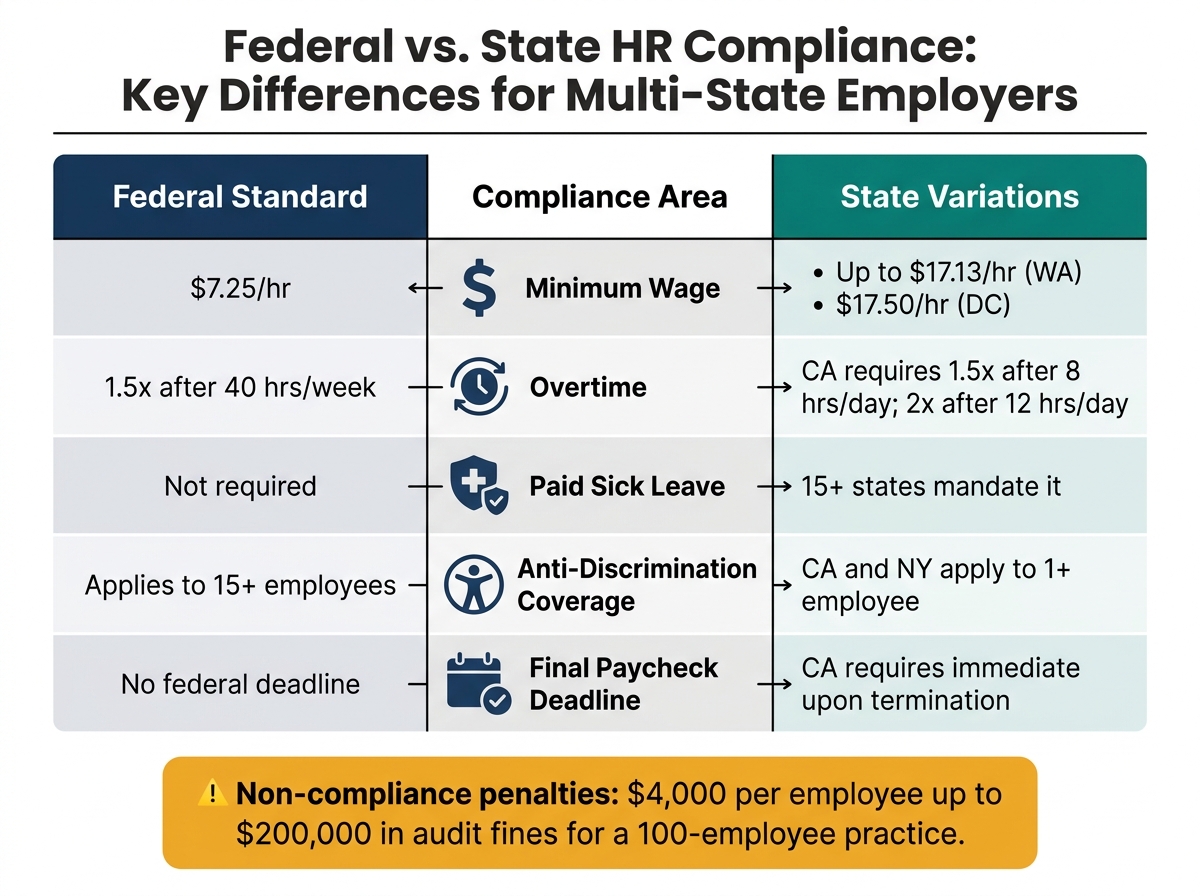
- Financial Risks: Non-compliance can result in penalties ranging from $4,000 per employee to $200,000 in audit fines for a 100-employee practice.
- Industry-Specific Challenges: Aesthetic and wellness practices face additional hurdles like licensing and scope-of-practice rules.
- Key Federal Laws: Regulations like FLSA, FMLA, and OSHA set minimum requirements, but state laws often impose stricter standards.
- Technology Helps: Tools like Prospyr streamline compliance by managing records, tracking training, and ensuring wage accuracy.
Bottom Line: Multi-state compliance requires tailored policies, regular updates, and centralized systems to avoid legal and financial pitfalls.
Legal Framework for Multi-State HR Compliance
Federal vs. State HR Compliance: Key Differences for Multi-State Employers
To navigate multi-state HR compliance, it's crucial to understand the legal framework. Employers must adhere to both federal and state laws, with federal regulations setting the baseline and state laws frequently imposing stricter requirements.
Key Federal Employment Laws to Know
Federal laws establish the minimum standards that all employers must follow. Here are some of the most important ones:
- FLSA (Fair Labor Standards Act): This law regulates minimum wage, overtime pay, and employee classification. The federal salary threshold for exempt employees is $684 per week ($35,568 annually).
- Title VII / ADA / ADEA: These laws prohibit workplace discrimination based on race, sex, religion, disability, and age. They apply to businesses with 15 or more employees.
- FMLA (Family and Medical Leave Act): Provides up to 12 weeks of unpaid, job-protected leave for employers with 50 or more employees.
- OSHA (Occupational Safety and Health Administration): Requires safe working conditions. For clinical practices, the Bloodborne Pathogens Standard (29 CFR 1910.1030) is particularly relevant due to the use of needles and injectables.
- HIPAA (Health Insurance Portability and Accountability Act): Protects patient health information, including medical charts, digital intake forms, and before-and-after photos.
- Pregnant Workers Fairness Act (PWFA): Mandates accommodations for pregnancy-related limitations and applies to employers of all sizes.
"Federal law establishes a floor, but 50 distinct state frameworks... impose their own wage, leave, anti-discrimination, and recordkeeping requirements that frequently exceed federal minimums." - National Human Resources Authority
State laws often add another layer of complexity to these federal requirements.
How State Employment Laws Differ
State laws frequently go beyond federal standards, creating unique challenges for multi-state employers. For example, 30 states and the District of Columbia have minimum wages higher than the federal rate of $7.25 per hour. Washington state leads with a minimum wage of $17.13 per hour.
Overtime regulations also vary. While federal law mandates 1.5x pay after 40 hours in a workweek, California requires 1.5x pay after 8 hours in a single day and double pay after 12 hours. This means that a uniform overtime policy across multiple states could lead to compliance issues.
The table below highlights some key differences between federal standards and state-specific requirements:
| Area | Federal Standard | State Variation Examples |
|---|---|---|
| Minimum Wage | $7.25/hr | $17.13/hr (WA); $17.50/hr (DC) |
| Overtime | 1.5x after 40 hrs/week | CA: 1.5x after 8 hrs/day; 2x after 12 hrs/day |
| Paid Sick Leave | Not required | 15+ states mandate it |
| Anti-Discrimination | 15+ employees | CA and NY: applies to 1+ employee |
| Final Paycheck | No federal deadline | CA: immediate upon termination |
"A single leave policy applied uniformly across all locations is a liability, not a solution." - SoftwareFinder
States like California, New York, Massachusetts, Illinois, and Washington are particularly challenging for employers due to their intricate requirements. If your business operates in these states, creating state-specific policy addenda is non-negotiable.
Beyond employment laws, clinical licensing and scope-of-practice rules add another layer of complexity.
Licensure and Scope-of-Practice Rules by State
For aesthetic and wellness practices, compliance extends to clinical staff licensing and scope-of-practice regulations, which vary significantly by state.
The Corporate Practice of Medicine (CPOM) doctrine is a key consideration. In states like New York and California, only physicians can own medical practices, while states like Arizona allow non-clinicians to own practices if licensed providers oversee clinical decisions. Missteps in structuring ownership can jeopardize operations.
Nurse Practitioner (NP) authority also differs widely. States such as Arizona and Colorado grant NPs full practice authority, enabling independent operation. In contrast, states like Florida, Texas, and Georgia require NPs to maintain collaborative agreements with physicians. These differences impact staffing and supervision needs.
Physician oversight is mandatory across all states, but supervision and documentation requirements vary. For instance, a medical director must hold an active license in each state where the practice operates. A California-licensed physician cannot legally oversee operations in Texas. The Interstate Medical Licensure Compact can simplify multi-state licensing for physicians.
The table below outlines key licensing and supervision rules for administering injectables like Botox and fillers:
| State | Who Can Inject (Botox/Fillers) | Supervision Level | Primary Board |
|---|---|---|---|
| California | MD, DO, NP, PA prescribe; RN administers | Direct for RN | CA Medical Board |
| Florida | MD, DO, ARNP, PA; RN under standing orders | Direct for RN | FL Board of Medicine |
| Texas | MD, DO, PA, NP; RN/LVN under delegation | General | TX Medical Board |
| New York | MD, DO, NP, PA; RN under written orders | Direct | NY Office of Professions |
| Arizona | MD, DO, NP, PA; RN under protocol | General | AZ Medical Board |
sbb-itb-02f5876
Reading about the problem? See how Prospyr solves it in one platform.
Book a DemoBuilding HR Policies and Systems for Multi-State Compliance
Turning legal requirements into actionable systems is where the challenge of multi-state compliance truly comes to life. Here's how to create systems that not only meet legal standards but also help you stay ahead of the curve.
Writing State-Specific Employee Handbooks
One of the best ways to handle multi-state compliance is by using a modular handbook structure. Start with a core handbook that outlines universal company policies, then add state-specific sections to address local laws. This way, if Illinois changes its paid leave rules, you only need to update the relevant addendum instead of rewriting the entire handbook.
State-specific addenda should focus on where local laws differ from federal ones. For example:
- At-will disclaimers: In California, the handbook must clearly state that it’s not an employment contract.
- Leave policies: As of April 2026, 13 states and Washington D.C. require mandatory Paid Family and Medical Leave (PFML).
- Wage and hour rules: Meal breaks, rest periods, and paycheck frequency vary widely, and a one-size-fits-all policy could lead to compliance issues.
Here’s a quick look at how handbook requirements differ across some states:
| State | Key Handbook Requirements |
|---|---|
| California | Daily overtime (8+ hrs), 30-min meal break by 5th hour, biennial harassment training, expense reimbursement |
| New York | Annual sexual harassment training, NYC salary transparency, weekly pay for manual workers |
| Illinois | 40 hours paid leave for any reason, AI hiring disclosures, annual harassment training |
| Washington | Salary ranges in job postings, 12–18 weeks PFML, non-compete limits below $120,559 |
| Colorado | FAMLI paid leave, mandatory salary ranges in all job postings |
Some companies simplify their approach by adopting the strictest state standard - often California’s - for all locations. While this reduces audit risks, it may not always be feasible for smaller organizations in less-regulated states.
Once your handbooks are tailored, the next step is to ensure your recordkeeping system aligns with compliance needs.
Centralized Recordkeeping and Data Management
Scattered records can make compliance a nightmare. A centralized compliance hub is essential for tracking key details, such as:
- Employee work locations
- State-specific wage and leave policies
- Policy version histories
- Mandatory training schedules
- Signed acknowledgments of policies
"A remote worker in California is not just an employee. They are a compliance event." - Practiq Team
If an employee relocates to a new state, it should trigger an immediate compliance review - not just an update to their payroll address. Electronic signatures for state-specific addenda create searchable records, which are invaluable during audits. For remote employees, a digital portal can deliver required labor law posters and confirm receipt, effectively replacing physical notices. Failure to provide required postings can result in penalties ranging from $500 to $5,000 per violation per location.
Keeping Policies Current
Employment laws evolve quickly. States are introducing new regulations on topics like AI in hiring, pay transparency, and workplace violence prevention at a rapid pace. Conducting quarterly policy audits is one of the best ways to stay ahead of these changes. Modular handbooks and centralized recordkeeping make updates more manageable, ensuring you stay compliant when laws shift.
"Awareness without infrastructure doesn't protect you, and the gap between knowing a law changed and actually being compliant with the change is where most employers get into trouble." - Bryan J. Driscoll, HR Consultant
Designate someone - whether an internal team member or an external legal advisor - to monitor legislative updates in every state where you operate. For highly regulated states like California, New York, Massachusetts, Illinois, and Washington, investing in state-specific legal expertise can save you from costly mistakes.
HR Compliance in Hiring, Onboarding, and Expansion
Establishing solid HR policies is just the beginning. Effective hiring and onboarding practices ensure that your business stays compliant as it grows across multiple states.
Planning Before Entering a New State
Before hiring in a new state, it’s important to lay the groundwork. Employment laws are tied to the state where the work is performed, not where your business is headquartered. Even hiring a single remote employee in a new state means you must comply with that state’s tax requirements, workers’ compensation rules, and labor laws.
Start by registering for a Foreign Qualification (business entity registration with the Secretary of State) and setting up employer tax accounts for unemployment insurance and income tax withholding. These registrations typically take 2–6 weeks, so it’s crucial to finalize them before expanding to avoid payroll issues. During this phase, you’ll also need to review state-specific requirements like physician supervision ratios, scope-of-practice rules, and Corporate Practice of Medicine restrictions that might impact your ownership structure.
"Scaling a med spa isn't just about replicating your business model - it's about building legal infrastructure that can support sustainable growth while managing the unique risks inherent to the aesthetic medicine industry." - Adam Witkov, Michael Best
Hiring Practices That Meet Compliance Standards
Once you’ve completed state registration, the hiring process itself comes with its own compliance challenges. Misclassifying workers is one of the most common and costly mistakes. States like California, Massachusetts, and New Jersey use the strict "ABC test" to determine whether a worker qualifies as an independent contractor or an employee.
Pay transparency laws are also becoming more common. States such as California, New York, Washington, Colorado, and Illinois now require salary ranges and benefit details to be included in job postings. Additionally, if your practice uses AI tools to evaluate candidates in Illinois, you’re legally required to disclose this information. Designing job postings that meet the most stringent standards across all your operating states can help streamline compliance without needing separate templates for each location. Once your hiring practices are compliant, tailored onboarding processes will further ensure you meet all legal requirements.
Delivering State-Specific Onboarding and Training
Onboarding processes must align with each state’s specific requirements. States mandate unique documentation, including wage notices, meal and rest break policies, and new hire reporting, which is typically due within 20 days of an employee’s start date. For aesthetic and wellness practices, onboarding should also include verification of clinical licensure and a detailed explanation of local scope-of-practice rules, particularly for roles like nurse practitioners and aestheticians.
Onboarding isn’t a one-and-done process. Just like employee handbooks, onboarding procedures must be updated regularly to reflect changes in state laws. Training requirements also vary widely by state. For smaller multi-state teams, adopting the strictest standards across all locations can simplify administration and reduce the risk of missing deadlines. For example, California requires a written Workplace Violence Prevention Plan and annual training under SB 553. Other states, including Oregon, Washington, New York, and New Jersey, are starting to implement similar requirements.
| State | Key Onboarding Requirements | Notable Hiring Obligations |
|---|---|---|
| California | SB 553 Workplace Violence Prevention Plan + annual training; clinical licensure verification | ABC contractor test; salary ranges in postings |
| New York | Wage notices; weekly pay documentation for manual workers | Salary transparency in all postings |
| Illinois | 40 hours paid leave documentation; clinical scope-of-practice briefing | AI hiring disclosure required |
| Massachusetts | PFML enrollment (up to 26 weeks); contractor classification documentation | Strict ABC test for contractors |
| Washington | Sector-specific training verification; non-compete wage threshold documentation ($120,559) | Salary ranges in postings |
Using Technology to Support HR Compliance
Keeping up with multi-state HR compliance is no small task, especially with the constant changes in employment laws. Technology has become a critical tool in managing these complexities. Relying on manual processes, like spreadsheets, just doesn’t cut it anymore. With hundreds of employment law updates every year - covering everything from paid leave to AI-related hiring disclosures - staying compliant manually is nearly impossible. By 2026, it’s estimated that about 60% of companies with fewer than 200 employees will have workers in multiple states. This makes the compliance workload a growing challenge for businesses.
Scheduling and Staffing That Aligns With State Labor Laws
State labor laws go beyond just varying rules on paper - they create real challenges for day-to-day operations, especially when it comes to scheduling. Take California, for instance: the state mandates daily overtime after 8 hours and double time after 12 hours, which is completely different from the federal standard that calculates overtime weekly. Now imagine a business with staff in California, Illinois, and Washington - each state has its own approach to overtime. Managing these differences manually is a recipe for errors.
This is where technology steps in. Automated systems can calculate wages and overtime based on each employee’s physical work location, ensuring compliance with state-specific laws. By eliminating manual calculations, businesses can avoid costly penalties that come with errors.
And it’s not just about scheduling. Digitizing policy documentation adds another layer of efficiency to compliance efforts.
Managing Forms and Policy Documentation Digitally
Trying to manage policy documents with paper files becomes unmanageable when you’re dealing with employees across multiple states. Digital platforms simplify this by automatically distributing state-specific handbooks, wage notices, and policy acknowledgments to employees based on their location. Plus, these systems track every acknowledgment electronically, creating a reliable audit trail. This is essential for resolving disputes, whether they involve wage claims or harassment complaints.
For businesses in the aesthetic and wellness industries, this also includes clinical documentation. Tools like Prospyr allow practices to collect and store licensure verifications, consent forms, and scope-of-practice acknowledgments all in one place. These platforms support HIPAA-compliant document management, integrating clinical and HR documentation into a single, efficient system.
But technology doesn’t stop at documentation - it also provides valuable insights through analytics.
Using Analytics to Track Compliance Across Locations
One of the standout benefits of modern practice management technology is its ability to generate detailed analytics. These tools can track critical compliance data, like hours worked by location, upcoming licensure renewal deadlines, and adherence to required training. This level of visibility is especially important for businesses managing clinical staff across multiple states. A missed training deadline or expired license isn’t just a compliance issue - it can also impact patient safety and lead to legal complications.
With automated tracking, businesses can move away from relying on manual checklists, making compliance monitoring more consistent and efficient. This underscores why adopting compliance-focused technology isn’t just practical - it’s a smart investment for any business navigating multi-state operations.
A Roadmap to Multi-State HR Compliance
Steps to Build and Maintain Compliance
Navigating multi-state HR compliance boils down to a few essential practices. The key principle? The rules are determined by the state where the employee physically works - not where your business is headquartered. Every time an employee’s work location changes, it triggers a new set of compliance requirements. To stay on top of this, maintain a detailed compliance matrix that tracks each state’s regulations, including minimum wage, overtime rules, paid leave policies, mandatory training, and final pay deadlines. Review and update this matrix quarterly, audit compliance for one state every three months, and check employee location changes monthly to avoid any surprises.
One effective strategy to reduce compliance risks is to adopt the strictest state standards across your entire organization. For example, using California’s harassment training guidelines or New York’s sick leave regulations as your company-wide baseline can help eliminate gaps in compliance. While this approach might slightly increase costs, it’s a proactive way to minimize risks. Without a compliance program, a 100-employee multi-state business could face audit penalties ranging from $50,000 to $200,000 in the first year alone.
"The compliance risk of multi-state employment grows geometrically with the number of states. Two states is 2x. Five states is 15x - because compliance conflicts and complexity compound." - Practiq Team
How Technology Like Prospyr Simplifies Compliance
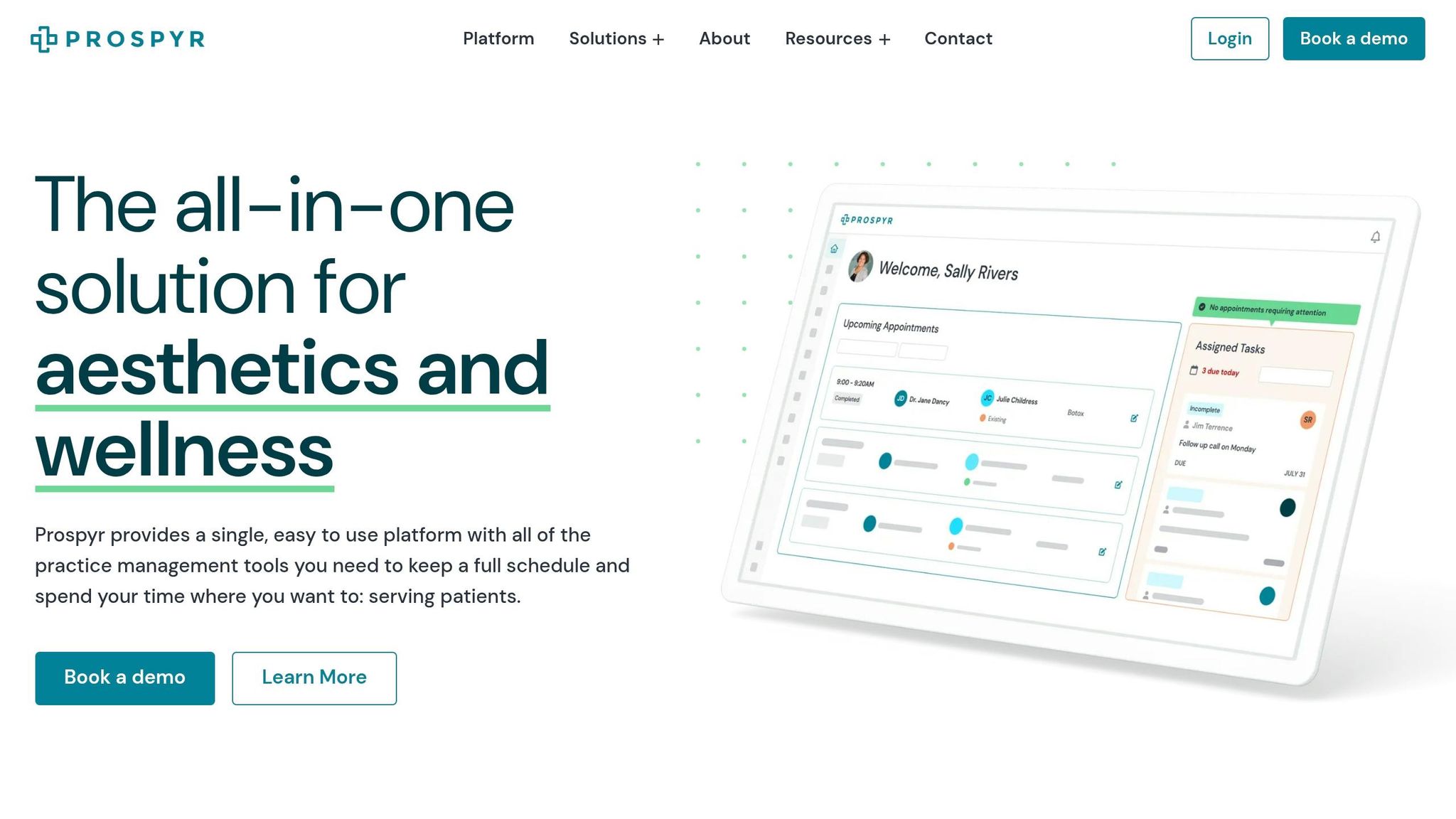
Establishing solid compliance practices is just the beginning. Leveraging technology can take your compliance efforts to the next level. For aesthetic and wellness practices managing employees across multiple states, a centralized platform can make a world of difference. Prospyr consolidates scheduling, digital documentation, and practice analytics into a single HIPAA-compliant system, ensuring that all clinical and HR records are stored in one place instead of scattered across various tools.
Prospyr’s built-in analytics offer clear insights for multi-location practices. It simplifies tracking hours by location, monitoring upcoming license renewals, and identifying overdue training requirements. With all this information centralized, managing compliance becomes far less daunting. This level of visibility not only streamlines day-to-day operations but also helps practices stay ahead of regulatory requirements, reducing the risk of costly mistakes.
FAQs
What changes when an employee moves to a new state?
When an employee moves to a different state, your responsibilities under employment law shift to align with that state's regulations. Here's what you need to do:
- Register for payroll tax withholding and unemployment insurance in the new state.
- Update HR policies to reflect the state's rules, such as those governing paid leave, harassment training, and final paycheck requirements.
- Review workers' compensation coverage to ensure it complies with the laws of the employee's new location.
Each state has its own specific requirements, so it's crucial to adapt your policies and procedures accordingly.
How can I avoid misclassifying employees as contractors across states?
To avoid the risks of misclassifying employees as independent contractors, it’s essential to know that classification rules differ by state. For example, states like California and Massachusetts apply the strict ABC test, which often favors treating workers as W-2 employees. Adding to the complexity, federal and state guidelines don’t always align, meaning a worker classified as a contractor in one state might not meet the criteria in another. When uncertain, it’s safer to classify workers as W-2 employees to steer clear of penalties, back wages, and tax obligations.
What records should I centralize to stay audit-ready in every state?
To ensure you're always prepared for audits, consolidate all your records into a compliance matrix or dashboard. This will act as your single source of truth for managing documentation. Make sure to include state-specific items like payroll tax registrations, unemployment filings, and workers' compensation coverage.
It’s also important to stay on top of labor law posters, wage and hour regulations, leave policies, and final pay procedures. Additionally, maintain up-to-date provider licensing, credentialing documents, and employee handbooks. Don’t forget to include state-specific addenda and signed acknowledgments for every jurisdiction where your business operates.