KPI Tracking for Aesthetic Clinics: FAQs
Measure profitability, efficiency, and patient loyalty with KPI benchmarks, automated reports, and HIPAA-safe analytics.

Key Performance Indicators (KPIs) are critical for running a successful aesthetic clinic. They help you measure what matters most - profitability, efficiency, and patient satisfaction. For example, tracking metrics like Revenue Per Hour (RPH) ($850+ per treatment room), patient retention rates (65%+ within 12 months), and gross margins (75%+) gives you a clear picture of your clinic's performance.
To get started:
- Build a 12-month baseline using historical data.
- Automate weekly reports via EMR or business intelligence tools.
- Focus on financial, operational, and patient-centric KPIs.
The right tools, like Prospyr, simplify tracking by consolidating data into one secure platform. This eliminates guesswork and helps you make informed decisions to improve revenue, efficiency, and patient loyalty.
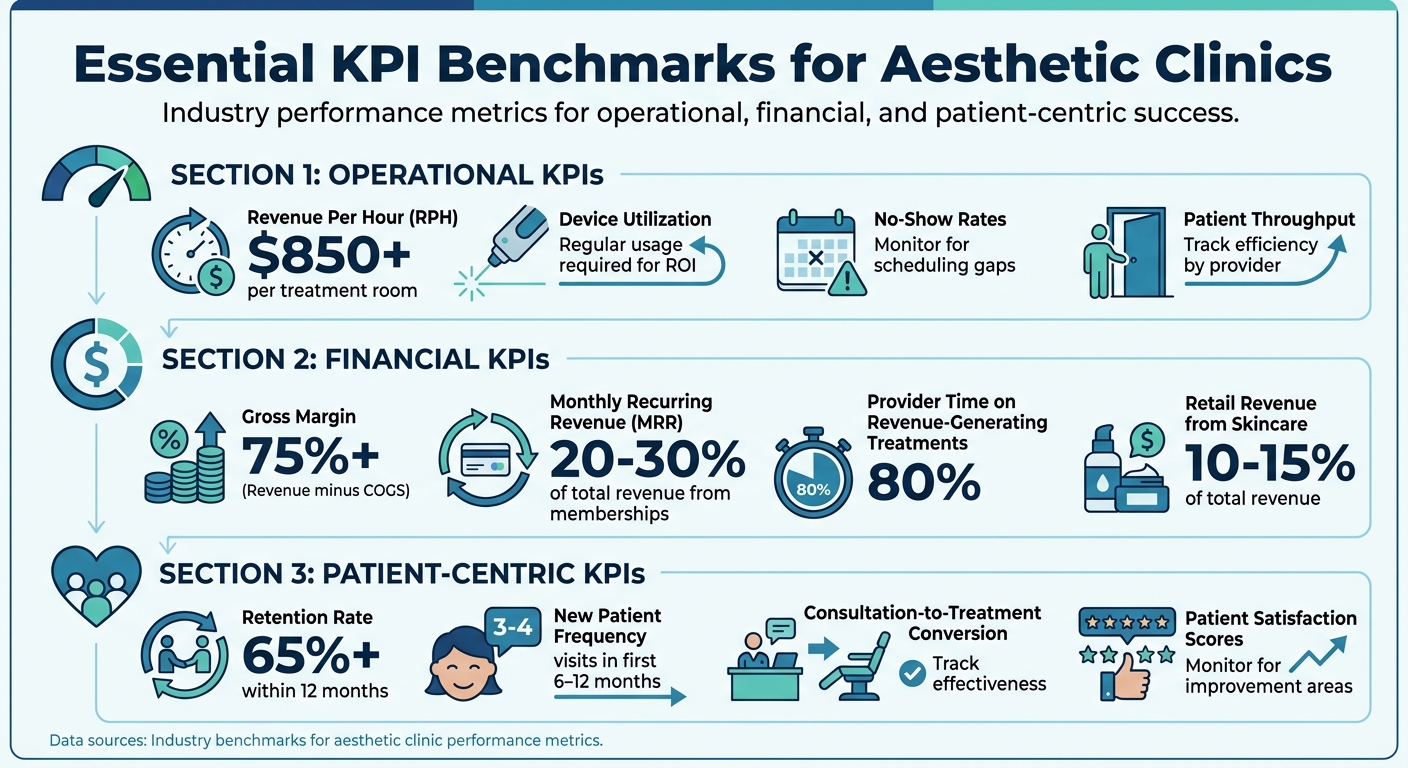
Essential KPI Benchmarks for Aesthetic Clinics
Key KPIs for Aesthetic Clinics
Operational KPIs
Revenue Per Hour (RPH) is a key indicator of how efficiently your clinic utilizes its resources daily. Ideally, each treatment room should generate at least $850 per hour. This metric is critical for evaluating the overall value of your practice, as it highlights whether your treatment spaces are generating sufficient income.
Device utilization tracks how often your aesthetic equipment - like laser systems or body contouring devices - is in use. Regular usage is essential to ensure a return on your investment. Additionally, keeping an eye on no-show rates can help identify scheduling gaps, while patient throughput measures how effectively patients move through your clinic. Breaking these metrics down by provider can reveal who may need additional training and who is excelling in their role.
While these operational metrics focus on the day-to-day, financial KPIs provide a broader view of profitability.
Financial KPIs
When it comes to financial performance, precision matters. Clinics should aim for a Gross Margin of at least 75%, calculated by subtracting the direct Cost of Goods Sold (COGS) from total revenue. To ensure accuracy, calculate COGS using invoices.
Monthly Recurring Revenue (MRR) from membership programs should contribute 20–30% of your total income. This helps create a more predictable revenue stream. Another critical metric is revenue per provider - providers should spend 80% of their time on treatments that directly generate income.
Don't overlook the importance of retail sales. Revenue from medical-grade skincare products should account for 10–15% of your total revenue. This not only boosts profitability but also reflects patients' commitment to their treatment plans.
Beyond financial and operational metrics, patient-focused KPIs provide insight into the strength of client relationships.
Patient-Centric KPIs
Patient-centered metrics go beyond financials to assess the quality of relationships with your clients, which is key to long-term success. A healthy clinic should maintain a retention rate of at least 65% over a 12-month period. Additionally, new patients should ideally schedule 3–4 appointments within their first 6 to 12 months, signaling successful integration into a treatment plan.
The consultation-to-treatment conversion rate is another valuable metric. It shows how effectively your clinic turns first-time visitors into paying clients. Poor conversion rates might point to issues like pricing concerns, a lack of trust, or a consultation process that feels overly pushy. Pairing this metric with patient satisfaction scores can uncover areas for improvement.
Here’s a quick breakdown of key patient-centric KPIs:
| Patient-Centric KPI | Target/Benchmark | Purpose |
|---|---|---|
| Retention Rate | 65%+ (within 12 months) | Assesses loyalty and satisfaction |
| New Patient Frequency | 3–4 visits (within the first year) | Tracks conversion to long-term plans |
| Membership Revenue | 20–30% of total revenue | Evaluates recurring revenue success |
| Retail Revenue | 10–15% of total revenue | Reflects patient engagement with home-care routines |
sbb-itb-02f5876
Reading about the problem? See how Prospyr solves it in one platform.
Book a DemoHow to Track KPIs
Using Practice Analytics Tools
To track KPIs effectively, practice analytics platforms can simplify the process by automating data collection. These tools eliminate the need for manual spreadsheets and consolidate data into a single, user-friendly dashboard. For example, platforms like Prospyr integrate data from EMR, scheduling, point-of-sale, and CRM systems. This setup allows you to keep tabs on key metrics - like Revenue Per Hour, patient retention rates, and gross margins - in real time as transactions occur throughout the day.
Business intelligence tools such as Domo and PowerBI can also be customized to pull data directly from your EMR system. These tools generate dynamic weekly reports, helping you avoid the last-minute rush to compile data at the end of the month. Plus, they reduce the likelihood of errors in your reports.
Integrating Data Across Systems
Accurate KPI tracking depends on seamless integration across all your systems. Data silos - where systems like scheduling, billing, CRM, and inventory management operate independently - can lead to incomplete or unreliable performance insights. All-in-one platforms are a great solution, offering a complete view of your clinic’s operations by breaking down these silos.
Capturing data directly at its source is another critical component. For instance, your inventory management software should calculate Cost of Goods Sold (COGS) on every invoice, providing real-time information on gross margins. This eliminates the need to manually reconstruct costs at the end of the month. Integration should also allow for granular data segmentation, such as tracking performance by individual providers. This can help pinpoint areas where additional training might be needed or highlight team members who are surpassing expectations.
Setting Benchmarks and Goals
Once your data is integrated and accurate, the next step is to establish clear benchmarks. Start by reviewing at least 12 months of historical data to identify your baseline metrics. Key figures like Lifetime Value (LTV) and Customer Acquisition Cost (CAC) are essential for understanding your starting point. With this baseline, you can set SMART goals - specific, measurable, achievable, relevant, and time-bound. For instance, you might aim to increase your average revenue per appointment from $350 to $425 within the next year.
Break down your revenue targets into actionable steps. Let’s say your goal is to generate $50,000 in monthly revenue, and your average patient value is $500. You’d need 100 patients to hit that target. From there, use your conversion rate to determine how many leads you’ll need to bring in. Regular leadership reviews of your KPI dashboard can help you address underperforming metrics quickly. You might also consider tying staff bonuses to specific KPIs, like Revenue Per Hour or patient retention rates. This encourages accountability and helps your team see how their daily efforts contribute to the clinic’s overall success.
Common Challenges in KPI Tracking
Data Silos and Inconsistencies
One of the biggest hurdles in KPI tracking is dealing with systems that don’t work seamlessly together. A common example? Clinics often track marketing metrics like Instagram followers or lead volume separately from financial or patient conversion data stored in their EMR systems. This lack of integration can lead to distorted insights about profitability.
Manually consolidating data adds another layer of complexity and increases the potential for errors. Even worse, focusing on revenue without factoring in unit economics - like Revenue Per Hour (RPH) per treatment room or provider productivity - can hide critical performance gaps.
"The aesthetic industry is data-rich but insight-poor. Many practice owners obsess over daily sales totals and social media engagement, ignoring the underlying unit economics." - Aesthetic.Consulting
Retail and inventory data often live in separate systems, making it tough to track whether skincare sales are hitting the recommended 10-15% of total revenue. Aggregating provider-level data into clinic-wide totals can also obscure individual performance issues, such as retention rates or RPH variations. Platforms like Prospyr tackle these challenges by consolidating scheduling, EMR, CRM, and financial data into one system, eliminating manual reconciliation headaches and providing a clearer operational picture. Addressing these silos is crucial before diving into the finer details of KPI analysis.
Interpreting KPI Data
Numbers alone don’t tell the whole story - they need context and actionable insights. A good starting point is segmenting your data rather than relying on clinic-wide averages. For instance, a retention rate of 65% might look solid overall, but breaking it down by provider could reveal areas needing immediate attention.
Setting a 12-month baseline for metrics like Lifetime Value (LTV) and Customer Acquisition Cost (CAC) is another effective way to differentiate long-term trends from normal fluctuations. Weekly leadership meetings to review KPI dashboards can also help identify emerging issues before they escalate into major problems. Beyond tracking, it’s important to educate your team about how their daily actions influence key metrics like RPH and retention. Some clinics even tie staff bonuses to these metrics, making it clear how everyone contributes to the clinic’s financial outcomes.
Maintaining HIPAA Compliance
Tracking KPIs isn’t just about numbers - it also involves protecting sensitive patient data. That’s why HIPAA compliance isn’t negotiable. Many clinics run into trouble when they export patient data to spreadsheets or use unsecured tools for follow-ups.
A safer alternative is to automate reporting within secure systems. Configuring your EMR or business intelligence tools to generate dynamic, in-system reports can eliminate the need for risky manual data handling. When monitoring retention KPIs, using integrated CRM systems with built-in HIPAA-compliant email and SMS tools ensures secure patient communication. Platforms like Prospyr offer a streamlined, HIPAA-compliant setup, keeping all patient data - from scheduling to financials - protected in one place. This allows clinics to track KPIs confidently without risking compliance issues.
Conclusion
Key Takeaways
Tracking the right KPIs can revolutionize how aesthetic clinics operate, moving from guesswork to precise, data-driven decisions that directly impact profitability. Focus on metrics that matter, like Revenue Per Hour (RPH) - aiming for $850+ per treatment room, patient retention at 65%+ within 12 months, and gross margins of 75% or higher.
Automation plays a crucial role here. Set up systems to deliver weekly flash reports on your key metrics. This allows you to catch potential problems early, keeping quarterly profitability on track. Additionally, train your team to understand how their performance influences RPH and retention rates, and consider tying bonuses to these metrics for better alignment.
Diversifying income streams is another critical strategy. Membership programs can contribute 20–30% of total revenue, while medical-grade skincare should account for 10–15%. Regular reviews - whether monthly or weekly - are essential to identify underperforming services. Adjust pricing or discontinue treatments that aren't meeting demand before they start to drain resources.
How Prospyr Can Help
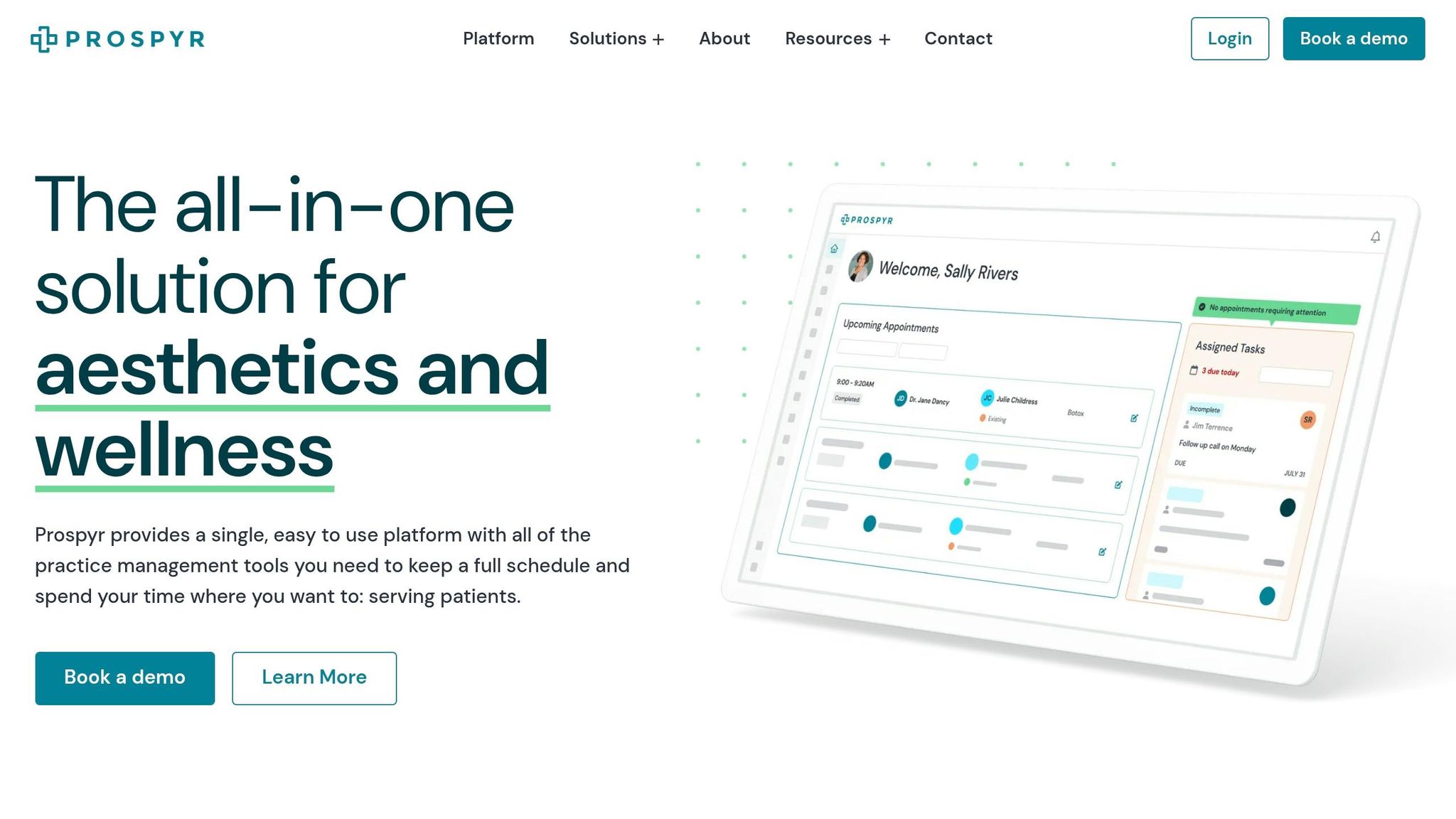
Prospyr simplifies the process of managing and acting on these insights. One of the biggest hurdles clinics face is dealing with fragmented data across multiple systems. Prospyr consolidates these silos into a single, HIPAA-compliant platform, providing a clear, real-time view of your clinic's performance through integrated practice analytics.
Beyond just data consolidation, Prospyr offers built-in CRM tools, automated email and SMS campaigns, and seamless payment processing. These features make it easier to implement strategies that directly target your key metrics. From tracking provider performance to monitoring revenue streams and identifying patient engagement issues, Prospyr equips you to boost retention rates, optimize RPH, and ensure steady, recurring revenue - all from one streamlined system.
FAQs
What KPIs should I track first in my clinic?
To get a clear picture of your clinic's performance, focus on tracking key metrics such as revenue per hour/room, Net Promoter Score (NPS), new client acquisition rate, average treatment revenue per client, and client retention rate. These indicators provide insights into efficiency, client satisfaction, marketing success, profitability, and loyalty - giving you valuable benchmarks to evaluate how well your clinic is doing.
How do I calculate Revenue Per Hour (RPH) accurately?
To figure out your Revenue Per Hour (RPH), take your total revenue for a given time frame and divide it by the total hours spent on revenue-generating activities during that same period.
For instance, let’s say your clinic brings in $12,000 in a week, and your staff collectively works 20 hours on revenue-generating tasks. The calculation would look like this:
RPH = $12,000 ÷ 20 = $600/hour
Using practice management tools can simplify this process, ensuring you track everything accurately and save time.
How can I track KPIs without risking HIPAA compliance?
To keep track of KPIs while staying HIPAA-compliant, consider using automated tools such as Prospyr. These platforms are designed to handle sensitive data securely and adhere to HIPAA regulations, reducing the risks tied to manual processes or unsecured data collection methods.