10 Leadership Tips for Growing Aesthetic Practices
10 actionable leadership strategies to grow aesthetic practices, retain staff, and build stronger patient trust.


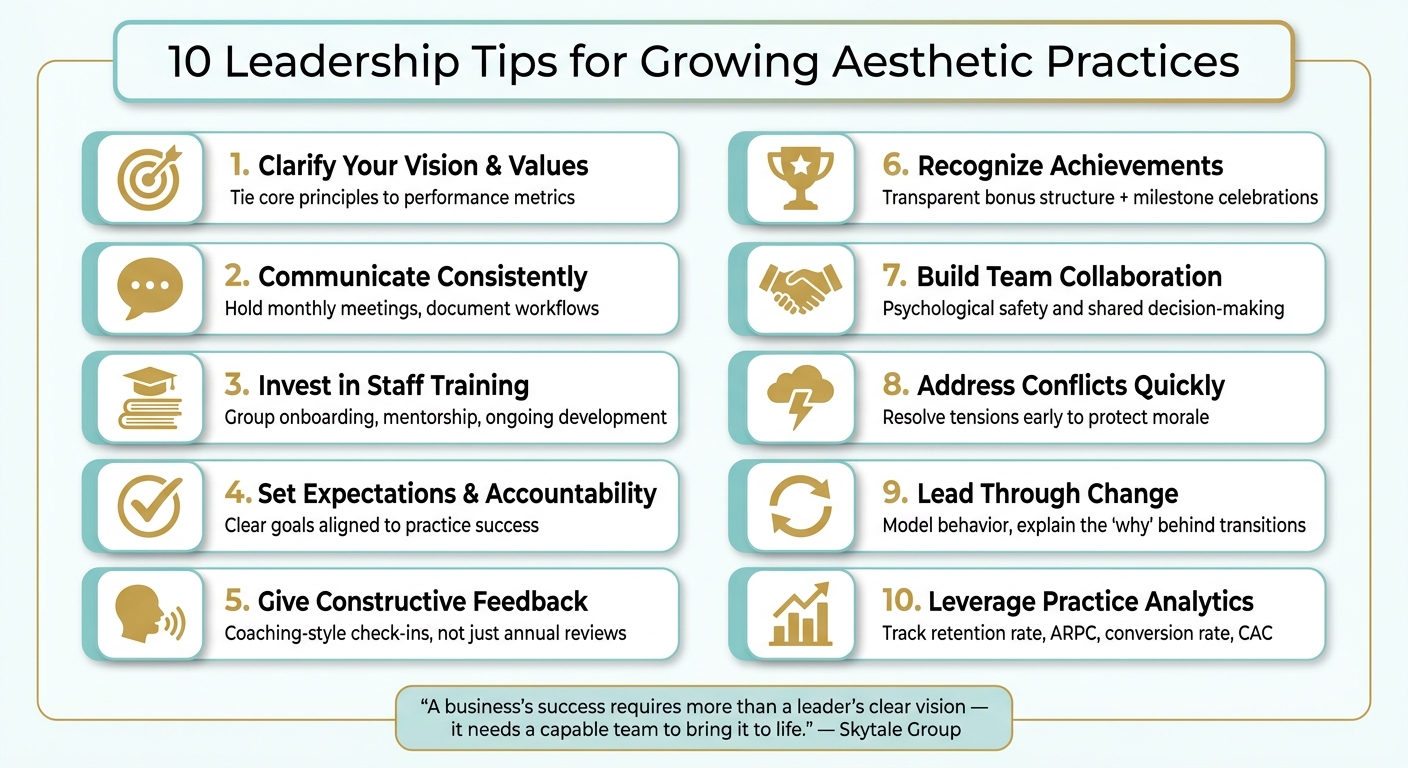
Running a successful aesthetic practice takes more than clinical skills - it requires purposeful leadership. Here’s a quick rundown of 10 actionable leadership tips to help you grow your practice, retain top talent, and improve patient trust:
- Clarify Your Vision and Values: Define the core principles of your practice and tie them to performance metrics to guide team decisions.
- Communicate Consistently: Hold regular team meetings, document workflows, and maintain transparency about goals and compensation.
- Invest in Training: Focus on continuous staff development, including group training for new injectors, mentorship, and additional responsibilities.
- Set Expectations and Accountability: Use clear goals and performance metrics to align individual contributions with practice success.
- Provide Constructive Feedback: Offer regular, honest feedback through coaching-style conversations to help staff improve and grow.
- Recognize Achievements: Implement a transparent bonus structure and highlight professional milestones to motivate your team.
- Encourage Collaboration: Create psychological safety by promoting open communication and valuing diverse contributions.
- Address Conflicts Quickly: Resolve workplace tensions promptly to maintain morale and ensure smooth operations.
- Lead Through Change: Model desired behaviors and communicate the "why" behind changes to help your team adapt.
- Leverage Analytics: Track key metrics like retention rates, revenue per client, and lead conversion rates to make informed decisions.
These practical strategies can transform your practice into a thriving, team-driven business. Start by implementing one or two tips and gradually build a leadership approach that supports sustainable growth.
10 Leadership Tips for Growing Aesthetic Practices
1. Clarify Your Vision and Values
Every decision your team makes should reflect the core principles of your practice. Without a well-defined vision and clear values, decisions can become inconsistent, ultimately undermining patient trust.
"As their companies scale, great medical aesthetic leaders are able to transition their businesses from being 'founder-led' to being 'vision-led.'" - Skytale Group
This transition is essential. A founder-led practice depends heavily on the owner's personal involvement and decision-making. In contrast, a vision-led practice operates based on shared principles, enabling the team to make decisions confidently - even when you're not there. To make this vision actionable, tie it to performance metrics. When your team understands how their daily efforts connect to key goals, they’re more likely to stay motivated. A quick monthly review can help align individual contributions with the practice’s overall success. As Skytale Group explains, "Meeting monthly with teams about these goals gives the entire company understanding and buy-in about the practice's growth and success."
Your values should also shape how roles and responsibilities are structured. For example, assigning team members additional duties - like mentoring colleagues or leading patient experience initiatives - can encourage professional growth and a sense of shared ownership. This approach not only keeps top talent engaged but also reduces turnover, both of which are critical for maintaining and growing a successful practice.
sbb-itb-02f5876
2. Communicate Consistently and Transparently
Having a shared vision is only effective if your team hears about it regularly - and in a way that's easy to understand. Without steady communication, even the clearest company values can remain stuck at the leadership level, never reaching the employees who carry out the daily work.
One way to ensure this communication happens is by holding monthly team meetings. These meetings should focus on practice goals and key metrics. Keep them short, straightforward, and regular. This consistency creates a space for open conversations about performance, including topics like compensation.
But communication doesn’t stop at meetings. Transparency in other areas, such as a well-defined bonus structure, plays a big role. A clear system for bonuses not only motivates employees but also connects their individual contributions to the company’s overall success.
Another important step? Document your processes. Jessica Hunter, Founder of Hunter Consulting, puts it plainly: "Your processes live in people's heads, not in documented workflows and tech. That's not buyable." Writing down workflows minimizes confusion and makes it easier to grow your med spa, ensuring everyone knows exactly what's expected.
3. Invest in Staff Training and Development
After establishing clear communication and a well-defined vision, the next step for effective leadership is to focus on continuous staff development. Hiring talented individuals is just the beginning; consistent training is what helps them reach their full potential. In aesthetic practices, this ongoing education not only enhances clinical skills but also builds the confidence necessary to deliver outstanding patient care.
One smart strategy is hiring injectors in groups rather than individually. Training a group of new providers together fosters a sense of camaraderie from the start, strengthens their loyalty to the practice, and simplifies the onboarding process.
According to Skytale Group, it takes about a year of dedicated training before a new injector can significantly contribute to the practice. This makes the early stages of their employment crucial for development and growth. Setting clear goals, providing mentorship, and recognizing achievements during this time can improve retention and boost long-term performance.
"Great injectors and providers require an upfront investment of time and training before they start to contribute to a practice's bottom line." - Skytale Group
Training shouldn’t stop at clinical skills. Assigning additional responsibilities, such as peer mentoring or organizing events, helps staff expand their expertise while deepening their commitment to the practice. When team members grow professionally, they become more motivated to contribute to the practice’s success, leading to better patient experiences and improved outcomes.
Tools like Prospyr can help streamline scheduling, track onboarding progress, and manage performance metrics, making it easier to support training and development efforts effectively.
4. Set Clear Expectations and Hold Your Team Accountable
Once your team is trained and growing, the next step is making sure everyone understands and meets clear, consistent expectations. Without well-defined standards, even the most skilled employees can lose focus, underperform, or feel disconnected from their purpose.
After laying the groundwork with strong training and open communication, creating a culture of accountability becomes essential. When team members not only know their clinical roles but also see how their efforts align with the practice's bigger goals, accountability becomes a natural part of the workflow.
Take the example of Dr. Gretchen Frieling. Between 2023 and 2024, she transitioned from being a full-time injector to a leader by setting clear goals, implementing a transparent bonus structure, and regularly reviewing metrics. This approach helped her address turnover risks and allowed her practice to operate smoothly without constant oversight. Her success illustrates how embedding accountability into daily operations can drive team performance and stability.
Interestingly, research shows that 85% of employees lack clarity on organizational goals, which can weaken accountability. To bridge this gap, practices can use tools like regular check-ins, clearly defined performance metrics, and bonus systems that connect individual contributions to overall growth. When staff members see how their work directly impacts the practice’s success, they’re more likely to take ownership of their results. This reinforces the vision and transparent communication already in place.
"Accountability breeds response-ability." - Stephen R. Covey
In leadership, this idea is key: when accountability is consistent and expectations are clear, your team gains the confidence and drive to push the practice forward.
Reading about the problem? See how Prospyr solves it in one platform.
Book a Demo5. Give Constructive Feedback and Coaching
Accountability becomes truly effective when paired with honest and regular feedback. It’s not enough to set expectations; your team needs consistent guidance to meet them. Relying solely on annual reviews can leave employees feeling blindsided. Instead, incorporate brief, ongoing check-ins to provide course corrections along the way. This approach fosters a coaching culture that helps your team thrive.
When delivering feedback, think of it as sharing data rather than passing judgment. Executive coach Ed Batista explains it well:
"The key with any painful feedback is ensuring that you don't miss the signal while filtering out the noise."
Adopting a coaching mindset means asking open-ended questions that encourage employees to arrive at their own solutions. Batista highlights that this approach avoids the pitfall of "limiting staff from using their own expertise and taking ownership." When employees develop their own solutions, they’re far more likely to follow through.
A practical way to structure these conversations is by using the "Connect, Reflect, Direct... Then Ask" framework. This four-step process ensures feedback feels collaborative rather than one-sided. You start by connecting with the person, reflect on the situation together, offer direction, and then invite their input. This method is particularly helpful when addressing recurring challenges, especially with newer team members.
To take coaching a step further, link feedback to individual career goals. For example, Dr. Gretchen Frieling’s focus on her team’s long-term development - including opportunities in mentorship and event planning - created a "fiercely loyal" staff and significantly reduced turnover. As Skytale Group observed, "This investment in her team's long term career goals and a commitment to their growth is a win-win." By aligning feedback with aspirations, you not only improve performance but also build a stronger, more engaged team.
6. Recognize Achievements and Offer Fair Incentives
Recognition is key to keeping employees engaged and motivated. Without it, even the most constructive feedback can lose its effectiveness. In fact, acknowledgment plays a direct role in boosting employee retention.
A clear and transparent bonus structure is one of the best ways to connect performance with rewards. As Skytale Group explains:
"A bonus structure that is clear, compelling, and transparent is a powerful way to motivate employees."
When employees understand exactly how their efforts impact their earnings, their motivation tends to last. On the flip side, unclear or inconsistently applied incentives can lead to frustration and mistrust.
But incentives don’t always have to be financial. Professional growth opportunities can be just as impactful. Assigning high-performing employees to meaningful projects - like leading clinical training sessions, managing a medical director program, or coordinating events - shows them that their skills and contributions are appreciated. This type of recognition becomes even more important as employees hit major milestones in their careers.
For example, at the one-year mark - when providers are typically fully trained - it’s crucial to express appreciation and set clear goals for the future. This combination of gratitude and forward-thinking is one of the most cost-effective ways to retain top talent.
To build on these efforts, regular performance reviews, such as monthly metric meetings, allow both individuals and teams to track their progress. As Skytale Group points out, "Tracking growth is satisfying to both individual providers as well as the team." Publicly celebrating achievements, no matter how small, helps boost morale and minimize turnover.
7. Build Team Collaboration and Psychological Safety
Creating a workplace where everyone feels comfortable speaking up is key to fostering real collaboration. Psychological safety - the ability to ask questions, share ideas, and voice concerns without fear of judgment - turns a group of individuals into a unified team. When combined with strong communication and effective training, this sense of safety strengthens team bonds even further.
A big part of nurturing psychological safety is adopting a collaborative leadership style:
"Collaborative leadership means working closely with all team members, regardless of their title or role. Under collaborative leadership, managers value employee contributions equally and make shared decisions."
In aesthetic practices, for example, front desk coordinators might identify patient flow and scheduling challenges that injectors might miss. Similarly, a new provider could suggest a fresh approach to consultations. These contributions not only enhance patient care but also highlight how shared insights can lead to better outcomes. Collaborative leadership encourages this dynamic by promoting team autonomy and valuing diverse perspectives.
Dr. Frieling exemplified this approach by empowering her team to take on responsibilities beyond their clinical roles. This shift not only eased her transition to CEO but also deepened team commitment through shared decision-making and open dialogue. By fostering transparent communication and setting clear expectations, every team member feels valued and supported. Encouraging input from all levels builds trust, sparks creative problem-solving, and makes collaboration a natural and integral part of your practice.
8. Address Conflicts Quickly and Directly
Conflict is bound to happen in any workplace, especially in aesthetic practices where diverse personalities, varying work styles, and high-pressure situations collide. What sets successful practices apart is how swiftly and openly leaders tackle these tensions when they arise.
One of the biggest mistakes leaders can make is ignoring the early signs of conflict. Studies reveal that over 65% of employees encounter workplace conflict, yet only 35% feel comfortable addressing it directly. When left unresolved, even minor issues can snowball, harming team morale. Leadership consultant Liz McKeon highlights this risk:
"A team member who feels you do not believe in them will not perform well and this can create a domino effect of poor morale across the business."
This domino effect can be particularly harmful in patient-facing environments like aesthetic clinics, where team tension can directly affect the quality of care. Tackling conflicts quickly fosters a culture of honest, constructive communication.
To address conflicts effectively, adopt a coaching mindset. This means confronting issues directly and avoiding the temptation to gloss over problems with only positive feedback. Honest, constructive feedback is far more impactful. As McKeon emphasizes:
"If you want business success, you cannot ignore problems within your team and you must learn to give the negative feedback in as positive a manner as possible."
In practice, this involves addressing issues promptly, listening actively without interrupting, and staying focused on the current problem rather than dredging up past grievances. If necessary, involve a neutral third party to ensure fairness. After resolving the issue, follow up to confirm that the agreed-upon changes are being implemented.
Here’s a quick guide to conflict resolution styles and when to use them:
| Conflict Style | Approach | Best Used When... |
|---|---|---|
| Collaborating | Win-Win | Long-term solutions and maintaining relationships are key. |
| Compromising | Lose-Lose | A quick resolution is needed, and both sides can make concessions. |
| Accommodating | Lose-Win | The issue matters more to the other person, or you realize you’re in the wrong. |
| Competing | Win-Lose | An unpopular but necessary decision must be made quickly. |
| Avoiding | No-Win | The issue is trivial, or a cooling-off period is required. |
Choosing the right approach for the situation can help resolve conflicts without damaging relationships or trust within the team. In most aesthetic practices, the collaborating style is often the best choice because it keeps everyone engaged and supports a culture of psychological safety. Addressing conflicts in a timely manner not only boosts morale but also sets the stage for stronger, more effective management practices.
9. Lead Through Change and New Ideas
Change can be tough. Whether you're upgrading systems or shifting your focus from clinical work to management, guiding your team through transitions is a critical skill for any leader.
The best way to lead during change? Show, don’t just tell. Liz McKeon, Founder of International Clinic Management Solutions, explains it best:
"A core characteristic of transformational leaders is the ability to be a role model – show those around you exactly what you'd like to see them do and how you would like them to behave."
By modeling the behavior you want to see, you create a foundation for clear and open communication. This approach helps your team understand the "why" behind changes. Pair this with performance metrics to make abstract ideas concrete and actionable.
Take Dr. Gretchen Frieling’s journey as an example. When she transitioned from being a full-time injector to serving as CEO of GFaceMD and GFace Academy, she didn’t just announce the shift. Instead, she gave her injectors ownership of key non-clinical tasks, like managing her medical director program and organizing events. This move didn’t just lighten her load - it empowered her team, strengthened their resilience, and allowed her businesses to grow without compromising patient trust. As Skytale Group aptly put it:
"A business's success requires more than a leader's clear vision - it needs a capable team to bring it to life."
Another important aspect of leading through change? Admit when something doesn’t work. Be upfront with your team, acknowledge the misstep, and focus on how to improve. This kind of transparency fosters trust and encourages a mindset that values thoughtful risk-taking.
10. Use Practice Analytics to Make Better Decisions
Strong leadership thrives on understanding your numbers. By using analytics, you can sharpen your decision-making, spot issues early, and figure out where your time and money will have the most impact. Being data-driven isn't just a bonus anymore - it's essential.
"Data-driven decision-making is no longer optional for practices seeking to scale or attract investment." - Skytale Group
Here are four key metrics to keep an eye on:
| Metric | What It Tells You |
|---|---|
| Client Retention Rate | Indicates if patients are returning. A rate of 70% or higher is solid, but anything below 50% suggests you need to revisit your operations. |
| Average Revenue Per Client (ARPC) | Shows the revenue each client brings in, helping you set realistic revenue goals for the day or week. |
| Conversion Rate | Tracks how often consultations turn into booked treatments, offering insight into staff performance. |
| Client Acquisition Cost (CAC) | Measures how much you're spending to bring in each new patient through marketing channels. |
(Source: Industry metrics insights)
These numbers can help you quickly spot problems and uncover opportunities for growth. For example, if your retention rate is under 50%, it may be time to reevaluate your booking and follow-up processes before pouring more money into marketing. Similarly, a high CAC might mean you need to dig into your marketing spend - break it down by channel (like embedded marketing campaigns, postcards, or video ads) and compare it to the number of new clients you're gaining.
Tools like Prospyr can make this process simpler. They combine practice analytics with scheduling, CRM, and membership management, providing real-time insights in one place. With everything centralized, you can make faster, data-based decisions that drive growth.
The key is to focus on the metrics that matter most, review them consistently, and let the data guide your next steps.
Conclusion
Building a thriving aesthetic practice goes beyond mastering clinical skills - it requires purposeful leadership. These 10 tips work together to form a solid strategy: a clear vision sets the course, consistent communication ensures alignment, and ongoing training equips your team with the tools to perform at their best. Add in accountability, honest feedback, fair recognition, and psychological safety, and you create an environment where your team feels motivated to excel.
"A business's success requires more than a leader's clear vision– it needs a capable team to bring it to life." - Skytale Group
By using these principles, you can elevate your practice management into strategic leadership. From defining a clear direction to fostering open feedback, these strategies empower your team to take ownership and drive success collectively.
Put these tips into action by regularly reviewing important metrics and connecting them to your daily operations. For example, a monthly review of retention rates, conversion numbers, and revenue goals - combined with a transparent bonus system - helps team members see how their efforts contribute to the practice’s achievements. Tools like Prospyr make this process smoother by centralizing analytics, scheduling, CRM, communication, and membership management. With Prospyr, you can focus on the big picture, catch potential issues early, and make better decisions quickly.
Leadership is a journey built one step at a time. Start small by implementing one or two of these tips, and refine your approach as your practice grows.
FAQs
Which metrics should I track first to grow my aesthetic practice?
To understand how your practice is performing, focus on tracking essential metrics such as client retention rate, new client acquisition rate, revenue per hour or room, and average treatment revenue per client. These key performance indicators (KPIs) reveal valuable details about client satisfaction, marketing success, operational efficiency, and profitability. By analyzing these numbers, you can make smarter decisions to support the growth of your business.
How do I build a transparent bonus plan without hurting morale?
To design a bonus plan that keeps morale high, start by setting clear and measurable criteria linked to both individual and team goals. Be upfront with your team about how the plan works - transparency builds trust. Recognize and celebrate achievements, whether they're big or small, to keep motivation strong. Focus on fostering collaboration rather than competition, and make it a habit to review the plan regularly, incorporating feedback to ensure it stays fair and effective.
What’s the best way to coach and retain new injectors in year one?
To help new injectors succeed and stay engaged during their first year, prioritize structured training and set clear, achievable goals. Pair them with experienced mentors, provide consistent feedback, and maintain open lines of communication to ensure they feel supported. Tools like Prospyr can be invaluable for tracking progress, simplifying workflows, and boosting overall engagement. Additionally, lead by example and cultivate a workplace culture that emphasizes support and collaboration to improve retention during this pivotal time.