Online vs. In-Person Training for Aesthetic Staff
Compare online, in-person, and blended training for aesthetic staff—costs, flexibility, hands-on skills, and when to use each method.
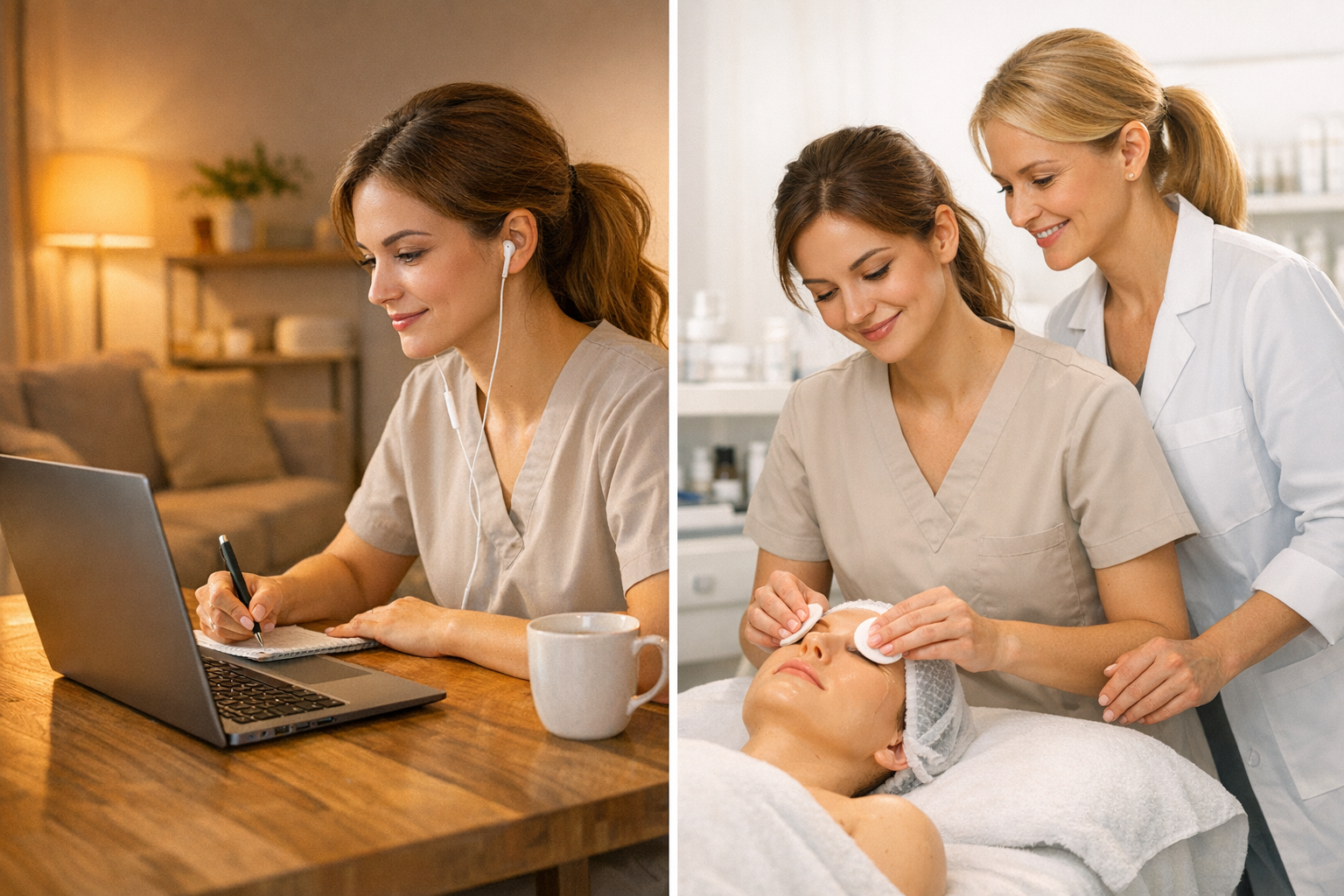

Choosing the right training for your aesthetic staff depends on your clinic's needs and goals. Online training is cost-effective and flexible, ideal for covering theoretical knowledge like anatomy and safety protocols. In contrast, in-person training provides hands-on experience and real-time feedback, essential for mastering injection and laser techniques. A blended approach - starting with online modules followed by in-person practice - offers the best balance of convenience, cost, and skill-building.
Key Points:
- Online Training: Affordable, self-paced, and accessible anywhere; lacks tactile practice and real-time feedback.
- In-Person Training: Hands-on learning with immediate corrections; higher costs and scheduling challenges.
- Blended Learning: Combines the strengths of both methods, maximizing efficiency and effectiveness.
Quick Comparison:
| Factor | Online Training | In-Person Training |
|---|---|---|
| Cost | $300–$1,500 per course | $1,500–$5,000+ per course |
| Flexibility | High (self-paced) | Low (fixed schedules) |
| Hands-On Skills | Limited | Extensive |
| Feedback | Limited (virtual) | Immediate (real-time) |
| Accessibility | High (internet-based) | Limited (location-based) |
| Impact on Clinic | Minimal disruption | Requires staff absences |
Blended learning ensures your team gains both the knowledge and practical skills needed to deliver safe and effective treatments while maintaining clinic efficiency.
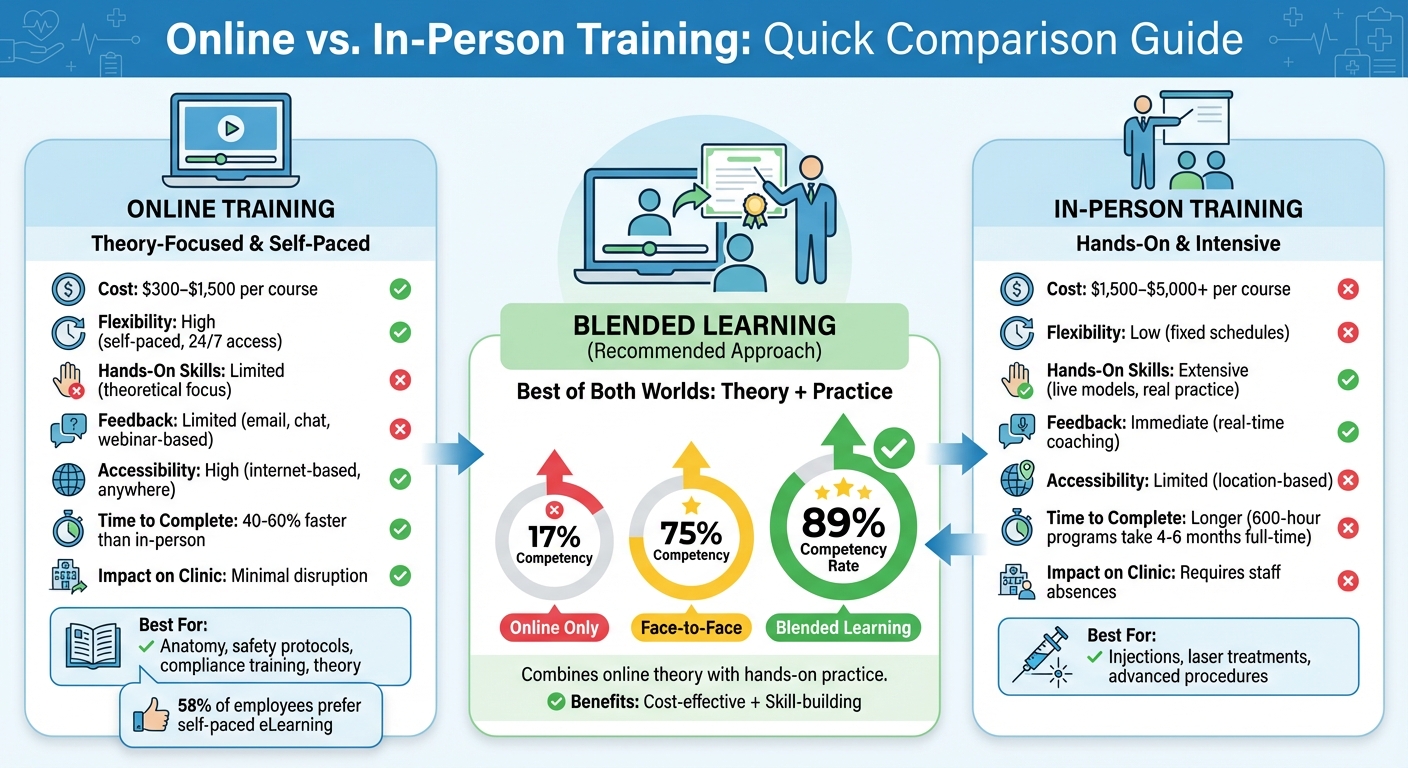
Online vs In-Person Training Comparison for Aesthetic Staff
Online Training: Benefits and Drawbacks
Flexibility and Lower Costs
Online training offers convenience and affordability that traditional classroom settings struggle to match. Employees can access courses anytime, allowing them to fit learning into their packed schedules. This flexibility matters - 58% of employees prefer self-paced eLearning over traditional formats.
The cost savings are another major perk. As RESTOR Medical Spa points out: "Online classes tend to be more affordable since they don't require as many resources and additional changes to your life". Plus, eLearning can slash training time by 40-60%, meaning employees spend less time away from patient care while still gaining critical knowledge.
Online platforms are especially effective for delivering specialized content tailored to aesthetic practices. From advanced safety protocols to treatment theory updates, these programs cater to experienced practitioners looking to stay certified. And because digital materials scale easily, they grow alongside your business.
Limited Hands-On Practice
Despite its many advantages, online training has clear limitations.
One of the biggest drawbacks is the lack of hands-on practice, which is essential for mastering aesthetic procedures like injections, laser treatments, and dermal fillers. These skills require real-world application to build expertise. In fact, a randomized controlled trial found that only 17% of students in a fully online group achieved competency in skinfold measurement, compared to 75% in face-to-face training and 89% in blended learning.
This challenge goes beyond technique. Skills that rely on haptic awareness, manual dexterity, and sensory feedback are much harder to develop through virtual platforms. Employees trained exclusively online often report lower confidence when performing clinical procedures compared to those with in-person experience. While some programs include practice kits with mannequins and tools for at-home use, these can't fully replicate the value of immediate professional feedback and real-time guidance available during in-person training.
Next, we’ll dive into how in-person training addresses these hands-on challenges.
sbb-itb-02f5876
In-Person Training: Benefits and Drawbacks
Direct Experience and Real-Time Feedback
In-person training stands out in areas where online learning often struggles, particularly when it comes to hands-on practice and immediate feedback. An instructor can quickly identify and correct errors during procedures like injections or laser treatments, ensuring a higher level of precision.
For instance, a 2022 trial in Dublin involving 47 students revealed a stark difference in outcomes: 75% of face-to-face learners achieved competency in haptic tasks, compared to just 17% of those who trained exclusively online.
"While online courses offer foundational knowledge, hands-on training is essential for mastering techniques and building competence." - American Association of Aesthetic Medicine and Surgery (AAAMS)
This kind of practical supervision is critical for aesthetic procedures, especially those involving high-risk anatomical areas. Precision is key to avoiding complications, and in-person training helps practitioners develop the muscle memory and confidence needed for natural, safe results. It also provides a better understanding of danger zones and how to manage patient reactions effectively. According to the 70:20:10 learning model, 70% of knowledge comes from hands-on experience, 20% from interactions with trainers and peers, and only 10% from formal coursework. In-person training seamlessly incorporates all these elements, making it a comprehensive approach to skill-building.
Scheduling and Cost Challenges
Despite its undeniable advantages, in-person training comes with logistical and financial hurdles. The biggest challenges are time and cost. Classroom sessions operate on fixed schedules, which means staff must attend at specific times, often clashing with clinic operations or personal commitments. Coordinating these sessions can be an administrative headache, and the additional costs for transportation, lodging, and time away from patient care only add to the burden. In fact, traditional in-person training can take 40% to 60% more time than comparable eLearning modules. For example, full-time in-person esthetician programs - typically requiring around 600 hours - are completed in four to six months, whereas part-time online versions often take about a year.
"Hands-on training might take time and money away from you that you do not have for commuting, transportation, and accommodation." - RESTOR Medical Spa
While in-person training excels at developing practical skills, its resource-intensive nature means that a blended approach might be the best solution. Combining online learning with hands-on sessions can strike a balance between thorough training and operational efficiency, ensuring both staff development and clinic productivity.
Side-by-Side Comparison: Online vs. In-Person Training
Comparison Table
When deciding between online and in-person training, it's essential to weigh factors like cost, scheduling, and skill-building opportunities. These considerations influence not just training expenses, but also how effectively staff acquire knowledge, develop practical skills, and manage clinic operations and charting.
The table below highlights the key differences in cost, flexibility, and skill development. While online training shines in terms of convenience and affordability, in-person training creates a hands-on environment ideal for mastering procedures like Botox injections and laser treatments.
| Factor | Online Training | In-Person Training |
|---|---|---|
| Direct Cost | $300–$1,500 per course | $1,500–$5,000+ per course |
| Travel & Lodging | None - no expenses for airfare, hotels, or meals | Extra costs for transportation and accommodations |
| Flexibility | High - self-paced, 24/7 access, works around clinic hours | Low - fixed schedules that may require time off work |
| Hands-On Skills | Mostly theoretical, with limited tactile practice | Extensive, with live models and real-time corrections |
| Interaction & Feedback | Limited - email, chat, or webinar-based responses | Immediate - real-time coaching and feedback |
| Accessibility | High - accessible anywhere with internet | Limited - requires physical presence at a training center |
| Time to Complete | 40–60% faster than in-person for the same content | Longer - 600-hour programs may take 4–6 months full-time compared to one year part-time online |
| Practice Impact | Minimal disruption - staff can train during off-hours | Requires planning around staff absences, potentially affecting patient care |
| Technology Proficiency | Needs reliable internet and basic digital skills | Minimal tech use, focusing more on medical equipment |
These differences can help you choose the best training method to fit your clinic's needs without disrupting operations. Online training is a great way to efficiently cover theoretical knowledge, while in-person training provides the hands-on experience essential for mastering practical skills. Many clinics are now combining the two approaches - using online modules for foundational learning and in-person sessions for critical hands-on practice. This blended approach ensures staff are well-rounded and prepared for real-world scenarios.
Reading about the problem? See how Prospyr solves it in one platform.
Book a DemoWhen Online Training Works Best
Online training works particularly well when your clinic needs to cover essential knowledge while keeping costs and scheduling headaches to a minimum. It’s especially effective for topics like facial anatomy, physiology, and pharmacology, where hands-on practice isn't immediately necessary. These subjects benefit from visual aids and the flexibility of self-paced learning, allowing staff to revisit material until they fully grasp it. For instance, understanding the science behind neuromodulators and dermal fillers becomes much more manageable with this approach, building a solid foundation before diving into practical applications.
Compliance and safety training is another area where online learning excels. Certifications like HIPAA, OSHA safety standards, and infection control protocols can be taught efficiently through self-paced modules. This method not only saves money but also ensures consistent training for all team members. Plus, it keeps your clinic audit-ready without disrupting daily operations.
"Online training is also more affordable than traditional classes, as it eliminates the need for travel and accommodation expenses." - The American Association of Aesthetic Medicine and Surgery (AAAMS)
For clinics with staff spread across multiple locations, online training eliminates the logistical challenges of coordinating travel, lodging, and time off. Virtual platforms ensure that everyone, regardless of location, can access the same high-quality instruction from industry experts. Whether you’re training five employees or fifty, the cost of course materials remains the same, and staff in different time zones can complete modules at their own convenience. This approach helps maintain a consistent training standard across various locations, ensuring uniformity in care delivery.
Online training is also great for ongoing education in areas like practice management and marketing features, as well as for refresher courses for seasoned staff. By assigning online modules before in-person workshops, you can adopt a "theory-first" strategy. This ensures that face-to-face sessions are used more effectively for hands-on practice, with staff arriving well-prepared and ready to focus on skill application. In this way, online learning becomes a powerful tool for preparing your team for practical, in-person training.
When In-Person Training Works Best
In-person training offers something online modules simply can't: hands-on practice. While telehealth is excellent for initial consultations and follow-ups, it cannot replace the physical presence required for technical mastery. This kind of training is crucial for building tactile precision and muscle memory. For example, understanding the "feel" of dermal fillers in different facial planes, mastering the right injection depth and pressure, and learning how to recognize tissue resistance are experiences that can't be fully conveyed through a screen. The 70:20:10 learning model highlights that most skill development happens through practice and collaboration, making hands-on training indispensable.
This hands-on approach becomes even more critical when tackling advanced aesthetic procedures. Techniques like non-surgical rhinoplasty, jawline and chin enhancement, or forehead contouring require expert guidance in real time. These high-stakes procedures involve navigating around critical structures like blood vessels, nerves, and muscles, where even a small mistake could lead to serious complications. Research confirms that hands-on training significantly improves competency compared to online methods, especially when patient safety is on the line.
Another major advantage of in-person training is immediate feedback. Having an instructor physically guide your hand, refine your technique on the spot, and help you interpret subtle cues from patients allows you to build confidence faster. This kind of real-time correction transforms hesitation into skill, something that video tutorials simply can't replicate.
When it comes to complication management and using advanced tools like cannulas or laser devices, hands-on practice under expert supervision is non-negotiable. Practicing on live models provides the real-world experience needed to make quick, safe decisions for a variety of facial anatomies. This is where theory meets application, allowing your team to deliver procedures with the precision and artistry that define aesthetic medicine.
Combining Both Training Methods
The best way to train effectively is by combining online and in-person learning. This blended learning approach kicks off with online modules that cover essential theoretical topics, like facial anatomy, patient assessment protocols, and product pharmacology. These online lessons allow staff to learn at their own pace, cutting down on travel expenses and minimizing disruptions to work schedules. Afterward, participants come together for hands-on sessions, where they practice and refine tactile skills that simply can't be mastered through a screen.
This combination bridges the gap between theory and practice while addressing the shortcomings of purely online training. Research backs this up: for tasks requiring manual skills, such as skinfold measurement, only 17% of students in fully online programs achieved competency, compared to 89% in a blended learning setup. By integrating both methods, blended learning tackles the sensory limitations of online-only formats.
"Both face-to-face and blended teaching methods were more effective at leading to skill acquisition and were preferred by students when compared to a fully online teaching method."
- Medical Science Educator
Programs like AAAMS exemplify the success of this model. As of May 2023, their "Aesthetics Training 101" program features a two-part hybrid structure. Module 1 is an online, self-paced series covering facial aesthetics and chemical peels, while Module 2 is a full-day, hands-on workshop focused on Botox and dermal fillers. Similarly, RESTOR Academy blends "On-Demand Training" for foundational knowledge with "Shadow Days", where students gain practical experience and receive real-time feedback in a clinical setting.
The appeal of blended learning is undeniable. In one study, 71% of students favored this approach, while 29% preferred face-to-face training only. Interestingly, no one opted for online-only learning. By using online modules for theoretical groundwork and reserving costly, instructor-led sessions for critical practical skills - like laser treatments or advanced injection techniques - you can achieve better learning outcomes while keeping costs in check. This integrated method is an efficient way to prepare your team for advanced procedures and technology in your practice.
Training Staff on Technology and Equipment
Beyond clinical expertise, ensuring your team is well-versed in digital tools is crucial for keeping operations smooth. Many modern aesthetic clinics depend on practice management platforms for tasks like scheduling, patient charting, billing, and communication. If staff members struggle with these tools, it can create bottlenecks that slow everything down. Let’s explore how to effectively train your team to master the technology that keeps your clinic running efficiently.
Online training modules are a great starting point for teaching the basics of software like Prospyr. These modules allow staff to familiarize themselves with the platform at their own pace, whether during downtime or from home. They can learn to navigate the interface, use features like digital intake forms and payment processing, and review HIPAA compliance protocols. This method is both cost-effective and scalable, making it especially useful for onboarding new hires without interrupting clinic operations. However, online training has its limits - mainly, it doesn’t provide the immediate feedback that’s often necessary for troubleshooting or understanding how the software fits into the clinic’s daily workflow.
On the other hand, in-person training offers hands-on experience and addresses real-time challenges. For example, new staff can shadow experienced team members as they use Prospyr during actual patient interactions. This approach demonstrates how the platform integrates into everyday tasks, from check-in to checkout. Hands-on exposure not only accelerates learning but also boosts confidence. According to the 70:20:10 learning model, the majority of knowledge - 70% - is gained through on-the-job experience, while only 10% comes from traditional coursework.
A blended learning approach often works best. Start with online modules to cover the essentials, like navigating the dashboard, creating patient records, and sending automated appointment reminders. Then, follow up with in-person sessions where staff can practice using the platform in mock scenarios or alongside seasoned colleagues. This combination ensures they not only know how to use the software but also understand why it’s structured the way it is. As Dr. Heidi Waldorf explains:
"People who understand concepts rather than just memorize facts are also better prepared to manage the unusual and to build on their knowledge base".
When training staff on platforms like Prospyr, focus on teaching system logic instead of just step-by-step instructions. For instance, explain how digital intake forms streamline the workflow or how automated SMS reminders help reduce no-show rates. This deeper understanding enables staff to adapt more easily when challenges arise. Additionally, cross-training team members on multiple platform functions - such as scheduling, billing, and patient communication - ensures they can step in and cover for one another during busy times or staff shortages.
Building both digital proficiency and clinical expertise is essential for keeping your clinic running like a well-oiled machine. A thoughtful training approach can make all the difference.
Conclusion
Choose the right training method based on the skill set you’re aiming to develop. Online modules are ideal for covering foundational topics like anatomy, safety protocols, and compliance requirements. On the other hand, in-person sessions are indispensable for mastering hands-on procedures, such as injectables and laser treatments.
"Online training is typically recommended for those who already have some knowledge in the field... hands-on training is recommended for those who have... little experience in the aesthetics field".
The most effective training combines both approaches. Begin with online modules to build a solid knowledge base, then transition to hands-on practice where staff can refine their skills under direct supervision. This blended learning model not only accelerates training - cutting time by 40–60% - but also ensures staff develop the accuracy and confidence necessary for patient care. Together, these methods create a strong foundation for running a more efficient practice.
Additionally, integrating technology into your operations can further enhance efficiency. Platforms like Prospyr simplify administrative tasks, streamline documentation, and maintain clinical standards with standardized digital forms.
FAQs
What are the benefits of combining online and in-person training for aesthetic staff?
Blended learning, which integrates online learning with in-person, hands-on training, offers an ideal way to train aesthetic staff. Team members can dive into theoretical topics - such as anatomy, product details, and client communication - through online modules at their own pace. Meanwhile, supervised in-person sessions provide the opportunity to practice procedures like Botox and filler injections, ensuring they gain essential hands-on experience.
This approach is both adaptable and efficient, allowing staff to balance training with their busy schedules while minimizing travel and downtime. It also strengthens practical skills, ensuring clinicians develop the hands-on expertise required to deliver safe, high-quality results. On top of that, combining learning formats boosts engagement and retention, helping learners stay actively involved and better equipped to navigate the ever-changing field of aesthetics. For practices looking to enhance their team's skills, this method offers a smart and effective solution.
Does online training help aesthetic staff feel confident in performing procedures?
Online training can help aesthetic staff build confidence by offering flexible learning that can be revisited as needed. Features like structured video demonstrations, interactive quizzes, and instant feedback make it easier for learners to feel ready to apply their skills in practical scenarios.
Although online training is convenient and accessible, it doesn’t always replicate the hands-on experience of in-person sessions. The most effective programs strike a balance, offering clear goals, practical lessons, and ways to verify skills. Tools such as Prospyr add value by tracking progress and boosting confidence with practice analytics and AI-generated insights.
Why is hands-on training important for learning advanced aesthetic techniques?
Hands-on training plays a crucial role in mastering advanced aesthetic techniques because it connects theoretical knowledge with practical application. It gives practitioners the chance to work on live models under the guidance of experts, honing essential skills like needle placement, understanding facial anatomy, and recognizing high-risk areas. This hands-on approach not only builds confidence but also sharpens motor skills, leading to safer procedures and more natural-looking outcomes.
For treatments that rely on sensory feedback - like precise filler injections or laser adjustments - learning in person offers a distinct advantage. Immediate feedback allows practitioners to make adjustments on the spot, improving decision-making and preparing them for real-world patient interactions. When combined with tools like Prospyr, clinics can streamline operations, document results effectively, and focus on providing outstanding patient care.