Claim Appeal Deadlines by Payer: Medicare, UHC, Aetna and Cigna
Claim appeal deadlines by payer: Medicare 120 days, Aetna and Cigna 180 days, UnitedHealthcare 12 months for both steps. Check your contract.
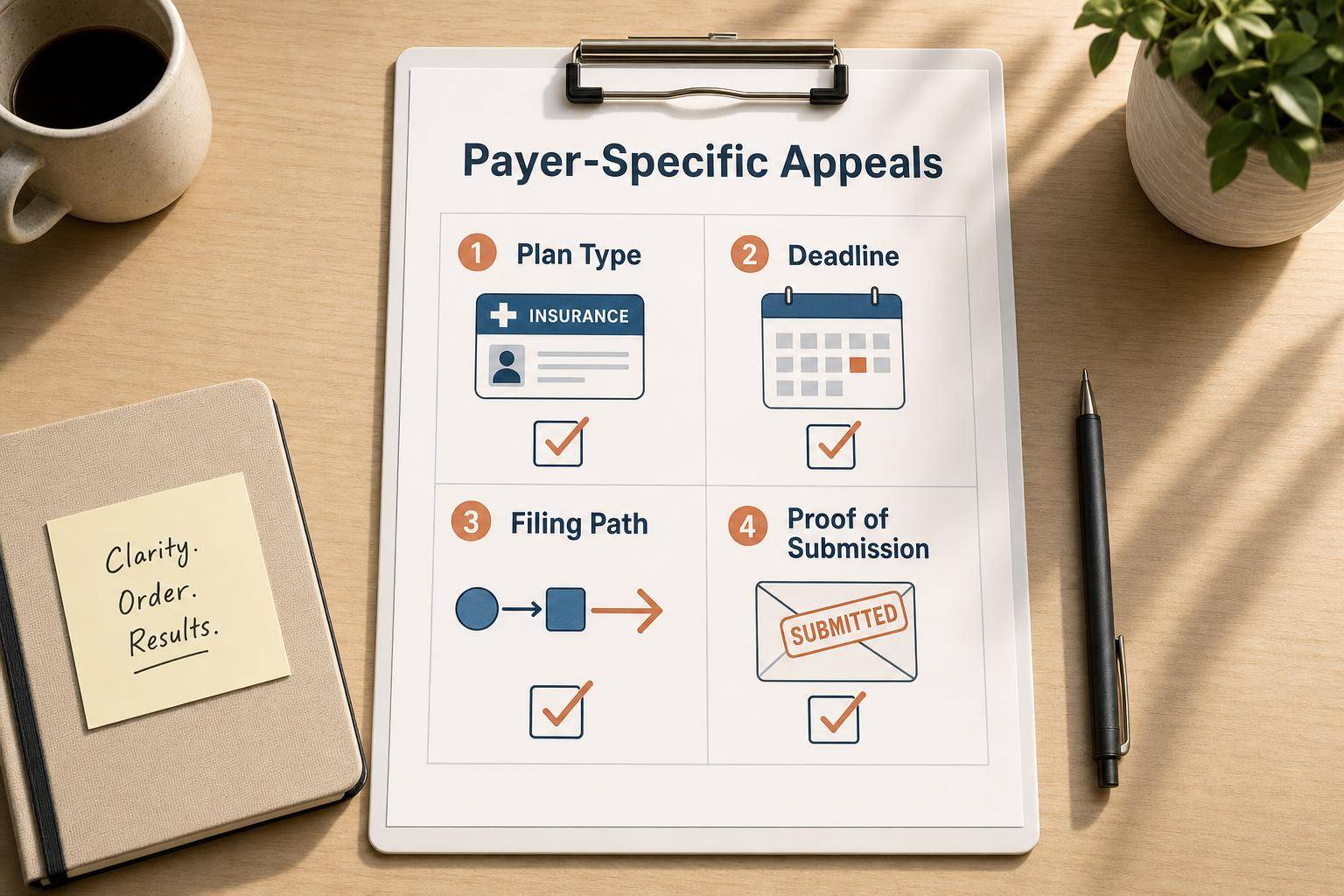

Claim appeal deadlines differ by payer: Original Medicare allows 120 days to request a redetermination, Cigna and Aetna generally allow 180 days for the first-level dispute, and UnitedHealthcare allows 12 months from the original EOB or remittance for its two-step reconsideration and appeal process, unless your contract or state law says otherwise. Quick reference, from each payer's own published rules:
- Original Medicare (Parts A and B): redetermination by the Medicare Administrative Contractor within 120 days of receiving the initial determination (receipt is presumed 5 days after the notice date). Then four more levels, each with its own deadline.
- UnitedHealthcare (commercial, Individual Exchange and Medicare Advantage network providers): step 1 is a claim reconsideration, step 2 an appeal. Both must be submitted within 12 months of the date of the original claim EOB or provider remittance advice, or as required by law or your agreement.
- Aetna: a reconsideration within 180 calendar days of the initial claim decision, then an appeal within 60 calendar days of the reconsideration decision. Aetna's 180-day dispute standard can be replaced by state rules for fully insured plans.
- Cigna: a single-level internal appeal, filed in writing within 180 calendar days of the initial payment or denial decision (or of the last payment adjustment).
- Blue Cross Blue Shield plans: each Blue plan sets its own process. For an out-of-state Blue patient, the BlueCard program has you appeal through your local Blue plan, which coordinates with the patient's plan.
Check your contract; limits vary by plan and contract. Medicaid and Medicaid managed care appeal rules are set by each state and plan.
Sources checked October 14, 2026 · Prepared by Prospyr. This update replaces an earlier version that listed appeal windows we could not confirm on payers' own sites. No certified-coder or billing-specialist review is claimed.
Original Medicare: five appeal levels
| Level | Who decides | Deadline to file | Amount in controversy |
|---|---|---|---|
| 1. Redetermination | Medicare Administrative Contractor (MAC) | 120 days from receipt of the initial determination | None |
| 2. Reconsideration | Qualified Independent Contractor (QIC) | 180 days from the redetermination decision | None |
| 3. Hearing | Administrative law judge, Office of Medicare Hearings and Appeals | 60 days from the QIC decision | $200 in 2026 and 2027 |
| 4. Review | Medicare Appeals Council | 60 days from the hearing decision | None |
| 5. Judicial review | Federal district court | 60 days from the Council decision | $1,960 in 2026; $2,000 for requests filed on or after January 1, 2027 |
Two details matter at level 1. The 120 days run from the date you receive the initial determination, which Medicare presumes is 5 days after the date on the notice. And a request counts as filed on the date the contractor receives it, not the date you send it.
A claim denied because it was filed more than 12 months after the date of service is different: that denial is not an initial determination and cannot be appealed. See Timely Filing Deadlines: What Happens When a Claim Is Late.
UnitedHealthcare: reconsideration, then appeal
UnitedHealthcare's 2026 administrative guide recommends a two-step process, except where state law prohibits it:
- Claim reconsideration. Submit online through the UnitedHealthcare Provider Portal (Claims & Payments) or by API, and explain why you disagree, with any supporting material not sent with the original claim.
- Appeal. If you disagree with the reconsideration outcome, submit an appeal the same way and attach all new supporting material, such as clinical records. Do not resend what you sent with the reconsideration.
Both steps must fit inside 12 months from the date of the original claim EOB or PRA, unless law or your agreement sets a different time. Some states have their own dispute processes, and non-network Medicare Advantage providers follow a separate process published on UHCprovider.com.
A timely filing denial also goes through reconsideration, with proof that the claim was received and accepted within your filing limit.
Reading about the problem? See how Prospyr solves it in one platform.
Book a DemoAetna: reconsideration and appeal
Aetna's disputes and appeals page sorts disputes by subject:
- Reconsiderations cover reimbursement decisions, coding decisions and claims that need to be reprocessed. File within 180 calendar days of the initial claim decision.
- Appeals cover decisions based on medical necessity, a payment policy, or experimental or investigational criteria. After a reconsideration, file the appeal within 60 calendar days of the reconsideration decision. Some issues skip reconsideration and go straight to appeal.
For fully insured plans, Aetna lists state exceptions that replace its 180-day standard, such as one year in Arizona and 24 months in Georgia. Check the list for your state.
Cigna: one internal appeal level
Cigna first tries to resolve issues informally when you contact it. If that does not fix the problem, Cigna offers a single-level internal appeal, which must be started in writing within 180 calendar days of the initial payment or denial decision, or within 180 days of the last payment adjustment. Arbitration may follow only if your provider agreement or program requirements call for it. The appeals address depends on the member's ID card.
Blue Cross Blue Shield plans
Each Blue plan is an independent company with its own provider manual, forms and portal. For patients covered by another state's Blue plan, the BlueCard program makes your local Blue plan your single contact for claims payment, adjustments and issue resolution; BCBS of Texas's BlueCard manual, for example, says appeals for all claims are handled through the local plan, which coordinates with the member's plan if needed.
Build one appeal workflow for every payer
- Identify the payer and product line from the ID card and the denial (commercial, Medicare Advantage, Medicaid managed care, exchange plan).
- Calculate the deadline from the date the payer's rule uses: the EOB or remittance date, the decision date, or (for Medicare) presumed receipt.
- Pick the right first step: reconsideration or appeal, according to the payer's rules for that denial type.
- Match the record to the reason. Read the denial reason code and any cited payer policy, then send the specific chart notes that answer it.
- File through the payer's listed channel and keep proof of submission and receipt.
- Log the follow-up date and check status before the next deadline.
Where Prospyr fits
Prospyr supports charting, digital intake, inventory and practice operations; practices that bill insurance heavily need a separate claims solution.
Sources
- CMS, Original Medicare appeals process flowchart (2026 amounts)
- 42 CFR 405.942, time frame for filing a redetermination
- Federal Register, CY 2027 amount in controversy thresholds (September 16, 2026)
- UnitedHealthcare 2026 Care Provider Administrative Guide
- Aetna, Disputes and appeals overview
- Aetna, Provider appeals and state exceptions
- Cigna, Medical and clinical reimbursement policies and procedures
- BCBS of Texas, BlueCard Program Provider Manual
Free PDF guide + worksheets
Claims readiness workbook
Get the public answers and fillable review worksheets in one PDF. Save your own copy or print it for a team review. Use internal references only; keep patient information in your authorized clinical system.
- ✓ Sourced answers and practical examples
- ✓ Worksheets for your team to complete
- ✓ Official references and review prompts