Ultimate Guide to Local Competitor Analysis
A practical, step-by-step framework to audit local aesthetics competitors, compare services and pricing, evaluate online presence, and find gaps to grow your practice.


Want to stay ahead in the aesthetics and wellness industry? Local competitor analysis is your key to understanding the market around you. This guide breaks down how to identify competitors, analyze their services, pricing, and online presence, and use these insights to boost your practice's performance.
Key Takeaways:
- Identify Competitors: Use tools like Google Maps and social media to find nearby practices.
- Analyze Services & Pricing: Compare offerings, pricing structures, and identify gaps or opportunities.
- Evaluate Online Presence: Review websites, SEO rankings, and social media engagement.
- Study Marketing Strategies: Track promotions, customer engagement, and advertising efforts.
- Leverage Tools Like Prospyr: Streamline operations, track performance, and enhance marketing.
Pro Tip: Regularly update your analysis - competitors and trends evolve quickly. Start by auditing your top 5 local competitors and look for areas where you can stand out, such as unique services, better pricing models, or stronger online visibility.
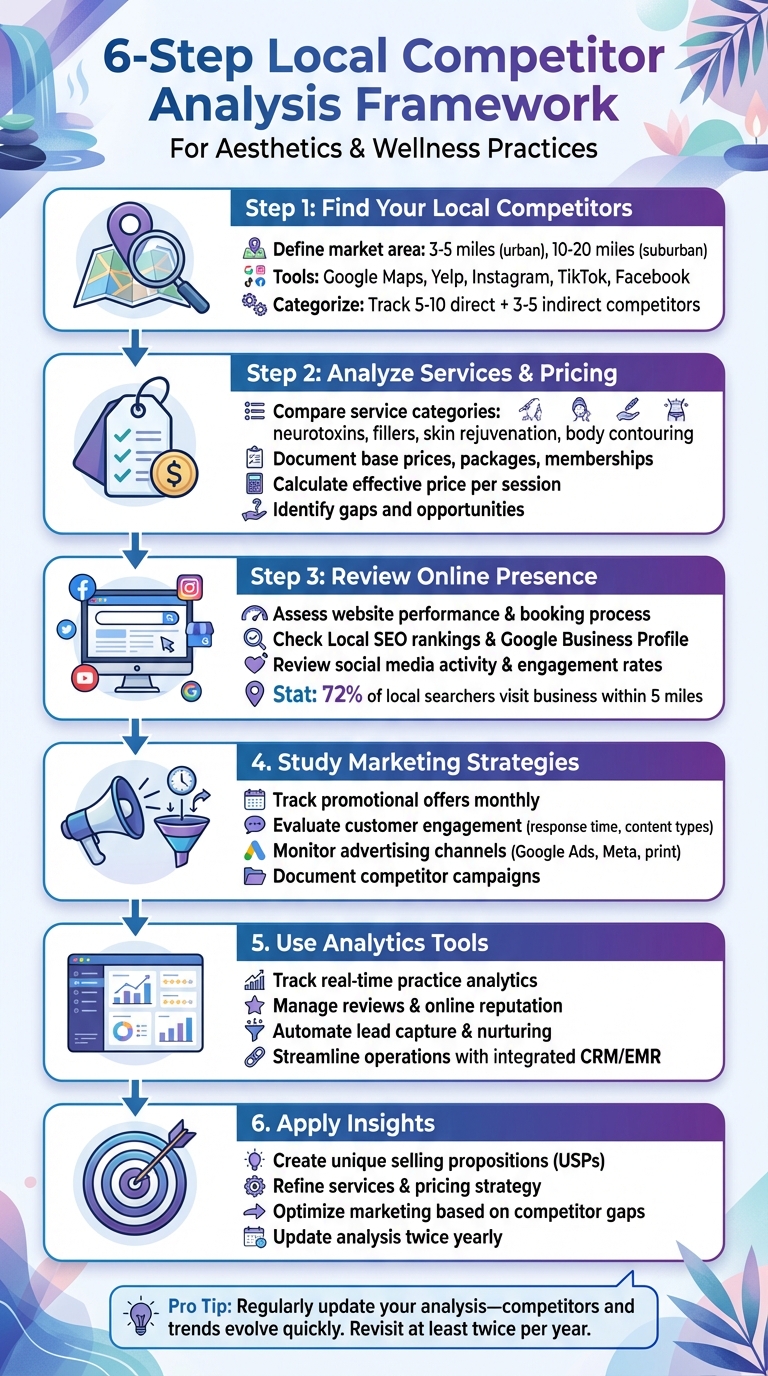
6-Step Local Competitor Analysis Framework for Aesthetics Practices
Step 1: Find Your Local Competitors
Define Your Market Area
Start by identifying where your patients are coming from. Review zip codes from intake forms or CRM reports to get a clear picture of your practice’s geographic reach. In densely populated urban areas, most aesthetics patients won’t travel more than 3–5 miles for quick treatments like Botox or laser hair removal. Suburban practices typically draw patients from a 10–20 mile radius, while rural clinics may attract clients from even farther away.
Tailor your geographic focus to the type of services you offer. Treatments that are quick and routine generally appeal to a smaller local area, while destination services - like surgical procedures - can justify a broader reach. Pay special attention to higher-income neighborhoods within a 15–20 minute drive, as most aesthetics spending in the U.S. comes from middle- to upper-income groups. If you notice competitors clustering in certain zip codes, consider adjusting your boundaries to better position your practice.
Once you’ve defined your market area, the next step is finding your competitors using specialized tools.
Tools to Find Competitors
Start with Google Maps. Search for terms like "med spa near me" or "Botox [your city]" to identify nearby practices. Take note of their operational details, patient reviews, and overall presence. Yelp can also be a goldmine for finding "aesthetic clinics" and specific services, offering user reviews, service descriptions, and proximity-based sorting all in one place.
Don’t stop there - social media platforms like Instagram, TikTok, and Facebook are excellent for finding smaller, boutique practices that may not appear in traditional directories. Search local hashtags (e.g., #DallasBotox or #MiamiFiller) to uncover mobile injectors and clinics that actively engage with their audience. Pay attention to their before-and-after photos, engagement rates, and overall activity.
Once you’ve compiled a list, it’s time to organize and categorize these competitors.
Categorize Your Competitors
Now that you’ve identified potential competitors, sort them into direct and indirect categories.
- Direct competitors are those offering a similar mix of services to a similar demographic within your area. For example, another med spa targeting women ages 30–55 with injectables, laser treatments, and body contouring within a 5–10 mile radius.
- Indirect competitors address similar patient needs but in different ways. These might include plastic surgeons promoting surgical facelifts instead of injectables, dermatologists handling cosmetic concerns in a clinical setting, wellness centers offering weight loss programs that overlap with body contouring, or high-end salons competing for "self-care" dollars with facials.
Direct competitors will influence your pricing and service lineup, while indirect competitors shape your overall positioning in the market. Aim to track 5–10 direct competitors and 3–5 indirect competitors to gather ongoing insights.
This categorization will prepare you for the next step: comparing services and pricing in detail.
Step 2: Analyze Competitor Services and Pricing
Compare Services Offered
Once you've categorized your competitors, take a closer look at the services they provide. Create a detailed comparison table that breaks down their offerings. Organize services into clear categories such as:
- Neurotoxins (e.g., Botox, Dysport, Xeomin, Daxxify)
- Dermal fillers (e.g., Juvederm, Restylane, Sculptra)
- Skin rejuvenation (e.g., chemical peels, microneedling, laser treatments)
- Body contouring (e.g., CoolSculpting, RF treatments)
- Facials and skincare
- Membership or wellness programs
For each competitor, include details like service category, treatment type, starting price, duration, technology used, and any special features (e.g., "doctor-only procedure" or "same-day consult and treatment").
Add a final column labeled "Gap/Opportunity for Our Practice" to highlight services missing from your menu or areas where you can stand out. For instance, if only one competitor in your area offers RF microneedling, this could be a niche worth exploring. Track how many competitors provide each treatment - services that are widely available may be essential for your market, while less common ones could give you a competitive edge.
Evaluate Pricing Strategies
Document the base prices for each service, along with any discounts or packages offered. Note specifics like discount thresholds (e.g., "$50 off a three-session bundle"), membership fees, member-exclusive discounts, and minimum spending requirements. To get a clearer picture, calculate the effective price per session for bundled services.
For membership programs, total the retail value of the included services over a month or year, subtract the membership fee, and express the savings as a percentage. This helps you see which competitors focus on discounts, which are neutral, and which position themselves as premium providers. Pay attention to services with constant discounts, as this can indicate overly aggressive pricing strategies or confusing pricing structures that may frustrate potential customers.
Look for opportunities where competitors fall short - for example, treatments requiring multiple sessions that lack clear package options, pricing that doesn’t reflect provider expertise, or failure to connect pricing with outcomes using before-and-after photos or follow-up care.
Identify Differentiation Opportunities
Use the insights from your analysis to position your practice effectively. Plot competitors on a Price vs. Perceived Quality grid, using their pricing, branding, and customer reviews as indicators. If the mid-range is overcrowded, consider positioning yourself as either a premium expert or a value-focused provider.
Tailor your service offerings, packages, and messaging to match your chosen niche. For example, if you aim to specialize in injectables or treatments tailored for skin of color, ensure that few competitors in your area dominate this space. Then, create targeted packages, educational content, and pricing strategies to establish your leadership.
Avoid competing solely on price - it’s more effective to align your pricing with your target audience’s income, your brand image (whether it’s luxury, clinical, results-driven, or wellness-oriented), and your operational costs. This ensures that your packages and memberships remain profitable.
Finally, remember to revisit your competitor analysis at least twice a year. The aesthetic market evolves quickly, with new competitors, technologies, and promotions constantly emerging. Regular updates will help you stay ahead.
Reading about the problem? See how Prospyr solves it in one platform.
Book a DemoStep 3: Review Competitor Online Presence
A competitor’s online footprint offers valuable insight into how effectively they attract and convert local patients. Most aesthetic and wellness clients start their journey online, comparing websites, reading reviews, and scrolling through social media before making a decision. In fact, 72% of people conducting local searches visit a business within five miles. This makes your competitors’ online visibility a strong indicator of local demand. Let’s break down how these digital touchpoints contribute to their overall patient conversion strategies.
Assess Website Performance
Start by visiting competitor websites on both desktop and mobile devices. Pay attention to page load times and overall design - slow or cluttered websites can drive potential patients away. As you navigate their site, think like a prospective client. Is there a prominent "Book Now" or "Schedule Consultation" button above the fold? How many clicks does it take to request an appointment?.
Evaluate the efficiency of their booking process. The best practices use automated scheduling systems and digital intake forms to create a seamless experience from the first click to a confirmed appointment. Check whether the process involves back-and-forth phone calls or allows instant online booking. Also, review the website’s content and trust-building elements. Look for clear descriptions of services, FAQs, educational blog posts, and before-and-after galleries. Trust signals like provider credentials, patient testimonials, embedded review widgets, and safety statements further enhance credibility.
Another key factor is whether the website offers conveniences like membership plans, financing options, or online payment links. These features reduce friction and make the process easier for patients. Integrated platforms that combine scheduling, intake, and payment systems into one streamline the experience for both patients and staff.
Check Local SEO Rankings
Using an incognito browser or your mobile device, search for terms like "Botox near me", "med spa in [City]", "lip fillers [City]", or "laser hair removal near me." Take note of which competitors appear in the Google Local Pack (the map with three listings) and the top organic results - these spots capture the majority of local clicks.
Next, examine their Google Business Profile. Check whether they’ve listed all their services, operating hours, and included an appointment link. Pay attention to how many reviews they have, their average star rating, and how recent the feedback is. Also, look at their photos and videos - interior shots, staff pictures, and before-and-after results can build trust with potential patients. Identify which competitors dominate specific treatments, and use rank-tracking tools to compare your position for key keywords.
These insights can help you pinpoint areas where your practice can stand out and capture more of the local market.
Review Social Media Activity
Competitors’ social media efforts can provide even more clues about their patient engagement strategies. Focus on the platforms they prioritize, such as Instagram, Facebook, TikTok, and YouTube. Instagram and TikTok, in particular, are popular for showcasing visual content like treatment results and building a sense of community.
Pay attention to how often they post and the type of content they share. Top practices regularly post before-and-after photos, educational reels or TikToks, behind-the-scenes videos, and patient testimonials. To gauge their audience connection, calculate their engagement rate by dividing the average number of likes and comments by their follower count. For instance, a competitor with 5,000 followers and 200 likes per post (4% engagement) may be more effective than one with 20,000 followers and 300 likes (1.5% engagement). Higher engagement often signals a stronger connection with their audience.
Also, observe how quickly and thoughtfully they respond to comments or direct messages. Do they feature real patients and providers in their posts, using HIPAA-safe imagery and disclaimers? Look for special campaigns or offers, such as seasonal Botox promotions, membership plans, or referral incentives, that link back to targeted landing pages or booking links.
Check if their social profiles include integrated "Book Now" buttons or lead capture forms. Competitors that make it easy to schedule appointments directly from social media tend to convert more followers into patients. Tools like Prospyr can help you maintain consistent engagement across platforms while tracking which efforts drive the most leads.
Finally, create a simple scorecard to evaluate each competitor across key areas like website usability, local SEO visibility, review volume and recency, and social media engagement. Use a 1–5 scale to quickly identify where your practice can improve - whether it’s through better educational content, faster response times, or a smoother booking process. Revisit this assessment at least twice a year to stay on top of evolving digital strategies.
Step 4: Study Competitor Marketing Strategies
After analyzing competitors' online presence, it's time to dig deeper into their marketing strategies. This step reveals how they attract and retain patients, providing insights into what works and where opportunities exist for you to stand out.
Identify Promotional Offers
Start tracking your competitors' promotions by creating a simple spreadsheet. Include details like:
- Competitor name
- Offer type (e.g., first-time Botox discount)
- Discount or package price
- Offer dates
- Call-to-action
- Promotion channel
- Target audience
Update this tracker monthly by reviewing competitor websites, social media, Google Business Profiles, and their email newsletters. Over time - say, three to six months - you’ll notice patterns. For instance, perhaps most competitors discount neurotoxin treatments, but few offer memberships targeting men’s wellness. These trends can help you identify areas where you can stand out with your own promotions.
Evaluate Customer Engagement
Take a closer look at how your top five to ten local competitors engage with their audience on platforms like Instagram, Facebook, and TikTok. Pay attention to:
- Posting frequency
- Content types (e.g., before-and-after photos, educational reels, behind-the-scenes videos, or user-generated content)
- Engagement metrics (likes, comments, shares, saves)
Also, assess how they interact with their audience. Do they respond to comments and messages quickly, ideally within 24 hours? Are their responses helpful and clear, or do they leave questions unanswered? The best performers post consistently, respond promptly, and share educational, visually compelling content that builds trust - especially important in an industry where safety and results matter deeply.
For email and SMS marketing, sign up for competitors' newsletters and text lists. Track how often they send messages, the type of content they share (promotions, educational info, or event invites), and whether they personalize messages (e.g., using first names or targeting specific groups like "VIP members"). Note when they send communications - do they focus on holidays or slower times of the year? Save any particularly effective messages to use as inspiration for your own campaigns. Practices that use HIPAA-compliant CRM tools to automate email and SMS outreach often see better lead nurturing and higher return visit rates.
In a real-world example, Dr. Daniel Lee, Founder of New Life Cosmetic Surgery, saw a 50% revenue increase and a 40% boost in appointments after consolidating multiple software systems into the Prospyr platform. This shift streamlined patient management and marketing, proving how integrated tools can drive growth and engagement.
"We've seen a 50% increase in revenue and a 40% increase in appointments booked since switching away from using several different point solutions to running our practice on Prospyr." – Dr. Daniel Lee, Founder, New Life Cosmetic Surgery
Once you’ve analyzed engagement strategies, shift your focus to understanding competitors’ advertising efforts.
Track Advertising Channels
To uncover competitors' paid advertising strategies, start with Google Ads. Search for terms like "Botox near me" or "laser hair removal [your city]" and note which clinics appear under "Sponsored" ads. Use the ad info icon to confirm the advertiser. For Meta (Facebook and Instagram) ads, check the Meta Ad Library to view competitors' active campaigns. Don’t forget to look at local print ads, direct-mail coupons, lifestyle magazines, and billboards near shopping areas or medical hubs.
Take screenshots of competitors' search, social, and display ads. Pay attention to:
- Headlines
- Value propositions (e.g., safety, convenience, affordability, luxury)
- Offer details
- Creative assets (before-and-after images, video testimonials, provider photos)
- Social proof (star ratings, reviews, patient quotes)
Meta ads often provide clues about target demographics, such as age, gender, and specific concerns like acne or anti-aging. If you notice gaps - like no one highlighting memberships, men’s services, or wellness offerings - you can use that as an opportunity to shape your own ad strategy.
When Dr. Saami Khalifian opened SOM Aesthetics in 2024, he used an integrated practice management platform to generate $40,000 in revenue within two days of launch. By leveraging automated lead capture and engagement tools, the practice exceeded $100,000 in monthly revenue within just two months, showcasing how unified platforms can accelerate growth.
"Prospyr has helped us launch SOM Aesthetics like a rocketship. Their powerful platform and helpful support have enabled us to exceed our financial targets while delivering an unmatched experience for our patients." – Dr. Saami Khalifian, Founder and CEO, SOM Aesthetics
Finally, use practice analytics to measure how your promotions perform compared to competitor-style offers. Automate email and SMS campaigns around seasonal trends, manage online reviews and social media from a single dashboard, and use AI tools for content creation, note-taking, and booking assistance. Regularly revisit your competitor marketing audit - at least twice a year - to stay ahead of shifting strategies.
sbb-itb-02f5876
Step 5: Use Prospyr for Competitive Analysis
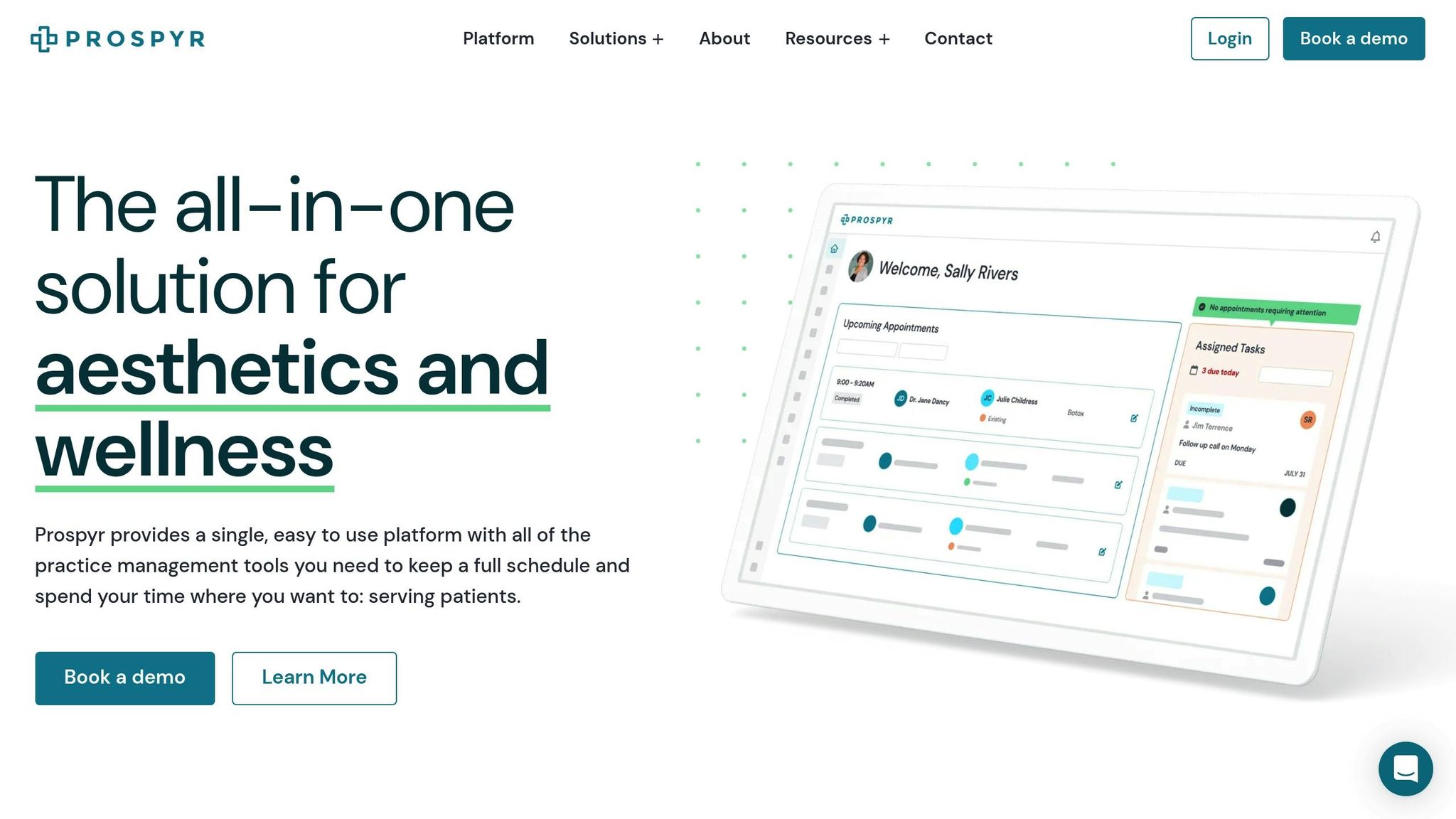
Once you've analyzed your competitors' marketing strategies, it's time to turn those insights into action. This is where Prospyr steps in, bridging the gap between research and execution. Prospyr is a comprehensive practice management platform designed to help you track performance, outpace local competitors, and provide top-tier patient experiences - all while leveraging data-driven marketing.
Prospyr's Practice Analytics Features
Prospyr offers a real-time practice analytics dashboard that takes the guesswork out of managing your business. From financial performance and appointment trends to service popularity and revenue growth, everything you need is at your fingertips. This allows you to identify your most profitable treatments, spot slow periods that could benefit from promotions, and measure your growth against the competition you've been monitoring.
The platform also includes review management tools to help you keep tabs on your online reputation. Considering that 72% of people searching locally for aesthetic services visit a business within five miles, maintaining a strong online presence is crucial. Prospyr's centralized dashboard lets you track and respond to reviews quickly, ensuring your practice stands out when potential patients are comparing their options.
Streamline Marketing and Drive Client Growth
Prospyr's integrated lead capture system seamlessly pulls information from your website and social media accounts into a HIPAA-compliant CRM. This ensures you never miss a lead. You can easily track which channels - whether it's Instagram, Google Ads, or referrals - are generating the most leads and adjust your marketing spend accordingly. Meanwhile, Prospyr's email and SMS marketing automation keeps your practice top-of-mind by nurturing leads and encouraging repeat visits, all without requiring manual effort. This gives you a clear edge over competitors who rely on inconsistent outreach.
Take, for example, Dr. Saami Khalifian, who launched SOM Aesthetics in 2023. Using Prospyr's tools, his practice hit its sales targets 21 times faster than expected, generating $40,000 in revenue within the first two days and surpassing $100,000 in monthly revenue within just two months.
"Prospyr has helped us launch SOM Aesthetics like a rocketship. Their platform and support have enabled us to exceed our financial targets while delivering an unmatched experience for our patients." – Dr. Saami Khalifian, Founder and CEO, SOM Aesthetics
With a solid marketing and lead capture system in place, you can focus on optimizing your daily operations to further set your practice apart.
Enhance Operational Efficiency
Operational efficiency can be a game-changer in standing out from the competition. Prospyr's CRM/EMR integration consolidates patient data, scheduling, digital intake forms, payment processing, and task management into one streamlined system - replacing the need for up to seven separate tools. This not only reduces administrative fatigue but also speeds up patient intake and ensures no detail is overlooked. Features like smart scheduling and automated membership management simplify operations, creating a seamless experience for patients. This level of efficiency leads to better retention and more word-of-mouth referrals, giving you a clear advantage over practices still juggling multiple platforms.
Step 6: Apply Insights to Differentiate Your Practice
Turn your insights into strategies that make your practice stand out. In a crowded local market, the most successful practices don’t just mimic their competitors - they fill gaps, address unmet patient needs, and emphasize their distinct value at every opportunity. Here’s how to transform competitor insights into actionable steps that elevate your practice.
Create Your Selling Points
Start by analyzing the weaknesses you’ve identified in competitor reviews and online presence. Common complaints, like rushed appointments, inconsistent outcomes, booking difficulties, or surprise fees, can become opportunities for you to shine. These pain points can help you craft unique selling propositions (USPs) that clearly set your practice apart.
Focus on practical, patient-focused solutions. For instance, if competitors only offer brief consultations, your USP could be: "Comprehensive 45-minute consultations with a board-certified injector for every patient." If others have unclear pricing, yours could be: "Transparent, all-inclusive pricing - no hidden fees."
Make sure your USPs are measurable. Use metrics like appointment availability, patient satisfaction scores, or advanced technology to back up your claims. Write them in language that resonates with patients and answers the critical question: “Why should I choose you over the med spa down the street?” Once your USPs are defined, incorporate them consistently across all touchpoints - your website, social media, in-office materials, and even staff conversations. Every interaction should reinforce these messages.
After establishing your selling points, revisit your services and pricing to ensure they align with your positioning.
Refine Services and Pricing
Use competitor insights to fine-tune your offerings and pricing. Compare your service menu with theirs. Are there high-demand treatments like RF microneedling or IV therapy that you’re not offering? Are there low-margin services that are already oversaturated in your area? Address these gaps strategically. For example, consider bundling treatments in creative ways, like offering a “Skin Reset Package” that includes a consultation, medical-grade skincare, and a series of peels for $899, rather than pricing each component separately.
When it comes to pricing, decide where your practice fits - value-driven, mid-market, or premium - and adjust accordingly. If you’re positioning as a premium provider, justify higher prices with clear differentiators, such as board-certified staff, cutting-edge technology, longer appointments, and personalized follow-ups. For value-based positioning, avoid a pricing war. Instead, focus on packages, memberships, and financing options that enhance perceived value without undercutting competitors on individual treatments. Small pricing tweaks, like $349 instead of $350, can also make a difference. Regularly review your pricing and service utilization to ensure profitability and patient satisfaction.
Optimize Marketing Strategies
Stand out by creating original content that addresses gaps in your competitors’ messaging. Focus on topics they overlook, such as treatments for men, postpartum women, or people of color, or highlight procedures they don’t offer. On social media, analyze what competitors post and how their audience responds, then go a step further. Share authentic behind-the-scenes moments, educational content from your providers, and live Q&A sessions to connect with your audience in a more personal way. Use local hashtags and clear calls to action to amplify your reach.
Rather than copying competitor promotions, design offers that align with your practice’s strengths. For example, instead of simple discounts, consider value-added promotions like a complimentary skin analysis with injectable consultations, limited-time bundle pricing for combined treatments, or small perks like an LED session or post-care kit. Tailor these offers to specific patient journeys, such as introductory packages for new patients, birthday rewards, or flash sales for members. Track how each promotion performs so you can refine your approach over time.
Conclusion
Keeping an eye on local competitors isn’t a one-and-done task - it’s an ongoing effort that ensures your practice stays relevant and profitable. With new med spas and clinics popping up regularly, knowing what others are offering, how they price their services, and where they’re falling short can give you the upper hand in attracting local patients and meeting their needs.
Key Takeaways
The steps in this guide offer a straightforward way to stay competitive. Start by defining your market area and identifying both direct and indirect competitors. Then, evaluate their services and pricing to uncover gaps you can address with unique treatments or value-packed offerings. Examine their online presence, including website performance, local SEO, and social media activity, to find areas where you can stand out. Lastly, study their marketing tactics to see what’s working for them and develop campaigns that showcase what makes your practice stand out.
Using tools like Prospyr's practice analytics can help you make smarter, data-driven decisions. For example, Dr. Daniel Lee, founder of New Life Cosmetic Surgery, replaced four different software systems with Prospyr in 2025. The result? A 50% increase in revenue and a 40% boost in booked appointments. Insights like these can guide you to refine your services, pricing, and marketing strategies, ensuring every interaction with patients highlights what sets your practice apart.
Next Steps for Your Practice
Now’s the time to put these insights into action. Start by conducting your first competitor audit this week: identify your top five local competitors, review their websites and social media, and take note of their service offerings and pricing. Look for three areas where you can differentiate yourself, and update your website, social media, and promotional materials to emphasize those strengths.
You might also consider streamlining your operations by consolidating your practice management tools. Take inspiration from Dr. Saami Khalifian, founder and CEO of SOM Aesthetics, who used Prospyr to launch his practice in 2025. He hit sales targets 21 times faster than expected and generated $40,000 in revenue within just two days. Track key metrics like appointment bookings, retention rates, and revenue per service each month to measure your progress and adjust your strategies as needed.
FAQs
What’s the best way to identify and categorize local competitors for my practice?
To get a clear picture of your local competitors, start by digging into their online presence. Look at their websites, social media profiles, and listings on local directories. Focus on details like the services they offer, their pricing, customer reviews, and how they market themselves. This will give you a sense of where they excel and where they might fall short.
Next, organize competitors into groups based on factors like their practice size, specialties, location, and the audience they aim to attract. This kind of segmentation makes it easier to spot areas where you can stand out and fine-tune your growth strategy. Tools like practice management platforms can make gathering and analyzing this data much simpler, helping you save time while staying organized.
How can I make my aesthetics or wellness practice stand out from local competitors?
To set your practice apart, start by crafting a personalized experience for your patients. This means offering treatments tailored to their specific needs and ensuring thoughtful follow-ups that show you genuinely care about their well-being. Small touches like these can leave a lasting impression.
Enhance your online presence by actively managing patient reviews, engaging with your community on social media, and sharing educational content that highlights your expertise. This not only builds trust but also positions you as a go-to resource in your field. Additionally, leverage practice analytics to uncover growth opportunities and fine-tune your strategies using data-driven insights.
When you combine these initiatives with a strong focus on patient satisfaction, you’ll create a practice that truly stands out in your local market.
How often should I review my local competitors to stay ahead?
Keeping an eye on your local competitors every three months is a smart move to stay ahead. Regular reviews help you track changes in their strategies, pricing, services, and marketing efforts, ensuring you're not caught off guard.
In fast-changing industries like aesthetics and wellness, you might need to check in even more often. New competitors can pop up, or market trends can shift in no time. Staying alert and adaptable allows you to respond quickly and keep your practice on solid ground.