Ultimate Guide to Audience Segmentation for Med Spas
Turn patient data into actionable segments to boost rebooking, retention, and revenue with HIPAA-safe workflows and timing.

Most med spas do not need more campaigns. They need better patient groups. If I segment patients by recency, spend, treatment timing, and booking behavior, I can improve rebooking, fill more open slots, and avoid sending the wrong offer to the wrong person. That matters because repeat clients spend 67% more than new patients, and even a 5% bump in retention can grow profits by 25% to 95%.
Here’s the short version:
- I start with 3 simple groups: active patients, lapsed patients, and leads who never booked
- Then I layer in 4 filters: demographic, geographic, psychographic, and behavioral data
- I match each segment to one offer, one channel, and one follow-up window
- I use treatment timing like Botox at 3–4 months and filler at 6–12 months
- I keep outreach HIPAA-safe by using broad categories, keeping marketing and clinical messages separate, and using platforms with a signed BAA
- I review results every month and clean lists every quarter
A few numbers shape the plan:
- Segmented email campaigns can get about 50% higher open rates
- SMS can reach open rates near 98%
- Email in service businesses averages about $36 for every $1 spent
- Most med spa patients travel about 15–25 minutes for visits
- Patients ages 35–54 make up the biggest share of visits at 42%
- Patients ages 25–34 are one of the fastest-growing groups, up 28% since 2022
If I were putting this into practice, I’d keep it simple:
- Pull patient data from the EMR and booking system
- Group people by visit recency and treatment cycle
- Tag them by broad interest like Injectables or Skin Maintenance
- Rank segments by revenue potential, retention pattern, and ease of contact
- Build rebooking, upsell, and win-back flows around those tags
The main idea is simple: better timing and better fit beat mass blasts. This guide shows how I’d turn patient data into clear segments my team can use every day.
Understanding Audience Segmentation in Med Spas
What Audience Segmentation Means for Aesthetic Practices
Audience segmentation means grouping patients and prospects based on things like treatment history, visit frequency, spend, and booking intent. The goal is simple: send the right consultation, promotion, or follow-up to the right person at the right time. In a med spa, that changes not just the message, but also the offer, timing, and channel.
A 20-year-old looking for acne care and a 50-year-old looking for skin tightening won’t respond to the same pitch. They care about different outcomes, notice different price points, and react to different wording. Demographics tell you who someone is. Psychographics tell you why they buy. Good segmentation uses both.
From there, the big question becomes how this affects revenue, retention, and schedule fill.
How Segmentation Affects Revenue, Retention, and Scheduling
Segmentation can lift engagement, repeat bookings, and schedule fill when your messaging lines up with patient intent. Segmented email campaigns generate about 50% higher open rates than unsegmented broadcasts. In plain English, that can mean more rebookings and fewer empty spots on the calendar.
It also helps you match higher-ticket services, like body contouring, to people who are more likely to book them. That’s a lot better than blasting the same monthly special to everyone. Generic offers can chip away at margin and teach patients to hold off until the next discount drops. Different segments need different messages. That’s where the money is.
Once you see those patterns through practice analytics, the next trap is making your segments too messy.
Common Segmentation Mistakes and How to Avoid Them
The most common mistake is lumping all patients into one bucket. If you send a Botox offer to a weight loss patient, or use the same message for a brand-new lead and a loyal long-term client, you burn budget and weaken response.
Another mistake is leaning only on age, gender, or location. Those details don’t tell you much about what a patient wants, what they worry about, or what might push them to book. A 45-year-old patient could be price-sensitive or ready to spend more. Demographics alone won’t tell you that.
Then there’s over-segmentation. If you build more than two or three personas too early, your marketing can get harder to run than it needs to be. Messages start piling up. Execution slips. Results get muddy.
A better place to start is with three core groups:
- Active patients: visited in the last 90 days
- Lapsed patients: 90–365 days since their last visit
- Leads who never converted: showed interest but never booked
That setup alone can sharpen your outreach before you pile on more detail.
| Segment | Focus | Primary Goal |
|---|---|---|
| Active Patients | Loyalty & upsells | Loyalty |
| Lapsed Patients | Reactivation | Reactivation |
| New Leads | Education & trust | Education |
Keep mass messages behavioral, not treatment-specific.
sbb-itb-02f5876
Core Segmentation Frameworks for Med Spas
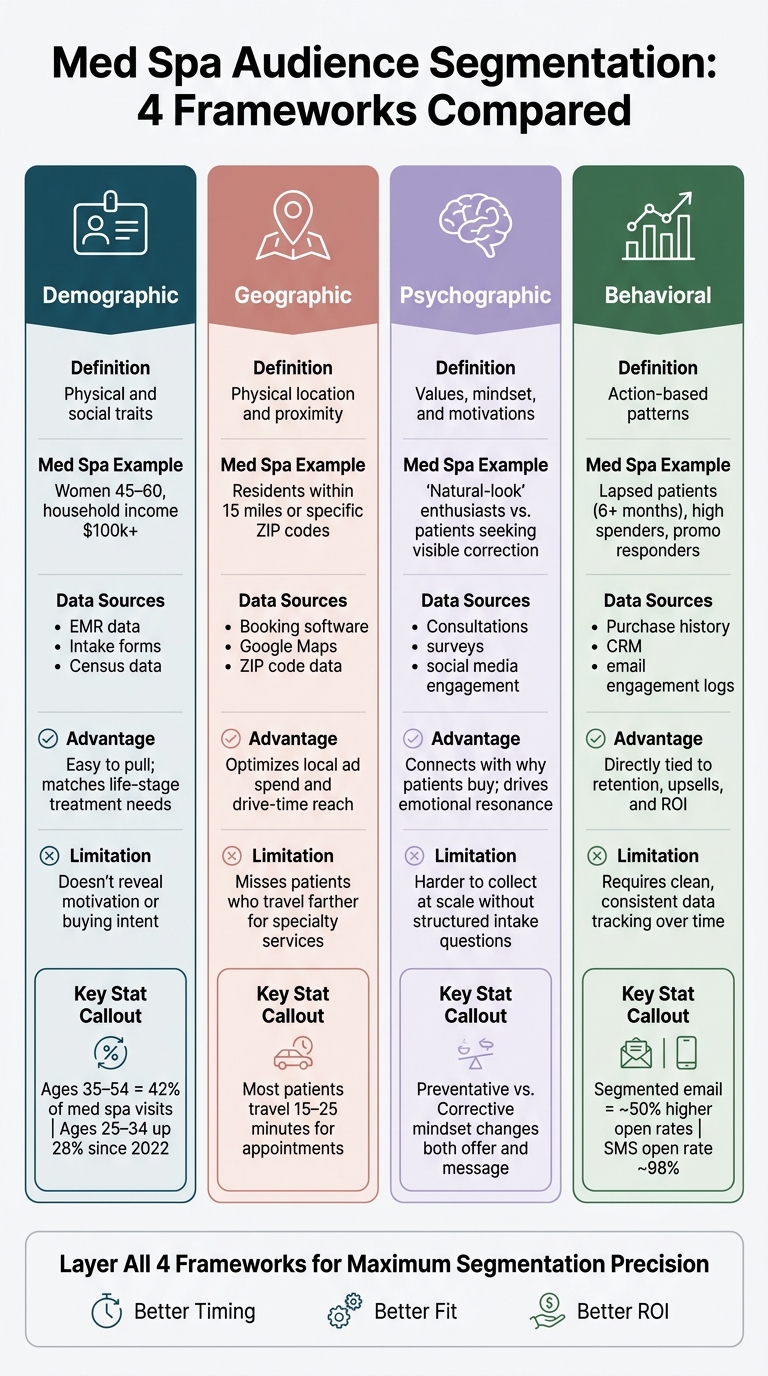
Med Spa Audience Segmentation: 4 Frameworks Compared
Demographic and Geographic Segmentation for Local Market Fit
Use these four lenses to sharpen the active, lapsed, and lead groups you’ve already mapped out.
Demographic segmentation answers a simple question: who is this person? For med spas, the most useful data points are age, gender, income, and life stage. Patients ages 35–54 account for the biggest share of med spa visits at 42%. At the same time, patients ages 25–34 are the fastest-growing group, up 28% since 2022.
That gap matters. A 29-year-old looking for preventative baby Botox is not shopping the same way as a 48-year-old focused on anti-aging or skin-firming treatments. If your marketing treats both groups the same, you can burn through budget without much to show for it.
Geographic segmentation adds another layer: where do they live, and how far will they go? Most patients travel 15 to 25 minutes for an appointment. That makes drive time and ZIP codes useful filters when you decide where to spend on ads, direct mail, or local campaigns.
Psychographic and Behavioral Segmentation for Better Offers and Messaging
Psychographic segmentation looks past surface traits and gets to why patients buy. Two people can have the same age, income, and ZIP code but want very different things. One may want subtle, natural-looking results and feel nervous about looking "overdone." Another may want more visible correction and feel ready to commit to a full treatment plan.
That’s why grouping patients by aesthetic mindset - preventative vs. corrective - can change both the offer and the message. The treatment may overlap, but the pitch shouldn’t.
Behavioral segmentation is where things get more concrete. It focuses on what patients do: how often they visit, how much they spend, which offers they respond to, and where they booked from. A high-spend patient who books on a steady cadence and never waits for a discount belongs in a very different segment than someone who only books after a bundle offer hits their inbox.
Booking data, purchase history, and email engagement help you split high-LTV patients from price-sensitive ones. From there, you can match offers to the habits each group already shows.
Comparison Table: Demographic, Geographic, Psychographic, and Behavioral Segmentation
Here’s how the four segmentation types play out in practice.
| Segmentation Type | Definition | Med Spa Example | Likely Data Sources | Advantage | Limitation |
|---|---|---|---|---|---|
| Demographic | Physical and social traits | Women 45–60, household income $100k+ | EMR data, intake forms, Census data | Easy to pull; matches life-stage treatment needs | Doesn't reveal motivation or buying intent |
| Geographic | Physical location and proximity | Residents within 15 miles or specific ZIP codes | Booking software, Google Maps, ZIP code data | Optimizes local ad spend and drive-time reach | Misses patients who travel farther for specialty services |
| Psychographic | Values, mindset, and motivations | "Natural-look" enthusiasts vs. patients seeking visible correction | Consultations, surveys, social media engagement | Connects with why patients buy; drives emotional resonance | Harder to collect at scale without structured intake questions |
| Behavioral | Action-based patterns | Lapsed patients (6+ months), high spenders, promo responders | Purchase history, CRM, email engagement logs | Directly tied to retention, upsells, and ROI | Requires clean, consistent data tracking over time |
Next, turn these frameworks into segment profiles and a simple scoring model.
Reading about the problem? See how Prospyr solves it in one platform.
Book a DemoHow to Build Usable Med Spa Segments Step by Step
Start with Business Goals and the Right Patient Data
Start with the business goal first. Then pull ONLY the patient data you need to support that goal.
If you're trying to improve retention, you don't need every data point in your system. You need the ones that show who comes back, who drops off, and who responds to outreach. Pull reports from your EMR or booking software and look for patterns in age, gender, ZIP code, most-purchased services, and average spend. Then layer in visit recency, booking frequency, and promo response.
A simple place to begin is the Active/Cooling/Lapsed/Reactivation model. It groups patients by how long it's been since their last visit:
- Active: 0–3 months
- Cooling: 3–6 months
- Lapsed: 6–12 months
- Reactivation: 12–18+ months
From there, tag patients by treatment cycle so your messaging shows up when it makes sense. Botox patients usually rebook every 3–4 months, while filler patients often return every 6–12 months. That timing matters. A reminder sent too early gets ignored. Too late, and the patient may book somewhere else.
These inputs become your working segments. Not theory. Not a giant spreadsheet no one opens. Actual groups you can target.
Use HIPAA-compliant systems, broad treatment categories, separate marketing lists, and a signed BAA.
Core Segment Profiles Med Spas Can Use Right Away
Start small. Two or three working profiles are enough at first. Add more only when your data shows a clear reason to.
The goal here is to turn raw data into labels your team can use every day. A front desk coordinator, patient care coordinator, or marketing lead should be able to look at a patient and know which message, offer, or follow-up fits best. Use recency, spend, and motivation to place patients into the closest-fit profile.
| Profile | Age Range | Primary Motivation | Key Treatments |
|---|---|---|---|
| Preventative Millennial | 25–35 | Proactive aging, natural results | Preventative Botox, Hydrafacials, peels |
| Career Professional | 35–50 | Professional confidence, efficiency, maintenance | Botox, fillers, laser resurfacing |
| High-Ticket Corrective | 45–65 | Volume restoration, reversing sun damage | PDO threads, RF microneedling, high-ticket packages |
| Men's Aesthetics Client | 35–55 | Discretion, professional edge, quick results | Botox for Men, hair restoration, body contouring |
| Bridal Client | 24–32 | Event timeline, high referral potential | Lip filler, skincare regimens, laser hair removal |
| Value-Driven Client | Varies | Deals, bundles, value | Flash sales, intro offers, loyalty perks |
Think of these as working labels, not fixed identities. Patients move between them all the time. Someone may start as a Bridal Client, then shift into a maintenance-focused profile later. Someone else may look value-driven at first, then turn into a high-spend repeat patient once trust is built.
That’s the whole point of segmentation: keep outreach tied to where the patient is NOW, not where they were six months ago.
How to Rank Segments Using a Simple Scoring Model
Once you have segments, the next step is figuring out which ones deserve the most attention.
A simple scoring model helps you compare revenue potential, retention likelihood, and ease of activation on a 1–5 scale.
| Factor | Low Score (1) | High Score (5) |
|---|---|---|
| Revenue potential | Low spend or occasional visits | Strong spend, memberships, or high-ticket service interest |
| Retention likelihood | No predictable return pattern | Regular visits and clear rebooking cycles |
| Ease of activation | Hard to reach or low engagement | Already engaged or easy to contact |
This gives you a simple way to rank segments based on your current goal.
If the practice is focused on retention, active patients and high-value members may move to the top. If the goal is filling the schedule, hot leads and lapsed patients may matter more. Same business, same patient base, different priority.
Update the scores monthly as results shift. That way, your team isn't working off stale assumptions. Use the top-ranked segments to guide offers, pricing, and follow-up in the next section.
Using Segmentation to Personalize Offers, Pricing, and Communication
Match Services, Bundles, and Memberships to Each Segment
Use your ranked segments to decide what to sell, how to price it, and when to promote it. This is the point where segmentation turns into actual offers.
Tiered memberships give patients a clear path to move up over time. Beauty banks work well for people who want room to choose, while service-specific memberships fit patients who come in often for the same treatment. A beauty bank charges a monthly fee that turns into credits for any service, which gives occasional users more freedom. Service-specific memberships are a better fit for frequent treatments like monthly facials or laser hair removal because they help patients stick to a routine.
For High-Ticket Corrective segments, bundled packages that combine lasers, injectables, and skincare into a rejuvenation plan tend to land better than à la carte pricing. It feels simpler. It also helps patients see the full treatment path instead of a menu of separate line items.
For Preventative Millennial segments, flexible payment options and loyalty programs can lower the barrier to long-term maintenance. For Value-Driven clients, a limited-time bundle - like a 6-pack of peels at a fixed rate - puts the focus on results, not just price.
One thing to avoid: discount-led offers for loyal patients. That can train people to hold off until the next deal and chip away at lifetime value.
Adjust Messaging, Channels, and Timing by Patient Behavior
Once the offer is set, match the message, channel, and timing to how the patient acts.
SMS has a 98% open rate and is usually read within three minutes. That makes it a strong choice for rebooking reminders, flash offers, and post-treatment check-ins with active patients. Email is a better fit for treatments that take more thought. Think educational content, before-and-after sequences, and longer nurture flows. In service industries, email brings an average ROI of $36 for every $1 spent.
Different segments respond to different angles:
- Use Instagram for Preventative Millennial clients with education-first content and a natural-results angle.
- For Men's Aesthetics clients, keep the language direct and focus on efficiency, discretion, and results through email or SMS.
- For High-Ticket Corrective patients, a personal email or direct SMS that highlights VIP treatment and exclusive access helps set the right tone.
Timing matters too. Send promotional emails Tuesday through Thursday, between 9–11 AM or 1–2 PM. Trigger Botox reminders at week 11–12 after treatment, and filler reminders at six months.
Plan Retention, Upsell, and Win-Back Flows by Segment
Map each segment across a 6- to 12-month cycle. The goal changes based on where the patient is in that cycle.
For an Active patient, the job is to get the rebooking done before they drift away. For a Drifting patient at the six-month mark, re-engage them with education. For a Lapsed patient at 12+ months, lead with a check-in consultation instead of a discount.
| Stage | Timing | Recommended Action |
|---|---|---|
| Active (Warm) | 3 Months | Personal SMS for Botox rebooking or skin maintenance |
| Drifting | 6 Months | Email on filler longevity or "next phase" skin treatments |
| Lapsed | 12 Months | "We miss you" check-in consultation offer |
| Win-Back | 18+ Months | Highlight new devices, refreshed menus, or new practitioners |
Cross-sell opportunities should come from behavior, not pressure. A Preventative Millennial patient who has been getting HydraFacials for six months is a natural fit for a conservative Botox conversation. That’s not a hard sell. It’s simply the next step that makes sense, introduced at the right point in the patient journey.
Build these flows into your system so recalls, renewals, and win-back outreach happen automatically.
Making Segmentation Part of Daily Practice Operations
Once segments shape your offers and follow-up, the next step is simple: build them into daily work.
Set Up Segments in Patient Records, Scheduling, and Marketing Lists
Segmentation falls apart when patient records, scheduling, and marketing all run on different tags. Your front desk sees one thing, providers see another, and marketing works from a third list. That kind of split creates confusion fast.
A better setup is to use the same tags across every system your team touches.
Start in the patient record. Tag patients by broad treatment category, not by specific clinical diagnosis. For example, use "Injectables" or "Skin Maintenance" instead of listing a medical condition. That gives your team enough context to act while helping you stay on the right side of HIPAA.
Along with those tags, keep a few other details in the same place:
- communication preferences
- consent status
- spend level
That way, the data stays current and easy to find.
In scheduling, add short segment-based notes to appointment types. Those notes can help staff handle check-in, rebooking, and bundle conversations without guessing what matters to that patient.
On the marketing side, sync those same tags to your CRM and SMS lists so updates happen on their own. Keep marketing and clinical communication lists fully separate. And for every marketing contact, make sure you have a recorded, verifiable opt-in.
That only works well when the whole team uses one system of record.
How Prospyr Supports Segmentation Workflows Across the Practice
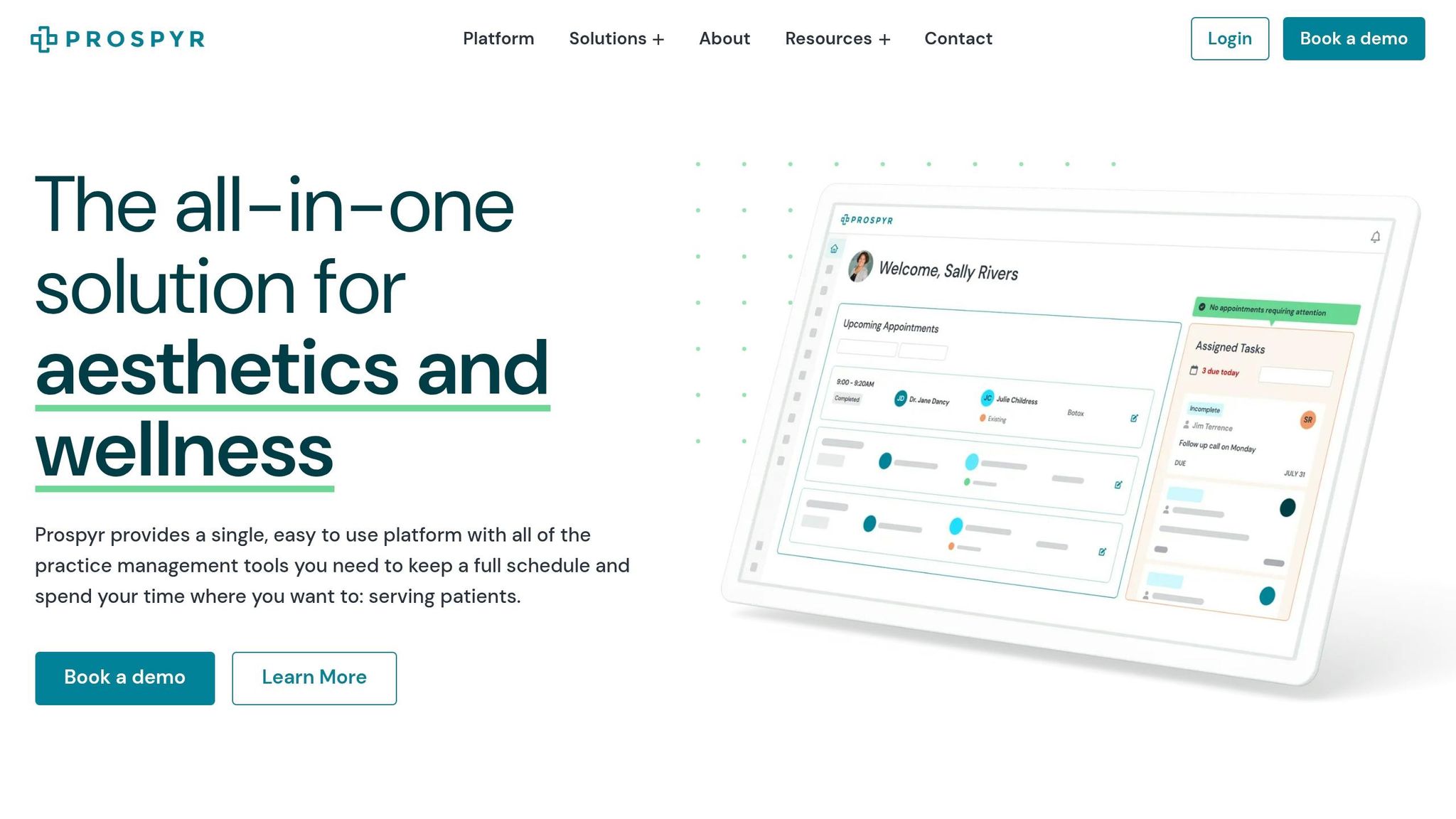
Prospyr brings together CRM/EMR, intake, email/SMS, automation, analytics, and membership management in one HIPAA-compliant system, so segment tags and triggers stay linked.
Here’s what that looks like in practice:
- Digital intake forms send patient preferences and treatment interests straight into the patient profile when the form is submitted.
- Lead capture tools tag new inquiries by interest area before they book.
- Email and SMS campaigns can be built around those tags.
- Marketing automation manages timing for rebooking reminders, membership renewal notices, and win-back sequences for patients who have been inactive for more than a year.
- Practice analytics show segment performance live, so you can spot which groups are growing, which are drifting, and where revenue is coming from.
After the setup is done, performance data helps you keep those segments current instead of letting them sit untouched.
Track Segment Metrics, Test Changes, and Refine Over Time
Track segment performance every month, then test one variable at a time. If you don’t watch the numbers, segmentation can turn into nothing more than neatly labeled data that no one uses.
The table below shows the main benchmarks to watch and what to do when a number slips:
| Metric | Med Spa Benchmark | Action if Below Benchmark |
|---|---|---|
| Open Rate | 25–40% | Test subject lines; run list hygiene |
| Click-Through Rate | 2–5% | Improve CTA placement and copy clarity |
| Conversion Rate | 1–3% | Simplify the online booking flow |
| Unsubscribe Rate | < 0.5% | Improve segmentation; reduce send frequency |
| Hard Bounce Rate | < 2% | Remove invalid addresses immediately |
Each month, run one A/B test on a single variable, like a subject line, send time, or CTA. Keep it narrow. If you change three things at once, you won’t know what moved the result.
Every quarter, audit your lists. Suppress anyone who hasn’t engaged in 180+ days, and review your automation sequences to make sure treatment protocols and pricing still match what you offer. Then once a year, revisit your main segment definitions so they line up with shifts in your local market or your practice focus.
More messages don’t always mean better results. Relevance usually does more work than volume.
Conclusion
Key Takeaways for Med Spa Audience Segmentation
Once your segments are live, keep them simple, useful, and measurable. Build them from real patient data, not guesswork. A good place to start is with EMR and booking data tied to your main goal, then shape 2 or 3 segments your team can actually use.
Next, connect each segment to one offer, one marketing channel, and one follow-up window. That’s where segmentation starts to pay off. When the message fits the patient and arrives at the right time, results tend to improve.
The numbers back that up. Segmented email can lift engagement, personalized offers can lead to more conversions, and stronger retention can build more return over time.
It also helps to keep the same tags across patient records, scheduling tools, and marketing lists. Review results on a regular basis, look at segment-level metrics to adjust what you send, and audit your lists every quarter. Segmentation isn’t a set-it-and-forget-it job. It gets better when you use it with care and stay consistent.
Simple, steady segmentation can turn patient data into repeat revenue.
FAQs
How do I start segmenting with limited patient data?
Even if your data set is small, you can still get started with what your practice already has. Look through patient records in your booking software or EMR and watch for patterns in demographics, visit frequency, and treatment history.
Then layer in the human side. Ask front-desk and clinical staff what goals patients talk about most, what worries come up, and what objections they hear before someone books. You can also scan online comments or send a short three-question survey to get a clearer sense of what drives patient decisions.
What segment should a patient move into over time?
As patients move through their aesthetic journey, their segment should change too. That shift should reflect where they are in the relationship, how often they come in, and the signals they give through their actions.
A patient shouldn’t stay in a prospect segment after they’ve booked or completed a first visit. Instead, move them into new-patient onboarding, then into established-patient retention based on their treatment cycle. That way, your messaging matches what’s happening in their care.
For example, someone who goes from an initial consultation to regular maintenance should move into segments built around results, follow-up timing, and the next best services to consider. Prospyr can help automate these moves by using treatment history and engagement data.
How can I segment patients without risking HIPAA issues?
Prioritize data security and clear patient consent. Use a HIPAA-compliant platform like Prospyr to keep CRM and EMR data in one secure place.
Don’t upload PHI to third-party advertising platforms. Instead, build audience segments inside your secure system with demographic and interest-based filters, and make sure you have documented written authorization before using identifiable patient data for marketing.