Top Features for Recurring Appointment Software
Key features for med spas: automated series, flexible scheduling, self-booking, payments, reminders, HIPAA security, and analytics.
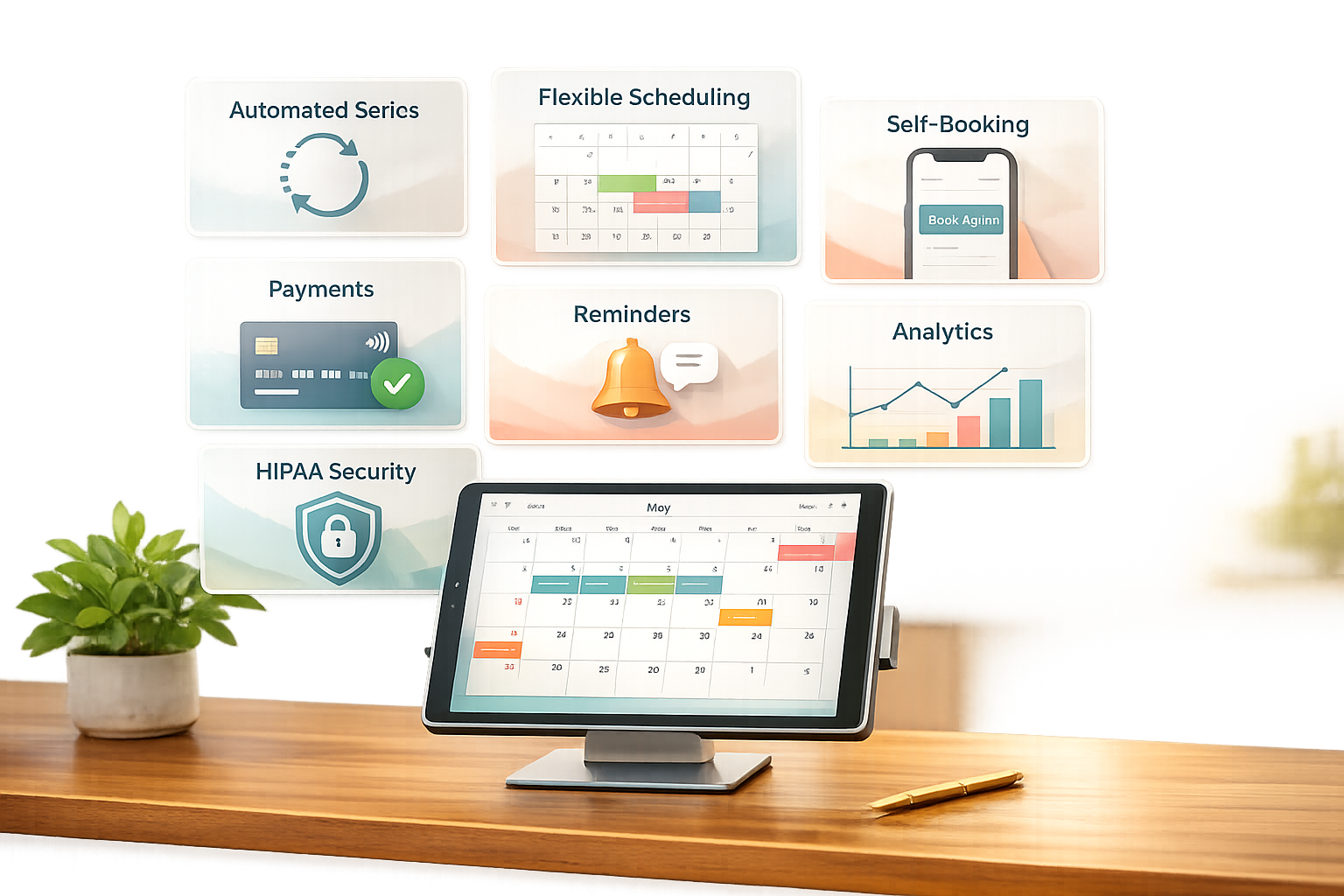

Recurring appointment software is essential for managing med spas and wellness clinics efficiently. It simplifies booking, reduces administrative workload, and ensures steady revenue. Here’s a quick breakdown of its key features:
- Automated Scheduling: Pre-book entire treatment plans, reduce errors, and maintain predictable income.
- Flexible Options: Handle different appointment rhythms, adjust for holidays, and manage prep times.
- Client Self-Booking: Empower clients to manage their own appointments online, reducing front desk calls. This often includes digital intake forms to streamline the check-in process.
- Integrated Payments: Automate deposits, installments, and billing for series packages.
- Reminders: Send email and SMS notifications to reduce no-shows.
- Team Scheduling: Sync calendars, avoid double-booking, and manage resources like rooms and equipment.
- HIPAA Compliance: Protect patient data with encryption, access controls, and secure communication.
- Analytics: Track metrics like retention and rebooking rates to optimize client engagement.
These tools help clinics run smoothly, improve client satisfaction, and grow revenue. Platforms like Prospyr combine all these features in one system, making appointment management easier and more secure.
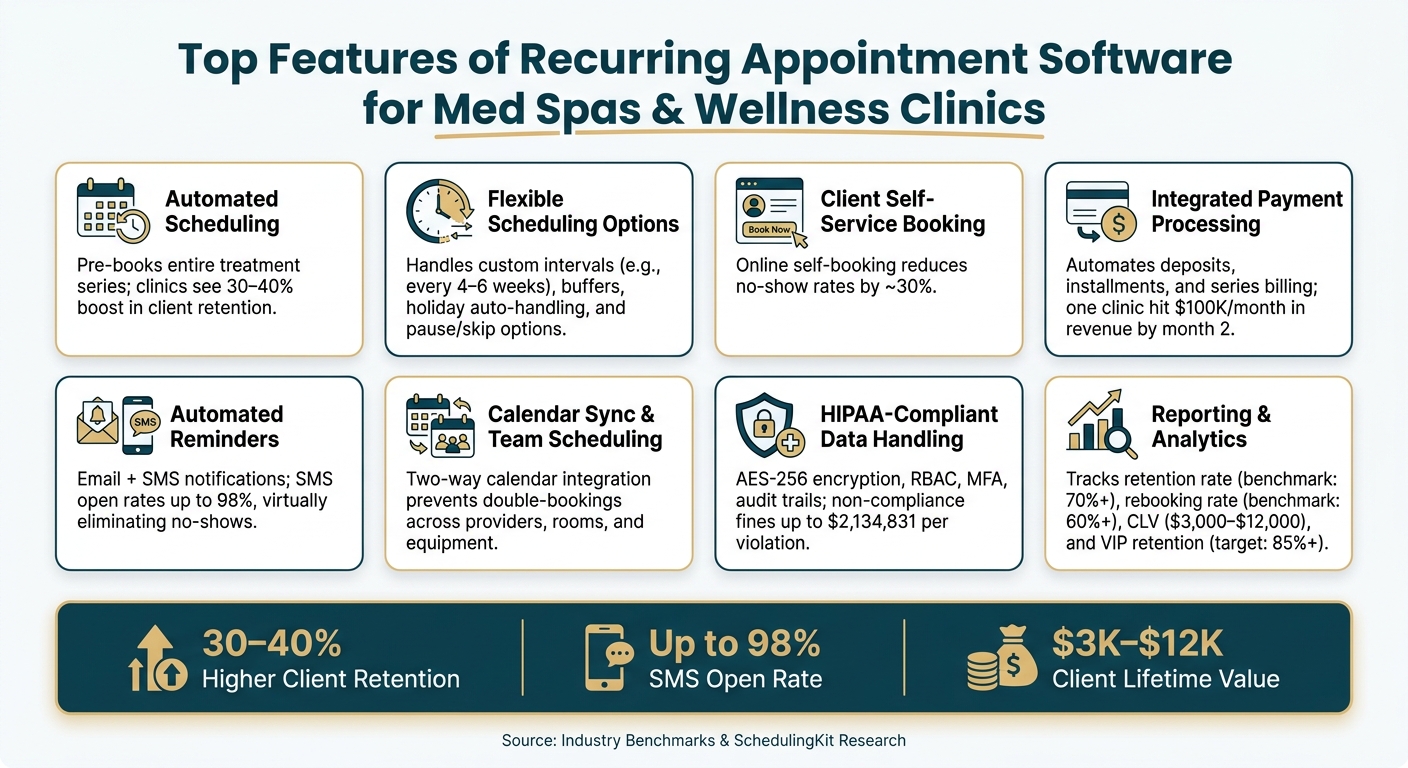
Key Features of Recurring Appointment Software for Med Spas
1. Automated Recurring Series Creation
Rebooking every client visit manually can be a huge drain on administrative resources. Automated recurring series creation simplifies this by setting up an entire treatment schedule in one step, pre-booking all necessary sessions. For example, whether it's a six-session laser hair removal package spaced every 4–6 weeks or monthly facials as standing appointments, the system handles everything automatically.
This approach not only saves time but also ensures consistent revenue. As SchedulingKit explains, "Recurring appointments automate the rebooking process so both you and your client save time, your calendar stays full, and you build predictable revenue." Take this example: 50 weekly recurring clients at $80 per session translate into $4,000 in guaranteed weekly income. Clinics using such systems often experience a 30–40% boost in client retention rates.
In addition to revenue benefits, automated scheduling reduces errors by checking availability to avoid double-bookings or resource conflicts. These systems can even adjust for holidays or clinic closures, rescheduling appointments to the next available slot. This level of efficiency is especially important for med spas and wellness clinics looking to streamline operations and keep clients coming back.
Here’s a quick look at how automation benefits different services:
| Service Type | Typical Recurrence | Automation Benefit |
|---|---|---|
| Injectables (Botox/Fillers) | Every 3–4 months | Automatically schedules 2-week safety follow-ups |
| Laser Hair Removal | Every 4–6 weeks | Pre-books entire multi-session packages |
| Facials/Skin Care | Monthly | Ensures consistent revenue with standing appointments |
| Chronic Maintenance | Weekly/Biweekly | Cuts down admin time for repeat clients |
One effective tip: offer a 10–15% discount to clients who commit to a recurring series upfront. This not only encourages long-term bookings but also makes it easier to predict revenue and reduces last-minute cancellations.
sbb-itb-02f5876
2. Flexible Scheduling Options
Flexible scheduling takes automated series creation a step further by accommodating the varied appointment rhythms med spa clients require. Treatments like laser hair removal might need sessions every 4–6 weeks, Botox touch-ups every 3–4 months, or a monthly facial scheduled on the first Tuesday. A recurring appointment system can manage these patterns effortlessly, eliminating the need for manual adjustments. This adaptability is crucial for meeting the unique timing needs of different treatments.
An effective scheduling system should allow you to define series endpoints - whether by a set number of sessions, a specific date, or as ongoing until cancellation. This clarity ensures package deals and subscription services are managed efficiently, keeping your calendar accurate and billing hassle-free.
Another key aspect is treatment-specific timing. Kyle Mills of Reviva highlights this by stating:
"If a treatment requires a specific numbing period or additional setup time, the software should automatically adjust the available slots to accommodate these needs."
This means the system should account for prep, recovery, and setup time, ensuring providers stay on track and clients remain comfortable. Additionally, enabling appointment scheduling 60–90 days in advance, with built-in 5–10 minute buffers, further enhances schedule accuracy.
| Scheduling Feature | Why It Matters |
|---|---|
| Custom intervals (e.g., every 6 weeks) | Matches treatment cycles for services like laser hair removal |
| Buffer/prep time | Keeps providers on schedule and ensures client comfort |
| Fixed vs. ongoing end conditions | Clearly defines whether appointments are part of a package or subscription model |
| Instance skipping/pausing | Allows adjustments for client travel or illness without canceling the entire series |
| Holiday auto-handling | Automatically reschedules appointments falling on holidays to the next available time slot |
3. Client Self-Service Booking
Building on automated scheduling and flexible timing, client self-service booking puts patients in charge of managing their recurring appointments. By allowing clients to book their own sessions online, your front desk staff can focus on in-clinic tasks instead of handling routine calls or manually entering data. This client-first approach works hand-in-hand with automated scheduling to create a smooth and hassle-free booking experience.
Clients can easily book treatments like microneedling, Botox, or even multi-session packages at their convenience, pre-scheduling entire series if needed. This system not only simplifies scheduling but also gives clients the freedom to manage their appointments directly.
For more complex or first-time procedures, consultations may be required before booking. A good system should allow you to control which services are available for online booking and which require staff involvement. As the PatientNow team explains:
"Define which treatments are available for online booking and which need a consultation."
A well-designed client portal can also provide additional features like access to treatment history, digital intake forms, and appointment management. Combined with automated confirmations, these tools can help reduce no-show rates by approximately 30%.
Kyle Mills of Reviva highlights the importance of making the process effortless:
"The rebooking process should be smooth, taking just seconds to complete."
Whether accessed through a desktop or mobile device, rebooking should be quick and easy. This ensures your recurring appointment calendar stays full while boosting efficiency and client satisfaction.
4. Payment Processing for Appointment Series
Once the booking process is running smoothly, the next step is ensuring payments are handled efficiently. For recurring appointment series, having a system that automates payment collection is crucial. Built-in tools can manage billing from the first booking all the way through to the final payment, saving time and reducing errors.
One feature to prioritize is the ability to collect deposits at the time of booking. Asking for a deposit upfront not only secures the client’s commitment but also protects your revenue in case of last-minute cancellations. For higher-priced packages, offering split payment options makes it easier for clients to afford premium services without creating financial strain for your practice.
Automated billing for memberships and packages is another game-changer. It eliminates the need for manual invoicing, helping maintain steady cash flow while freeing your team from chasing payments every billing cycle. Additionally, sending payment links directly to clients allows for convenient remote payments, which is especially handy for pre-paying an entire series before the first session.
In 2024, SOM Aesthetics, founded by Dr. Saami Khalifian and Dr. Jess Shisler, achieved remarkable success by using Prospyr's platform. Through automated memberships and packages, the practice generated $40,000 in sales within two days and reached $100,000 in monthly revenue by their second month - exceeding their initial goals by 21 times.
"Prospyr has helped us launch SOM Aesthetics like a rocketship. Their powerful platform and helpful support have enabled us to exceed our financial targets while delivering an unmatched experience for our patients." - Dr. Saami Khalifian, Founder and CEO, SOM Aesthetics
When choosing software for recurring appointments, don’t overlook payment processing. The most effective systems integrate billing seamlessly with scheduling, ensuring that every booking, reminder, and payment confirmation works together as part of a unified process. This integration supports smooth operations, making it easier to run a med spa or wellness clinic efficiently.
Reading about the problem? See how Prospyr solves it in one platform.
Book a Demo5. Automated Reminders and Notifications
Even the most organized clients can occasionally miss recurring appointments. By automating reminders, you save staff time while also securing your revenue. This kind of system works hand-in-hand with the flexible scheduling and self-service booking features discussed earlier.
A smart strategy uses both email and SMS reminders at carefully chosen intervals. Sending an email 2–3 days before an appointment gives clients enough time to reschedule if needed, staying within your cancellation policy. Then, a short SMS reminder 1–8 hours before the appointment acts as a final nudge. With SMS open rates reaching up to 98%, these messages are highly effective at keeping appointments on track.
Each method serves a purpose: emails are perfect for sharing detailed appointment information, while SMS is ideal for quick, last-minute reminders. To make these messages even more effective, include key details like the client's name, service, appointment date and time, and a link to reschedule if necessary. This approach significantly reduces no-shows and makes rescheduling easier for everyone.
"Most of us are busy and we just need a little reminder at times. The email and text reminders have helped make my no-calls/no-shows nonexistent." - A Little Gelly
Automated reminders aren’t just for clients. Push notifications for staff can ensure smooth coordination. For instance, an alert 15 minutes before an appointment helps staff stay on top of their schedules. When these reminders are integrated directly into your aesthetic practice management software, everything stays aligned, minimizing errors and cutting down on administrative work.
6. Calendar Sync and Team Scheduling
Managing schedules in multi-provider clinics is a juggling act. To keep everything running smoothly and avoid conflicts, synchronized calendars are essential. By combining automated scheduling with two-way calendar integration, you can ensure that team availability and resource allocation align perfectly with client bookings. As Kyle Mills from Reviva aptly puts it:
"Scheduling in a medspa is no small feat - it's like air traffic control for your practice."
Two-way calendar integration is the backbone of effective team scheduling. When a provider blocks off time in tools like Google Calendar or Outlook, that time slot is automatically marked as unavailable in the booking system. Similarly, any changes made by clients are instantly reflected in the master calendar. This automation eliminates the risk of manual entry delays that can lead to double-bookings or scheduling errors.
The system goes beyond just managing provider availability. It also treats treatment rooms and equipment as bookable resources, ensuring that everything from laser machines to consultation rooms is scheduled without overlap. The team at PatientNow explains it well:
"The best med spa booking systems help you assign rooms, devices, or providers to each appointment. This ensures that your laser machine is not double-booked and that providers' schedules remain balanced."
Double-booking remains one of the most common operational headaches for medical spas in the U.S., with equipment conflicts being a significant factor.
To streamline operations further, two small but impactful strategies can make a big difference. First, add a 5–10 minute buffer between complex appointments. This prevents one delay from derailing the rest of the day. Second, group similar treatments together, such as scheduling all injectable procedures in the morning. This approach helps providers maintain focus, reduces room turnover time, and keeps the day running efficiently - all while minimizing stress for the team.
7. HIPAA-Compliant Data Handling
Recurring appointments involve managing sensitive patient data repeatedly. For example, every time a client schedules a series of laser treatments or injectable sessions, their Protected Health Information (PHI) passes through your system. This makes secure data handling absolutely crucial.
Failing to comply with HIPAA can result in hefty fines and a loss of client trust - penalties can soar up to $2,134,831 per violation. Beyond the financial hit, a single data breach could permanently damage the reputation and trust you've built with your clients. As DaySmart Appointments highlights:
"HIPAA compliance isn't just a box to check off. It's the standard for being a reliable medical provider that patients are happy to return to."
To safeguard PHI, encrypt data using AES-256 while it's stored and TLS 1.2+ during transmission. Additionally, implement role-based access control (RBAC) to restrict data access based on job roles. Audit trails should log every action, such as who accessed or modified a record and when. Pair these measures with multi-factor authentication (MFA) and automatic logoff on shared devices to enhance security.
A common pitfall to avoid: SMS and email are not HIPAA-compliant for transmitting PHI. Appointment reminders should steer clear of including specific treatment details. Instead, use generic messages like "Appointment with Dr. Smith" to maintain privacy. For any communication involving medical details, rely on secure, encrypted client portals.
Before committing to any scheduling software, confirm that the provider signs a Business Associate Agreement (BAA). This legal document ensures the vendor is held responsible for protecting patient data. As AestheticsPro puts it:
"If your software provider won't sign a BAA with you, they're not HIPAA compliant. Period."
Be cautious of platforms that use vague terms like "HIPAA-ready" or "HIPAA-friendly" without offering a BAA. Prospyr stands out by embedding HIPAA compliance into its core design - not as an afterthought. This makes it a dependable choice for aesthetics and wellness clinics managing PHI in recurring appointment workflows. With strong data protection measures in place, Prospyr ensures secure and seamless operations.
8. Reporting and Analytics for Recurring Bookings
Once you've set up automated scheduling and payment integration, the next step is using analytics to fine-tune your recurring appointment strategies. Great scheduling software doesn’t just handle bookings - it also uncovers patterns in client behavior. Without proper reporting, clinics risk missing out on crucial insights about client retention, revenue trends, and which services keep clients coming back.
Here’s a startling fact: med spas lose 40–50% of new clients after their first treatment. But here’s the flip side - if you can turn a client into a loyal one, their lifetime value can range from $3,000 to $12,000. That’s why tracking the right metrics and acting on them is so important.
Some of the most important metrics to monitor include:
- Client Retention Rate: This tells you how many clients stick around over time.
- Rebooking Rate: Tracks how often clients schedule their next appointment within the ideal timeframe - like every 4–6 weeks for HydraFacial or every 12–14 weeks for Botox.
- Client Lifetime Value (CLV): Shows the long-term financial impact of keeping clients on a recurring schedule.
One metric that often flies under the radar is the VIP Retention Rate. The top 20% of your clients typically account for 65–75% of your revenue. Keeping these high-value clients engaged is crucial, and the goal should be to retain at least 85% of them. Analytics tools can also help you spot potential revenue losses by flagging VIP clients who haven’t booked in their usual timeframe. Reaching out to a lapsed client within 1–2 weeks of their missed appointment window can be three times more effective than waiting months.
Here’s a quick breakdown of key metrics and their benchmarks:
| Metric | Formula | Industry Benchmark |
|---|---|---|
| Client Retention Rate | ((Active Clients at End – New Clients) / Active Clients at Start) x 100 | 50–60% (Avg); 70%+ (High) |
| Rebooking Rate | (Clients Rebooked in Optimal Window / Total Clients Treated) x 100 | 40–50% (Typical); 60%+ (Strong) |
| Service Mix Ratio | Total Distinct Services / Total Clients | 1.5–2.0 (Typical); 2.5+ (Effective) |
| VIP Retention Rate | VIP Clients Retained / Total VIP Clients at Start | 85%+ (Target) |
9. Integration with Practice Management Tools
Integration takes scheduling and notifications a step further by connecting all practice management functions into one streamlined system. It bridges the gap between CRM, EMR, and payment processing, turning insights into actionable workflows. Instead of juggling isolated systems, this connectivity reduces manual tasks and minimizes errors across the board.
For example, when a client books a recurring laser hair removal series, integration kicks off several processes automatically: sending digital intake forms, updating EMR records, reserving clinical resources, and scheduling reminders. By syncing scheduling with clinical and financial data, this approach ensures a smooth and efficient experience, perfectly aligned with the needs of recurring appointment management. As Prospyr explains: "Online booking directly addresses everyday challenges by eliminating missed calls, reducing front-desk bottlenecks, and minimizing scheduling errors".
Integration also plays a big role in resource management. By treating rooms and devices as bookable assets, it prevents scheduling conflicts before they arise - especially important for recurring treatments.
Clinical safety is another key benefit. When scheduling integrates with the EMR, staff can access a client’s complete treatment history before confirming appointments. This allows the system to enforce safety rules, like ensuring a chemical peel isn’t scheduled too soon after a laser resurfacing treatment. These safeguards are built directly into the booking workflow.
"Appointment scheduling for aesthetic clinics is more than an administrative function. It is an opportunity to show patients that your clinic values their time, safety, and comfort." - PatientNow Team
Additionally, integration simplifies memberships, packages, and payments by automatically tracking pre-paid sessions, processing renewals, and syncing payment data in real time. The result? A practice that operates more efficiently and a client experience that feels effortless from start to finish.
10. Prospyr's Recurring Appointment Capabilities
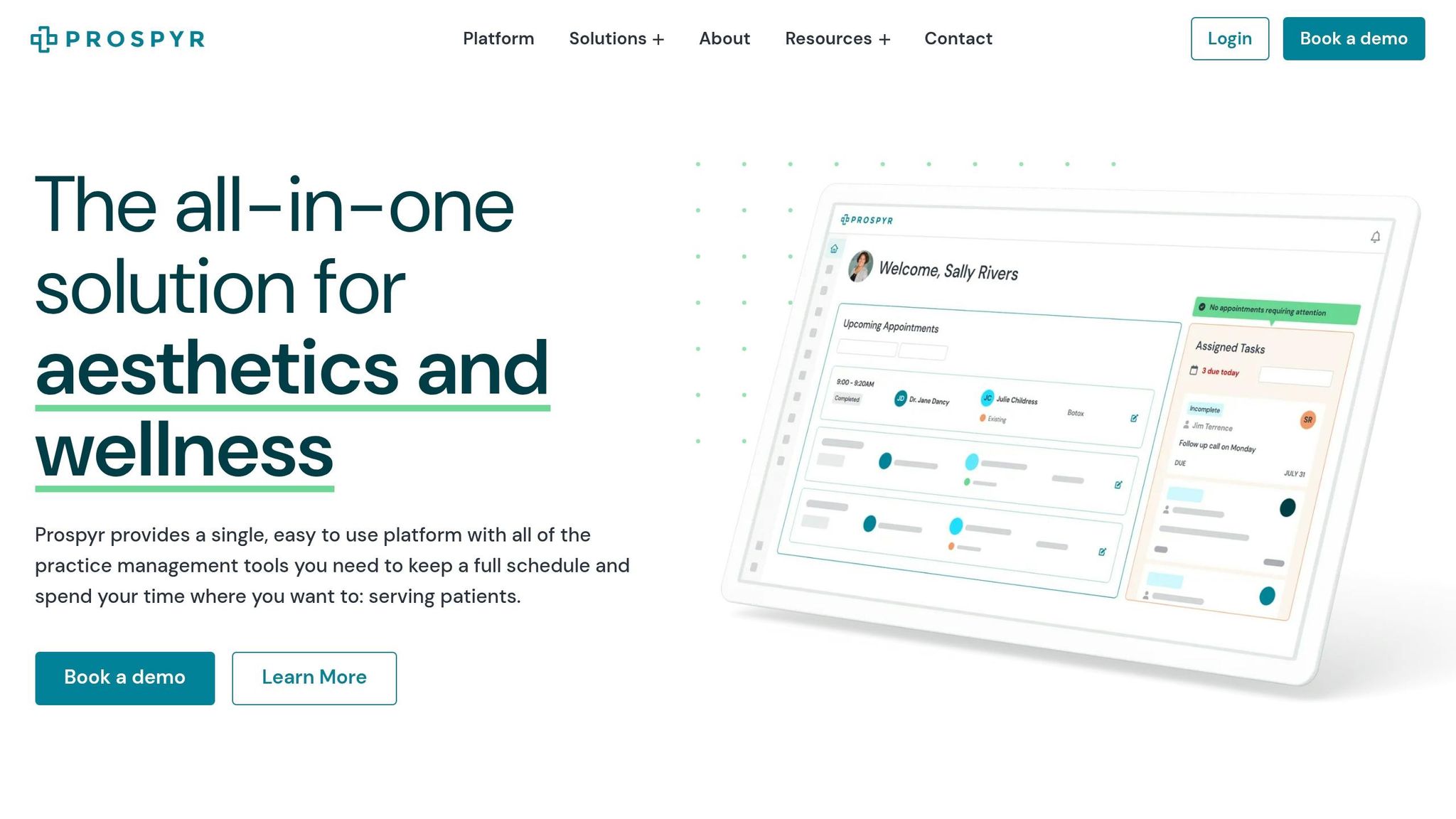
Prospyr brings together all the essential tools that aesthetics and wellness clinics need into one streamlined platform. Instead of juggling multiple systems, clinics can handle scheduling, payments, reminders, HIPAA-compliant data management, and analytics - all in one place. On the scheduling front, Prospyr's integrated system includes conflict detection, automatically resolving room and device overlaps. This makes managing appointments smoother and more efficient for med spas and wellness clinics. Plus, clients can book their own appointments through a self-service portal, while Prospyr's AI-driven booking tools reduce the need for staff involvement.
Payments are just as seamless. Prospyr supports prepaid series packages, installment plans, and auto-charging per session. It also automates deposits and no-show fees, simplifying financial management. Dr. Daniel Lee from New Life Cosmetic Surgery experienced impressive results after adopting Prospyr, reporting a 50% increase in revenue and a 40% rise in appointments booked:
"We've seen a 50% increase in revenue and a 40% increase in appointments booked since switching away from using several different point solutions to running our practice on Prospyr." - Dr. Daniel Lee, Founder, New Life Cosmetic Surgery
Prospyr also excels in providing operational insights. Its analytics dashboard tracks key metrics like series completion rates, no-show patterns, and revenue per recurring client. All of this is managed within a HIPAA-compliant framework, featuring end-to-end encryption, role-based access, and audit logs to ensure patient data remains secure during recurring appointments.
Wrapping It Up
When it comes to choosing the right recurring appointment software, there are a few must-have features: automated series creation, flexible scheduling, client self-booking, integrated payments, smart reminders, calendar sync, HIPAA-compliant data handling, and actionable analytics. For med spas and wellness clinics, these tools are critical for running day-to-day operations smoothly and keeping patients coming back.
The PatientNow Team puts it best: "Think of your appointment schedule as the silent partner in your clinic's success." The right software operates behind the scenes, simplifying complex tasks so your staff can focus on what really matters - delivering exceptional patient care. These features don’t just make life easier; they’ve been shown to directly boost revenue, as industry experts confirm.
Those opening a med spa need software that’s tailored to their unique requirements, such as managing Good Faith Exams, tracking consent, resolving device conflicts, and handling multi-session packages. A platform designed specifically for these clinical needs - and built to meet HIPAA standards - can make all the difference.
Dr. Saami Khalifian’s experience with SOM Aesthetics offers a clear example. By implementing Prospyr, they saw impressive revenue growth in a short time. Prospyr streamlines the entire appointment management process into one unified system, delivering on the promise of simplifying operations for med spas and wellness clinics while eliminating the headaches of juggling multiple tools.
If your clinic is ready to ditch the patchwork approach and embrace a seamless, compliant, and profitable scheduling system, check out Prospyr. It might just be the game-changer your practice needs.
FAQs
How do I set up a recurring series for a treatment package?
To create a recurring series for a treatment package, use an automated scheduling tool to set up patterns like weekly, biweekly, monthly, or even custom intervals. Decide on an end condition - this could be a specific number of sessions, a particular end date, or an open-ended arrangement that continues until canceled. The system will handle rebooking automatically, simplify payment processing, and give clients the flexibility to manage or modify their appointments as needed.
What should reminders include to stay HIPAA-compliant?
To ensure HIPAA compliance, use secure communication channels like SMS or email for appointment reminders. Keep the messages privacy-focused, avoiding sensitive details. For optimal timing, send reminders 48 hours and 24 hours before the appointment to safeguard patient information while maintaining confidentiality.
Which recurring-booking metrics should my med spa track?
To make the most of recurring bookings, it’s crucial for your med spa to monitor key metrics like no-show rates, appointment trends, client retention, rebooking rates, and waitlist fill rates. Keeping an eye on these numbers can streamline your scheduling process and boost client satisfaction.