Multi-Location Scheduling for Med Spas: Guide 2025
Streamline multi-location med spa operations with centralized scheduling, automated reminders, resource tracking, and HIPAA-compliant patient management.

Managing schedules across multiple med spa locations can feel overwhelming, but it doesn't have to be. Here's the bottom line: a centralized scheduling system is key to improving efficiency, reducing errors, and boosting revenue. Without it, you risk double bookings, wasted resources, and frustrated clients, which can quickly add up to financial losses.
Key Takeaways:
- Disorganized workflows cost 46% of healthcare organizations significant revenue annually.
- A single no-show can lose $500 weekly, or $26,000 a year - multiplied across locations, the impact grows.
- The med spa scheduling software market is projected to grow from $7.22 billion in 2025 to $15.46 billion by 2034.
What You Need to Know:
- Centralized Systems: Combine scheduling, client records, and inventory management to avoid double bookings and inefficiencies.
- Tailored Schedules: Create location-specific calendars while maintaining a master view for overall management.
- Automation: Use tools like automated reminders, waitlists, and pre-scheduling to reduce no-shows and save time.
- Client Experience: Offer online booking, a unified portal, and clear communication to simplify the process for clients.
- Data Insights: Analyze scheduling trends to identify bottlenecks, optimize resources, and prepare for peak periods.
Whether you're expanding a single location or managing multiple sites, modern scheduling tools like Prospyr can simplify operations while improving client satisfaction. The right system doesn't just organize your business - it helps it grow.
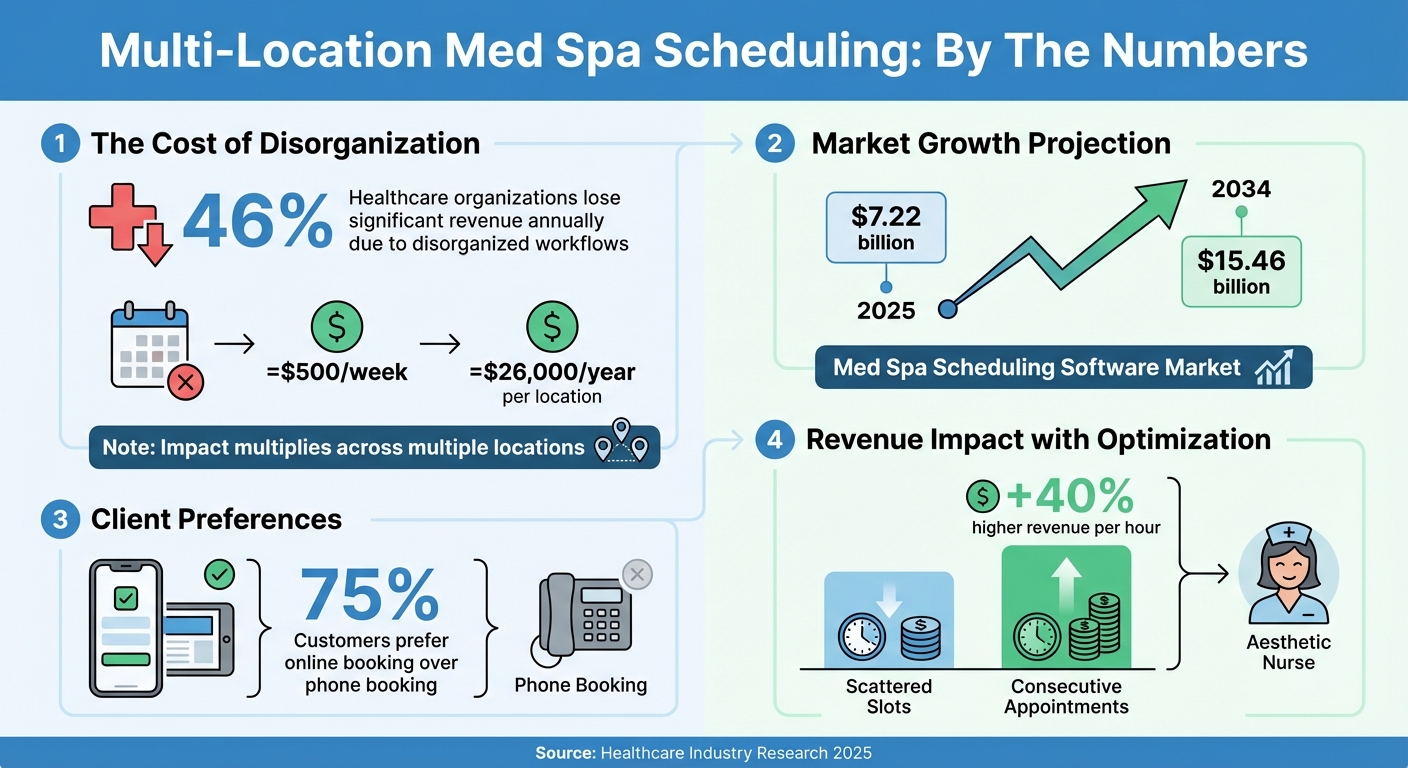
Multi-Location Med Spa Scheduling Statistics and Market Growth 2025-2034
Setting Up Multi-Location Scheduling
Create a seamless system that ties all locations together while addressing the specific needs of each branch.
Centralized Scheduling System
Start with a single platform that combines scheduling, client records, and inventory management into one easy-to-navigate dashboard. This eliminates the hassle of jumping between multiple apps and helps avoid double-bookings. With real-time availability visible across all locations, your team can make better staffing decisions.
A key benefit? Client records can move effortlessly between locations, ensuring consistent and informed care. To protect sensitive patient information, choose a platform that’s HIPAA-compliant.
Additionally, customize calendars for each location to manage resources and schedules in a way that fits the specific needs of that branch.
Configuring Location-Specific Calendars
Set up individual calendars for each branch while maintaining a master calendar for overall management. Assign staff to specific locations so their availability is limited to the branch they’re scheduled to work at. This avoids mix-ups, like accidentally booking a provider at two locations at the same time.
Tie rooms and equipment to certain appointment types, and adjust appointment durations and buffer times based on the service. This prevents delays from piling up throughout the day.
Each calendar should reflect the services offered at that location. For instance, CoolSculpting might only be available at your flagship clinic, while a satellite office offers different treatments. Don’t forget to adjust pricing based on each branch’s costs and local market conditions.
Client Booking Options
Once your calendars are tailored, make booking easier for clients by using a location-first selection tool. An online booking widget that asks clients to choose their preferred clinic simplifies the process. Recent studies show that 75% of customers prefer booking appointments online rather than over the phone.
Include automated reminders that clearly state the appointment location to minimize no-shows. For multi-session treatments like laser hair removal, let clients book all their sessions upfront. This not only locks in revenue but also ensures a smooth treatment schedule.
Offer a unified client portal where patients can log in to view their complete treatment history, upcoming appointments across all locations, and fill out digital intake forms. Use role-based permissions so front desk teams can access calendars for all branches, making it easier to redirect clients if their preferred location is fully booked.
sbb-itb-02f5876
Cut your no-shows in half
The same reminder, deposit, and waitlist-backfill playbook Prospyr practices use — free, no calculator required.
Key Features of an Effective Multi-Location Scheduling Solution
A solid scheduling platform is a game-changer when it comes to avoiding double bookings, resource conflicts, and client frustrations. The best solutions combine real-time syncing, smart resource allocation, and automated communication into one cohesive system.
Real-Time Syncing and Availability
A centralized calendar that updates instantly across all locations is your first line of defense against double bookings. For example, if a provider or a piece of equipment - like a laser machine - is reserved at one clinic, the system should automatically mark it as unavailable everywhere else. This kind of automated conflict detection saves time and eliminates the need for constant staff coordination.
Real-time updates also help you recover lost revenue. If a client cancels, waitlist automation can notify other clients instantly, filling the gap without delay. This feature not only protects your bottom line but also ensures efficient use of resources. With this level of clarity, staff and resource allocation become much easier to manage.
Staff and Room Allocation
Precise allocation of staff and rooms is essential for keeping operations running smoothly. A good scheduling system allows you to assign specific providers to locations based on their certifications or local demand. For instance, if an aesthetic nurse works at two clinics, the platform should prevent double-booking them at both locations during overlapping times.
Equipment management is just as important. High-value devices like CoolSculpting machines or specialized lasers should be linked directly to appointments to avoid scheduling conflicts. Adding short buffer times - such as 5 to 10 minutes - between complex treatments ensures there’s enough time for room cleaning and provider transitions, keeping the day’s schedule realistic.
"Analysis of staffing patterns showed that aesthetic nurses can generate 40% higher revenue per hour when scheduled for consecutive appointments rather than scattered slots." – Zenoti Platform Analysis
Integrated Communication Tools
Effective scheduling goes hand-in-hand with integrated communication tools. Automated SMS and email reminders help reduce no-shows and ensure clients know exactly where their appointments are. Considering that 75% of customers prefer booking online instead of over the phone, your communication tools should seamlessly connect with your online booking system. These reminders can also include important details like pre-treatment instructions or post-care follow-ups, which enhance both compliance and client satisfaction.
Prospyr's Multi-Location Scheduling Capabilities
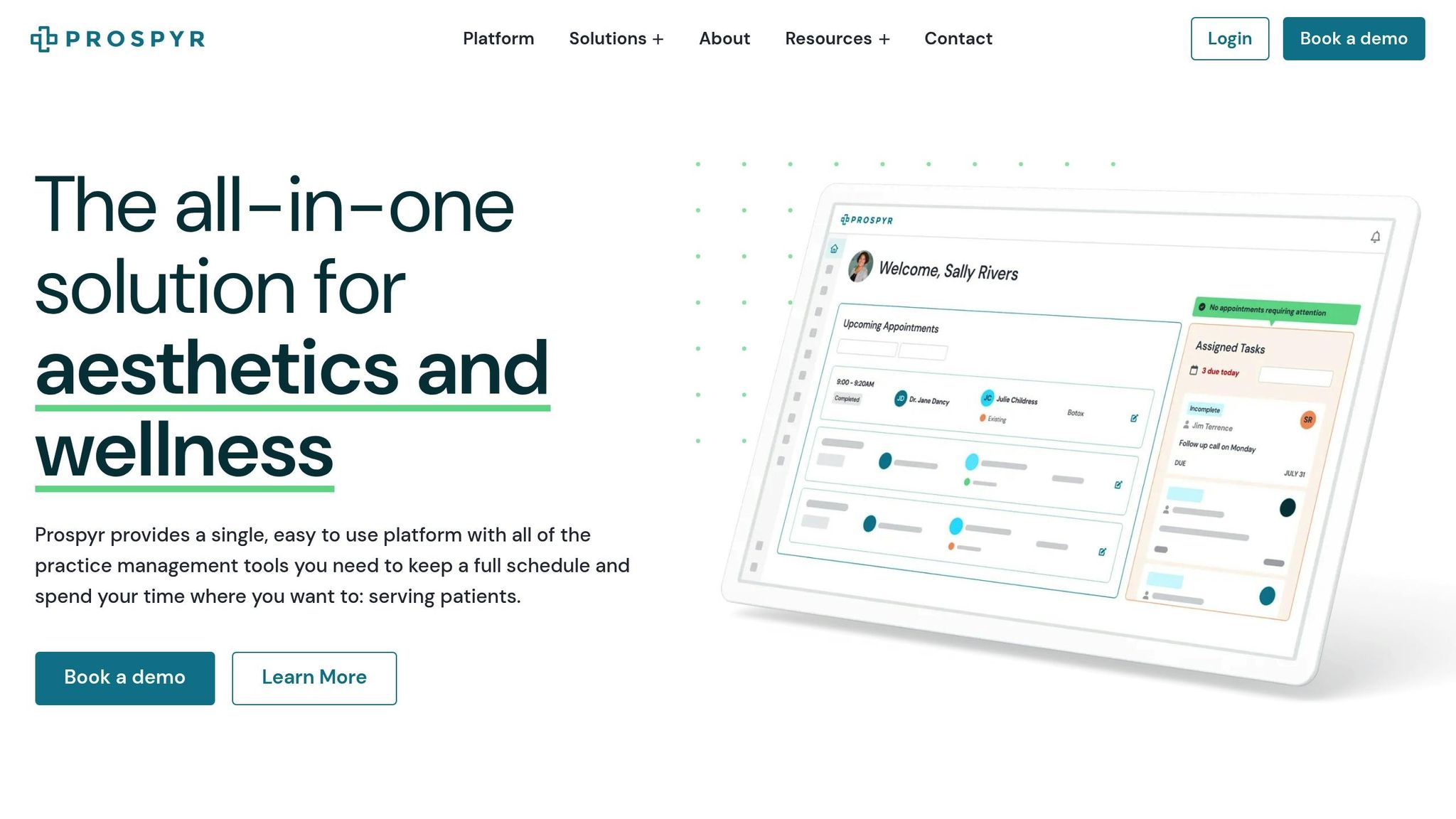
Managing multiple med spa locations can be chaotic when you're juggling different software systems. Prospyr simplifies this by combining scheduling, patient records, payments, and communication into one integrated platform. It’s designed to tackle the headaches of running multi-location practices, making operations smoother and more efficient.
Smart Scheduling Across Locations
Prospyr’s centralized scheduling system keeps tabs on provider availability, treatment rooms, and medical devices across all your locations. It’s smart enough to prevent double-booking by tracking resource usage in real time. For instance, if a provider is booked at one clinic, their availability is automatically blocked at other locations during the same time. Similarly, high-demand devices, like a CoolSculpting machine, are marked unavailable elsewhere once reserved at one site.
This seamless system ensures patient records, treatment histories, and preferences are accessible no matter which location a client visits. Dr. Daniel Lee, founder of New Life Cosmetic Surgery, experienced this firsthand when switching from four separate software platforms to Prospyr. The result? A 40% jump in appointments and a 50% boost in revenue.
"We've seen a 50% increase in revenue and a 40% increase in appointments booked since switching away from using several different point solutions to running our practice on Prospyr." – Dr. Daniel Lee, Founder, New Life Cosmetic Surgery
Automation and AI Tools
Prospyr’s automation features take care of repetitive tasks so your staff can focus on what they do best - caring for clients. Automated appointment reminders and confirmations, sent via email and SMS, help reduce no-shows. The platform also includes marketing automation tools to re-engage patients and nurture leads through a HIPAA-compliant CRM, giving your team more time to deliver top-notch service.
Membership management and digital intake forms further streamline client onboarding, automating renewals and tracking member benefits across all locations. An integrated task management system ensures daily operations run smoothly, keeping staff on the same page.
When SOM Aesthetics launched in 2024, Founder and CEO Dr. Saami Khalifian relied on Prospyr to hit the ground running. Within two days, the practice generated $40,000 in revenue and surpassed $100,000 in monthly revenue by the second month - 21 times faster than expected.
"Prospyr has helped us launch SOM Aesthetics like a rocketship. Their powerful platform and helpful support have enabled us to exceed our financial targets while delivering an unmatched experience for our patients." – Dr. Saami Khalifian, Founder and CEO, SOM Aesthetics
HIPAA-Compliant Data Security
Operating multiple locations increases the potential for HIPAA violations, which can lead to fines as high as $2 million. Prospyr’s cloud-based infrastructure is built to protect patient data while allowing authorized staff to access records across clinics. The system uses encryption, secure password protocols, and regular backups to meet 2025 cybersecurity standards, giving you peace of mind.
Optimizing Multi-Location Scheduling for Med Spas: Guide 2025
Using Data to Drive Decisions
Your scheduling data can uncover operational bottlenecks and opportunities for improvement. Cross-location performance reports highlight which treatments perform best at specific sites, giving you a clear picture of strengths and areas to refine. For example, tracking no-show trends helps you implement strategies like automated waitlists or requiring deposits to protect revenue. Historical booking patterns also guide you in preparing for busy periods, such as holidays, wedding season, or summer. This might mean extending hours, opening additional slots, or hiring temporary staff. It's worth noting that 46% of healthcare organizations have reported financial losses due to workflow inefficiencies. A centralized dashboard can address this by offering a comprehensive view of revenue and bookings across locations, while still allowing each clinic to handle its daily operations effectively.
Using Automation Tools
Automation takes over repetitive tasks, freeing up your team for more valuable work. Features like automated appointment confirmations and reminders via SMS or email minimize no-shows without requiring manual follow-up. Automated waitlists can fill last-minute cancellations, salvaging revenue that would otherwise slip away. For treatments requiring multiple sessions - such as laser hair removal - pre-scheduling all visits during the initial appointment encourages client commitment and improves revenue predictability. Automation also ensures safety by managing scheduling rules, like enforcing proper recovery times between treatments such as chemical peels or heat-based procedures. Additionally, integrating scheduling systems with inventory management can trigger automatic reorder alerts for low supplies, ensuring treatments proceed without delays. Once these systems are in place, the focus can shift to enhancing the client experience.
Improving Client Experience
Today's clients value convenience at every step. Offering 24/7 self-service scheduling with clear location options meets these expectations. For remote consultations, integrated telehealth solutions provide further flexibility. Automated digital intake forms simplify check-ins and reduce the workload for your staff.
"For our clinic, it was fundamental to find software that facilitates online bookings... being able to offer bookings at your fingertips was absolutely key." – Dr. Leah Totton, Founder/Co-Owner of Dr. Leah Skin Clinics
Location-specific QR codes on marketing materials and social media can guide clients directly to the appropriate booking page, making the process seamless. Additionally, location-based pricing allows you to tailor service costs to reflect each branch's operating expenses and local market demands. This approach not only enhances the client experience but also optimizes your clinic's overall efficiency.
Conclusion
Key Takeaways
Managing multiple med spa locations doesn’t have to mean wrestling with spreadsheets or dealing with scheduling chaos. A centralized scheduling system offers real-time oversight of all your locations - covering everything from staff availability to room assignments - while ensuring client records are accessible no matter where they book. With the med spa market projected to grow from $7.22 billion in 2025 to $15.46 billion by 2034, tools like automated waitlists, SMS reminders, and location-specific pricing are essential for safeguarding revenue and simplifying operations for both your team and clients. Disorganized workflows have already impacted nearly half of healthcare organizations by cutting into their earnings, but scheduling software can directly counteract these losses. These insights provide a roadmap for meaningful operational improvements.
Next Steps
Now is the time to assess whether your current system supports seamless multi-location functionality. Are you piecing together various tools, or do you have a platform that truly meets the demands of managing multiple clinics? To streamline operations, you’ll need a system that grows with your business, eliminates the need for staff retraining, and aligns with your operational goals. Look for HIPAA-compliant solutions that unify client records, automate communication, and deliver actionable insights.
Prospyr’s all-in-one platform is designed to simplify multi-location management through integrated scheduling, AI-powered automation, and centralized patient management - all while maintaining personalized care. Its HIPAA-compliant framework ensures your data remains secure as your business expands. Explore how Prospyr can optimize your scheduling and free up your team to focus on delivering outstanding patient experiences by visiting https://prospyrmed.com.
FAQs
What’s the fastest way to switch to centralized scheduling without disrupting daily operations?
To make the shift to centralized scheduling as smooth as possible, invest in software that brings together patient data and scheduling across all locations. Look for tools that offer online booking, automated reminders, and real-time data access. These features can simplify the process and reduce the need for manual updates. By using a well-designed system, you can keep scheduling efficient during the transition, allowing patients to book appointments easily without causing unnecessary disruptions to your operations.
How do I handle staff who work at multiple locations without creating double bookings?
To keep double bookings at bay for staff who work across multiple locations, make sure their availability is clearly defined in your scheduling system. Assign each employee to their designated location and adjust their working hours as needed. Tools like Prospyr can make this process easier by offering features such as calendar synchronization, automated conflict alerts, and real-time schedule updates. These tools help you stay on top of staff management and avoid overlapping appointments.
Which automation features reduce no-shows the most across multiple clinics?
Automated reminders sent through SMS and email have proven to be highly effective in cutting down no-show rates in clinics. Some practices have seen reductions as high as 75%. These reminders help keep patients informed and engaged, which not only reduces scheduling gaps but also boosts the overall efficiency of clinic operations.