Complications Insurance: Options for Med Spas
Comprehensive coverage—professional, products, general, EPLI, and cyber—protects med spas from treatment, staff, and data risks.


Running a med spa comes with unique risks. From treatment-related injuries to data breaches and employee disputes, the right insurance can protect your business from financial and legal fallout. Here’s a quick breakdown of the five key types of coverage every med spa should consider:
- Professional Liability Insurance: Covers claims of negligence or errors during procedures like Botox or laser treatments.
- Products Liability Insurance: Protects against harm caused by defective devices, injectables, or skincare products.
- General Liability Insurance: Handles non-medical incidents, such as slip-and-fall accidents on your premises.
- Employment Practices Liability Insurance (EPLI): Addresses workplace claims like harassment, discrimination, or wrongful termination.
- Cyber Liability Insurance: Covers costs related to data breaches, ransomware attacks, and HIPAA violations.
Each policy serves a distinct purpose, and combining them ensures your med spa is safeguarded from various risks. Whether it’s protecting patient records, covering treatment complications, or managing employee disputes, insurance is a critical tool to secure your practice’s future. Let’s dive into the details.
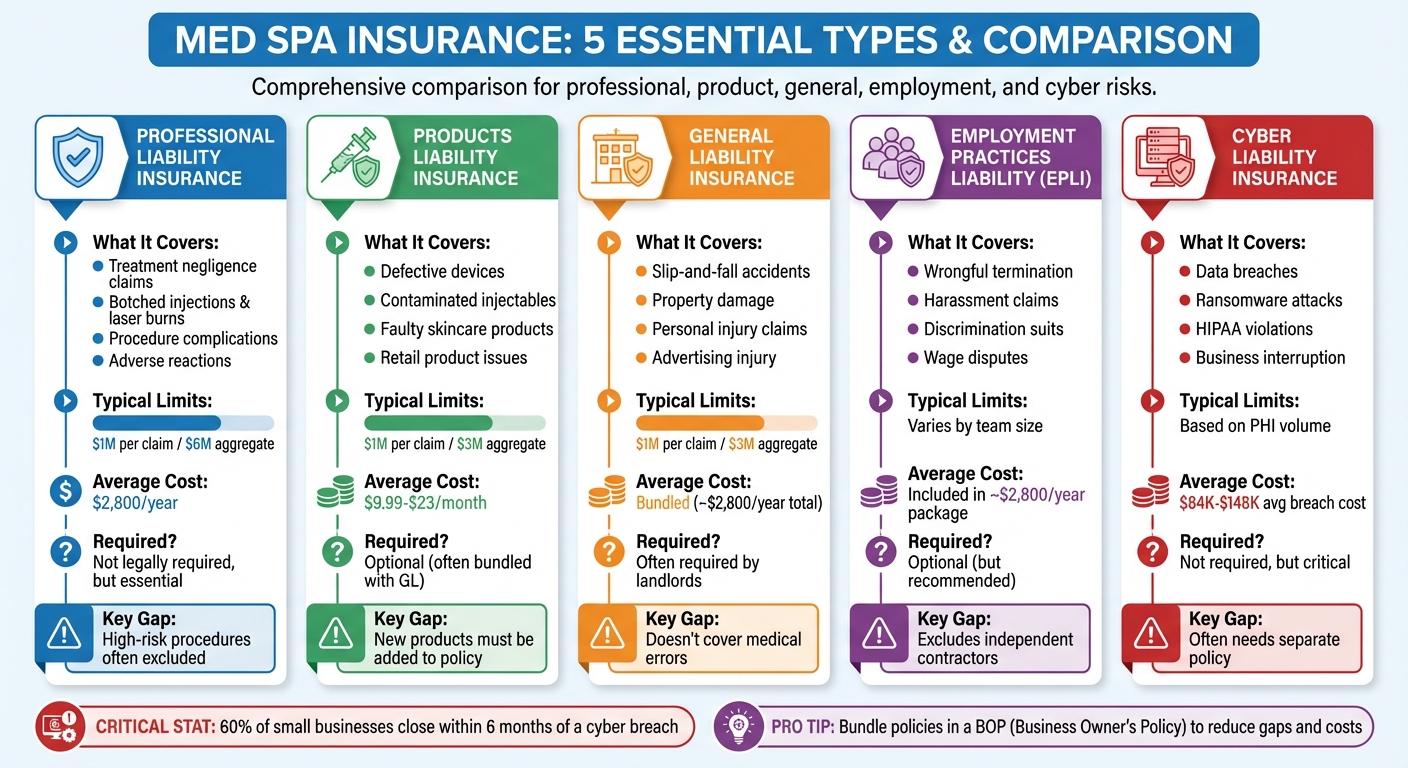
5 Essential Insurance Types for Med Spas: Coverage Comparison Guide
1. Professional Liability Insurance
Coverage Focus
Professional liability insurance, often referred to as malpractice insurance, is designed to handle claims of negligence, errors, or omissions in procedures like Botox injections or laser resurfacing treatments. This type of insurance is a must-have for practices offering aesthetic treatments. Bobbie Williams, Healthcare/Professional Lines Division Lead at Novatae, emphasizes its importance:
"Medical professional liability: Claims can arise from botched injections, laser treatments, or other procedures that result in scarring, burns, or complications."
This insurance forms the backbone of protection for a wide range of complications that aesthetic practices may encounter.
Typical Complications Covered
This coverage typically addresses issues like botched filler or Botox injections, burns or lasting scars from laser treatments, and adverse reactions to procedures such as chemical peels, IV vitamin therapy, or fat-dissolving injections. It also extends to problems arising from microneedling, PRP treatments, and body contouring. Some policies even include perks like needle stick reimbursement.
Key Gaps or Exclusions
Understanding what isn’t covered is just as important as knowing what is. For example, introducing new treatments without updating your policy could result in denied claims. Independent contractors may not be covered unless they’re explicitly listed in the policy. Additionally, high-risk procedures like microblading, permanent makeup, and certain laser treatments are often excluded from basic policies.
Most med spa policies are claims-made policies, which means incidents occurring before the retroactive date or during lapses in coverage are not covered. This makes understanding your policy’s retroactive date and maintaining continuous coverage critical.
Standard Liability Limits
Some providers, such as ASCP, offer aggregate liability limits up to $6 million, with average premiums hovering around $2,800. These costs can vary depending on factors like location, services offered, and claims history.
| Policy Feature | Claims-Made Policy | Occurrence Policy |
|---|---|---|
| Coverage Trigger | Claim must be reported while the policy is active | Incident must occur during the policy period |
| Tail Coverage | Required if policy is canceled to cover future claims | Generally not required |
| Availability | Most common for med spa carriers | Offered by select carriers |
Required vs. Optional
Though not legally mandated, professional liability insurance is essential to shield your practice from potentially devastating lawsuits. Kyle Mills highlights the risks:
"If someone isn't explicitly named, you could be unprotected."
Legal fees from a single lawsuit can easily surpass $100,000, making this coverage indispensable for any practice. To avoid coverage gaps, regularly review your procedures and ensure all treatments are listed in your policy. Confirm that both employees and independent contractors are covered, and maintain continuous coverage to avoid exclusions for prior acts. If you’re switching providers or shutting down your practice, purchasing tail coverage is a smart move to protect against claims filed after your policy ends.
sbb-itb-02f5876
2. Products Liability Insurance
Coverage Focus
Products liability insurance is designed to address claims related to defective devices, injectables, or skincare products used in your med spa. This type of coverage is essential when equipment malfunctions or products cause harm to clients. Bobbie Williams from Novatae explains:
"Product liability: Use of defective devices, injectables, or skincare products can result in product-related claims."
It also extends to retail products sold for home use, ensuring your bases are covered beyond in-spa treatments.
Typical Complications Covered
This insurance steps in when injuries arise from defective medical devices, such as lasers or energy-based equipment, or when adverse reactions result from contaminated or faulty injectables like fillers and neuromodulators. Utilizing an eRX system can help ensure these prescriptions are handled accurately. It also covers harm caused by skincare products used during treatments or sold to clients. For instance, if a laser malfunction causes burns or a contaminated filler triggers complications, products liability insurance ensures you're protected against these product-related issues.
Key Gaps or Exclusions
Failing to update your policy for new product lines can leave you vulnerable to uncovered claims. For example, if a med spa adds vitamin therapy to its offerings but doesn’t update its malpractice policy, the insurer may deny coverage for adverse reactions since the procedure wasn’t included.
Additionally, many standard carriers exclude high-risk items like Botox, fillers, and CO2 lasers, which often require specialized policies. To avoid gaps, always update your policy when introducing new products or treatments. It’s also crucial to ensure that independent contractors are explicitly named in your policy, as their omission could lead to coverage issues.
Standard Liability Limits
Proper liability limits are critical for managing product-related risks. Most med spa policies offer $1 million per claim and $3 million in aggregate limits. Some specialized providers may increase the per-occurrence limit to $2 million. For practices handling higher-risk procedures or serving a large client base, excess liability coverage can provide an additional layer of protection on top of your primary policy.
Required vs. Optional
Products liability insurance is often bundled with general liability coverage, but it’s an indispensable part of a comprehensive risk management plan. Monthly premiums typically range from $9.99 to $23. If you’re introducing new retail products or treatment materials, notify your broker immediately. Failing to do so could lead to coverage gaps and denied claims when you need protection the most.
Reading about the problem? See how Prospyr solves it in one platform.
Book a Demo3. General Liability Insurance
Coverage Focus
General Liability (GL) insurance is designed to handle non-medical incidents that occur on your business premises. Unlike professional liability insurance, which deals with treatment-related issues, GL addresses everyday business risks. Bobbie Williams from Novatae explains it well:
"Med spas face traditional retail exposures like slips, trips, and equipment injuries."
This type of insurance also protects against personal and advertising injury claims, such as slander, libel, or accusations of false advertising. Many landlords and lenders require GL coverage as a condition for leases or financing agreements. While professional and product liability insurance focus on treatment-related risks, GL provides coverage for the more routine hazards your business might face.
Typical Complications Covered
GL insurance is there for incidents like a client slipping on a wet floor in your lobby, tripping over a cord, or being injured by falling equipment. It also covers property damage caused by your business to third parties. World Insurance Associates highlights its importance:
"General Liability Insurance protects against bodily injury, such as slip and fall claims, and damage done to your property by a third party."
Key Gaps or Exclusions
There are key areas GL insurance doesn’t cover. It won’t protect against professional medical mistakes - like botched treatments or laser burns - which require malpractice insurance. Similarly, it doesn’t cover data breaches or HIPAA violations; those require cyber liability insurance. Employee injuries are also excluded and are instead covered by workers’ compensation insurance. If your business uses vehicles, personal auto insurance won’t cut it - you’ll need commercial auto coverage.
Another gap involves independent contractors. Many GL policies don’t automatically cover contracted providers unless they’re specifically named in the policy.
Standard Liability Limits
Most med spas opt for liability limits of $1 million per claim and $3 million aggregate. To simplify risk management and close potential coverage gaps, many businesses bundle GL with other policies in a Business Owner’s Policy (BOP). On average, a comprehensive insurance package that includes both general liability and malpractice coverage costs around $2,800 annually.
Required vs. Optional
General Liability insurance is often required by landlords or lenders, especially if you operate in leased commercial spaces. While it’s frequently bundled with other types of insurance, GL forms the backbone of risk management for med spas. Be sure to notify your broker about new equipment or services to keep your coverage up to date.
4. Employment Practices Liability Insurance
Coverage Focus
Med spas are increasingly dealing with employment-related claims, making targeted risk management a necessity. Employment Practices Liability Insurance (EPLI) is designed to protect med spas from claims tied to workplace conduct and HR decisions. Unlike workers' compensation - which handles job-related injuries - EPLI focuses on disputes stemming from employment relationships and management actions. Bobbie Williams from Novatae highlights this distinction:
"Employment-related claims are increasingly common in personal services industries. EPLI helps defend against allegations of wrongful termination, harassment, or wage-and-hour disputes."
This type of coverage is particularly relevant for med spas, given their high employee turnover rates and the close, personal interactions with clients. EPLI provides protection against a variety of employment-related disputes, as outlined below.
Typical Complications Covered
EPLI typically addresses claims such as:
- Wrongful termination
- Harassment, including sexual harassment or hostile work environment claims
- Discrimination based on race, gender, age, or other protected categories
- Wage-and-hour disputes, such as unpaid overtime or minimum wage violations
Key Gaps or Exclusions
While EPLI covers many employment-related issues, it has notable exclusions:
- Workplace injuries are not covered and require workers' compensation insurance.
- Claims related to medical errors fall under professional liability coverage, not EPLI.
- Many policies exclude claims involving independent contractors, which is a significant consideration for med spas employing contractors.
- Allegations of sexual misconduct are often excluded from standard policies and may require a separate endorsement.
Standard Liability Limits
For smaller med spas, EPLI is often added as an endorsement to a Business Owner's Policy (BOP). Larger med spas, however, may need a standalone policy. On average, a comprehensive insurance package that includes EPLI costs about $2,800 annually. Choosing a policy with defense costs outside the liability limits is recommended to ensure settlement funds remain intact.
Required vs. Optional
EPLI is not mandatory, unlike workers' compensation, which is required in most states. However, it is highly recommended for med spas, especially those with larger teams. Kyle Mills from Reviva underscores its importance:
"These [Employment Protection Riders] are optional but valuable for medspas with larger teams."
Although optional, EPLI is a smart choice for med spas looking to mitigate employment-related risks. Bundling EPLI with other coverages like general liability, property, and cyber insurance can create a more comprehensive risk management strategy.
5. Cyber Liability Insurance
Coverage Focus
Med spas rely heavily on technology for tasks like digital scheduling, payment processing, and maintaining electronic health records. This dependence on digital systems makes them prime targets for cyber threats. Cyber liability insurance is designed to handle the fallout from these digital risks, such as data breaches and ransomware attacks. Unlike general liability insurance, which focuses on physical incidents, this type of coverage specifically addresses digital vulnerabilities. As Bobbie Williams, Healthcare/Professional Lines Division Lead at Novatae, puts it:
"With digital scheduling, payment processing, and patient data storage, medical spas are vulnerable to data breaches and ransomware attacks."
This specialized coverage is tailored to the unique digital risks med spas face.
Typical Complications Covered
Cyber liability insurance can help med spas manage a variety of risks tied to cyber incidents. Here’s what it typically covers:
- Data breach recovery: Covers costs like notifying affected patients, providing credit monitoring, and handling legal fees.
- HIPAA compliance protection: Addresses insurable fines and penalties for regulatory breaches.
- Ransomware and extortion coverage: Provides funds for ransom payments and technical recovery of encrypted data.
- Business interruption compensation: Helps cover lost income and operational costs if the med spa must temporarily shut down due to a cyber attack.
- Crisis management services: Assists in rebuilding trust and repairing the practice's reputation after an incident.
To put the financial stakes into perspective, PricewaterhouseCoopers estimates that a cyber attack can cost between $84,000 and $148,000. Additionally, a Champlain College study found that 60% of small businesses shut down within six months of a breach.
Key Gaps or Exclusions
Many med spas mistakenly believe their existing insurance policies cover cyber risks. However, there are notable gaps:
- HIPAA violations: These are often excluded from standard professional liability policies unless specific regulatory protection riders are added.
- High-risk services: If a service isn’t explicitly listed in the policy, related data or record-keeping issues may not be covered.
- Limited cyber endorsements: Some medical malpractice policies only offer minimal cyber coverage, which may not be sufficient to handle a major breach.
Understanding these exclusions is critical for ensuring adequate protection.
Standard Liability Limits
Cyber liability coverage can be obtained in several ways: as a standalone policy, part of a business office package, or an endorsement on a medical malpractice policy. Standalone policies typically offer more comprehensive benefits, such as crisis management and public relations support, while endorsements on malpractice policies may only cover basic costs like legal fees or notifications.
Med spas should assess their coverage needs based on the amount of Personal Health Information (PHI) they manage. Practices using extensive digital tools, like online booking systems and platforms such as Prospyr, are at greater risk and should consider higher coverage limits. Bundling cyber liability with other insurance types - like property or general liability - can streamline claims and reduce coverage gaps.
Required vs. Optional
While cyber liability insurance isn’t legally required like workers’ compensation, its value is hard to ignore. Alex R. Thiersch, JD, CEO of the American Med Spa Association (AmSpa), emphasizes its importance:
"Cyber liability insurance helps policyholders endure a cyber attack by paying their recovery costs - customer notification, credit monitoring, legal fees and other expenses."
Given the sensitive nature of the data med spas handle daily, this type of insurance is a practical necessity. With the high rate of business closures following cyber attacks, having this coverage can be the difference between recovery and shutting down.
Pros and Cons
Choosing the right insurance for your med spa involves weighing the benefits and limitations of each type of coverage. Each policy serves a unique purpose, and understanding their nuances helps ensure your business is protected without unnecessary overlaps.
Professional liability is a must-have for med spas. It covers legal defense, settlements, and clinical mistakes that could harm your reputation. However, switching carriers can lead to extra costs for tail coverage. Additionally, some high-risk procedures - like fat-dissolving injections - might not be included unless you negotiate them specifically.
General liability steps in for non-clinical incidents, such as slip-and-fall accidents, but it doesn’t cover injuries tied to aesthetic treatments. On the other hand, cyber liability shields you from data breaches and HIPAA-related fines, though it often requires a separate policy or rider rather than being included in basic plans. Similarly, employment practices liability (EPLI) protects against workplace issues like discrimination or wrongful termination but excludes clinical malpractice and physical injuries. High employee turnover can also drive up EPLI premiums.
Navigating the overlap between policies is crucial for comprehensive protection. For instance, while both general and professional liability address bodily injuries, general liability typically excludes those caused by medical procedures. It’s also vital to explicitly name independent contractors in your policies to avoid any gaps in coverage.
Bobbie Williams, Healthcare/Professional Lines Division Lead at Novatae, emphasizes the risks:
"Gaps can quickly turn into costly claims, whether from a procedure gone wrong, an employee misstep, or a data breach involving sensitive patient information."
Bundling policies with a single carrier can help minimize overlaps and simplify risk management. Most med spas opt for minimum coverage limits of $1 million per claim and $3 million aggregate, though services considered high-risk may require higher limits. Specialized brokers are invaluable in tailoring coverage to your needs, especially for procedures like laser treatments, injectables, and newer offerings like IV therapy. These insights are key to crafting the best insurance strategy, which will be explored further in the conclusion.
Conclusion
Med spas face risks that basic business insurance just doesn’t address. While professional liability covers treatment-related claims, it won’t help if a patient slips in your lobby or if your patient database is hacked. This is why a well-rounded insurance plan needs to include several types of coverage - professional liability, general liability, cyber insurance, employment practices liability, and products liability insurance - to ensure you're protected on all fronts.
Kyle Mills sums it up perfectly:
"Getting the right policy - not just the cheapest - can save you from devastating financial, legal, and reputational harm".
To start, review your service menu and confirm that every procedure you offer is specifically included in your policy. Treatments like CO₂ lasers, ketamine therapy, and stem cell treatments are often excluded by standard carriers, so you may need specialized underwriting. Also, make sure your practice entity, clinicians, and independent contractors are all named in your coverage to avoid any gaps.
A specialized broker with experience in aesthetic medicine can guide you through the complexities of coverage options and policy limits. They’ll help you navigate the nuances of what your practice truly needs.
When shopping for policies, gather multiple quotes and explore bundling options like a Business Owners Policy (BOP) to streamline claims management and potentially lower costs. Many digital providers now offer instant online quotes, making it easier to compare pricing . Additionally, ask about discounts for completing risk-management training or being part of professional associations.
The right mix of insurance isn’t just about meeting regulations - it’s about safeguarding your reputation, your team, and your ability to grow. As MedispaCover puts it:
"Our mission is to empower providers to practice with confidence, knowing their coverage is built for today's risks and tomorrow's possibilities".
FAQs
Which policy pays if a treatment goes wrong?
Malpractice, or professional liability insurance, steps in when treatments don’t go as planned. It provides coverage for claims involving negligence, mistakes, or oversights that lead to unfavorable treatment results. This kind of insurance is crucial for shielding med spas from the financial fallout of such claims.
Do my contractors need to be named on the policy?
Contractors generally need to be added to the policy to ensure they’re protected against claims tied to their work. This is particularly crucial for high-risk procedures, making it an essential component of strong risk management practices.
How much coverage does a med spa usually need?
Med spas typically need coverage for professional liability, general liability, property, cyber liability, and complications insurance. The level of coverage required varies based on the size of the practice and the types of services provided. However, having thorough insurance is essential to manage the diverse risks that med spas encounter.