Ultimate Guide to Insurance for Non-Surgical Aesthetic Clinics
Clear guide to insurance for non-surgical aesthetic clinics: professional liability, general/property, cyber coverage, costs, and practical risk-reduction tips.


Non-surgical aesthetic clinics face significant risks - legal claims, complications from procedures, and even data breaches. Without proper insurance, a single incident can lead to financial ruin. This guide explains the types of insurance clinics need, including professional liability, general liability, and property coverage, along with strategies to reduce risks.
Key Takeaways:
- Professional Liability Insurance: Covers treatment-related claims like nerve damage or burns. Policies cost $800–$12,000 annually, depending on clinic size and services.
- Complications Insurance: Addresses non-negligent adverse reactions, like allergic responses to fillers.
- General Liability & Property Insurance: Protects against accidents (e.g., slips) and equipment damage.
- Cyber Liability Insurance: Essential for clinics handling sensitive patient data, costing $300–$1,000 annually.
- Risk Management: Use digital consent forms, pre-treatment photos, and staff training to mitigate claims.
Insurance is your financial safety net, but proactive measures - like thorough documentation and compliance with state laws - are equally important. Together, they protect your clinic's reputation and ensure long-term success.
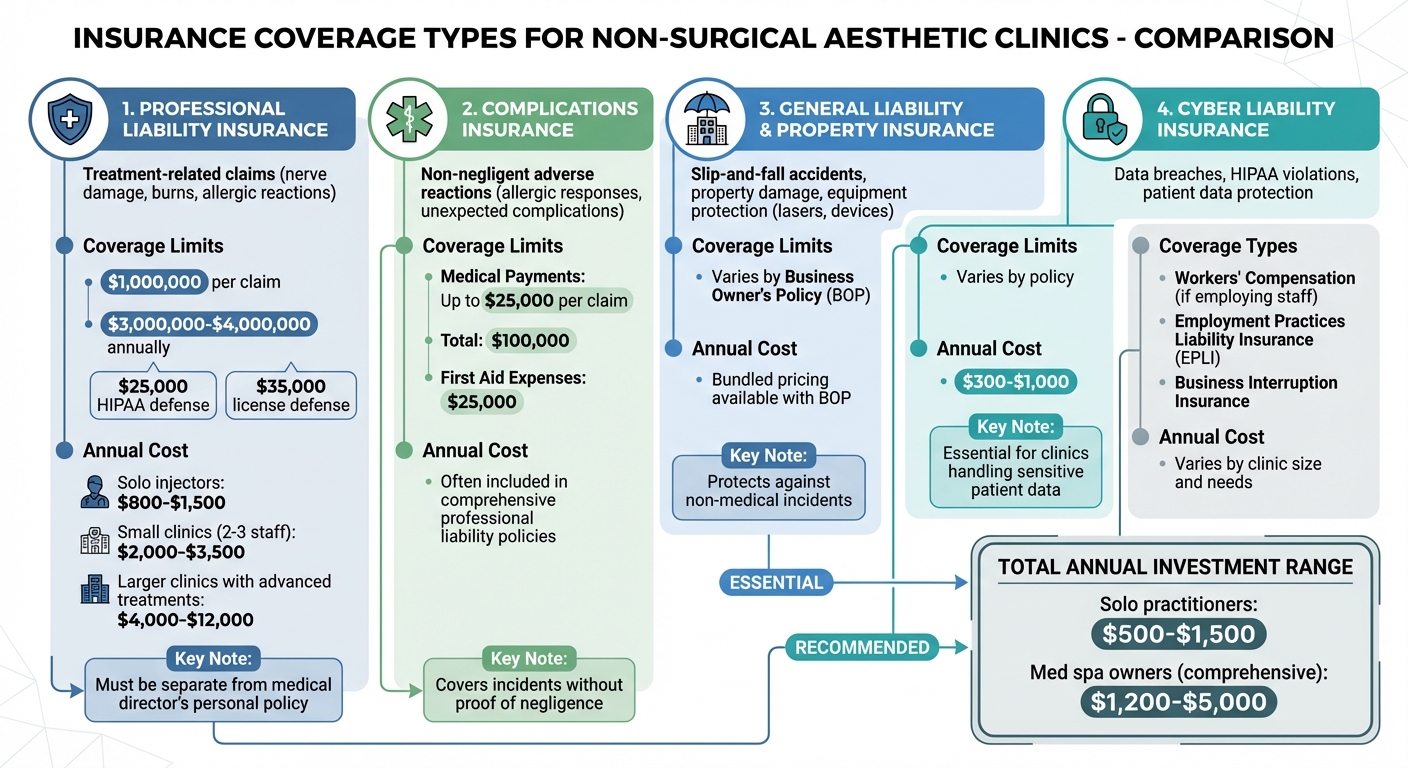
Types of Insurance Coverage for Non-Surgical Aesthetic Clinics: Coverage and Costs
Types of Insurance Coverage for Non-Surgical Aesthetic Clinics
Running a non-surgical aesthetic clinic comes with its own set of risks, and managing those risks often requires multiple insurance policies. From professional liability to general liability and beyond, here's a breakdown of the key coverage options your clinic might need.
Malpractice and Professional Liability Insurance
Professional liability insurance is critical for protecting your clinic when a client claims they were harmed due to your treatments. Whether it’s nerve damage from Botox, scarring from laser therapy, or an allergic reaction to dermal fillers, this policy focuses on injuries directly linked to the services you provide.
"It is a common misconception that a MedSpa's medical director's individual malpractice insurance policy will cover the MedSpa's staff and operations." - Hal Williams, Gallagher Healthcare
This highlights an important point: your clinic needs its own policy, separate from the medical director's personal coverage. The policy should cover all practitioners, including aesthetic nurses, physician assistants, and even the medical director when performing duties for the clinic. Typical coverage limits are $1,000,000 per claim and $3,000,000 annually, though some policies go up to $4,000,000. Additional sub-limits often include $25,000 for HIPAA defense and $35,000 for license defense.
Premiums can vary significantly. Solo injectors may pay $800 to $1,500 annually, while smaller clinics with 2–3 staff members might spend $2,000 to $3,500. Larger, more established clinics offering advanced treatments like laser therapy often see premiums in the $4,000 to $12,000 range. When shopping for coverage, prioritize "occurrence" policies over "claims-made" ones. Occurrence policies cover incidents that happen during the policy period, even if the claim is filed later, saving you from the added cost of tail coverage when switching insurers.
Next, let’s look at coverage for complications that aren’t tied to negligence.
Complications Insurance for Aesthetic Treatments
Even with flawless technique, complications can arise. Complications insurance steps in to cover adverse reactions that aren’t caused by negligence - like an unexpected allergic reaction to a filler or a burn from a chemical peel applied correctly. Also known as treatment risk insurance, this fills gaps that standard professional liability policies may not cover.
Many professional liability policies include a Medical Payments feature, which can cover a client’s medical expenses from a covered incident - up to $25,000 per claim and $100,000 in total - without requiring proof of negligence. This allows for quick intervention, such as funding corrective care for muscle weakness from Botox or laser-induced scarring. Some policies even provide up to $25,000 for First Aid Expenses, ensuring immediate care during an adverse event.
Make sure your policy specifies all the treatments your clinic offers, from laser body contouring to advanced dermal fillers, as each procedure carries unique risks. While standalone complications insurance is available, many clinics find that comprehensive professional liability policies designed for aesthetic practices offer sufficient protection. This approach integrates seamlessly into your clinic’s risk management plan, ensuring swift resolution of unforeseen client reactions.
General Liability and Property Insurance
While professional liability focuses on treatment-related issues, general liability covers everyday accidents unrelated to medical services. This includes incidents like a client slipping in your lobby, damage to their belongings, or even third-party property damage.
"Think of general liability as your 'trip and fall' insurance. It's not enough by itself if you're doing any type of aesthetic medical service." - CarePro Insurance
Property insurance, on the other hand, safeguards your clinic’s valuable equipment - like medical lasers, treatment devices, and furniture - against risks like fire, theft, or vandalism. Considering the high cost of laser devices, this coverage is essential for protecting your investment. Many clinics opt to bundle general liability and property insurance into a Business Owner’s Policy (BOP), which can help lower overall costs.
Additional policies to consider include cyber liability insurance (typically $300 to $1,000 annually) to protect against data breaches and HIPAA violations, workers’ compensation if you employ staff, and employment practices liability insurance (EPLI) to cover claims of wrongful termination or discrimination. Business interruption insurance can also be a lifesaver, compensating for lost revenue if your clinic temporarily closes due to events like a fire or natural disaster.
sbb-itb-02f5876
Reading about the problem? See how Prospyr solves it in one platform.
Book a DemoCommon Non-Surgical Procedures and Their Insurance Needs
Non-surgical aesthetic treatments come with their own set of risks, making tailored insurance coverage critical. Here's a breakdown of insurance considerations for some of the most popular procedures.
Injectables (Botox, Dermal Fillers)

Injectables are a staple in aesthetic clinics, but they come with notable risks. Complications like vascular occlusion, nerve damage, eyelid drooping, or facial asymmetry can occur - even when procedures are performed correctly. Dissatisfaction with results alone can also lead to claims.
To protect against these risks, professional liability insurance is a must. Standard policies often provide coverage limits of $1,000,000 per claim and $4,000,000 in total. Policies should also include product liability coverage to address issues like allergic reactions or adverse responses to a specific filler batch. Annual premiums vary: Botox-only providers typically pay $1,500–$1,900, while clinics offering a broader range of injectables might see premiums between $2,100 and $2,600.
When selecting a policy, ensure it doesn’t exclude specific products like hyaluronic acid (HA) or non-HA fillers, as some budget-friendly plans do. Many policies also include up to $25,000 in medical payments coverage, allowing for quick resolution of complications without waiting for negligence determinations.
To strengthen your defense against claims, maintain signed consent forms and pre-treatment photos. Detailed records - such as injection sites, techniques, and dosages - can also be invaluable. Finally, use only FDA-approved products or materials from authorized compounding companies, as using unapproved substances may void your coverage.
While injectables carry their own risks, laser treatments present a completely different set of challenges.
Laser and Energy-Based Treatments
Laser and energy-based procedures involve thermal energy, which increases the chances of permanent scarring, burns, or even eye injuries. Insurers will scrutinize the devices used in your clinic and the training level of your operators.
The average aesthetic claim costs around $20,740, including legal defense and settlements, with laser hair removal and IPL ranking among the most frequently litigated treatments. For example, certain CO₂ lasers can cause post-inflammatory hyperpigmentation in all patients with Fitzpatrick IV skin tones - a complication that can lead to lawsuits. In some cases, defense costs alone account for over 60% of total claim expenses.
Your liability policy should explicitly cover the specific laser technologies and the roles of all operators, including technicians, nurses, and physician assistants. Clinics offering laser services typically pay $1,200–$5,000 annually, while solo injectors without laser equipment pay $500–$1,500.
Safety protocols are critical. Keep logs of equipment maintenance and ensure staff are trained in proper eye protection that complies with ANSI Z136 standards in the U.S.. Some states require a medical director to be present during laser treatments; failure to comply with such rules can void your coverage. Always obtain dated consent forms for each session.
Next, let’s look at the insurance needs for skin rejuvenation procedures.
Skin Rejuvenation and Chemical Peels
Skin rejuvenation treatments, including chemical peels, involve applying acids to exfoliate the skin. If not done properly, they can cause burns, scarring, or severe allergic reactions. General liability insurance often doesn’t cover errors during these procedures, so professional liability insurance tailored to aesthetic services is necessary.
"A client who experiences a burn or allergic reaction to a chemical peel may be left with disfigurement or scarring; their recovery can incur significant medical expenses and loss of income, which you can be held liable for." - S.W.A.N. Insurance
Many insurers exclude advanced procedures like deep chemical peels or microneedling, so clinics may need specialized policies designed for med spas. Annual premiums for these services typically range from $800–$3,000, depending on the provider's scope of practice. Product liability coverage is also important to address potential adverse reactions to chemical solutions or skincare products.
Detailed documentation is key. Pre-treatment assessments, including photos, acid concentrations, and application times, can support your defense. Comprehensive consent forms that clearly outline risks like burns or irritation are essential to avoid litigation. Additionally, insurers often require proof of certifications and training for technicians performing these procedures.
Most professional liability policies for med spas operate on a "claims-made" basis, meaning coverage is only active while the policy is in effect. If you close your clinic or switch providers, consider purchasing tail coverage to protect against future claims tied to past treatments.
How to Choose an Insurance Provider for Your Clinic
Choosing the right insurance provider is one of the essential steps for opening a med spa and can be the difference between solid protection and unexpected financial headaches. It’s essential to find a provider who understands the specific risks tied to non-surgical aesthetics, not just general medical malpractice. This insight makes comparing providers much smoother.
What to Look for in an Insurance Provider
Look for a provider that specializes in aesthetics and is familiar with terms like vascular occlusion, filler migration, and IPL burns. Many generic insurers treat med spas like standard salons, which can lead to exclusions for high-risk procedures such as IV therapy or certain laser treatments.
"Most of them [insurance carriers] don't understand the unique liability risks that come with injectables, lasers, IV therapy, or microneedling." - CarePro Insurance
The type of policy you choose is also crucial. Opt for occurrence policies instead of claims-made ones to avoid the need for costly tail coverage later. Make sure the provider adheres to your state’s aesthetic regulations.
Policies with a "Full Consent to Settle" clause are particularly valuable. These clauses ensure that no malpractice settlement can occur without your written approval, helping to safeguard your professional reputation. Additionally, ensure the policy includes license defense coverage, which extends beyond civil lawsuits to cover board investigations and administrative hearings. Many aesthetic-focused policies also offer HIPAA defense sub-limits ranging from $25,000 to $35,000.
Check whether the coverage is portable for multi-location work, off-site events, or telehealth services. Also, review the insurer’s financial strength by consulting A.M. Best ratings - look for providers rated A++ (Superior) to ensure they can handle long-term claims.
Lastly, consider bundling options. Combining Professional, General, Cyber, and Property Insurance into a Business Owner’s Policy can help reduce costs. On average, med spa owners spend $1,200 to $5,000 annually for comprehensive coverage, while solo injectors typically pay between $500 and $1,500.
Comparing Insurance Providers
To make an informed decision, compare providers directly. Not all insurers offer the same level of coverage, especially when it comes to aesthetics. Understanding these differences can help you find a policy that aligns with your clinic’s specific needs.
| Criteria | Specialist Aesthetic Insurer | Generic Business Insurer |
|---|---|---|
| Procedure Knowledge | Familiar with "PRP", "IPL", and "Vascular Occlusion" | May only offer generic "medical" coverage |
| Policy Customization | Designed for injectables and energy-based devices | Often a standard package |
| Claims Support | Experienced in aesthetic malpractice cases | May lack expertise in cosmetic negligence |
| State Compliance | In-depth knowledge of Medical Director laws | May overlook state-specific aesthetic regulations |
| Certificate Delivery | Quick delivery tailored to licensing needs | Potential delays due to lack of specialization |
When comparing providers, ask questions like:
- Does the policy cover independent contractors and supervised nurses, or only W-2 employees?
- Are off-label uses of FDA-approved products included?
- What exclusions apply to procedures like microneedling or deep chemical peels?
"Many medical spa owners discover coverage gaps only after facing a claim." - Adam Witkov, Business Attorney, Michael Best
Specialized brokers who focus on aesthetics can connect you with top-rated carriers and ensure your policy addresses the specific risks of your industry.
Additionally, confirm that all procedures you perform - such as Botox, dermal fillers, laser treatments, PRP, and chemical peels - are explicitly listed in your policy. Keep thorough documentation of your staff’s certifications and training, as some insurers offer discounts or require this for advanced procedures. If you purchase new equipment, notify your broker right away to ensure it’s covered under your property insurance.
Risk Reduction Strategies to Support Insurance Coverage
Insurance provides a safety net for financial risks, but proactive prevention is key to keeping claims - and premiums - under control. By focusing on effective risk reduction strategies, you not only improve patient safety but also strengthen your position with insurers.
Standardized Protocols and Staff Training
Standardized procedures help ensure consistent care and reduce the chances of errors. Standard Operating Procedures (SOPs) are essential for this, offering clear, actionable guidelines for your team.
"Standard Operating Procedures turn expectations into repeatable steps, reducing risk and variation in care." - Kevin Henry, AccountableHQ
For example, injectable treatments should include protocols for verifying dosages, maintaining aseptic techniques, following aspiration policies, and managing adverse events. Laser treatments benefit from standardized practices like using the Fitzpatrick scale for skin typing, conducting test spots, enforcing eye protection, and documenting parameter settings. Similarly, chemical peel procedures should outline product selection, patch testing, neutralization steps, and burn management.
Training isn’t a one-and-done task. Start with robust HIPAA and OSHA training during onboarding, then schedule annual refreshers and additional sessions whenever new products or devices are introduced. Use competency checklists and hands-on demonstrations to confirm staff proficiency in injections and laser equipment operation. Monthly safety walks are another layer of protection, allowing you to proactively address hazards, check eyewash stations, and inspect emergency kits.
Here’s a quick look at how often certain tasks should be performed:
| Checklist Frequency | Key Tasks to Perform |
|---|---|
| Daily | Check room turnover logs, monitor sharps container levels, record refrigerator temperatures, verify emergency kit seals |
| Weekly | Review new product Safety Data Sheets (SDS), activate eyewash stations, inspect laser eyewear for integrity |
| Monthly | Conduct hand hygiene audits, perform sterilizer biological indicator (BI) tests, review cleaning logs, analyze incident trends |
| Quarterly | Audit against a Master Compliance Checklist, review expired supplies, hold Safety Committee meetings |
These steps create a solid foundation for integrating digital tools, which bring even more efficiency and security to your practice.
Using Practice Management Tools
Digital platforms can transform your operations, minimizing human error and enhancing patient safety. Prospyr, for instance, centralizes patient data, automates scheduling, and keeps records HIPAA-compliant - all while supporting your insurance needs.
One standout feature of digital systems is their ability to simplify documentation. Prospyr’s CRM and EMR systems securely store everything from pre-treatment assessments and high-resolution photos to treatment parameters and consent forms. This creates an audit-ready record that meets both regulatory and insurance requirements. Automated follow-up reminders ensure patients stay on track with post-treatment care, reducing the risk of complications.
Prospyr also incorporates AI tools for note creation and transcription, allowing you to document treatments seamlessly without slowing down your workflow. In the event of an adverse incident, you can quickly log the details, including interventions and patient communications, creating a clear and defensible timeline. Additionally, Prospyr helps manage digital copies of staff certifications and training records, which can be crucial in countering claims of negligent hiring or supervision.
Conclusion
Running a non-surgical aesthetic clinic comes with its share of responsibilities, especially when it comes to balancing patient care with the financial and legal risks involved. Insurance acts as your safety net when complications arise, but it's equally important to take proactive steps to minimize those risks. That’s why combining strong insurance coverage with effective risk management is key to protecting both your clinic's finances and reputation.
Think of it this way: insurance is your financial shield, while risk management is your first layer of defense. A well-structured policy can cover the financial fallout from claims, but practices like thorough documentation, staff training, and a quick response to incidents can significantly reduce the chances of those claims happening in the first place. Dr. Stephen Cosentino, President of Empire Medical Training, emphasizes this point:
"Without adequate medical spa insurance, your practice could be vulnerable to patient and vendor lawsuits that damage its reputation and drain its coffers".
Successful clinics treat insurance and risk management as complementary. Tools like pre-treatment photos and consent forms act as your first line of protection against liability claims. When those measures fall short, your insurance policy steps in to cover legal costs, settlements, and other damages that could otherwise jeopardize your business. Together, these strategies create a solid foundation for any thriving clinic.
It's also crucial to remember that insurance policies often exclude procedures performed outside your training scope or involve off-label product use. To avoid coverage gaps, ensure your team operates within approved boundaries by conducting regular compliance reviews and verifying staff qualifications. Incorporating secure, HIPAA-compliant systems like Prospyr for documentation further strengthens your clinic's defenses, ensuring both patient safety and operational integrity.
In short, insurance protects your assets, while proactive risk management keeps your patients safe. Together, they help secure your clinic's reputation and pave the way for long-term success.
FAQs
What coverage limits should my med spa carry?
When determining coverage limits for your med spa, it’s crucial to match them with the risks associated with your services and your state’s legal requirements. Liability limits usually fall between $1 million and $3 million per occurrence, with total aggregate limits ranging from $2 million to $6 million. For procedures that carry higher risks, such as Botox or fillers, it’s wise to aim for at least $1 million per incident and $3 million annually. Make it a habit to review your policy regularly to ensure it keeps pace with your offerings and complies with legal standards.
Does malpractice insurance cover non-negligent complications?
Malpractice insurance generally protects against complications resulting from negligence, such as errors in treatment. However, it often excludes coverage for non-negligent or anticipated adverse outcomes, as these are seen as inherent risks associated with medical procedures. It's crucial to carefully review your policy to fully understand what is - and isn't - covered for your practice.
Will my policy cover contractors, new services, and new devices?
Expanding your business - whether by hiring contractors, offering new services, or incorporating additional devices - can introduce risks that your current policy might not address. These changes often require specific adjustments to your insurance to ensure all aspects of your updated operations are properly covered. Taking the time to review and tailor your policy is essential to stay protected.