Ultimate Guide to Competitor Content Analysis for Clinics
A practical guide for clinics to analyze competitor blogs, social, and SEO—find content gaps, track engagement, and turn insights into patient leads.

Competitor content analysis helps clinics understand how rivals attract patients through blogs, social media, testimonials, and videos. This process identifies what works, what doesn’t, and untapped opportunities in the aesthetics and wellness industry. By analyzing metrics like engagement, reach, and conversion, clinics can refine their strategies to build trust, rank higher, and drive patient lead capture. Tools like Semrush, SpyFu, and MarketMuse simplify this by uncovering keyword gaps, tracking performance, and analyzing competitor strategies.
Key Takeaways:
- Why It Matters: Patients research extensively online. Educational content addressing their concerns builds trust and attracts high-quality leads.
- Metrics to Watch: Engagement (likes, shares), reach (traffic, views), and conversion (sign-ups, CTAs).
- Tools to Use: Semrush (SEO), Rival IQ (social media), Brand24 (sentiment analysis).
- Spot Gaps: Look for shallow topics, missing formats (e.g., videos), or unaddressed patient needs.
- Action Plan: Optimize existing content, target niche keywords, and use diverse formats (videos, infographics).
This guide equips clinics to analyze competitors effectively and improve their marketing efforts.
Key Metrics for Evaluating Competitor Content
Essential Metrics for Clinic Competitor Content Analysis
For clinics, analyzing these metrics is crucial to fine-tune educational content strategies.
Engagement Metrics and Audience Interaction
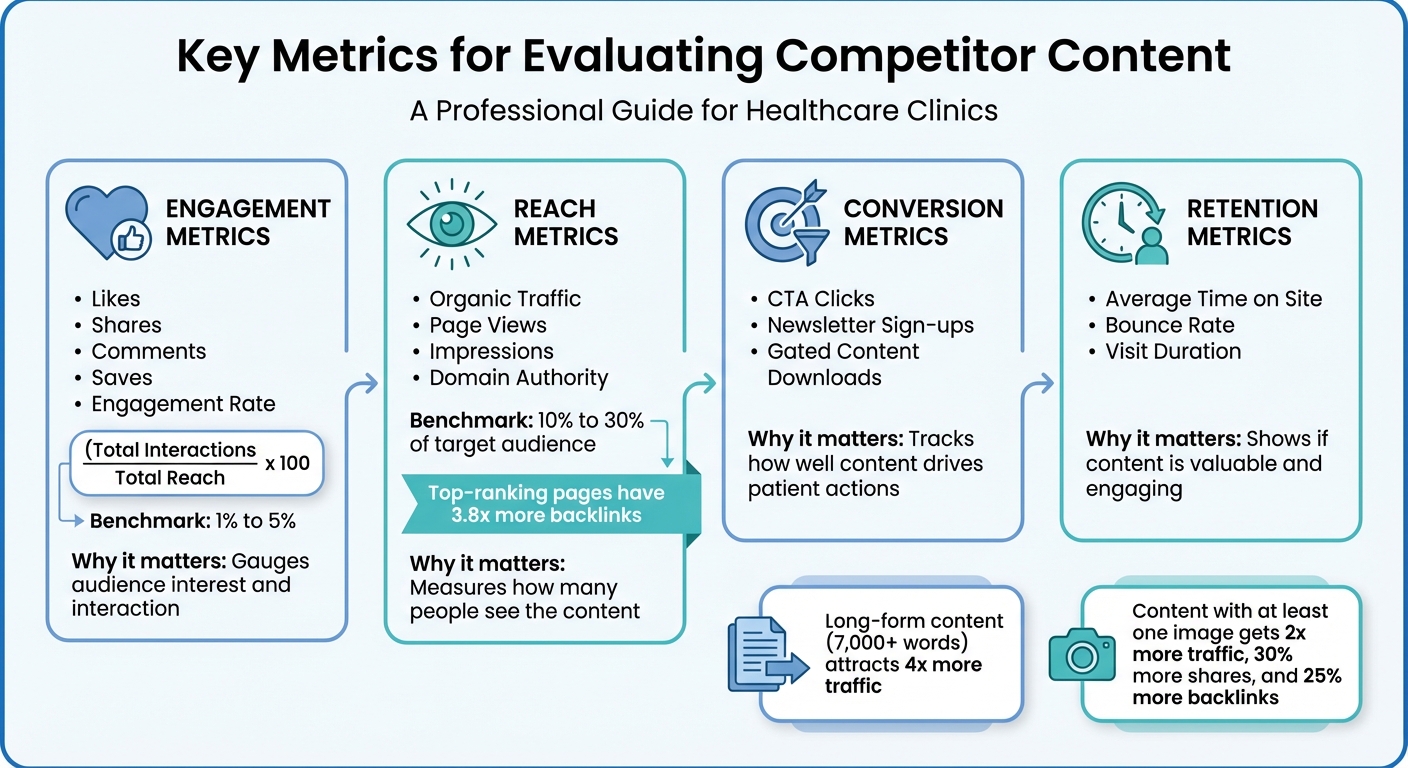
Engagement metrics help measure how well competitor content connects with potential patients. Keep an eye on likes, shares, comments, and saves across social media to identify what genuinely captures attention. Engagement rate can be calculated as (Total Interactions / Total Reach) x 100. Most platforms show engagement rates ranging from 1% to 5%.
But don’t just focus on numbers - look at the quality of engagement. What emotional triggers or recurring hooks are driving interactions? Julia Holmqvist, Social Media Manager at Semrush, emphasizes:
"When I review a competitor's top-performing posts, I don't look at one-off wins. I look for patterns. I pay close attention to the hooks... and the emotional trigger. Is it creating curiosity, FOMO, or authority?"
Comments can also reveal intent. For example, if people are asking for links, templates, or trials, it’s a sign that the content is nudging them toward action.
Content Reach and Conversion Indicators
Once you’ve gauged engagement, it’s time to assess how far competitor content spreads and whether it leads to patient actions.
Reach metrics indicate how many people are exposed to competitor content, while conversion indicators show if that exposure results in meaningful actions. Key metrics include organic search traffic, page views, and session duration, which help identify topics that hold attention. Typically, content reach represents 10% to 30% of a brand’s target audience.
Conversion-focused elements are where the real insights lie. Look at competitor websites for features like newsletter sign-up forms, downloadable guides, and strong calls-to-action (CTAs) for scheduling appointments. These elements often reveal what competitors are offering in exchange for patient contact details. Domain Authority and backlink counts are also worth tracking - higher scores and more backlinks suggest better organic traffic. Notably, top-ranking pages have 3.8x more backlinks than those ranking lower.
Publishing Frequency and Content Types
Publishing frequency plays a role in signaling website activity to search engines, which can boost rankings. Monitor how often competitors post to establish benchmarks for your own content schedule. A rise in video engagement may also indicate shifting audience preferences.
Content format matters too. Analyze competitor content types, such as blog posts, procedure videos, patient testimonials, infographics, or tools like cost calculators. Long-form articles over 7,000 words attract nearly 4x more traffic than shorter ones, while content with at least one image gets 2x more traffic, 30% more shares, and 25% more backlinks than text-only posts. By identifying areas where competitors rely heavily on one format, you can stand out by offering a mix that appeals to overlooked segments of your audience.
| Metric Category | Key Metrics to Track | Why It Matters |
|---|---|---|
| Engagement | Likes, Shares, Comments, Saves, Engagement Rate | Gauges audience interest and interaction |
| Reach | Organic Traffic, Page Views, Impressions, Domain Authority | Measures how many people see the content |
| Conversion | CTA Clicks, Newsletter Sign-ups, Gated Content Downloads | Tracks how well content drives patient actions |
| Retention | Average Time on Site, Bounce Rate, Visit Duration | Shows if content is valuable and engaging |
sbb-itb-02f5876
Tools and Resources for Competitor Content Research
Using the right tools can make competitor analysis faster and more precise. These platforms simplify data collection, providing insights that help you stay ahead.
Analytics and SEO Platforms
SEO tools are essential for understanding what drives competitors’ success in search rankings. Platforms like Semrush and SpyFu can identify keyword gaps - terms your competitors rank for but you don’t. For example, if a rival ranks for "Botox aftercare tips", that highlights a content opportunity. These tools also analyze backlinks, revealing the websites that enhance your competitors' authority.
MarketMuse takes it further by analyzing content structure, including headings, images, and word count. Its "Heatmap" feature visualizes gaps in coverage across the top 20 search results, showing areas competitors haven’t fully addressed. Andy Crestodina, CMO of Orbit Media Studios, explains:
"This platform allows you to plan precisely how you can outmaneuver your largest competitors".
Pricing for these tools varies. Semrush starts at $117.33/month (billed annually), SpyFu offers plans from $33/month, SE Ranking starts at $52/month, and SimilarWeb begins at $125/month after a free trial.
Social Media Monitoring Tools
Social media platforms are treasure troves of engagement data. Tools like Rival IQ and Semrush Social track metrics such as likes, shares, and comments across platforms like Facebook, Instagram, TikTok, and Google Business Profile. They also categorize posts by format - video, photo, or link - helping you identify what resonates most with audiences.
These tools don’t just track engagement; they also analyze posting schedules and audience growth patterns, revealing the best times to post for maximum impact. Rival IQ, for example, offers a 14-day free trial and provides "Head-to-Head" reports for specific social channels. For an additional $20/month, Semrush’s Social Media toolkit can be added to your plan. Meanwhile, the Meta Ads Library offers a look at active ads from competitors, showcasing their promotions and messaging strategies.
Review and Sentiment Analysis Tools
Reputation monitoring tools can help you understand how patients perceive competitors online. Platforms like Brand24 and Talkwalker use AI to track mentions and analyze sentiment, categorizing feedback as positive, negative, or neutral. They also measure "share of voice", showing how often a clinic is mentioned compared to its competitors.
Kara Wenman, Digital Content Marketing Manager at James Hardie, shares:
"Listening not only helps us better understand what the conversations are about our brand in the digital space, it lets us make sure we're dominating share of voice in our industry in a relevant, impactful and positive way".
Brand24’s annual plans start at $119/year, while Visualping offers a free tier with paid plans starting at $10/month. Visualping even alerts you when competitors update their websites, making it easy to track pricing changes or new service launches.
Summary of Tools and Pricing
| Tool Category | Recommended Tools | Starting Price |
|---|---|---|
| SEO & Keywords | Semrush, SpyFu, SE Ranking | $33/month – $117.33/month |
| Social Media | Rival IQ, Semrush Social | $20/month (add-on) + free trials |
| Sentiment/Reputation | Brand24, Talkwalker, Visualping | $10/month – $119/year |
| Content Strategy | MarketMuse, BuzzSumo | $199/month+ |
Reading about the problem? See how Prospyr solves it in one platform.
Book a DemoAnalyzing Competitor Educational Content
Taking a closer look at competitor educational content can provide valuable insights to refine your clinic's messaging and content strategies. By examining key metrics and approaches, you can better understand what resonates with your audience and where opportunities lie.
Identifying Core Topics and Themes
Start by exploring competitor blog categories and tags to uncover recurring themes like anti-aging treatments, skincare tips, or post-procedure care. High-traffic pages often align with patient interests, so analyzing these pages can reveal what topics are driving engagement.
Don’t overlook hidden gems in site navigation or footers, such as resource libraries, FAQs, or dedicated content hubs. A keyword gap analysis can also highlight areas where your competitors are ranking but you’re not, pointing to untapped content opportunities. For a quick snapshot, scan page titles and H1/H2 headers to identify target keywords and recurring themes.
Map competitor content to the buyer's journey to ensure they’re covering all stages: Awareness (educational content), Consideration (comparisons and guides), and Decision (testimonials and pricing details).
"I look for patterns. I pay close attention to the hooks... and the emotional trigger"
Dive into comment sections to spot common patient questions - these can serve as inspiration for your own content.
| Method | Tools Required | Insight Gained |
|---|---|---|
| Blog Tag Audit | Manual / Browser | Identifies content priorities and internal hierarchy. |
| Top Pages Report | Semrush, Ahrefs, Similarweb | Reveals which topics attract the most traffic. |
| Keyword Gap Analysis | Similarweb, Semrush | Highlights search terms competitors rank for that you don’t. |
Once you’ve identified key topics, it’s time to examine how competitors are presenting their content.
Content Format and Platform Selection
The format of content can be just as important as the message itself. Look at whether competitors lean toward videos, blog posts, infographics, or interactive tools like treatment cost calculators. Long-form, image-rich content tends to perform particularly well in this space.
Pay close attention to where competitors are most active. For aesthetics and wellness clinics, platforms like Instagram, Facebook, and TikTok are key. Are they prioritizing Instagram Stories, or focusing on YouTube videos that showcase procedures? Tools like the Meta Ad Library can reveal which formats - videos or images - they’re actively promoting.
Engagement metrics such as likes, comments, and shares can show which formats resonate most. In the aesthetics industry, before-and-after photos and educational videos often drive the highest interaction. On-site metrics like visit duration and bounce rate also provide clues about whether the format aligns with visitor expectations.
Interactive content is gaining traction. Features like skin assessment quizzes or health calculators often achieve higher engagement compared to static text.
"Social media... is your direct window into what users are thinking, so don't overlook it"
Messaging and Target Audience Alignment
Great messaging goes beyond keywords - it’s about tone, personality, and emotional appeal. Does a competitor adopt a conversational tone or a more professional, authoritative voice? Do they tap into curiosity, FOMO, or trust to connect with their audience? Their "About Us" pages and homepage meta descriptions often provide valuable clues about how they position their brand and target demographic.
Community interaction is another strong signal of alignment. If comment sections are filled with thoughtful questions, link requests, or friend tags, it’s a sign the content is resonating. On the flip side, generic emojis or minimal interaction might indicate low-quality or automated engagement.
Assess the depth and complexity of competitor content. Is it beginner-friendly or more advanced? Checking the reading level ensures it matches your target audience’s needs. Categorize their content by search intent - informational (e.g., "benefits of PRP"), navigational, or transactional - to see which part of the patient journey they’re addressing.
Finally, examine their calls-to-action (CTAs) and gated content like ebooks or quizzes. These can reveal what types of offers or information their audience values most.
"Analyzing competitors' marketing campaigns can help you better understand client pain points and desires"
Subscribe to competitor newsletters to get a sense of their communication frequency and promotional strategies. This final step ties everything together, helping you integrate these insights into a stronger, more effective content strategy. Combine these observations with earlier metrics to complete the picture of your competitive landscape.
Identifying Content Gaps and Opportunities
After outlining your competitors' content strategies and metrics, the next step is figuring out where they fall short. This is where you can uncover ways to position your clinic as a more patient-focused and comprehensive resource. Spotting those gaps and turning them into opportunities is where the real value lies.
Spotting Competitor Weaknesses
Take a close look at your competitors' educational materials and identify four key gaps:
- Depth gaps appear when competitors only skim the surface of a topic - like publishing an 800-word article - when patients are searching for an in-depth guide.
- Perspective gaps occur when content is written strictly from a clinical perspective, ignoring the emotional or practical concerns that patients might have.
- Format gaps show up when competitors stick to one type of content, such as blog posts, while neglecting other formats like videos, interactive tools, or downloadable checklists.
- Audience gaps happen when content is aimed at a wide audience instead of addressing specific patient groups. For instance, instead of broadly discussing "Botox for wrinkles", competitors might miss niche searches like "Botox for laugh lines".
Technical issues are another area to explore. Check for slow-loading websites (anything over 3 seconds), poor mobile optimization, or missing metadata. Quality issues, like typos, broken images, or incomplete coverage of the patient journey, can also highlight areas where your clinic can shine.
"Real competitive analysis means understanding why certain content ranks, what topics competitors completely miss, and how to find angles they haven't discovered yet."
– Isabel S. Cruz, ContentPeter
A great example of addressing these gaps comes from SEO expert Victoria Kurichenko. In February 2024, she analyzed competitor content on Beehiiv, identified missing keywords, and optimized meta titles and descriptions. The result? Impressions tripled in two weeks, daily clicks jumped from 2–5 to 20–30, and the content climbed to a top 5 ranking for its target keywords.
The next step is aligning these gaps with patient needs to uncover even more opportunities.
Understanding Client Needs and Expectations
Patient feedback can be a treasure trove of content ideas. Dive into competitor social media comments, reviews, and engagement to find unanswered questions or recurring concerns. For example, if people frequently ask about recovery timelines or detailed cost breakdowns and competitors fail to address these topics, you've found a chance to step in.
Mapping content to the buyer's journey can also reveal where patients lose interest. While competitors might do well with awareness-stage content, they might neglect decision-stage materials like pricing guides or consultation checklists. Reviewing the top 10 Google results for your target keywords can also highlight unanswered questions.
"It's about finding holes in your content, specifically missing content that should help the buyer on their journey."
– Chima Mmeje, Founder, Zenith Copy
These insights can help you craft a strategy that not only addresses these gaps but also sets your clinic apart.
Building a Differentiation Strategy
Standing out goes beyond sounding different - it’s about clearly showcasing your unique value. Healthcare content often leans toward being overly clinical or generic, so simplifying medical jargon into relatable language can make a big difference. If competitors post monthly, publishing weekly can also help establish your authority.
Focus on overlooked keywords that competitors miss. Instead of chasing broad terms, target long-tail phrases that address specific patient concerns. Additionally, if competitors stick to text-heavy content, diversify your approach with procedure videos, patient testimonials, or interactive tools like digital intake skin assessment quizzes. For instance, in 2022, the Hunter blog team identified a gap in "Bottom of Funnel" content - listicles comparing tools. By targeting 15 high-revenue keywords and building clusters around them, they turned organic traffic into revenue despite stiff competition.
"The right question isn't, 'How can we sound different?' It's, 'How are we different - and how can we use this to our advantage?'"
– Ahava Leibtag, Founder and CEO, Aha Media Group
Implementing Insights into Your Content Strategy
Using the competitor analysis insights discussed earlier, it’s time to turn those findings into actionable steps for your clinic's content roadmap.
Prioritizing Content Development
Start by focusing on "quick wins." These are existing pages on your site that already rank on the second or third page of search results for high-value keywords identified during competitor analysis. Optimizing these pages can deliver faster results compared to creating entirely new content.
Next, target "low-hanging fruit" keywords - areas where competitors have weak rankings or shallow content. Instead of competing head-on with rivals on their strongest topics, build authority in these underserved areas. For instance, if competitors only provide brief overviews of microneedling, consider creating a detailed guide covering patient concerns like "What to Expect During Your First Microneedling Appointment".
A great example of this approach is The Dental Team, a multi-location dental practice. In April 2025, they implemented an SEO and content strategy based on competitor gap analysis. By targeting high-intent keywords and tailoring content to meet patient needs, they achieved a 238% increase in organic traffic and a 109% increase in leads.
Invest in content that sets you apart. Incorporate expert interviews, patient surveys, or data-driven infographics into your materials. Long-form articles - those exceeding 7,000 words - attract nearly 4X more traffic than shorter posts, making depth a crucial factor when optimizing underperforming content.
"When you know not only who is beating you in the content game, but why and how they are beating you, you can take steps to address the specific issue instead of wasting precious resources trying to fix something in your content strategy that may not be broken."
– Erica Follette, Content and Customer Service Specialist, Vendilli
If your engagement metrics are low despite frequent posting, it’s worth reducing output and shifting focus toward higher-quality content.
Creating a Content Rollout Plan
To stay competitive, benchmark your publishing frequency against competitors. Create a sustainable schedule that aligns with your team’s capacity and highlights your unique perspective.
Focus on the gaps identified in your analysis. Develop content that competitors have either overlooked or covered poorly. This allows you to address patient information needs before your rivals catch up. Use a mix of formats - such as videos, infographics, and long-form articles - based on what drives the most engagement for your competitors.
"Align your content creation with competitor activity to maximize impact. Consider publishing high-value content around the same time as your competitors to leverage audience interest, but ensure you offer a unique and valuable perspective."
– Irina Weber, Content Marketing Specialist, StoryChief
Set clear, time-bound goals for your rollout. For example, aim to improve organic search visibility by 20% within six months. Connor Wilkins, CMO of Direction.com, advises:
"Identify quick wins, such as optimizing existing content for high-value keywords where your site currently ranks on the second or third search page. This approach often yields more immediate improvements in search visibility compared to more time-intensive initiatives."
To maintain a steady publishing rate without overburdening your team, repurpose successful blog posts into videos, whitepapers, or social media snippets. Ensure your site is technically ready - both users and search engines prefer pages that load in under three seconds. Regularly review competitor activity and adjust your schedule to stay ahead.
Tracking and Refining Performance
Once your content plan is underway, tracking its performance is vital to refining your approach.
Monitor metrics like organic search trends, page views, and session duration to measure reach. For social media, track likes, shares, comments, and saves. Engagement rates typically range between 1% and 5%, while reach often falls between 10% and 30% of your target audience.
Keep an eye on SEO health indicators such as Domain Authority (DA), keyword rankings (especially top 10 positions), and the quality of your backlink profile. Metrics like bounce rate, average visit duration, and pages per visit can reveal whether your content meets patient expectations.
For example, WordStream used competitor analysis to identify content gaps, leading to a 626% increase in total clicks within 12 months. Achieving such results requires consistent monitoring and adjustments.
"SEOs should still care about domain authority because it is a good indicator of a website's overall authority and trustworthiness in relation to providing information on a particular topic."
– Vanessa Bellanti, SEO Lead, Shopify
Conduct a quarterly analysis of both competitor and self-performance data to adapt to market changes. Audit the quantity and quality of your published assets - blogs, videos, case studies - and update older content as needed. Refreshing existing material can cut production costs by over 80% while still driving traffic and conversions.
When targeting keywords, prioritize search intent over sheer volume. Sean Begg Flint, Founder of Position Digital, explains:
"One best practice we swear by is focusing on search intent over just keyword volume. It's easy to get caught up chasing high-volume keywords, but if the intent doesn't match your content, you'll struggle to convert that traffic."
Ensure your content aligns with user intent, whether it’s informational (e.g., learning about a condition) or transactional (e.g., booking a treatment).
For streamlined management, consider platforms like Prospyr, which combine patient management tools with digital marketing analytics to support an informed content strategy.
Conclusion: Staying Ahead with Continuous Analysis
Key Points to Remember
Competitor analysis isn’t a one-and-done task - it’s an ongoing effort to keep your clinic visible and adaptable. Regularly reviewing your competitors helps you stay aligned with shifting patient demands and market trends.
Focus on the essentials: pinpoint content gaps where competitors fall short and optimize pages currently sitting on the second or third page of search results. Why? Because engaging content paired with strong visuals can significantly boost traffic.
"Competitor analysis is not just about keeping up with others but finding and leveraging unique opportunities to stand out."
– Connor Wilkins, CMO, Direction.com
It’s not just about numbers, though. Pay attention to how competitors showcase their expertise. Look at their use of H2 and H3 headers, which can improve post performance by up to 44%. Study their calls-to-action and overall content structure to uncover ways to refine your own approach.
These observations provide the foundation for actionable steps to strengthen your clinic’s content strategy.
Next Steps for Your Clinic
Here’s how you can put these insights into action right away:
- Select two or three key competitors and use tools like SEMrush or Ahrefs to identify high-value keywords where your rankings are close to breaking through. Focus on optimizing those pages for quicker wins.
- Commit to regular analysis. Perform monthly checks to monitor competitors and a comprehensive review each quarter. If resources are tight, aim for an annual deep dive while keeping tabs on major competitors monthly through SEO and social media monitoring platforms.
- Simplify tracking and management by using platforms like Prospyr. This can centralize patient management and marketing analytics, helping you monitor content performance alongside clinic operations.
Consistency is what turns competitor insights into long-term growth. Regular analysis ensures your clinic stays ahead and adapts effectively to the ever-changing landscape.
FAQs
Which competitor metrics matter most for clinics?
Key metrics to watch for competitor clinics revolve around how their content performs. This includes tracking website traffic, how long visitors stay on their site (session duration), social media interactions, and keyword rankings. Beyond that, analyzing their backlink profiles and content performance - like open rates, click-through rates, and areas where their content might fall short - can provide valuable insights. These numbers give a clearer picture of where opportunities lie, help fine-tune your strategies, and offer a solid way to measure your clinic against the competition.
How do I find content gaps my competitors miss?
One smart way to strengthen your content strategy is by identifying gaps in your competitors' content. These are the topics or keywords they either miss entirely or fail to cover effectively. By stepping into these overlooked areas, you can create content that stands out and meets audience needs more thoroughly.
To do this, tools like SEMrush or Ahrefs are incredibly helpful. They allow you to uncover underutilized keywords your competitors aren't ranking well for - or aren't targeting at all. Once you find these opportunities, focus on crafting targeted, high-quality content that addresses those gaps.
This method not only boosts your clinic's visibility but also positions your content as a go-to resource in your field. By being more thorough and addressing areas others neglect, you can engage your audience more effectively and build trust.
How often should I redo competitor content analysis?
How often you should revisit your analysis largely depends on how quickly your industry changes. In dynamic fields like aesthetics and wellness clinics, experts recommend reviewing your strategy every 3–6 months. Regular updates allow you to spot emerging trends, fill content gaps, and monitor competitor strategies, keeping your approach fresh and effective. For most clinics, quarterly or bi-annual reviews strike the right balance to remain competitive and in sync with market shifts.