6 Follow-Up Workflows for Botox and Filler Visits
A predictable six-touch follow-up system prevents post-injectable gaps, flags complications early, and boosts rebooking.


Most Botox and filler follow-up problems start after the patient leaves. A set post-visit workflow can help you catch issues early, guide recovery, and improve rebooking. In one figure from the article, practices with automated follow-up sequences saw 90-day rebooking rates of 50%–60%, versus 28%–35% with no set process.
Here’s the short version: you need six timed touchpoints after treatment. They cover same-day aftercare, 24–48 hour recovery, Day 7 progress, Day 10–14 review, touch-up choice, and maintenance reminders. Botox and filler should not use the same timing or message rules, because Botox takes up to 14 days to show full results, while filler follow-up needs closer watch for early swelling, pain, or skin color changes.
If I were setting this up, I’d keep the workflow focused on four things at each step:
- Who sends the message
- What the message says
- What staff record
- When a staff member must step in (potentially via telehealth for quick visual assessments)
I’d also make sure automation stops right away if a patient replies with words like pain, swelling, redness, or says they’re unhappy.
Quick comparison
| Workflow step | Main goal | Best timing |
|---|---|---|
| Aftercare note | Give care instructions | 2–4 hours after checkout |
| Recovery check-in | Catch early issues | 24–48 hours |
| Progress update | Set expectations, check healing | Day 7 |
| Clinical review | Check results, decide next step | Day 10–14 |
| Touch-up decision | Book, defer, or move on | Right after review |
| Maintenance reminder | Bring patient back | Based on product timing |
You can think of the whole system like this: guide recovery first, review results next, then ask for the rebook at the right time.
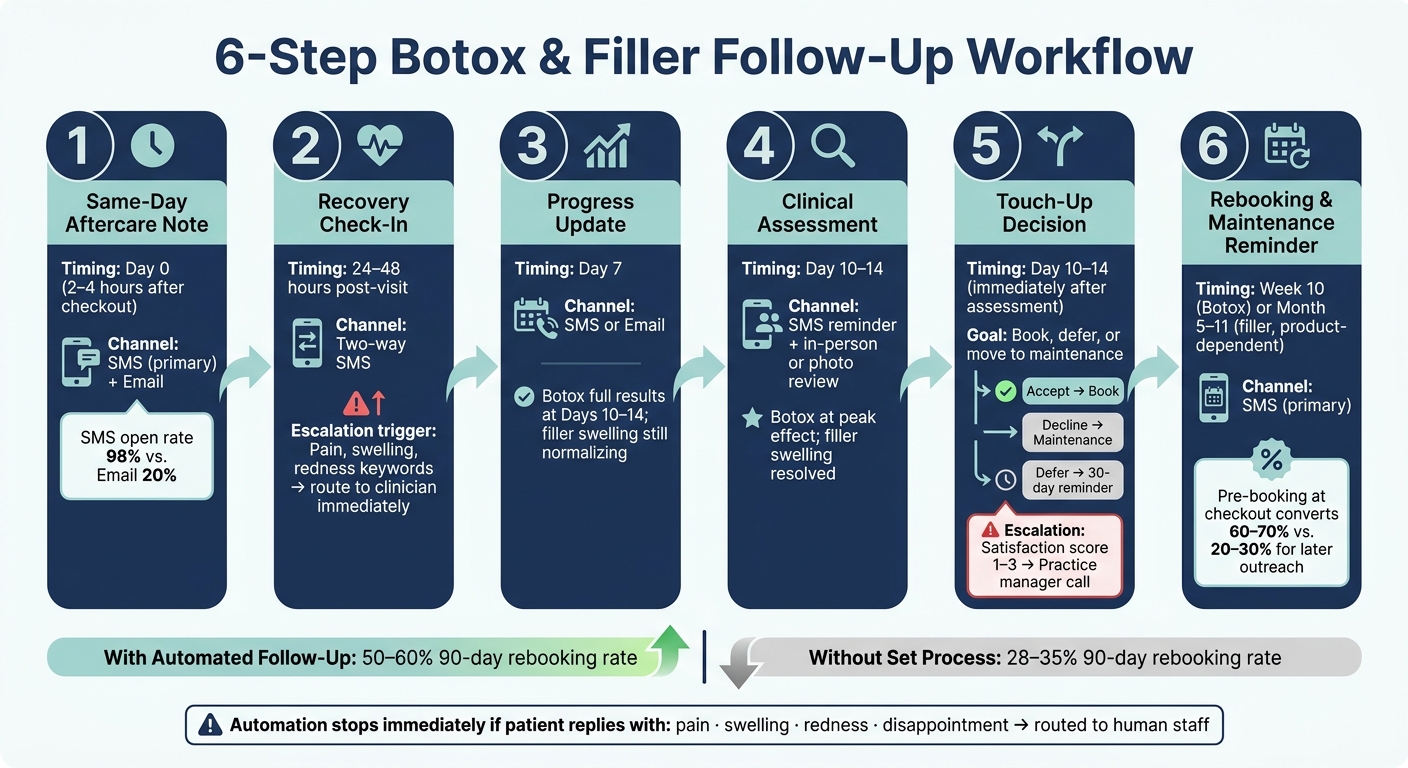
6-Step Botox & Filler Follow-Up Workflow Timeline
What Each Injectable Follow-Up Workflow Step Should Include
Every follow-up touchpoint - whether it goes out the same day or weeks later as a maintenance reminder - should spell out four things: who it's from, what it says, what gets documented, and when staff need to step in. The six workflows below follow that setup at each touchpoint.
The sender should look like the injector or the practice, even if the message is automated. The message needs to match the treatment. For documentation, keep it tight and useful: batch numbers, units/volume, injection sites, and satisfaction scores via digital intake forms. And before any workflow goes live, the escalation trigger needs to be set in advance.
Botox and filler don't follow the same timeline. Botox results can take up to 14 days. That lag changes when you check in, when you talk about touch-ups, and when you ask about satisfaction. Filler follow-ups have a different focus. Swelling and bruising may show up in the first 24–48 hours, but severe pain, skin blanching, or duskiness can point to vascular compromise and need immediate clinical escalation. That difference should shape the timing, tone, and escalation rules for each message.
Any workflow used for injectable follow-ups - including Prospyr - should stop automated sequences the moment a patient replies with terms like pain, swelling, redness, or disappointment, and send that message to a human right away. Those escalation rules should be built into the automation from the start so staff can step in before symptoms get worse.
Use the framework below to keep each message consistent.
| Workflow Element | What It Covers |
|---|---|
| Sender | Automated message that appears to come from the injector or practice |
| Message | Treatment-specific aftercare, results expectations, and rebooking prompts |
| Staff Documentation | Batch numbers, units/volume, injection sites, and satisfaction scores |
| Escalation Trigger | Pain, swelling, redness, skin color changes, or satisfaction scores of 1–3 |
sbb-itb-02f5876
1. Same-Day Aftercare Note and Delivery
Send the first aftercare message 2 to 4 hours after checkout, once the visit is marked complete. This message sets expectations before the first recovery check-in.
Give this task to the front desk or injector, then automate delivery as soon as checkout is completed. SMS should be the main channel. Post-treatment SMS open rates reach 98%, compared with 20% for email. Use email as the written record.
The message should match the treatment. Set up branching logic so Botox and filler patients get the right aftercare.
- Botox patients should be told to skip exercise for 24 hours, avoid lying down for 4 hours, and stay out of direct sun.
- Filler patients should be told to ice the area to help with swelling, avoid touching or massaging the treated area for 6 hours, and wait 24 hours before intense exercise.
Branch by treatment: Botox or filler.
Prospyr supports this step with HIPAA-compliant SMS and email automation, including personalization by patient name, provider, and treatment type.
Track the delivery time, channel used, whether the patient replied, and any questions or concerns raised. That record feeds the next recovery check-in.
2. 24- to 48-Hour Recovery Check-In
Send this message within 48 hours after the appointment is marked complete, and set it to go out automatically. This is the first recovery checkpoint that matters. It covers the early window when swelling, bruising, and patient questions tend to show up. It also builds on the first aftercare instructions and helps catch issues before they get worse.
Keep the message short and direct: "How are you feeling after your treatment? Any concerns?" The point is fast triage, not a long back-and-forth.
Handle Botox and filler replies differently:
- Botox: confirm the patient has their aftercare instructions and knows they can contact the clinic with questions.
- Filler: focus on symptom triage first, with a clear path to escalate time-sensitive complications.
If a patient sends any red-flag reply, send it to a nurse or clinician right away. Document the reply, then escalate only when needed. Staff should track the details that shape the next step: response status, symptoms, swelling, bruising, red-flag terms, and satisfaction score. Any score from 1–3 should go to the practice manager for a same-day call.
Prospyr's HIPAA-compliant SMS tools support two-way messaging and keyword-based routing, which means these escalations can be handled automatically.
3. 1-Week Progress Update
After the 24- to 48-hour check-in, send a Day 7 progress update. This message should go out on Day 7 after the appointment is marked complete. At that point, results are starting to settle, but they are not final yet. That makes Day 7 the right moment for a short progress check before the 10- to 14-day assessment.
Set the message to trigger automatically from completed-appointment status. Keep it centered on healing progress and what the patient should expect next. For Botox, let patients know that full results usually show up between Days 10 and 14. For filler, let them know that any lingering swelling or bruising can still fall within the normal healing window. The goal here is simple: set clear expectations without overloading the patient.
Include one clear call to action that invites the patient to reply with any questions or concerns. If they report pain, swelling, or unevenness, send that straight to a clinician right away. Clinical concerns should always be handled first.
Track these fields at every Day 7 touchpoint:
| Documentation Field | What to Record |
|---|---|
| Patient Sentiment | Satisfaction score (1–5) |
| Clinical Progress | Healing status based on patient-reported feedback |
| Adverse Events | Any reported pain, swelling, or bruising flagged for clinical review |
| Touch-Up Necessity | Whether a 10- to 14-day assessment or touch-up should be scheduled |
Use the patient’s reply to decide if they need the 10- to 14-day assessment or a touch-up review. Prospyr can send the Day 7 message, route red flags, and track follow-up tasks.
Reading about the problem? See how Prospyr solves it in one platform.
Book a Demo4. 10- to 14-Day Clinical Assessment
Once early recovery is on track, shift to the Day 10–14 clinical assessment. This is the standard results-and-touch-up checkpoint. Botox is usually at peak effect by then, and filler has had time to settle as swelling goes down.
Automation should handle the reminder. The actual assessment should be done by a licensed clinician. An automated SMS or email can send the reminder and collect an early satisfaction rating, but the clinical review itself needs to be completed by a licensed clinician or injector.
That review can happen in person or through a secure photo review with SMS or email follow-up. If the patient still hasn't booked, send a Day 14 text reminder. SMS open rates for med spa follow-ups reach 98%, while email sits at 20%. That's a big gap.
Document the key details from the assessment:
| Documentation Field | What to Record |
|---|---|
| Treatment Type / Provider | Botox or filler visit and the clinician who completed the review |
| Patient Satisfaction | 1–5 rating or written feedback on results |
| Residual Asymmetry | Any uneven movement or volume noted by the clinician |
| Before-and-After Photos | Standardized images at rest and with full expression, stored securely |
| Adverse Events | Pain, swelling, bruising, or redness flagged for clinical review |
| Touch-Up Details | Units or volume added, exact injection sites |
| Rebooking Status | Whether the next visit was booked at the assessment |
| Maintenance Plan | Recommended date for the next full treatment cycle |
Use the outcome of the assessment to decide the next step: either record any touch-up care or move the patient into a maintenance rebook.
5. Touch-Up Decision and Documentation
At the 10- to 14-day assessment, this is where the process shifts from review to a clear next step. After the assessment, route the patient into one of three paths: book, defer, or move to maintenance.
Automation should send the first nudge, but a clinician should handle the actual conversation. A personalized SMS from the injector feels clinical instead of sales-driven. For example:
You're at the 2-week mark. Want to book a touch-up assessment? Reply YES and we'll find a time.
If the reply includes clinical keywords like pain, swelling, or asymmetry, route it at once to a licensed clinician.
Use this rule set so staff respond the same way every time.
| Decision | Workflow Action | What to Document |
|---|---|---|
| Accepted | Book touch-up, mark complete, stop reminders | Units/volume used, injection sites, updated photos and consent |
| Declined | Move to maintenance sequence | Satisfaction score (1–5), reason for decline, follow-up plan |
| Deferred | Send a 30-day follow-up reminder | Not ready vs. scheduling conflict, current concerns/notes, follow-up date |
If a patient gives a satisfaction score of 1–3, flag the record for a practice manager to make a personal recovery call instead of leaving that patient in automation. That extra human step matters. A low score usually means the patient needs care, clarity, or reassurance, not another generic reminder.
If the patient accepts, pause the reminder sequence right away. Prospyr can automate that stop trigger, so booking confirmation and reminder suppression happen at the same time.
If the patient declines or defers, move them into the maintenance sequence.
6. Rebooking and Maintenance Reminder Sequence
When patients don't book touch-up care before they leave, move them into a product-based maintenance cadence instead. This matters more than it may seem. Pre-booking at checkout converts 60–70%, compared with 20–30% for later outreach. So this schedule isn't just a reminder system. It's a retention play.
Build the cadence around how long each treatment tends to last, then adjust the message based on where the patient is in the sequence:
| Treatment | Typical Duration | First Reminder | Second Reminder | Final Reminder |
|---|---|---|---|---|
| Botox / Xeomin | 10–12 weeks | Week 10 | Week 11 | Week 12 |
| Dysport | 11–13 weeks | Week 10 | Week 12 | Week 13 |
| Lip Filler (HA) | 6–9 months | Month 5 | Month 6 | Month 7 |
| Cheek Filler (HA) | 12–18 months | Month 11 | Month 12 | Month 13 |
| Juvederm Voluma | 18–24 months | Month 15 | Month 16 | Month 18 |
The reminder should sound like it came from the injector, not from the clinic as a brand. That small shift can make a big difference. For the Week 10 message, focus on the patient's best refresh timing: "You're approaching your optimal refresh window. Here are 2 openings next week." In Week 11, add a soft incentive for first-time patients, like a complimentary add-on service. By Week 12, keep the tone light and low-pressure, with a note about limited availability. Also, use a booking-detection trigger so the sequence stops the moment a patient books.
After that, keep a close eye on the right fields. The ones that matter most are:
- product type
- units or volume used
- treatment area
- injector name
- last treatment date
- estimated next due date
- reminder stage
- rebooking outcome
- decline reason
You should also watch for churn signals, especially longer gaps, declined slots, and unused credits. If those signs show up, pause the automation and send the patient to a front desk call.
Workflow Summary Table
Use this table to keep all six follow-up touchpoints in one place. It gives your team a single operational view, so no step slips through the cracks.
The timing example below assumes the treatment was completed on July 26, 2026.
| Workflow Step | Timing | Example Date/Time | Sender | Primary Goal | Preferred Channel | Staff Tracking Items |
|---|---|---|---|---|---|---|
| 1. Aftercare Delivery | Day 0 (within 2–4 hrs of checkout) | July 26, 2026 at 4:00 PM | Automated system | Aftercare delivery | SMS + Email | Delivery status, link click-through, batch numbers, units, injection sites |
| 2. Recovery Check-In | 24–48 hrs post-visit | July 28, 2026 at 10:00 AM | Injector (personalized) | Triage early concerns | Two-way SMS | Red flag language (pain, swelling, bruising), response rate |
| 3. Progress Update | Day 7 | August 2, 2026 at 2:30 PM | Injector or coordinator | Track healing and satisfaction | SMS or Email | 1–5 satisfaction score, early result feedback |
| 4. Clinical Assessment | Day 10–14 | August 9, 2026 at 11:00 AM | Injector or coordinator | Confirm results and book review | SMS | Touch-up booking rate, standardized photos, clinical findings |
| 5. Touch-Up Decision | Day 10–14 (immediately after assessment) | August 9, 2026 at 11:30 AM | Injector | Record touch-up outcome | In-person or portal | Units administered, before/after photos, updated maintenance plan, consent |
| 6. Rebooking Reminder | Week 10 (Botox) or Month 5 or 11 (filler, depending on product) | October 4, 2026 at 9:00 AM | Injector/System | Rebook maintenance care | SMS (primary) | Rebooking rate, time-to-rebook, revenue per patient, lapse recovery rate |
If you use Prospyr, keep SMS and email triggers, satisfaction routing, and rebooking tracking inside one workflow.
Next, adjust these templates for Botox and filler-specific timing and escalation.
Botox vs. Filler Follow-Up Differences to Build Into Your Templates
One injectable template won’t work for both treatments. Botox and fillers need the same basic follow-up flow, but the message, timing, and escalation rules should change based on treatment type.
Here’s the simplest way to think about it:
- Botox templates should focus on expectation-setting on Day 2, then use the 10- to 14-day check-in to review results and see whether a touch-up is needed.
- Filler templates should start with aftercare on Day 0: icing, avoiding pressure, and limiting activity. Then use the later check-in to look at swelling, bruising, and final symmetry.
The table below shows the exact differences to build into your automation.
| Feature | Botox / Neuromodulators | Dermal Fillers |
|---|---|---|
| Template Emphasis | Expectation-setting on Day 2; results and touch-up review at Day 10–14 | Immediate aftercare on Day 0; symptom and symmetry review at later check-in |
| Initial Onset | 3–5 days | Immediate, but obscured by swelling |
| Full Results / Evaluation | 14 days | 7–10 days settled; review at weeks 2–4 |
| Normal Side Effects to Normalize | Minor bruising, mild swelling, "settling" sensation | Initial swelling, bruising, tenderness |
| Red-Flag Symptoms | Asymmetry after 14 days, severe headache, drooping | Excessive swelling, severe pain, skin discoloration |
Red flags need a different path. Any reply that mentions pain, swelling, discoloration, or discomfort should go to a clinician right away. For fillers, be even stricter: any text report of significant swelling should trigger an immediate clinical review.
If you use Prospyr, set up separate automated SMS branches for Botox and fillers. That way, each patient gets the right timing, the right message, and the right escalation path.
Conclusion
A strong injectable follow-up system works best when it’s predictable, documented, and clearly assigned.
Automation keeps follow-ups running on time and helps protect rebooking. It moves the patient from aftercare to the next appointment without staff having to chase every step by hand.
Ownership matters here. The injector handles clinical guidance and red-flag escalation. Clinical staff review photos and recovery concerns. The front desk or coordinators focus on rebooking. The practice manager steps in when satisfaction scores come in low. Clear handoffs like these keep the six-step sequence moving and help stop gaps before they turn into missed follow-ups.
A few numbers can tell you a lot:
- 90-day rebooking rate
- Average time to rebook
- How many adverse events your check-ins catch early
Use those metrics to find weak spots in timing, response, and conversion.
For practices that want to run this in one place, Prospyr can bring together communication, scheduling, clinical notes, and photos so a completed appointment triggers the right follow-up on its own.
FAQs
Why do Botox and filler follow-ups need different timing?
Botox and filler follow-ups shouldn't run on the same schedule. Each treatment wears off on a different timeline, and that changes when it makes sense to reach out.
Botox usually lasts 10 to 14 weeks, so rebooking often makes sense around 10 to 12 weeks. Dermal fillers tend to last 6 to 18 months, which means reminder timing should be pushed much farther out.
If you use one generic follow-up window for both, you can run into two problems: missed retention chances and outreach that lands at the wrong time.
What patient replies should trigger immediate staff follow-up?
If a patient reports pain, swelling, dissatisfaction, or fear, your team should step in right away. The same goes for messages that include complaint keywords or clear signs of serious concern. In those cases, pause any automated follow-up so a staff member can respond personally.
That gives your staff a chance to deal with clinical issues or a bad experience before the patient feels ignored - or worse, gets an automated rebooking prompt at the wrong time.
Who should own each step of the follow-up workflow?
Ownership should line up with each team member’s job.
- Providers: clinical follow-up, treatment goals, and return timing
- Front desk: same-day rebooking, preference logging, and flagged concerns or recovery calls
- Marketing/operations: automation setup, branching logic, performance tracking, and win-back sequences