Personalized Retention for Med Spas: Guide 2026
Boost med spa repeat visits with clean client data, treatment-timed SMS/email, HIPAA-safe automation, and clear staff ownership.
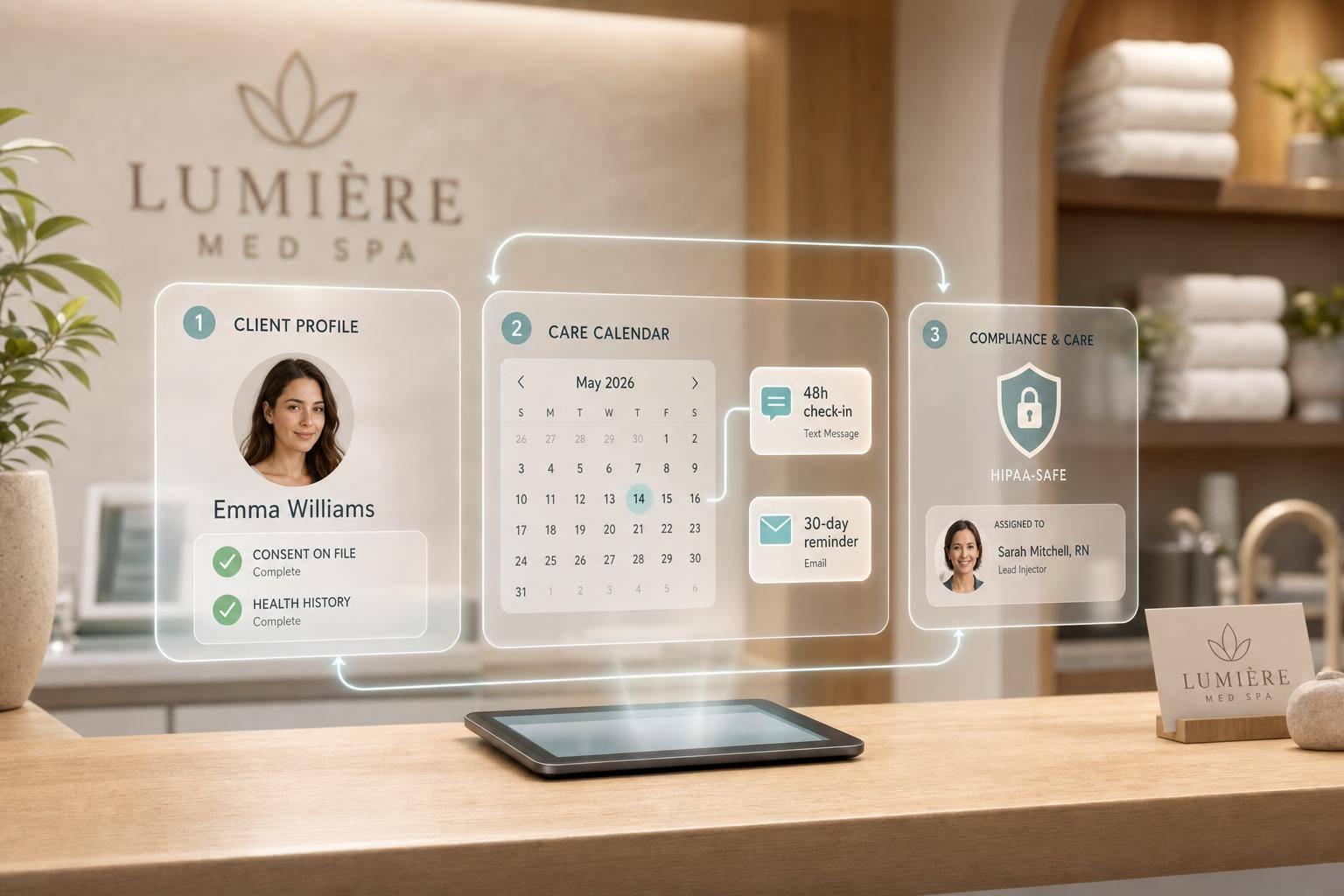

Most med spa clients do not return on their own. If you want more repeat visits in 2026, I’d focus on three things first: clean client data, timed follow-up based on treatment cycles, and clear staff ownership.
Here’s the short version:
- 60%–70% of new clients don’t come back without a set retention process.
- Keeping a client costs far less than finding a new one. In many cases, acquisition costs are 5–7x higher.
- A small retention lift can have a big money effect. Even a 5% improvement can increase profit by 25%–95%.
- Rebooking at checkout works much better than waiting. Many practices see 60%–70% rebooking rates at checkout, versus 20%–30% later.
- SMS works best for short, time-based reminders. Email works better for education, reviews, and win-back flows.
- Timing should match the service. A Botox client, filler client, and laser client should not get the same follow-up schedule.
- HIPAA rules matter. Consent, access controls, and plain wording are part of the process.
If I were building this from scratch, I’d keep it simple:
- Collect the right client fields, including last service, visit date, consent, provider, goals, and return window.
- Split clients into groups like active, at-risk, and lapsed.
- Set automated messages for post-visit care, rebooking, and win-back.
- Stop messages the moment someone books.
- Review rebooking, repeat visits, no-shows, and reactivation every month.
A platform like Prospyr can help by keeping scheduling, charting, communication, memberships, and reporting in one HIPAA-compliant place, which makes retention easier to run.
That’s the core idea: use client data to send the right message at the right time, then track who comes back and adjust from there.
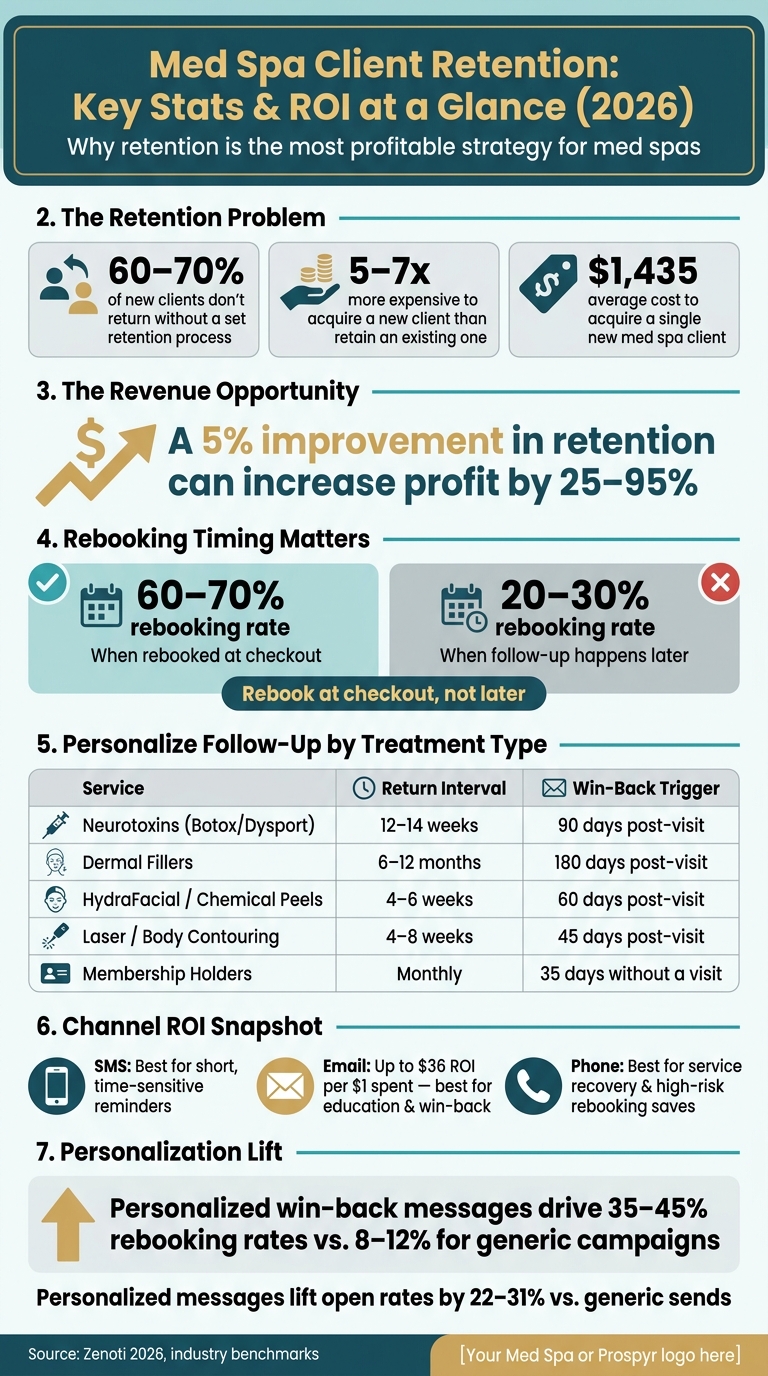
Med Spa Client Retention: Key Stats & ROI at a Glance (2026)
Build Your Client Data and Segmentation Foundation
What client data to collect for retention
Personalized retention starts with a client record that can trigger the right follow-up at the right time. That means collecting the fields that shape outreach: contact details, SMS and email preferences, consent status, last service, provider, lifetime value, average spend, membership status, maintenance interval, and aesthetic goals.
Two fields often get missed, and that’s a problem: recommended maintenance intervals and aesthetic goals. A client’s Botox window is roughly 90 days. A filler client may not need to return for six to twelve months. If those intervals aren’t in the record, your automation is just taking a shot in the dark. Digital intake forms help here because they cut down on manual entry and make the data ready to use before the next follow-up.
Service names also need to stay consistent across every record. If one team member logs “neuromodulator” and another logs “Botox,” the system may not trigger the right sequence. Pick one naming standard and use it everywhere.
Once those fields are clean and consistent, you can group clients by recency, service type, and value.
How to segment med spa clients for targeted outreach
When the data is clean, segmentation turns it into something you can act on. The simplest place to start is lifecycle segmentation. That means grouping clients by how recently they visited. Active clients visited within 90 days. At-risk clients are 90–180 days out. Lapsed clients are past 180 days.
Each group should have its own cadence, offer, and message angle. A client who was in last month should not get the same message as someone who hasn’t visited in seven months.
Then layer in behavioral segmentation. Injectables clients, laser clients, and facial regulars all follow different biological refresh cycles, so their timing and message copy should change too. After that, add a value tier. The top 20% of clients usually drive 65–75% of revenue. That’s a big deal. When you spot those high-spend clients and treat them differently with priority booking, exclusive previews, or premium add-ons, the payoff can be strong.
The table below shows common service categories, their usual return windows, and when a win-back trigger should fire:
| Service Category | Typical Return Interval | Win-Back Trigger |
|---|---|---|
| Neurotoxins (Botox/Dysport) | 12–14 weeks | 90 days post-visit |
| Dermal Fillers | 6–12 months | 180 days post-visit |
| HydraFacial / Chemical Peels | 4–6 weeks | 60 days post-visit |
| Laser / Body Contouring | 4–8 weeks | 45 days post-visit |
| Membership Holders | Monthly | 35 days without a visit |
Use these windows as trigger points for automated win-back sequences.
How connected systems keep client records accurate and usable
A lot of med spas run into trouble when scheduling, intake, notes, and communications sit in separate systems. Without one current client record, automation can’t tailor timing or message content very well. When the same data lives in three places with three different values, staff end up re-entering it by hand, mistakes slip in, and personalization starts to fall apart.
Prospyr connects scheduling, digital intake, EMR, communications, and analytics in a single HIPAA-compliant system, so client records stay accurate and ready to use across every touchpoint. If a provider adds a note after a laser session, the person sending the follow-up can see it right away. No manual sync. No duplicate records.
Messages that mention the last service and provider name lift open rates by 22–31% versus generic campaigns.
With clean segments in place, the next step is matching each segment to the right message and channel.
Reading about the problem? See how Prospyr solves it in one platform.
Book a DemoDesign Your Messages, Automation, and Channel Strategy
Core retention message templates for each stage of the client journey
Once your segments are in place, the next step is simple: decide what each group should hear and when they should hear it. Active clients usually need aftercare and rebooking nudges. At-risk clients need timely check-ins. Lapsed clients need a win-back sequence that feels personal, not random.
Here are the core message types a med spa should have ready:
| Message Type | Purpose | Timing | Key Personalization Fields | Channel |
|---|---|---|---|---|
| Aftercare | Safety instructions + thank-you | Within 2 hours post-visit | First name, service category, provider name | SMS or Email |
| Provider Check-in | Comfort + relationship | 24–48 hours post-visit | First name, provider name, service category | SMS |
| Results Review | Satisfaction + review request | 14 days post-visit | First name, service category, last visit date | Email or SMS |
| Rebooking Prompt | Maintenance habit | 1–2 weeks before clinical interval | First name, service category, interval window | SMS |
| Win-Back Touch 1 | Reactivation | 90 days lapsed | First name, last service, provider name | |
| Win-Back Touch 2 | Urgency reminder | 105 days lapsed | First name, last visit date | SMS |
Tie these templates to your active, at-risk, and lapsed segments so the timing lines up with where each client is in the journey. Use fields like first name, service category, provider name, and last visit date. Just as important, keep client-facing terms matched to what appears in your records.
That last part matters more than it seems. If your chart says one thing and your message says another, the note can feel sloppy fast.
Also, frame reminders as part of the treatment plan, not as a sale. That small shift changes the tone from “marketing blast” to “we’re helping you stay on track.”
Personalized win-back campaigns that use the client’s name, last service, and provider can drive 35–45% rebooking rates. Generic “we miss you” sends land much lower, at 8–12%.
Which follow-up sequences to automate first
You do not need to automate everything on day one. Start with the flows that give you the most lift across the whole client base:
- Post-visit follow-up
- Rebooking reminders
- Lapsed-client win-back
These add up fast because they touch clients at points where timing matters most. For lapsed clients, a three-touch Email-SMS-Email win-back sequence triggered at 90 days post-visit gives you more than one shot to bring them back.
There’s one rule here that can’t be ignored: trigger sequences at checkout, not at appointment creation. That way, you know the treatment actually happened before any follow-up goes out.
And the second a client books, remove them from any win-back or rebooking flow right away. Few things hurt trust faster than sending “we miss you” the day after someone just scheduled.
Automation should take care of reminders and logistics. Staff should step in for clinical concerns and service recovery. That division keeps the system useful without making it feel cold.
Choosing between SMS, email, and phone for each message type
Pick the channel based on the job the message needs to do.
Email brings in up to $36 for every $1 spent. It also gives you room for educational content, before-and-after photos, membership details, and multi-step win-back campaigns. Phone calls take staff time, so save them for service recovery and high-risk rebooking saves.
| Channel | Best Use Case | Message Length | Staffing Needs | Compliance Note |
|---|---|---|---|---|
| SMS | Aftercare, check-ins, rebooking reminders | Short (under 160 characters) | Low (automated) | Requires HIPAA-compliant SMS provider |
| Education, results reviews, memberships, win-back | 150–300 words | Low (automated) | No PHI in subject lines; requires BAA | |
| Phone | Service recovery, high-risk rebooking saves, complex rebooking | N/A | Manual | Most personal; best for rescue outreach |
As a rule of thumb, use SMS for short, time-sensitive notes. Use email when the client needs more context. Use phone when the situation calls for a human voice.
For educational and promotional email, the best send windows are Tuesday through Thursday, 9–11 AM or 1–2 PM. Subject lines should stay clear of specific clinical details. “Your Recent Visit” or “Maintenance Update” works better than naming the treatment directly.
Once you’ve picked your channels, set send permissions and approval rules before launch.
sbb-itb-02f5876
Set Up HIPAA-Safe Workflows and Team Responsibilities
How to keep personalized communication HIPAA-compliant
Personalized messages that mention treatments involve PHI. That means you need to keep clinical details inside secure systems and use more general wording in client-facing messages. Your platform also needs a signed Business Associate Agreement (BAA) and proper access controls.
Before you send any retention message, get documented consent. Clients must clearly authorize marketing messages that use their PHI. And if someone opts out or rebooks, stop the automated sequence right away.
Access controls also matter at the day-to-day level. Limit who can view or export client records. Your communication platform should log every delivery status and failed send too. Those audit trails help your team spot problems before they stack up in the background. Done right, compliance lets you personalize follow-up without putting privacy at risk.
With those guardrails in place, the next step is simple: give each touchpoint a clear owner.
Who owns each retention touchpoint on your team
Retention falls apart when people assume someone else handled the follow-up. Clear role ownership fixes that. Providers set timing, the front desk handles rebooking, and marketing or ops runs the automation.
Providers own the clinical side. At the end of each appointment, they document treatment goals, note the recommended return window, and send the Day 1 check-in. When follow-up sounds like a clinical recommendation instead of a sales push, clients tend to respond better.
Front desk owns same-day rebooking and preference logging.
Marketing or operations runs the retention engine: templates, automation triggers, branching logic, and performance tracking. They also make sure lapsed-client sequences fire at the right time and that rebooked clients are automatically removed from win-back messages.
| Role | Primary Responsibility | Key Touchpoint |
|---|---|---|
| Provider | Clinical sequencing & maintenance education | Day 1 check-in message |
| Front Desk | Rebooking & preference logging | Same-day rebooking at checkout |
| Marketing/Ops | CRM automation & performance tracking | Lapsed client win-back sequences |
Once ownership is clear, automation doesn't have to depend on staff memory.
How to run follow-up consistently with tasks and centralized communication
The most common retention problem is simple: missed follow-up. If your process depends on someone remembering to do it, things will slip. A basic SOP tied to system triggers works far better than relying on individual effort.
Set automation to start aftercare at checkout. Then run follow-up on Day 3–5, Week 2–4, and Week 6–8. If a client starts to lapse, like lower spending or missed rebooks, your system should surface a task for personal follow-up.
Prospyr puts HIPAA-compliant email, SMS, tasks, scheduling, notes, CRM/EMR data, and analytics in one place.
These workflows give you clean activity data, which sets up the retention measurement piece next.
Measure Results and Refine the System Over Time
Retention metrics that directly affect revenue
Once the system is live, the next job is simple: track which sequences are bringing people back.
A small monthly scorecard is usually enough. Focus on the numbers tied most closely to repeat revenue and a longer treatment cycle:
- Rebooking rate
- Repeat-visit rate
- No-show rate
- Lapsed-client reactivation
- Missed rebook opportunities
- Membership and package performance
Review volume and review sentiment matter too. More positive reviews can be an early sign of loyalty, even before rebooking numbers start to dip.
Zenoti's 2026 data found that injectable patients cancel first-rebook appointments at a 37% rate, compared with a 21% baseline cancellation rate for those who were never rebooked. After a second rebook - meaning a third visit - that cancellation rate drops to 4%.
That kind of drop tells a pretty clear story: getting clients to the next visit matters, and getting them to the visit after that matters even more.
How to use segment performance to improve outreach over time
Use your monthly numbers to tune each segment instead of treating every client group the same.
Compare rebooking rates by treatment category, membership status, visit frequency, and client lifecycle stage. If neurotoxin clients tend to lapse around the four-month mark, move the automated follow-up trigger to 3.5 months and review the next cycle's numbers.
Channel choice matters as well. If one segment replies more often by SMS than email, shift that segment's main channel. If lapsed-client reactivation is weak, tighten the offer or rewrite the message. If a high-value segment goes quiet, create a manual follow-up task and update the template using review and satisfaction data.
Prospyr's practice analytics can help you pull segment-level data across CRM, scheduling, and communication in one place, which makes performance reviews easier and cuts down on guesswork.
Conclusion: Start with clean data, simple automation, and clear accountability
At its core, the system is a short chain of actions: centralize client data, segment by lifecycle stage and treatment behavior, build personalized templates for each stage, automate interval-based follow-up, choose the right channel for each message type, protect client privacy, assign clear ownership, and review results each month.
Start with clean intake data and one automated sequence - usually post-visit follow-up. Then add segmentation and reactivation sequences once the basics are working. When systems share data across charting, point-of-sale, and communication, these metrics are easier to trust and easier to use.
Industry commentary notes that med spas can spend up to $1,435 to acquire each new client, so losing that client after one visit is one of the most expensive operational failures a practice can make.
A retention system will not stop churn completely. But it does make every acquisition dollar work harder. Clean data, one sequence, then monthly refinement - that's the starting point.
FAQs
What data should I collect first?
Start with four core data points from your booking system: the client’s first name, service or category, last appointment date, and preferred provider. Those details make your outreach feel more personal and less like a mass send.
Then use your CRM to track treatment history, preferences, visit frequency, and loyalty points. With that info, you can segment clients and send campaigns that fit where they are in their journey.
How do I choose the right follow-up timing?
Match follow-up timing to the treatment cycle and the stage of the patient relationship.
For rebooking, time your outreach around how long the treatment usually lasts. Botox usually runs 10–12 weeks, facials or peels 4–6 weeks, and fillers 6–12 months. Send the reminder 1–2 weeks before the patient is likely due.
For post-treatment care, move in a tighter window. Send aftercare within 2 hours, follow up with a comfort check at 48 hours, and schedule a results review at 2 weeks.
How can I personalize messages and stay HIPAA-compliant?
Use your CRM to auto-fill messages with patient details like name, treatment history, and provider preference.
To stay HIPAA-compliant, send those messages through a platform like Prospyr that includes a signed BAA and secure data storage. Skip generic marketing tools for treatment-specific follow-ups. Also, get written patient authorization for marketing messages, and have your clinical team or legal counsel review any automated templates.