New York Wage Notices: Med Spa Checklist
New York med spa checklist: give LS wage notices at hire, ensure pay stubs match, update notices before changes, keep records 6 years.
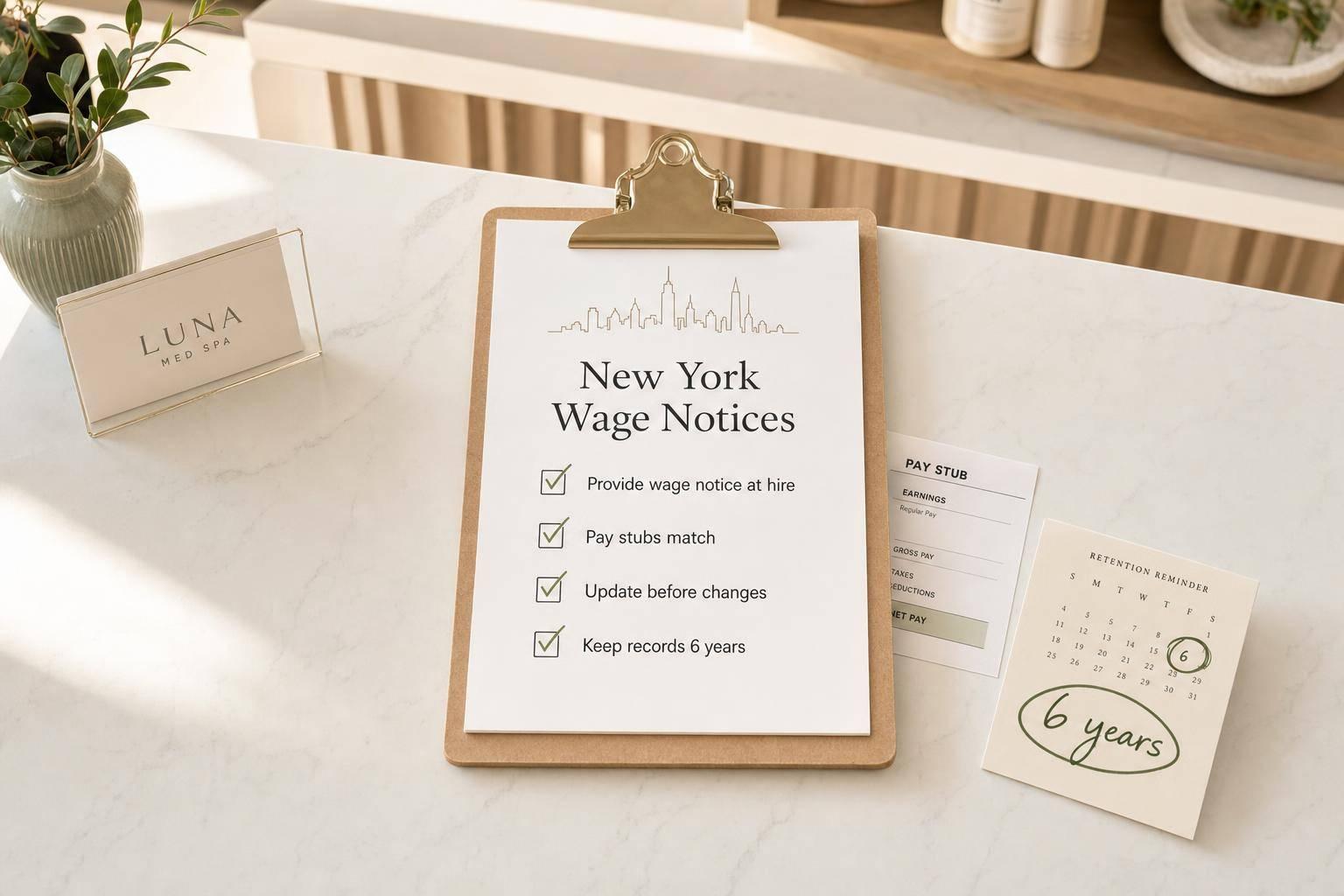

If you hire in New York, every new employee needs a written wage notice at hire, every paycheck needs a proper pay stub, and you need to keep the records for 6 years.
I’d boil this article down to three checks:
- At hire: use the right New York form and list the employee’s pay terms correctly
- Each pay period: make sure the pay stub matches those terms
- If pay changes: issue a new notice before the new pay setup starts
This matters even more in a med spa, where one team can include hourly staff, salaried managers, and treatment staff paid by commission, flat rate, or mixed pay. A small mismatch - like the wrong rate, missing overtime details, or no employee acknowledgment - can create risk fast.
Here are the main points I’d want in front of me right away:
- New York’s minimum wage as of 01/01/2026 is $17.00/hour in New York City, Long Island, and Westchester
- In the rest of New York State, it is $16.00/hour
- If a tip credit applies for service employees in NYC, Long Island, or Westchester, the article lists a maximum tip credit of $2.85/hour and a minimum cash wage of $14.15/hour
- The wage notice should include pay rate, overtime rate, pay basis, payday, pay frequency, employer details, and any allowances
- The employee should sign and date the acknowledgment, get a copy, and you should keep the record
- Pay stubs should show hours, rates, gross pay, deductions, credits or allowances, and net pay
- If pay terms change, the notice should be updated before the next payroll tied to that change
- Wage notices, pay stubs, and corrections should be stored for 6 years
Here’s the short version: use the right form, make the notice match the paycheck, fix errors right away, and keep every record. That’s the core of the checklist.
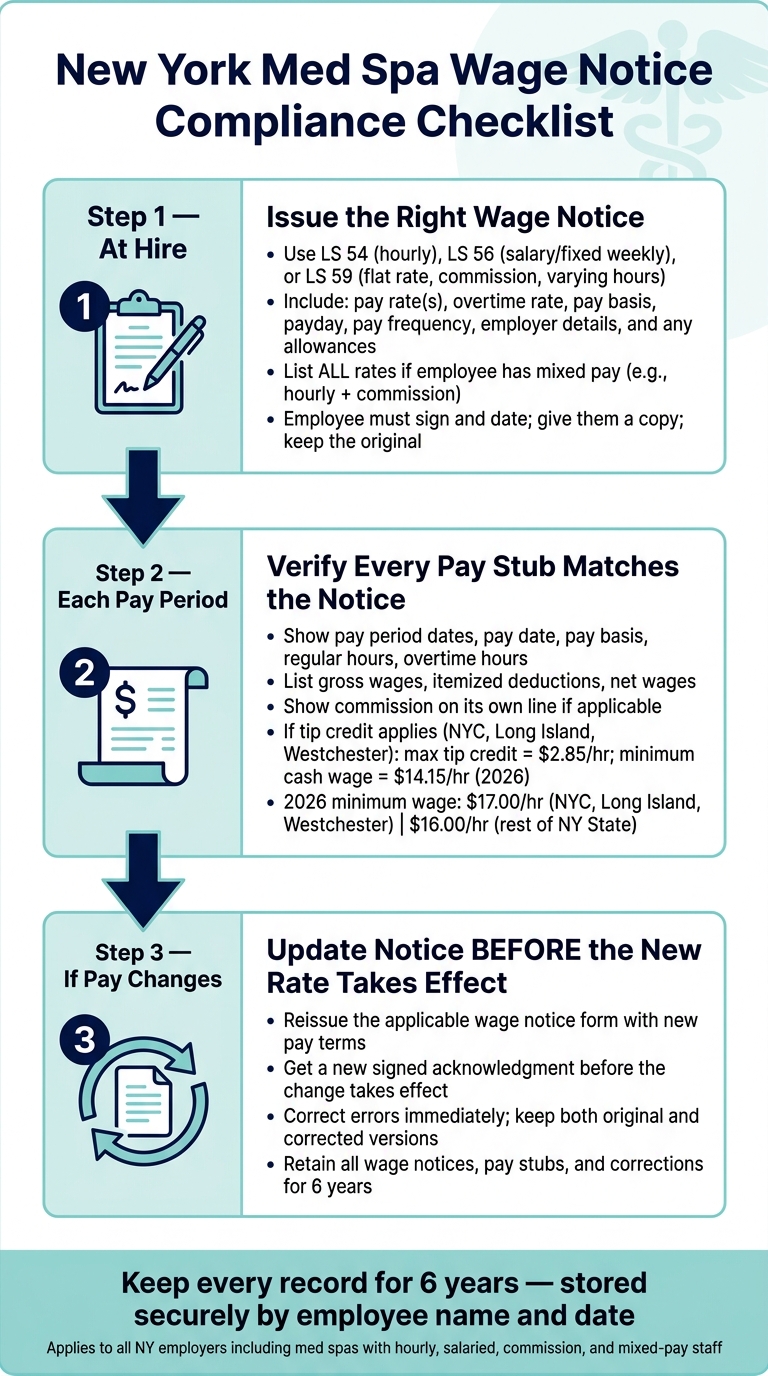
New York Med Spa Wage Notice Compliance: 3-Step Checklist
Hiring-Stage Wage Notice Checklist
New York law says every new hire must get a written wage notice at the time of hire.
Required Fields on the Wage Notice
The notice needs to include:
- The employer's legal name
- Any DBA name
- Business address and phone number
- Regular pay rate or rates
- Overtime rate
- Pay basis
- Regular payday and pay frequency
If an employee is paid in more than one way, include each rate that applies. For example, someone might earn an hourly base rate for administrative work and a flat-rate or commission treatment pay rate for other work. All of those rates need to appear on the notice.
You also need to list any claimed tip, meal, or lodging allowances. If none apply, say so. And one more thing: the pay terms on the notice should match the first paycheck.
Language and Form Requirements
Use LS 54 for hourly pay, LS 56 for salary or a weekly rate for fixed hours of 40 or fewer, and LS 59 for salary with varying hours, day rates, piece rates, flat rates, or other nonhourly pay.
Provide the notice in English and, when the DOL has a template for it, in the employee's primary language.
Signed Acknowledgment and Delivery
Have the employee sign and date the acknowledgment. Then give the employee a copy and keep the original for your records.
Use those same pay details when you review each pay stub in the next section.
sbb-itb-02f5876
Reading about the problem? See how Prospyr solves it in one platform.
Book a DemoPay Statement Checklist for Each Pay Period
Once someone is on the team, each payroll run needs to line up with the written wage notice. Under New York's Wage Theft Prevention Act, every wage payment must come with an itemized pay stub. Before payroll is sent, check that each stub includes all required details and uses the same rates and pay basis listed on the wage notice.
Required Pay Stub Fields
Each pay stub must include the employer's name, address, and phone number, plus the employee's name. It also must show:
- The pay period start and end dates
- The actual pay date
- The pay basis
- Regular hours worked
- Overtime hours worked, if any
- Gross wages
- Itemized deductions
- Claimed allowances or credits
- Net wages
Pay Structure Checks for Med Spas
Med spa payroll can get messy fast when one employee is paid in more than one way. If someone earns base pay plus commission, show the commission on its own line item. If that employee worked in two roles during the same pay period, split the hours and rates by role.
If you're taking a tip credit for service employees in New York City, Long Island, or Westchester, the 2026 maximum tip credit is $2.85 per hour. That means the minimum cash wage is $14.15 per hour. The stub needs to show that credit amount plainly. It also helps to compare each pay stub against the signed wage notice so you can catch any mismatch in pay setup before it turns into a problem.
Pay Stub Review Table
Use this table before payroll runs.
| Pay Stub Field | Med Spa-Specific Example | What to Verify |
|---|---|---|
| Employer Info | Radiant Skin Med Spa, 123 Broadway, NY, NY 10001, 555-0199 | Name, address, phone |
| Employee Name | Jane Doe | Matches legal name on file |
| Pay Period | 07/13/2026 – 07/26/2026 | Start and end dates shown |
| Pay Date | 07/31/2026 | Date payment is issued |
| Regular Rate | $25.00/hr | Rate matches signed wage notice |
| Overtime Rate | $37.50/hr | At least 1.5× the regular rate |
| Commission Line | Product Sales Commission: $450.00 | Listed separately from base pay |
| Tip Credit | $2.85/hr (Service Employee) | Does not exceed regional 2026 maximum |
| Itemized Deductions | NYS PFL: $4.12; Federal Tax: $120.00; Health Ins: $100.00 | Each deduction labeled individually |
| Net Wages | $1,850.00 | Final amount after all deductions and additions |
Pay Changes, Corrections, and Record Storage
When payroll details shift or mistakes show up, you need to do three things: update the notice, fix the pay stub, and keep both records on file.
When Pay Changes Require a New Notice
If the wage notice and pay stub stop matching, update the notice before the next payroll run. When an employee’s pay rate, pay basis, overtime status, or pay frequency changes, issue a new notice and get a signed acknowledgment before the change takes effect.
Under the New York Wage Theft Prevention Act, you must reissue the applicable wage notice form so it shows the new pay terms. This matters most when someone gets a raise or when their base pay structure changes. In plain English: if the way you pay them changes, the paperwork needs to change too.
How to Correct Notice or Pay Stub Errors
Use the pay stub review checklist to catch mistakes early, then fix them as soon as you find them. If a wage notice or pay stub has an error - like the wrong rate or a missing required field - correct it right away. Issue a corrected notice or statement, re-sign it if needed, and keep both versions for the audit trail.
Use the table below to match each error with the right fix.
| Error Type | Recommended Action | Risk Level |
|---|---|---|
| Pay rate change not documented | Issue new applicable wage notice form and get employee signature | High |
| Missing employee signature | Have employee sign existing or reissued notice immediately | High |
| Missing fields (e.g., overtime) | Re-issue a complete notice with all required fields | Medium |
| Incorrect payday listed | Issue corrected notice reflecting the actual regular payday | Medium |
| Late notice discovered | Issue the notice immediately | High |
Six-Year Record Retention and Secure Digital Storage
Once corrections are made, file both versions and keep the audit trail intact. Keep every wage notice, pay stub, and correction on file for six years. Store records by employee and date in an encrypted, backed-up system.
If your med spa uses Prospyr, you can use it to organize secure employee records and document storage.
Conclusion: New York Wage Notice Compliance Checklist for Med Spas
Use the right wage notice at hire, get a signed and dated acknowledgment, and keep a copy in the employee’s file. For med spas that use mixed pay setups, consistency is what matters most. If pay changes, issue a new signed notice before the new rate takes effect.
Use this checklist for a quick review of each step.
| Compliance Category | Key Action |
|---|---|
| Hiring Stage | Issue LS 54, LS 56 for salaried or fixed-weekly-rate employees, or LS 59 before work begins |
| Notice Content | Include pay rate, overtime rate, allowances, and payday |
| Signed Acknowledgment | Collect employee signature and date; provide a copy; retain the original |
| Pay Statements | Provide a complete pay stub every pay period |
| Pay Changes | Issue a new signed notice before the change takes effect |
| Record Retention | Archive signed notices and payroll records for at least 6 years |
FAQs
Which New York wage notice form should I use?
Under New York Labor Law Section 195.1, you need to give every new hire a written Notice and Acknowledgment of Pay Rate and Payday. If that employee’s pay rate changes later, you also need to provide an updated notice.
Use LS 54 for hourly employees. Use LS 56 for employees who are paid a weekly rate or a fixed salary for 40 hours or fewer per week.
Make sure the employee signs the acknowledgment, and keep those records for six years.
Do I need a new wage notice if pay changes?
Yes. In New York, you must give employees a new wage notice and get a signed acknowledgment before any change to pay rate, allowances, or payday takes effect.
You also need to keep that signed notice on file for six years.
What records do I need to keep for 6 years?
You need to keep payroll records for at least six years. That includes documents showing hours worked, pay rates, and any changes to employee pay.
It’s also smart to keep records tied to retirement plan contributions for about six years. A secure, centralized digital system makes this much easier. It helps you stay organized, ready for an audit, and in line with the rules.