Local SEO Keywords for Aesthetic Clinics
Practical guide to finding and using local SEO keywords for med spas and aesthetic clinics to attract high-intent nearby patients.
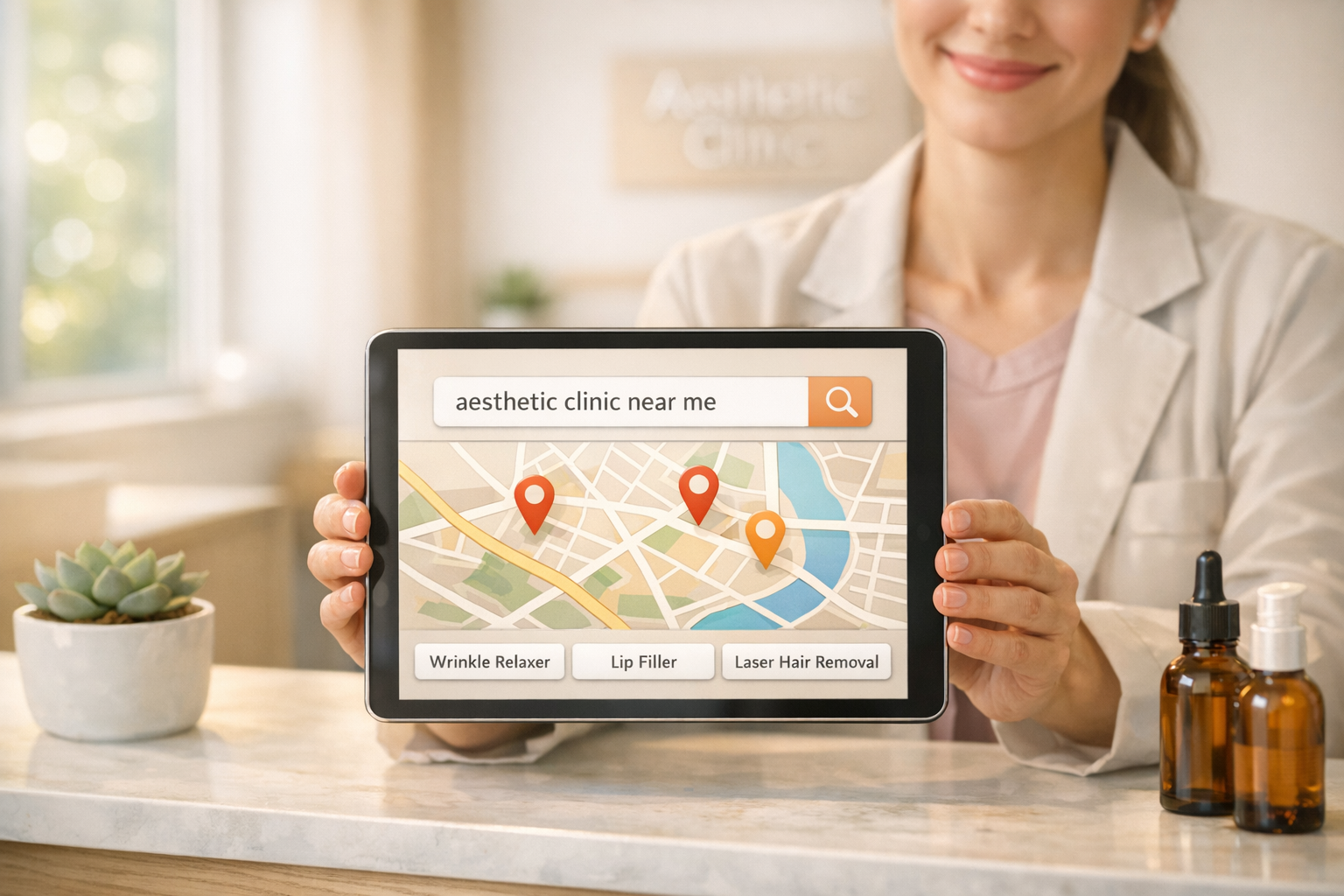

Want more patients to find your clinic online? Local SEO is the key. It ensures your clinic appears in search results when people nearby search for treatments like “Botox near me” or “lip fillers in Miami.” The goal? Attract high-intent patients ready to book. Use effective lead capture tools to convert this traffic into consultations.
Here’s what you need to know:
- Why it matters: Nearly half of all Google searches have local intent, and 78% of local mobile searches lead to visits within 24 hours.
- Keyword types to target: Focus on service + location (e.g., “Botox in Dallas”), hyperlocal terms (e.g., “Upper East Side laser hair removal”), and high-intent phrases (e.g., “best medspa near me”).
- Tools to help: Use platforms like Google Keyword Planner (free) or Semrush (paid) to find keywords patients are searching for.
- Where to use keywords: Optimize your website, Google Business Profile, and social media with embedded marketing strategies for maximum visibility.
How to Identify Local SEO Keywords
This section breaks down the essential types of keywords and search intent insights you need to target high-conversion local searches effectively.
Types of Local SEO Keywords
To drive more patient bookings, focus on five key categories of local SEO keywords:
- Foundational keywords: These define your business in broad terms, like "medical spa", "aesthetic clinic", or "med spa near me". They’re great for capturing the attention of patients starting their search.
- Service + location keywords: Combine a specific treatment with a geographic area. Phrases like "Botox in Miami", "lip fillers in Los Angeles", or "laser hair removal in Houston" directly connect with patients searching for services near them.
- Hyperlocal keywords: Narrow your focus to specific neighborhoods or micro-markets. For example, instead of "laser hair removal Dallas", try "Upper East Side laser hair removal" or "CoolSculpting in Yorkville". This approach helps you stand out in competitive urban areas.
- Symptom and result-based keywords: These reflect how patients describe their concerns, using phrases like "treat acne scars", "reduce fine lines", or "restore skin glow before wedding".
- High-intent "money" keywords: Focus on profitable treatments with transactional phrases like "under eye filler price" or "laser hair removal packages Dallas".
Choosing the right keywords means understanding how patient intent aligns with these categories.
Understanding Patient Search Intent
Search intent reveals where a patient is in their decision-making process. Typically, they pass through three stages:
- Informational searches: Phrases like "How does Botox work?" show that the patient is researching but not ready to book yet.
- Comparative searches: Queries such as "Botox vs. Dysport reviews" suggest the patient is weighing specific options and getting closer to a decision.
- Transactional searches: These are the most conversion-focused. Phrases like "Best Botox clinic in Dallas" or "Botox near me" indicate a patient is ready to book - often within a day. In fact, 78% of local mobile searches lead to an in-person visit within 24 hours.
"Standard SEO chases volume. Aesthetic SEO chases trust."
- Sunny Patel, Wolfable
Prioritize transactional keywords. Someone searching "wrinkles" is likely just browsing, but a query like "Botox clinic open Saturday in Austin" signals immediate intent to schedule.
Long-Tail Keywords for Aesthetic Practices
Long-tail keywords are highly specific phrases that attract ready-to-book patients. Instead of generic terms like "Botox", focus on detailed queries like "safe laser hair removal for darker skin in Beverly Hills." While these phrases may have lower search volume, they often lead to higher conversion rates because they match what patients are actively seeking.
Think about the exact questions your ideal patients might ask: "affordable Botox near me", "best med spa for natural-looking fillers in Chicago", or "rhinoplasty recovery time week by week". Using these precise terms filters out casual browsers and brings in patients who are ready to book.
To uncover these keywords, look at "voice of the customer" data from sources like Google reviews or direct messages. Patients often use simple, relatable language - like "lip filler" instead of "hyaluronic acid injection." Matching their terminology builds trust. And with over 60% of aesthetic inquiries happening on mobile devices, capturing these conversational, on-the-go searches is critical.
sbb-itb-02f5876
Reading about the problem? See how Prospyr solves it in one platform.
Book a DemoKeyword Research Tools
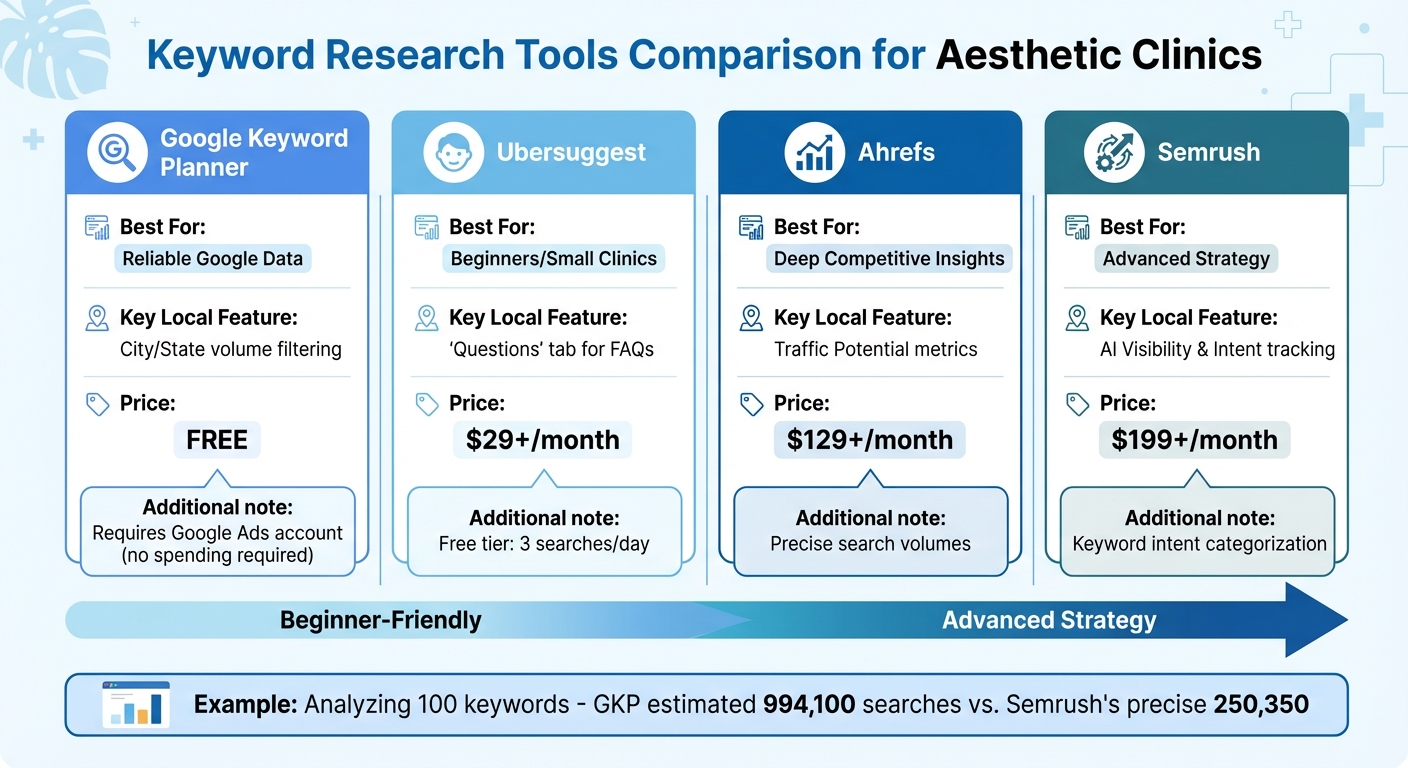
Local SEO Keyword Research Tools Comparison for Aesthetic Clinics
Keyword research tools are essential for understanding what potential local patients are searching for. Building on keyword strategy insights, these tools provide actionable data to fine-tune your clinic's local SEO efforts.
Google Keyword Planner
Google Keyword Planner (GKP) is a free tool available through Google Ads, offering insights directly from Google's search engine. While you’ll need a Google Ads account to access it, there’s no requirement to run ads or spend money. One of its standout features for local clinics is the ability to filter search volume by specific locations like cities, states, or ZIP codes. For example, you can set the location to "Miami, FL" or "90210" to get realistic traffic estimates for terms such as "Botox" or "lip fillers." GKP also allows you to input a competitor’s website URL to uncover the keywords they rank for, helping you identify potential gaps in your own strategy.
"Google Keyword Planner is a free SEO and PPC tool that uses Google's proprietary data to suggest relevant keywords based on a seed phrase or website URL." - Neil Patel, Co-Founder, NP Digital
Keep in mind that GKP displays search volumes in ranges like "1K–10K" rather than exact numbers. However, using the "Forecast" tab with a set maximum CPC bid can provide more detailed impressions. Additionally, the "Top of Page Bid" metric is a helpful indicator of high patient intent - if advertisers are paying more for a keyword, it’s likely to attract motivated searchers.
Ahrefs and Semrush
Ahrefs and Semrush are premium tools designed for those who need deeper insights than GKP provides. These platforms offer precise monthly search volumes, along with metrics like "Keyword Difficulty", which helps gauge how challenging it might be to rank for specific medical or aesthetic terms. For instance, when analyzing 100 keywords, GKP estimated a total of 994,100 searches, while Semrush's Keyword Magic Tool gave a more precise figure of 250,350.
Semrush also categorizes keywords by intent - labeling them as "Informational", "Commercial", or "Transactional" - making it easier to target patients who are ready to book an appointment. Ahrefs, on the other hand, includes a "Traffic Potential" metric, which estimates the actual traffic you could gain by ranking for a specific term.
These tools come with higher price tags - Ahrefs starts at $129 per month and Semrush at $199 per month - but for clinics focused on dominating local SEO, the investment can pay off.
Ubersuggest for Beginners
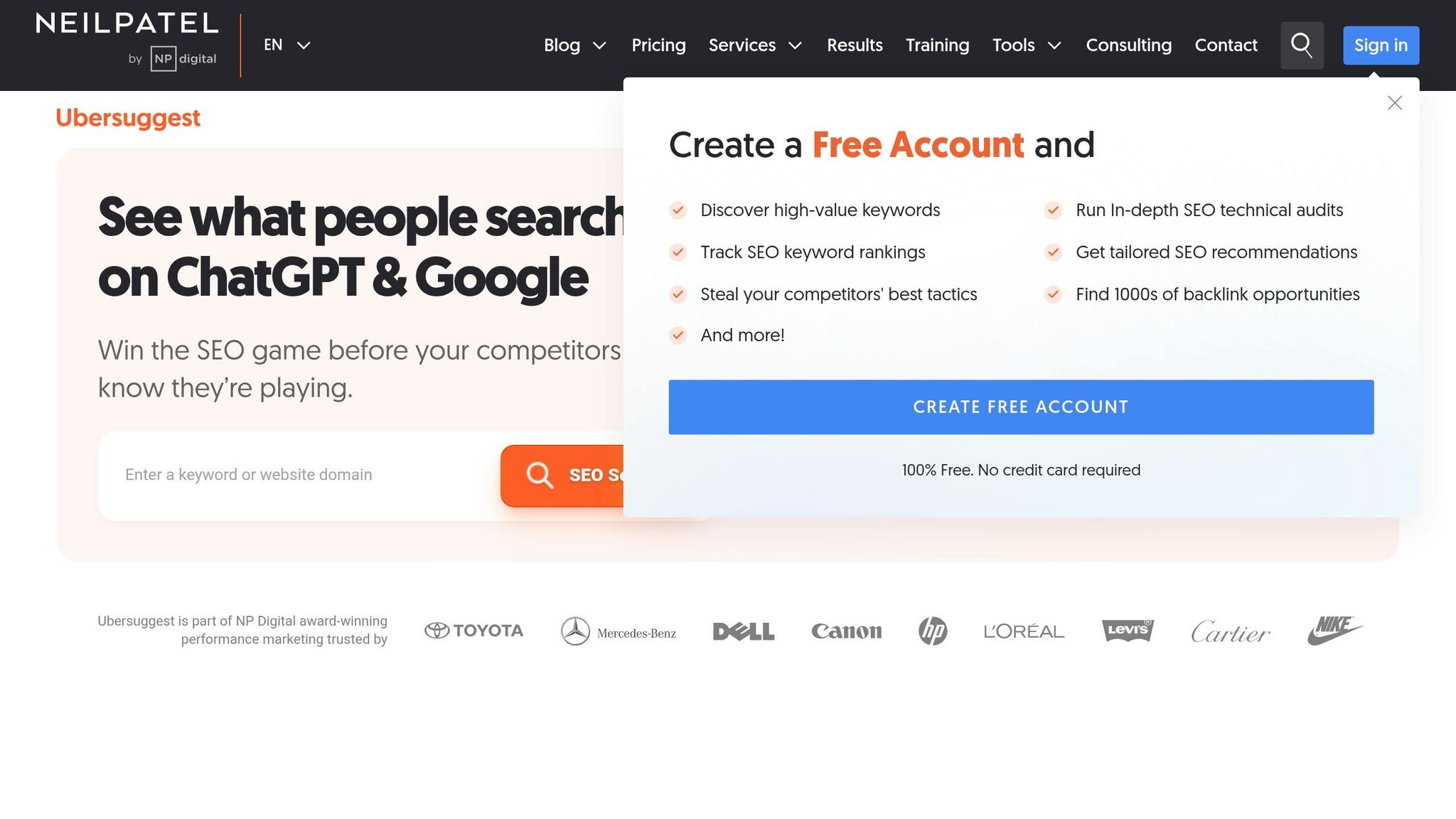
Ubersuggest is a user-friendly option for smaller clinics or those new to keyword research. It offers accurate search volume estimates and SEO difficulty scores without the complexity of premium platforms. Plans start at $29 per month, and the free tier allows for up to three searches per day.
One of its most helpful features is the "Questions" tab, which displays common patient queries like "How long does dermal filler last?" These question-based keywords are perfect for creating FAQ sections or blog posts that attract informational search traffic. Since many patients use conversational language when searching on mobile devices, Ubersuggest helps you tailor your content to match their natural tone.
Here’s a quick comparison of these tools to help you decide which one fits your clinic’s needs:
| Tool | Best For | Key Local Feature | Price |
|---|---|---|---|
| Google Keyword Planner | Reliable Google Data | City/State volume filtering | Free |
| Ubersuggest | Beginners/Small Clinics | "Questions" tab for FAQs | $29+/mo |
| Ahrefs | Deep Competitive Insights | Traffic Potential metrics | $129+/mo |
| Semrush | Advanced Strategy | AI Visibility & Intent tracking | $199+/mo |
Each tool offers unique strengths, so selecting the right one depends on your clinic's goals and budget. Whether you're just starting out or looking to refine an advanced SEO strategy, these tools can provide the insights you need to connect with local patients.
How to Use Local Keywords in Your Marketing
After identifying the right local keywords with research tools, the next step is to strategically integrate them across your clinic's digital platforms. This ensures Google connects your aesthetic practice with nearby patients actively searching for your services.
Adding Keywords to Website Content
Your website serves as the cornerstone of local SEO, and placing keywords strategically is key. Start by creating separate pages for each treatment and location. For example, having dedicated URLs like /botox-injections, /dermal-fillers, and /microneedling allows Google to better match specific local searches with your services.
If your clinic operates in multiple locations, build unique pages for each city or neighborhood. A page like /medspa-dallas should include the clinic's address, an embedded Google Map, and reviews from local patients.
Incorporate local keywords into your titles, headings, and meta descriptions. For instance, a title like "Best Botox in Miami | [Your Clinic Name]" immediately communicates your service and location to both Google and potential clients. Always prioritize natural integration - write for people first, then optimize for search engines.
Blog posts are another great way to target local audiences. Write content that addresses location-specific concerns, such as "How Phoenix's Dry Climate Affects Your Skin After Microneedling" or "Post-Treatment Skincare Tips for Chicago Winters". These posts not only attract local readers but also position your clinic as an expert in your area.
Don’t forget to optimize your image alt-text with local keywords, especially in your before-and-after galleries. For example, use descriptions like "Lip filler results – Austin client". This boosts your visibility in local image searches while reinforcing your geographic focus.
For technical SEO, implement schema markup for categories like Medical Spa, Clinic, and Physician. This helps search engines understand your services and locations more clearly. Additionally, structuring some content in a Q&A format can help capture voice searches. For example, questions like "How much does Botox cost in Denver?" align with how people naturally phrase queries when using voice assistants.
Next, take these keywords and apply them to your Google Business Profile (GBP) for even greater local visibility.
Optimizing Your Google Business Profile
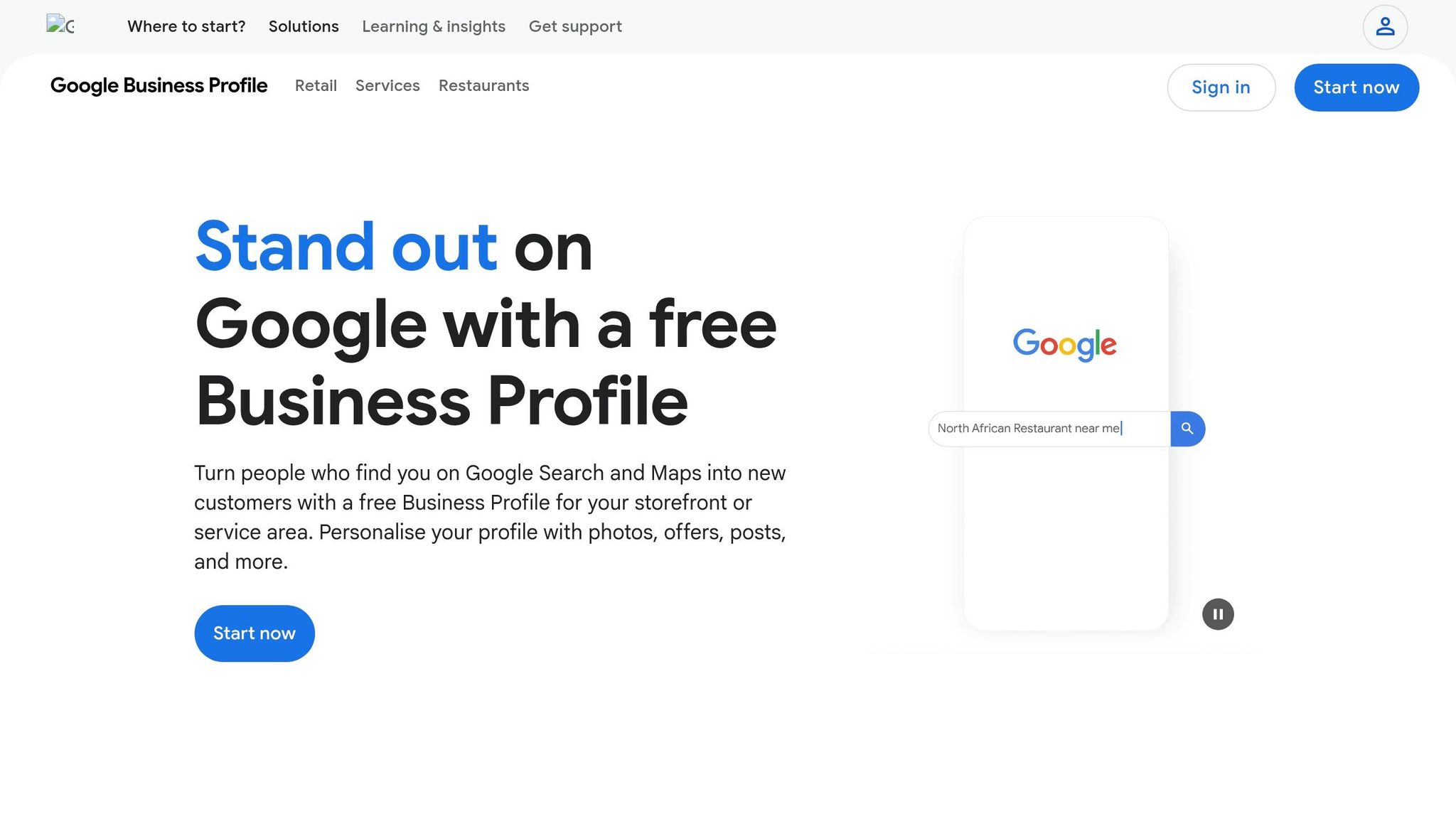
Your Google Business Profile is one of the most powerful tools for local SEO. As of 2026, GBP signals account for 32% of local pack ranking factors, making it the top-ranking factor. Businesses featured in Google's "Local Pack" (the map section displaying three businesses) experience an average 156% increase in booking inquiries , which requires efficient lead management to convert..
Start by selecting the most specific primary category available, such as "Medical Spa" or "Aesthetic Clinic", rather than a broader term like "Clinic." While secondary categories can be added, the primary one carries the most weight.
Use your 750-character business description wisely. Focus on local keywords in the first 250 characters, as mobile devices often truncate the rest. For example: "Miami's premier medical spa specializing in Botox, dermal fillers, and laser treatments in the Coral Gables area." This naturally incorporates both location and services without sounding forced.
In the Services section, list each treatment individually (e.g., Botox, dermal fillers, chemical peels) and include 300-character descriptions for each. When someone searches for "microneedling near me", Google scans these descriptions to determine if your clinic is a match.
As of November 2025, Google replaced the traditional Q&A feature with "Ask Maps", an AI-powered system that generates instant answers by analyzing your profile, website, and reviews. This change makes it even more critical to have detailed, keyword-rich information in your profile.
"Google officially discontinued the Q&A feature on November 3, 2025. It's been replaced by 'Ask Maps' - a Gemini AI-powered system that generates instant answers by scanning your profile, website, and reviews." - Deepika Gupta
Regular updates to your GBP are essential. Post at least twice weekly and include geo-targeted keywords in your updates. For example, "New clients in Scottsdale can save 20% on their first Botox treatment this month." These updates increase your chances of appearing in a "local justification" snippet within search results.
Photos are another critical element. Profiles with images see 42% more direction requests and 35% more website clicks. Before uploading, rename image files with descriptive names like best-botox-clinic-miami.jpg to add another layer of optimization. Following Google's January 2026 Authenticity Update, prioritize original photos of your clinic and staff over stock images.
Encourage patients to mention specific treatments in their reviews. For instance, a review saying, "Dr. Smith gave me the best Botox results in Austin" is far more valuable for local SEO than a generic "Great experience!" Google may even highlight such reviews as "review justifications".
Avoid adding keywords to your business name (e.g., "Clinic Name - Best Botox Chicago"), as this is a leading cause of profile suspension in 2026.
Finally, extend your local keyword strategy to social media and advertising.
Using Keywords in Social Media and Ads
Social media and paid ads can amplify your local SEO efforts, helping you connect with nearby patients while boosting your organic visibility. Ads using local keywords can drive immediate search activity, indirectly enhancing your organic rankings by increasing brand awareness.
For paid search or social media ads, focus on hyperlocal targeting within a 3–5 mile radius around your clinic. For example, a Facebook campaign targeting "Botox in Beverly Hills" and limited to users near your 90210 location ensures high-intent local engagement.
"Run paid search or social media ads targeted to a very tight radius (e.g., 5-10 km or 3-5 miles) around your clinic. This drives immediate local search behavior and creates a flywheel effect that boosts your organic rankings." - Consentz
On social media, integrate city-specific phrases naturally into captions. For instance, an Instagram post might say, "Spring is the perfect time for laser treatments in Seattle! Book your consultation today." This keeps your content relevant while engaging your audience.
Post weekly updates, special promotions, and before-and-after photos to your GBP using geo-targeted keywords. Many patients discover clinics directly through Google Maps, so these updates are just as important as traditional social media posts.
Track performance using UTM parameters on all social media links (e.g., Instagram bio, TikTok, Facebook posts). This data will show which keywords and platforms drive the most bookings, allowing you to refine your strategy based on actual patient behavior.
For mobile users, include "Click-to-Call" or "Text Us" buttons in your social ads. With 78% of local mobile searches leading to an in-store visit within 24 hours, making it easy for patients to contact you can significantly boost conversions.
Finally, share screenshots of glowing local reviews on your social channels. This builds "prominence" - a key factor in local SEO - while also providing social proof to encourage bookings.
Organizing Keywords with Prospyr
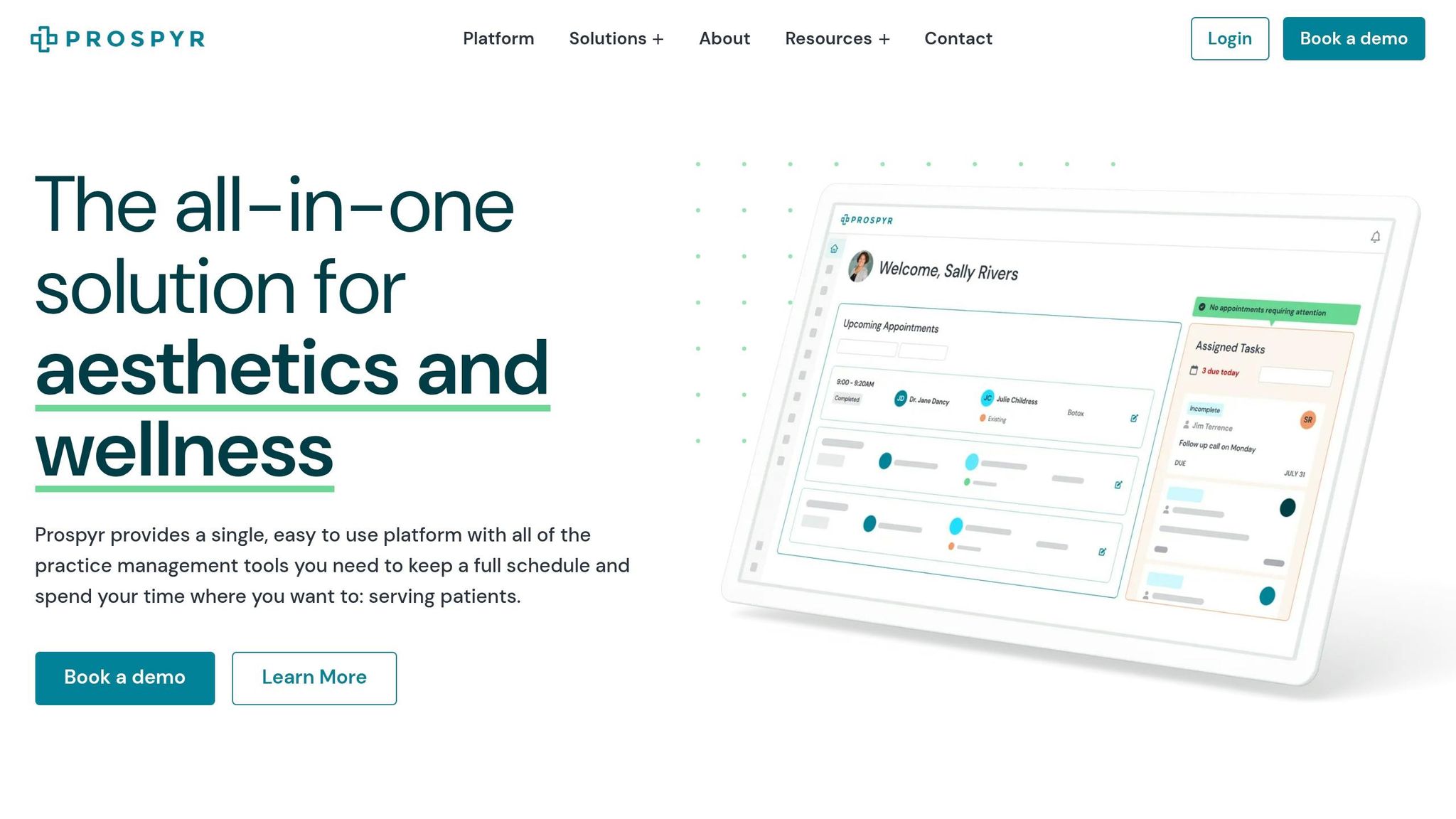
Once you've nailed down your local SEO keywords, the next hurdle is figuring out how to organize and measure their impact. That’s where Prospyr steps in. Designed to streamline this process, Prospyr is especially handy for aesthetic clinics juggling multiple services and locations. By integrating directly with your practice management system, it supports the entire patient experience from start to finish.
Using Prospyr's Marketing Tools for Local Keywords
Prospyr makes it easy to weave local keywords into your marketing campaigns. Its automated features are tailored to attract nearby patients by incorporating the keywords you've carefully researched. For example, email sequences can be triggered by patient behavior, ensuring your communication stays targeted and relevant.
Picture this: A lead fills out a form searching for "Botox in Seattle." Using digital intake forms, Prospyr steps in by tagging the lead and automatically sending a follow-up email sequence that naturally incorporates Seattle-specific terms and references to your local clinic. This ensures your messaging aligns perfectly with the keywords that initially caught the patient’s attention.
Prospyr also syncs your keyword-driven content calendar across social media channels, helping every clinic location strengthen its local presence.
"Clinics that combine social with SEO capture them, educate them, and convert them." - Jane Nriapia, Founder of BoutiqueSEO
And it doesn’t stop there. Prospyr’s review management feature automates review requests and helps manage feedback. Reviews that mention specific treatments and locations can improve your local rankings. By automating review requests after appointments, Prospyr makes it much easier to collect valuable, keyword-rich feedback.
With automation taking care of your keyword campaigns across platforms, the next step is analyzing their performance.
Tracking Keyword Performance with Prospyr
Prospyr shines when it comes to tracking how your local keywords drive leads and revenue. Instead of guessing which terms are working, you get clear, actionable insights into the keywords that generate the best results.
The platform follows the entire patient journey - from the first interaction to final conversion - so you can pinpoint the keywords that deliver real value. For instance, you might notice that "Sculptra near me" brings in fewer leads compared to "Botox near me", but the Sculptra leads could turn into higher-value patients. Prospyr’s analytics highlight these trends, helping you adjust your strategy to focus on the services that matter most.
Additionally, Prospyr’s revenue stream analysis breaks down performance by treatment. This allows you to see which service pages and associated keywords attract your most valuable patients. Armed with these insights, you can fine-tune your keyword strategy on the fly, ensuring your efforts consistently lead to high-value patient conversions.
Conclusion
Local SEO is not a one-and-done task - it’s an ongoing investment that steadily builds traffic and patient trust over time. These days, simply claiming the top spot on Google Maps won’t cut it. Your clinic needs to be the go-to recommendation from AI platforms like ChatGPT, Gemini, and voice assistants when patients are searching for aesthetic treatments.
Here’s why local SEO is critical: 46% of Google searches have local intent, and 28% of those searches result in bookings. That’s a huge opportunity. Plus, when you compare it to paid ads costing $50 to $200+ per click, organic local SEO provides a much more affordable growth path. In fact, SEO-generated leads can cost 60-80% less than paid advertising leads over a 12-month span. These numbers make it clear - local SEO isn’t just helpful; it’s essential for growing your clinic.
"Education equals conversion. And education lives on Google, not Instagram." - Jane Nriapia, Founder of BoutiqueSEO
To stay competitive, keep your Google Business Profile fresh. Upload new photos, videos, and posts weekly to show activity. Build dedicated service pages for every treatment you offer, and structure your content in a Q&A format to make it easy for AI tools to understand. Automate review requests after appointments to encourage more local feedback from patients. These small but consistent efforts can lead to noticeable results.
Tools like Prospyr can help you track which keywords are driving actual revenue - not just clicks. Dedicate 30 minutes each month to review your keyword rankings, Google Business Profile insights, and conversion rates. By aligning your keyword strategy with these actionable tips, your clinic can consistently attract high-intent local patients. Make local SEO a core part of your digital marketing strategy to dominate the local search landscape.
FAQs
Which local SEO keywords bring in patients who are ready to book?
Keywords such as “Botox near me,” “lip fillers in [your city],” and “medspa in [location]” work well to target potential patients with high intent. These searches reveal a local focus, indicating that users are not just browsing - they’re actively seeking services close to them and are likely prepared to book an appointment.
How can I find hyperlocal keywords for my clinic’s neighborhoods?
To discover hyperlocal keywords, focus on the exact terms potential patients might use when looking for aesthetic treatments in their area. For example, include location-specific phrases like “Botox in Miami” or “lip fillers near me” on your website and Google Business Profile. Leverage local keyword research tools to pinpoint what nearby clients are searching for. Then, build a strategy that balances broad terms with more specific ones that align with the neighborhoods your clinic serves.
How can I track which keywords actually produce appointments and revenue?
To keep tabs on how your keywords are performing, combine the right tools with smart strategies. A practice management platform like Prospyr can help you track patient conversions and gain insights into revenue trends.
Pair this with Google Analytics and Search Console to pinpoint the keywords driving traffic and bookings. Make sure to set up conversion tracking for key actions, such as appointment requests, and use UTM parameters to accurately attribute your campaigns.
Regularly reviewing this data will allow you to fine-tune your high-performing keywords and achieve even better results.