How to Create a Social Media Plan for Med Spas
A step-by-step guide to build a med spa social media plan that attracts local clients, shows results responsibly, schedules content, and converts engagement into bookings.

Social media is your med spa's storefront. With nearly 4 billion users worldwide, platforms like Instagram, Facebook, and TikTok are where potential clients discover and evaluate your services. But posting randomly won’t drive results. You need a clear plan that converts views into bookings.
Here’s how to build a results-driven social media strategy:
- Set SMART Goals: Align your social media efforts with business objectives (e.g., "Increase bookings by 20% in 3 months").
- Know Your Audience: Identify demographics, interests, and pain points to tailor content.
- Pick the Right Platforms: Use Instagram for visuals, TikTok for younger audiences, and Facebook for community engagement.
- Create a Content Mix: Focus on education, before-and-after photos, testimonials, and promotions.
- Schedule Consistently: Use tools like Prospyr to automate posts and maintain visibility.
- Engage with Followers: Respond to comments, run contests, and use CTAs like "DM us to book."
- Track Results: Measure engagement, traffic, and bookings to refine your strategy.
Social media isn’t just about likes - it’s about building trust and driving revenue. A structured approach ensures your med spa stands out and thrives.
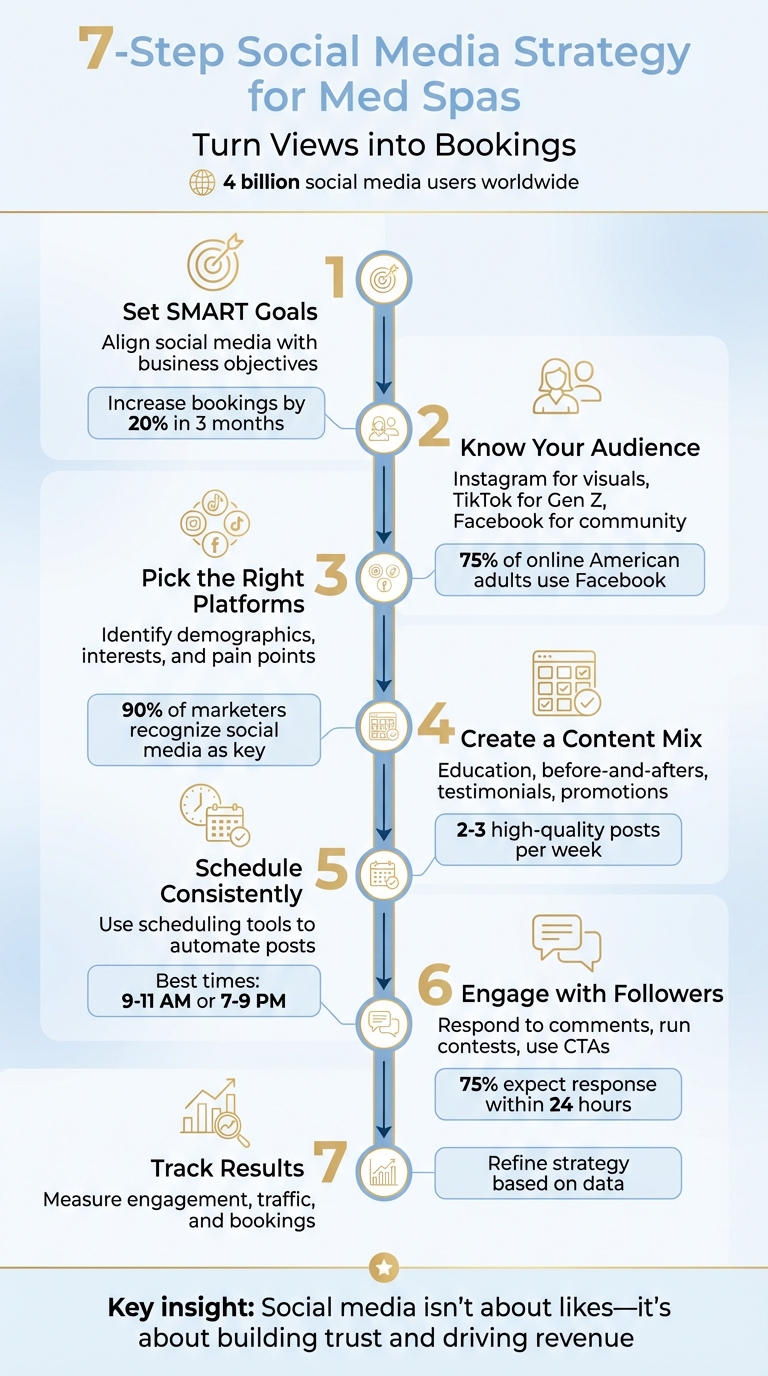
7-Step Social Media Strategy Framework for Med Spas
Set Your Goals and Identify Your Target Audience
Before you even think about posting content, you need to have two things crystal clear: what you want to achieve and who you’re speaking to. Without well-defined goals and a clear understanding of your audience, your social media efforts could feel scattered and ineffective.
Create SMART Goals for Social Media
Your social media goals should directly align with your broader business objectives. For example, if your med spa is aiming to boost revenue by 30% this year, your social media strategy should actively support that goal with specific and measurable targets. That’s where the SMART framework comes in - Specific, Measurable, Attainable, Relevant, and Time-bound. It takes ambitious ideas and turns them into actionable steps.
Instead of vague goals like "gain more followers", aim for something like: "Increase website traffic from social media by 15% over the next three months by publishing four high-quality posts weekly." Or, "Generate 20 new consultation bookings per month through Instagram by including online scheduling links in Stories and posts."
"The goal is clear: conversions. If you're posting without a focused strategy, you're missing out on the opportunity to turn those likes into tangible actions." - Michael Swartz, Co-Founder, Egg Health Holdings
Start by prioritizing primary goals like bookings and revenue. Metrics like follower counts, email subscribers, and reviews are useful, but they should always support your main objectives, not overshadow them. To track progress effectively, you need to know where you’re starting. Take stock of your current metrics: How many followers do you have? What’s your average engagement rate? How much traffic is coming from social media today? Establishing a baseline with integrated analytics is essential for measuring growth.
Identify and Profile Your Target Audience
Knowing your audience isn’t just helpful - it’s non-negotiable. For instance, 75% of online American adults use Facebook, while Instagram’s most active users are 18 to 29 years old. If you’re targeting younger clients interested in preventative treatments, Instagram is likely your go-to. On the other hand, if your services cater to a broader age range, like laser hair removal or skin rejuvenation, Facebook might be the better platform for reaching more people.
"Customer research isn't just part of my strategy. It's the foundation of everything I do." - Elise Darma, Instagram Creator and Consultant
To refine your approach, create detailed user personas for your ideal clients. Include key demographics like age, gender, location, and income, as well as lifestyle details such as values and interests. Most importantly, focus on their pain points - whether it’s aging skin, acne scars, or post-childbirth body confidence. Adjust these personas to reflect the unique needs of different age groups.
Gather this data through patient surveys, social listening, and analytics from your existing clients. Pay attention to patterns in treatment preferences and booking behaviors. The more precise your audience profile, the better social media algorithms can connect your content with the right people, helping you grow faster within your niche.
Once your goals are set and your audience is defined, the next step is choosing the platforms that will best connect you with your ideal clients.
sbb-itb-02f5876
Choose the Right Social Media Platforms
Once you’ve defined your goals and pinpointed your audience, the next step is selecting the social media platforms that align best with your med spa’s strategy. With around 90% of marketing professionals recognizing social media as a key part of their approach, choosing platforms that connect with your target audience is essential.
Different platforms cater to different demographics and content styles. For example, Instagram and TikTok are ideal for younger audiences who appreciate visual storytelling and quick, engaging content. If your med spa primarily serves Millennials and Gen Z, these platforms are a natural fit. On the other hand, Facebook is better suited for reaching Gen X and Baby Boomers.
To make informed decisions, use tools like Google Analytics to track where your website traffic originates. Dive into competitor research by analyzing 4–5 med spas in your area. You can also survey your current patients to gain insight into their social media habits. Once you’ve gathered this data, match each platform’s strengths to your audience’s preferences.
Prioritize Visual-Heavy Platforms
For med spas, visuals speak louder than words. High-quality before-and-after photos and treatment videos are powerful tools that can turn casual viewers into paying clients. Platforms like Instagram and TikTok are perfect for showcasing these visuals and building what Chris Zelig, Founder & CEO of Medstar Media, describes as "Visual Authority".
Instagram is a go-to platform for polished visuals and lifestyle content. Use Reels to create short, engaging videos that explain procedures or offer a behind-the-scenes look at your clinic. Post Stories regularly throughout the day to stay visible, and take advantage of interactive features like polls, Q&A stickers, and quizzes to engage your audience. Shoppable posts can also drive e-commerce sales directly from your feed.
TikTok, on the other hand, thrives on fast-paced, authentic video content. It’s a great way to connect with Gen Z through "edutainment" - videos that educate while entertaining. With nearly 44.8% of social media users discovering new products or services on platforms like TikTok, it’s a valuable space for reaching a younger audience.
Pinterest offers another visual-focused option, especially if your target audience includes women aged 25–40. As one of the fastest-growing platforms for this demographic, Pinterest is ideal for sharing infographics, aesthetic inspiration boards, and skincare tips that drive traffic to your website.
"Social media is often the first place where promise is seen, judged, and compared. If your feeds aren't visually aligned with your brand's aesthetic, it becomes harder to stand out."
– Chris Zelig, Founder & CEO, Medstar Media
Use Facebook for Community Engagement
While Instagram and TikTok excel in visual storytelling, Facebook remains a strong platform for fostering community connections and running targeted ad campaigns. It’s particularly effective for sharing detailed posts and engaging directly with your audience.
Use your Facebook page to post longer-form content, such as in-depth explanations of treatments, patient testimonials, and educational articles. Encourage clients to leave reviews and respond to them actively - about 67% of consumers use platforms like Facebook and Twitter to resolve brand-related issues, so engagement builds trust.
Facebook Ads are another powerful tool for med spas. For instance, one Miami-based med spa saw a 75% increase in appointments after running a targeted Facebook Ads campaign. The platform’s advanced targeting features allow you to reach users based on location, age, interests, and behaviors. You can even retarget visitors who’ve shown interest in your services but haven’t booked yet.
Additionally, use Facebook to promote limited-time offers, seasonal specials, or events like open houses or VIP treatment nights. Cross-posting this content to your Google Business Profile can also boost local SEO, making it easier for potential clients to find you in "near me" searches.
| Platform | Primary Audience | Best Use Case for Med Spas |
|---|---|---|
| Millennials & Gen Z | High-quality visuals, Reels, and daily Stories | |
| TikTok | Gen Z | Fast-paced, creative video content |
| Baby Boomers & Gen X | Community building, detailed posts, and local ads | |
| Women 25–40 | Visual discovery and driving website traffic |
These strategies set the stage for crafting a content plan tailored to your med spa’s audience and goals in the next section.
Reading about the problem? See how Prospyr solves it in one platform.
Book a DemoCreate Your Content Strategy
Once you've selected the best platforms for your med spa, it's time to craft a content strategy that makes the most of them. Instead of flooding your feed with frequent but low-quality posts, aim for two to three high-impact posts each week. This approach helps maintain your brand's integrity and keeps your audience engaged.
Your content should serve three main purposes: educating potential clients, building trust through social proof, and driving bookings. Authenticity is key - audiences are increasingly drawn to "real person energy", highlighting genuine interactions with clients and staff. In fact, 84% of consumers feel more confident in brands that use user-generated content (UGC), and 93% of marketers report UGC outperforms traditional branded content in beauty and wellness industries. Short-form videos like Instagram Reels and TikToks are especially effective, generating 2–3x more engagement than static posts. Educational carousels, such as "Top 3 Botox FAQs", also perform well by addressing common questions.
"In 2026, the med spa that wins will be the one that turns scrolling 'maybe someday I'll try it' into 'I just booked it'."
– Lasso Up
The next step is to define a balanced content mix that aligns with your goals.
Plan a Balanced Content Mix
Your content should revolve around five key pillars, each serving a unique purpose:
- Visual Authority: Highlight your expertise with before-and-after photos and procedure-focused videos.
- Education: Build trust by sharing skincare tips, treatment explanations, and myth-busting content.
- Social Proof: Showcase client testimonials and reshared Stories to validate your services.
- Humanization: Create personal connections with staff spotlights and behind-the-scenes glimpses.
- Promotional Offers: Drive revenue with limited-time discounts and clear calls-to-action.
"Social media isn't just a place to create content; it's a platform to foster community."
– Robin Ntoh, Nextech
To keep your posting consistent, batch-create content on a monthly basis. Every post should include a call-to-action, whether it's a soft nudge like "DM us to chat about your skin goals" or a direct prompt such as "Click the link in bio to claim your new patient offer".
| Content Pillar | Purpose | Example Post Type |
|---|---|---|
| Visual Authority | Showcases expertise and results | Before-and-after photos, procedure-focused Reels |
| Education | Builds trust through knowledge | "Did you know?" carousels, myth-busting videos |
| Proof | Provides social validation | Video testimonials, reshared client Stories |
| Humanization | Builds personal connection | Staff spotlights, behind-the-scenes tours |
| Offers | Drives immediate revenue | Flash sales, new patient discounts with CTAs |
Share Before-and-After Photos Responsibly
Before-and-after photos are a powerful way to showcase results - 83% of patients say they wouldn’t consider a clinic that doesn’t feature them. However, sharing these images comes with strict legal and ethical responsibilities. Under HIPAA laws, these photos are considered Protected Health Information (PHI) if they reveal identifiable details like full faces, tattoos, scars, or unique jewelry.
Verbal consent isn’t enough. You must obtain written authorization from patients, specifying how and where their images may be used (e.g., website vs. social media) and for how long. Make sure your consent forms clearly differentiate between permissions for different platforms. Patients can revoke consent at any time, so have a system in place to remove images promptly.
When taking photos, maintain consistency by using the same lighting, angles, and backgrounds for both "before" and "after" shots. Include detailed captions that provide context, such as the patient’s age, treatment type, and timeline (e.g., "Results after 3 sessions over 6 weeks").
"We use before and after photos to show progress throughout specific treatment plans. It's beneficial for clients to see positive changes pre- and post-treatment. Showcasing comparisons has increased client interest in treatments."
– Lauren Druskinis, Office Manager and Social Media Coordinator, Ageless Image Aesthetics
Always include disclaimers like "Results may vary depending on individual conditions" to manage expectations and comply with FTC guidelines and state licensing regulations. Avoid using filters or editing tools that could misrepresent results. If a patient prefers anonymity, blur or crop identifying features such as tattoos or jewelry. Store all images securely in encrypted systems or within your EMR platform - never on personal devices. Remember, HIPAA violations can result in fines ranging from $120 to $1.8 million per incident.
Use Prospyr's Social Media Tools for Scheduling
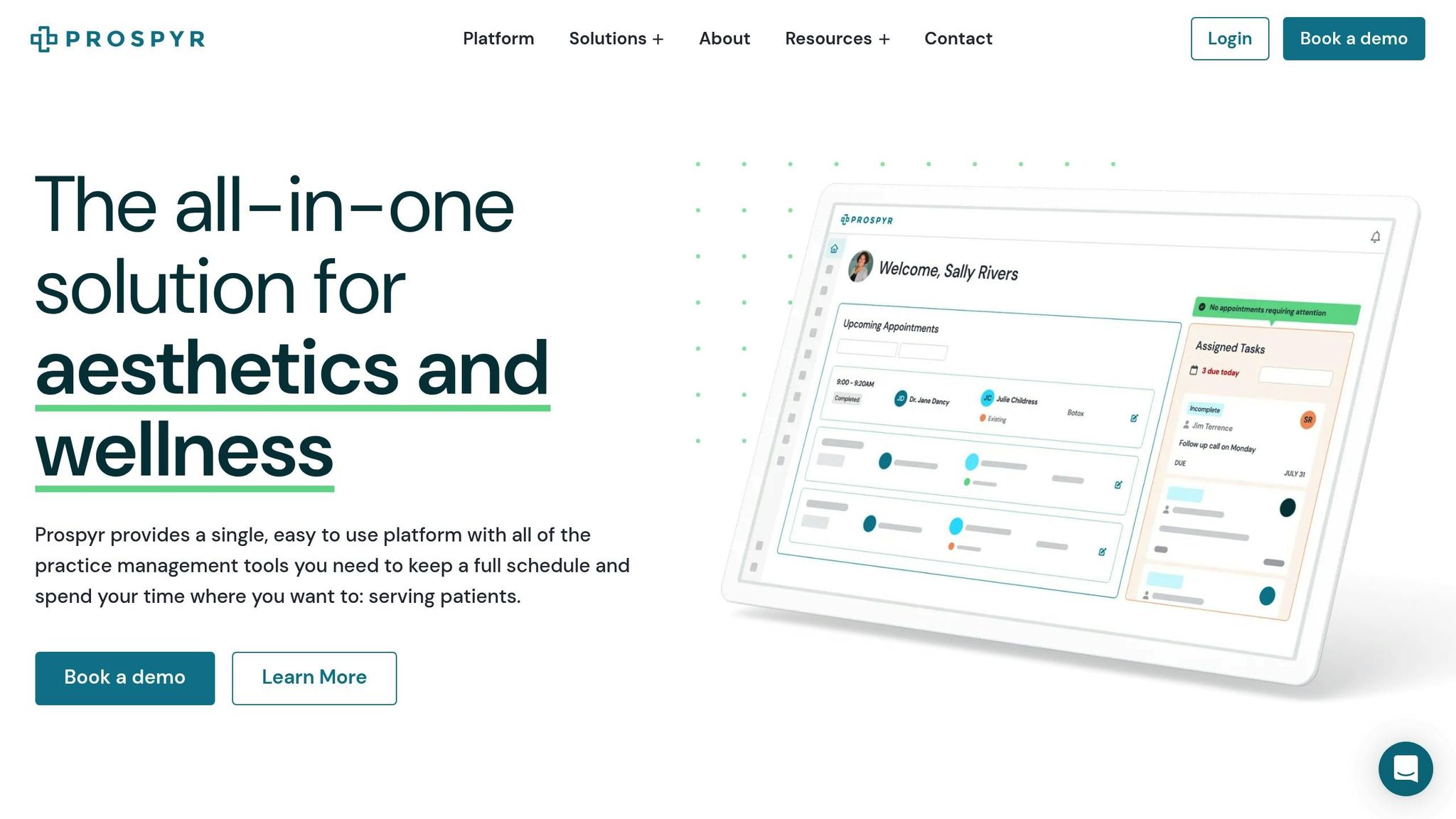
Managing a consistent posting schedule is crucial for keeping your audience engaged and maintaining visibility in social media algorithms. Prospyr's integrated tools simplify this process by allowing you to schedule posts across multiple platforms in advance. This ensures your content goes live at optimal times, such as 9:00 AM–11:00 AM or 7:00 PM–9:00 PM, even when you're busy with patients.
Prospyr integrates seamlessly with your practice management workflow, enabling you to batch-create and schedule a month’s worth of content in one sitting. This automation not only saves time but also allows your team to focus on patient care while keeping your social media presence active and engaging.
With this strategy in place, you’re ready to build a content calendar that keeps your posts on track and aligned with your goals.
Build a Content Calendar and Posting Schedule
A content calendar transforms your social media approach from reactive to proactive, ensuring you deliver consistent, high-quality posts. Planning at least a month ahead keeps you from scrambling for content daily and allows your team to focus on patient care instead.
Start by analyzing your current social media performance to guide your monthly plan. Review your channels, identify top-performing content, and save it for future use. This not only saves time but also builds on what’s already proven to resonate with your audience.
"Your calendar is a tool to help you manage and optimize your social media accounts... don't be afraid to change or stray from your content calendar to respond to what is resonating with your audience."
– Aesthetix CRM
Use your five content pillars - visual authority, education, social proof, humanization, and promotional offers - to create a balanced mix of posts. You could assign weekly themes, such as showcasing treatments in one week, sharing seasonal skincare tips in another, highlighting staff in the third, and featuring client success stories in the fourth. This structure keeps your content diverse and simplifies the planning process.
Create a Monthly Content Calendar
Use digital tools like Google Calendar or Asana to map out your month. This helps you identify content gaps and ensures you’re not overemphasizing one service. For instance, if you notice three weeks in a row focusing on Botox, you can adjust to include posts about facials or body contouring.
Establish a predictable posting schedule so followers know when to expect updates. On Facebook, aim for 4–5 posts per week, though starting with 2–4 posts is a great baseline. For Instagram, focus on 1–2 high-quality feed posts weekly and supplement with three Instagram Stories daily. These Stories can include quick tips, polls, or behind-the-scenes glimpses.
"Every post has a purpose."
– Projected Growth Consulting
Don’t overlook "skincare holidays" and seasonal events to capitalize on trending topics. For example, promote laser hair removal around National Bikini Day or run a "New Year, New You" campaign in January featuring skin rejuvenation packages. Timely posts like these often generate higher engagement by aligning with what people are already searching for.
Set aside one or two days each month to batch-create and design all your content. This eliminates the need to scramble daily and helps maintain consistent quality and branding. Tools like Canva make this process easier with customizable templates that keep your visuals polished and professional.
| Content Type | Recommended Frequency | Primary Goal |
|---|---|---|
| Feed Posts (Facebook/Instagram) | 2–5 times per week | Education, Results, Promotions |
| Instagram Stories | 3 times per day | Engagement, Q&A, Behind-the-Scenes |
| Before & After Photos | Weekly | Social Proof, Trust Building |
| Staff/Practice Highlights | Bi-weekly | Humanizing the Brand |
Once your calendar is finalized, automate your posts to maintain consistency and save time.
Use Scheduling Tools to Save Time
Manually posting every day is time-consuming and often leads to inconsistency, especially when your clinic gets busy. Scheduling tools solve this by allowing you to "set it and forget it" while keeping your brand active. Platforms like Prospyr simplify this process by integrating embedded marketing and scheduling with practice management, enabling you to plan and automate posts across multiple platforms from a single dashboard.
With Prospyr, you can schedule an entire month’s content in one session, ensuring posts go live at the best times - even when you’re busy with patients. The platform’s analytics also help pinpoint peak engagement times, so you can schedule posts for maximum visibility. This data-driven approach refines your strategy based on what’s actually working.
"Consistency is key, but it doesn't have to be time-consuming. Leverage social media tools to easily create, schedule, track performance, and respond to inquiries."
– AestheticsPro
Automation doesn’t mean sacrificing authenticity. You can still engage with comments and messages in real-time while your scheduled posts maintain your online presence. Many practices report noticeable increases in engagement within the first 30 days of implementing a structured content calendar with automated scheduling. The time saved can be redirected toward meaningful interactions - answering questions, responding to testimonials, and building relationships that turn followers into booked appointments.
Make sure every scheduled post includes a clear call-to-action, such as "DM us to schedule your consultation" or "Click the link in bio to claim your new patient discount." Prospyr’s integration with booking systems makes it easy to track which posts lead to appointments, giving you measurable results for your social media efforts.
Increase Engagement with Promotions and Interactions
Having a solid content calendar is great, but it’s only half the battle. If your followers aren’t taking action, your efforts won’t translate into bookings. The key difference between a med spa that gets likes and one that fills its appointment slots lies in how well it engages with its audience. As Egg Health Hub puts it: “Likes do not equal bookings”. Your social media strategy should focus on turning casual scrollers into loyal patients through smart promotions, interactive content, and timely communication.
Include Booking Links and Calls-to-Action
Every social media post should have a clear and direct call-to-action (CTA). Use strong CTAs like, “Claim your $30 credit by Friday”, to drive immediate action, or softer ones like, “DM us for a free skin consult”, to build relationships and nurture leads.
Tailor your CTAs to your location for better local SEO and to attract nearby patients. For example, a post saying, “Only for Miami patients - link in bio” can help you stand out in your area.
Make the booking process as seamless as possible by including mobile-friendly links in your bio, Stories, and posts. Tools like Prospyr can even track which CTAs lead to appointments, giving you insights into what’s working. Another tip? Cross-post your promotions to your Google Business Profile. This not only helps with local search rankings but also captures potential patients actively searching for your services.
“Urgency creates action. Offers can push hesitant patients to book sooner rather than later.”
– Egg Health Hub
Once your CTAs are in place, you can amplify your efforts with contests and influencer collaborations.
Run Contests and Partner with Influencers
Promotions don’t stop at CTAs. Contests and partnerships can expand your reach and boost engagement. Interactive features like polls, Q&A sessions, and live videos encourage direct interaction with your followers. For added urgency, use Instagram’s countdown stickers during flash sales or limited-time contests to visually remind your audience of deadlines.
Micro-influencers, with follower counts between 10K and 50K, are particularly effective. They tend to have high engagement rates and a more personal connection with their audience. Choose influencers whose style and values align with your med spa’s brand. According to data, influencer marketing generates an average of $18 in value for every $1 spent, making it a cost-efficient way to bring in new clients.
“By partnering with [micro-influencers], med spas can increase brand awareness, reach new potential clients, and leverage the influencer's credibility and expertise.”
– Andrew Weilbacher, Selworthy
Don’t forget referral programs! Incentivize your current clients to refer friends by offering rewards like discounts or free treatments. For example, you could offer a complimentary Botox session for every successful referral. Promote these programs across Instagram Stories and Facebook posts, and encourage clients to tag your med spa in their posts. User-generated content like this acts as authentic proof that helps build trust with potential patients.
Respond to Comments and Messages Quickly
Once you’ve driven engagement with CTAs and promotions, the next step is to maintain that momentum with quick responses. Replying promptly to comments and direct messages not only boosts engagement but also increases your visibility on social platforms.
When answering questions, keep your tone friendly and avoid overly clinical language. For example, if someone asks about the downtime for a treatment, provide a clear yet approachable response. For more detailed inquiries, take the conversation to DMs with a soft CTA like, “DM us for a free skin consult”.
“Social media isn’t just a place to create content; it’s a platform to foster community.”
– Robin Ntoh, Nextech
Handling negative feedback is just as important. Address any criticism professionally and promptly to protect your reputation. With 87% of consumers reading online reviews before visiting a business, how you respond to feedback can directly impact your bookings.
Finally, consider hosting live Q&A sessions, like “Ask Me Anything” events, on Instagram Stories or Facebook Live. These sessions allow you to answer common questions about recovery times, expected results, or pricing transparently. Not only do they humanize your brand, but they also build trust. In fact, 80% of consumers are more likely to make a purchase after watching a brand’s live video. This format can turn curiosity into actual appointments.
Track Results and Improve Your Strategy
When it comes to social media, guessing what works isn't enough. To turn online engagement into actual bookings, you need clear data to guide your decisions. The difference between a med spa that thrives on social media and one that struggles often boils down to how well they use data to refine their strategy. Let’s break down the key metrics that can help you measure success.
Monitor Key Performance Metrics
Not all metrics are created equal. While likes and comments might feel rewarding, they don’t always lead to revenue. Instead, focus on metrics that directly impact your business, such as engagement rates (likes, shares, comments, saves), follower growth, website clicks, and - most importantly - booking conversions. These could include consultation requests or phone calls tied to your social media efforts. For promotions with unique booking links, track which platforms deliver the most qualified leads.
Here’s a quick guide to the most meaningful metrics:
| Metric Category | What to Track | Why It Matters |
|---|---|---|
| Awareness | Reach, Impressions, Follower Growth | Shows how many people are seeing your content |
| Engagement | Likes, Comments, Shares, Saves | Highlights how well your content connects with your audience |
| Conversion | Website Clicks, Form Fills, Bookings | Measures how your efforts translate into revenue and new patients |
| Service | Response Time, Resolution Rate | Reflects customer satisfaction and builds trust |
Tools like Prospyr's practice analytics can simplify this process by syncing social media leads with your client records. This gives you a clear view of which platforms are driving the most valuable, long-term patients. Also, keep in mind that about 75% of social media users expect a response from brands within 24 hours. Monitoring your response times to comments and direct messages is just as critical as tracking engagement.
Review and Adjust Your Content Strategy
Once you’ve gathered the data, it’s time to put it to work. At the end of each month, analyze which posts performed best in terms of engagement and bookings. Look for patterns: Are before-and-after photos driving more interest than educational videos? Do your followers respond more during weekday mornings or weekend evenings?
If certain types of content aren’t hitting the mark, don’t hesitate to make changes. For instance, if long captions aren’t getting attention, try shorter posts with eye-catching visuals. If Instagram Stories are generating more clicks than regular feed posts, consider prioritizing Stories in your strategy. One study found that refining social media efforts based on analytics can boost engagement by 84.6% and increase conversion rates by 88.2%.
It’s also helpful to compare your performance to competitors. Use social analytics tools to benchmark your engagement rates and posting times against other local med spas. This can reveal opportunities you might be missing. If managing multiple platforms feels overwhelming, focus your energy on one or two channels where your audience is most active - Instagram and Facebook are typically top choices for med spas.
"Just posting to post is not a social media strategy." – Christie Osterhus, Social Media Expert at Loomly
Conclusion
A med spa's social media strategy should grow and adapt alongside your audience and objectives. Start by setting SMART goals, identifying your target audience, selecting the right platforms, and creating a mix of educational content, social proof, and promotions. A well-thought-out content calendar ensures consistency, while strategic calls-to-action turn online engagement into actual bookings.
"Just posting to post is not a social media strategy." – Christie Osterhus, Social Media Expert at Loomly
The key difference between med spas that struggle on social media and those that excel lies in intentional planning and regular adjustments. Shifting your focus from chasing likes to driving conversions is crucial - every post should work toward generating revenue and building patient loyalty. By prioritizing a data-driven approach, you can not only improve patient retention but also position your med spa to thrive in a growing market.
A strong presence on social media connects you with an audience actively looking for new services. With the global medical spa market projected to reach $34 billion by 2026, staying competitive is more important than ever. Regular audits help refine your strategy, allowing you to update visuals and adapt to trends in the industry. This commitment to ongoing improvement, paired with data-backed decisions, sets successful strategies apart from those that stagnate. It also streamlines operations and supports long-term growth.
Prospyr simplifies social media management by centralizing scheduling and analytics, giving you more time to focus on creating content that drives patient bookings. Automating your scheduling and tracking the performance of your campaigns allows you to dedicate your efforts to building genuine connections with your audience - and that’s where meaningful growth begins.
FAQs
How do I track the success of my med spa's social media strategy?
To measure how effective your med spa's social media efforts are, keep an eye on key performance metrics like follower growth, engagement rates (likes, comments, shares), website clicks, and the number of leads or appointments your posts generate. These numbers give you a clear picture of how well your strategy is connecting with your audience.
You should also assess your return on investment (ROI) by comparing the revenue earned from social media campaigns to the time and money spent on them. Tools with built-in analytics can make this process easier, helping you analyze the data and adjust your strategy for even better results.
What’s the best way to use before-and-after photos on social media for med spas?
Before-and-after photos can be a game-changer for med spas, but using them the right way takes some careful thought. First and foremost, always obtain written consent from your clients. This consent should clearly state that their photos can be used for marketing purposes, ensuring their privacy and staying compliant with HIPAA regulations.
To make these photos as effective as possible, focus on visual consistency. Photograph clients from the same angle and distance, and keep the lighting and background neutral. This keeps the attention on the transformation itself. Avoid heavy editing - your audience wants to see genuine results, not retouched perfection. High-quality, clear images can go a long way in building trust and confidence in your services.
When sharing these photos, provide context to help your audience understand the results. Include details like the type of treatment, the area treated, and the timeline for the results (e.g., "Botox, 4 weeks post-treatment"). Tools like Prospyr can make this process smoother by securely managing consent forms, organizing your photos, and even scheduling posts across social media platforms. This way, you can stay consistent and compliant without added stress.
How can I pick the best social media platforms to reach my med spa's audience?
To find the best social media platforms for your med spa, start by pinpointing your target audience. Think about factors like age, gender, income level, and interests, and then match these traits to the platforms they’re most likely to use. For instance, younger, beauty-focused clients often gravitate toward Instagram and TikTok, while professionals or higher-income groups may lean toward Facebook and LinkedIn to explore services and read reviews.
After narrowing down your options, test the waters by posting a few pieces of content and tracking engagement metrics such as likes, comments, and appointment bookings. Prioritize the platforms that consistently drive leads and reflect your med spa’s style. Tools like Prospyr’s social media management suite can simplify this process by helping you schedule posts, analyze performance, and tweak your strategy in real time, making your efforts both effective and efficient.