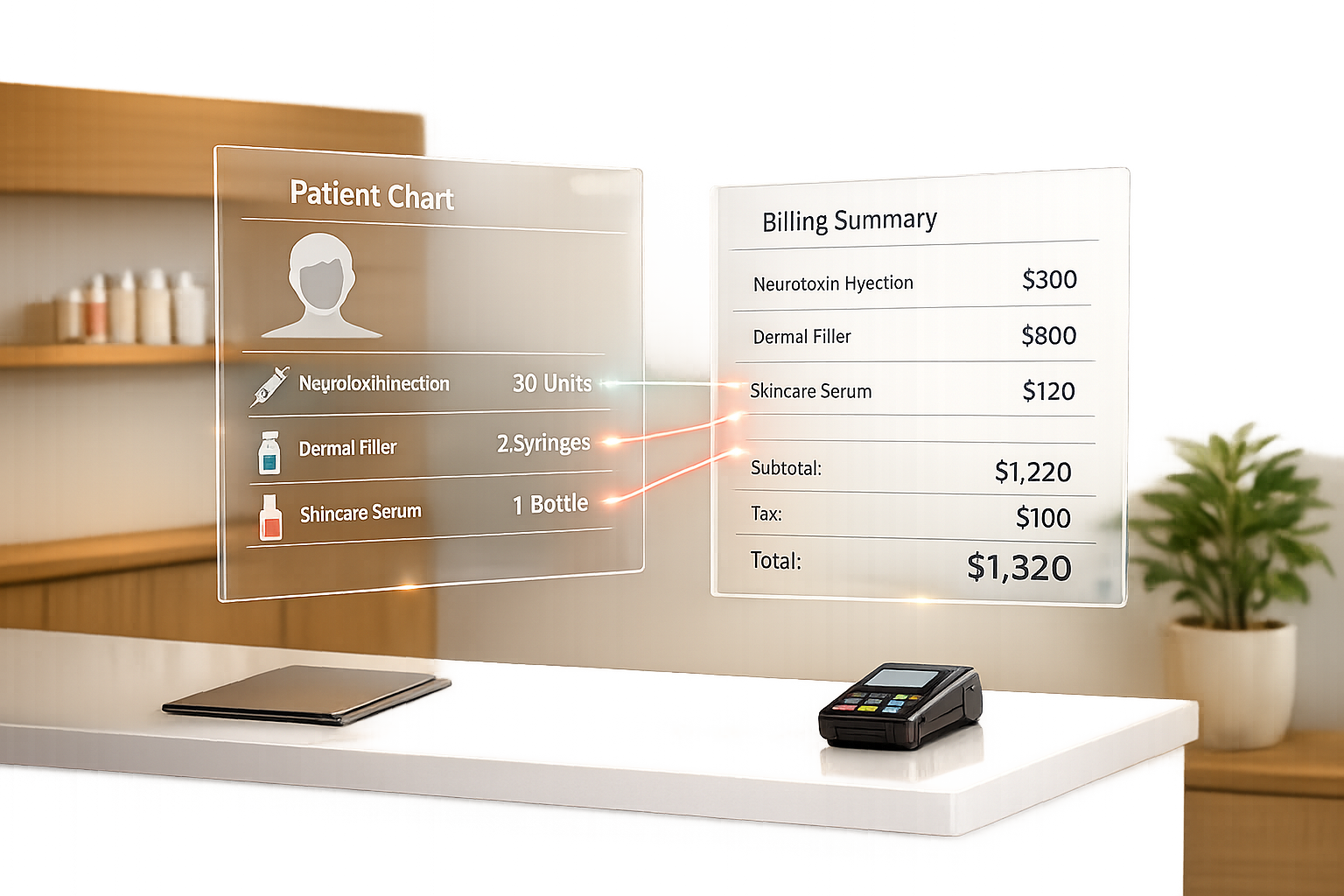
EHR billing integration solves one of the biggest pain points for aesthetic clinics: disconnected systems that waste time, cause billing errors, and hurt revenue. By linking clinical documentation directly to billing workflows, clinics can reduce errors, save staff hours, and recover lost income.
Key Benefits of Integration:
- Automatic charge capture: Reduces billing errors and speeds up invoicing.
- Inventory tracking: Ensures every product used is billed accurately.
- Faster payments: Integrated systems process payments 15–20 days quicker.
- Improved revenue: Clinics report up to a 50% revenue increase after switching.
Disconnected systems, on the other hand, lead to inefficiencies, missed charges, and compliance risks. Integration simplifies operations and improves patient satisfaction by creating a smoother, more accurate process from treatment to payment.
If your clinic relies on separate tools for charting, billing, and scheduling, it might be time to consider an integrated solution like Prospyr to streamline workflows and improve financial outcomes.
How EHR Billing Integration Changes Aesthetic Clinic Operations
One of the biggest shifts that EHR billing integration brings to aesthetic clinics is automatic charge capture. Traditionally, after completing a treatment, providers would document their notes, and someone from the billing team would manually re-enter the information. This process not only takes time but also increases the likelihood of errors or missing data. With integrated EHR billing, the process becomes seamless: as soon as a clinician signs off on a treatment note, a billing prompt is automatically generated. This automation has been shown to reduce the average charge turnaround time from 5.67 days to 4.42 days. It’s a game-changer that sets the stage for other important integrations.
Inventory linkage is another area where clinics see clear financial benefits. For example, when a provider uses a syringe of filler or a vial of neurotoxin during a procedure, the system automatically adds it to the patient’s invoice. Integrated platforms ensure that every product used is tracked and billed accurately. Without this connection, consumables often go unbilled - manual processes typically miss 5–10% of these charges. That’s revenue that clinics simply can’t afford to lose.
Payment processing also gets a major upgrade with integration. Unified platforms handle everything from card-on-file payments and deposits to split payments and membership renewals and packages, all within the same system used for clinical documentation. This eliminates the need to juggle multiple tools like separate billing software, POS terminals, or spreadsheets. The result? Practices using integrated systems receive payments 15–20 days faster compared to those relying on disconnected setups.
The results speak for themselves. Prospyr’s unified workflow, for instance, connects CRM, EMR, and POS systems, enabling staff to manage the entire patient journey - from intake to payment - without switching platforms. New Life Cosmetic Surgery saw dramatic improvements after consolidating four systems into Prospyr, achieving a 50% revenue increase and a 40% boost in appointments. SOM Aesthetics also benefited from Prospyr’s integration, hitting a $40,000 sales target in just two days - 21 times faster than their original goal.
These examples highlight how integration doesn’t just streamline operations - it drives measurable growth.
sbb-itb-02f5876
1. Disconnected EHR and Billing Systems
When EHR and billing systems operate separately, they create hidden costs that can disrupt daily workflows and eat away at profitability throughout the patient journey.
Workflow efficiency takes a serious hit. Staff often have to juggle multiple logins and interfaces just to complete a single patient interaction. This constant switching between systems leads to errors and wasted time. In fact, studies show that 72% of administrative errors in healthcare stem from task-switching between disconnected systems. On average, staff spend 10 to 15 hours each month navigating these fragmented platforms - time that could be better spent on patient care or revenue-generating activities.
"Tech fragmentation leads to inefficiencies, staff confusion and, ultimately, lost revenue." - Coverwell
Revenue management also takes a toll. Without an integrated connection between clinical documentation and billing, staff are forced to manually re-enter information. This process increases the risk of miskeyed codes, missed charges, and under-coding. For a clinic generating $2 million annually, these errors could result in losses ranging from $60,000 to $100,000 per year. Clinics with disconnected systems report up to 45% more billing errors compared to those using unified platforms.
Compliance and security risks are another major concern. Fragmented systems often lack consistent encryption and unified HIPAA-compliant payment standards. This creates vulnerabilities that can lead to costly fines - small healthcare entities face average penalties of $100,000 per incident for non-compliance with digital payment protocols. A single violation could threaten a clinic's financial health.
And let’s not forget how patients experience the fallout. In elective aesthetics, trust is everything. Disconnected systems can cause inconsistent communication, unclear billing processes, and gaps in post-procedure follow-ups. These issues undermine patient confidence. As the American Med Spa Association puts it, "In the world of elective medical procedures, patient trust hinges on transparency, safety and reassurance". Practices that switch to integrated solutions report a 20% boost in patient satisfaction scores.
These challenges highlight the need for a fully integrated EHR and billing system, which can streamline operations, improve revenue accuracy, and build patient trust.
2. Fully Integrated EHR Billing Ecosystem
A fully integrated EHR billing ecosystem can completely reshape clinic operations by eliminating the inefficiencies caused by disconnected systems. Instead of wasting time juggling multiple logins or re-entering data manually, staff can operate within a single, secure platform where everything - from clinical notes to billing - is seamlessly connected. This streamlined approach leads to immediate, noticeable improvements in workflow.
The benefits are undeniable. For example, when POS, CRM, and EHR functions are unified, staff no longer need to switch between systems to manage a single patient interaction. Take New Life Cosmetic Surgery Center as an example. After implementing Prospyr's integrated platform, they experienced a 50% increase in revenue and a 40% rise in appointment bookings. Dr. Lee, who leads the clinic, credited this success to the platform's unified design:
"The increase in efficiency for staff when POS, CRM, and EHR are all in one software as well as the effectiveness of Prospyr's HIPAA compliant CRM to convert leads into patients." - Dr. Lee, New Life Cosmetic Surgery Center
Revenue management also becomes much more accurate with an integrated system. Automated charge capture and AI-assisted coding ensure that accurate CPT and ICD-10 codes are assigned as soon as clinical notes are signed off. This eliminates the need for manual re-entry. For instance, Arizona Dermatology Clinic switched to an integrated solution and saw its first-pass claim acceptance rate jump to 96%, a 40% drop in denial rates, and an increase of over $25,000 in monthly collections. Built-in claim scrubbing tools also flag mismatches, reducing the chances of denials before claims are submitted.
Security and compliance are another area where integrated systems shine. A unified platform ensures consistent encryption and HIPAA-compliant payment standards at every stage - from lead capture to post-procedure billing. By keeping all patient data within a single, secure system, clinics can maintain a high standard of data protection without extra effort.
The impact extends to patient experience as well. Tools like integrated pre-booking and a HIPAA-compliant CRM allow clinics to engage patients with personalized outreach at just the right time. SOM Aesthetics leveraged Prospyr's combined EMR, CRM, and POS to pre-book appointments even before their official opening. The result? They generated $40,000 in revenue within their first two days and hit their six-week sales target 21 times faster than anticipated.
This kind of efficiency and precision doesn’t just improve operations - it drives measurable results for clinics and enhances the overall patient journey.
Pros and Cons of Each Approach
Disconnected vs. Integrated EHR Billing: Key Stats for Aesthetic Clinics
The table below highlights the key differences between disconnected systems and integrated solutions for EHR and billing.
| Area | Disconnected Systems | Integrated EHR & Billing |
|---|---|---|
| Staff Time | 10–15 hours lost per staff member, per month | 25–35% increase in overall staff efficiency |
| Billing Errors | Up to 80% of medical bills contain errors | Automated claim scrubbing and AI-assisted coding reduce errors significantly |
| Revenue | Up to 30% of potential annual revenue lost to inefficiency | 2–3% net profit recovery per transaction |
| Patient No-Shows | Up to 45% more no-shows and billing errors | Appointment confirmation rates improve by more than 60% with automation |
| Overhead Costs | Extra software fees and manual reconciliation | Up to 18% reduction in annual overhead |
| Compliance Risk | Fragmented records increase HIPAA exposure; average fine is $100,000 per incident | Centralized encryption, audit trails, and built-in HIPAA readiness |
| Patient Experience | Slow checkouts and inconsistent communication | 15% increase in patient satisfaction; 30% faster checkout times |
This comparison clearly lays out the operational and financial gaps between the two approaches. Disconnected systems often drain time and resources, while integrated systems streamline workflows and improve outcomes.
Switching to an integrated platform isn’t without its challenges, though. Migrating patient data from older systems requires meticulous planning to ensure data accuracy and maintain HIPAA compliance. Additionally, staff may need time to adapt to the new tools. Practices that skip proper onboarding often face temporary productivity dips, but structured training can increase successful implementation rates by 40%.
For aesthetic clinics, platforms like Prospyr can simplify this transition. By combining CRM, EMR, scheduling, and payment processing into one interface, Prospyr eliminates the need for staff to juggle multiple tools, reducing friction and boosting efficiency.
Conclusion
Disconnected systems are more than just an inconvenience for aesthetic clinics - they're a drain on resources, time, and patient trust. The inefficiencies caused by fragmented tools lead to billing mistakes, extra manual work, and missed charges, all of which chip away at profitability.
Switching to fully integrated systems changes the game. Clinics that have embraced integration report noticeable improvements in critical areas: fewer billing errors, smoother payment workflows, reduced overhead costs, and stronger patient retention. These changes not only simplify day-to-day operations but also help protect long-term financial health.
Dr. Daniel Lee, founder of New Life Cosmetic Surgery, shares how this transformation impacted his practice:
"We've seen a 50% increase in revenue and a 40% increase in appointments booked since switching away from using several different point solutions to running our practice on Prospyr." - Dr. Daniel Lee, Founder, New Life Cosmetic Surgery
For clinics considering their current system setup, integration isn't just a technical upgrade - it’s a strategic move toward better efficiency and patient care. A solution like Prospyr combines EMR, CRM, scheduling, and payment processing into one HIPAA-compliant platform, ensuring seamless data flow that eliminates the hidden costs of disjointed tools. With structured onboarding, clinics can see success rates improve by 40%, proving that the long-term benefits far outweigh the short-term effort.
If your clinic is still managing separate tools for charting, billing, and scheduling, the cost of maintaining the status quo may be greater than you realize. Adopting an integrated system could be the key to enhancing efficiency and driving future growth.
FAQs
How hard is it to migrate data to an integrated EHR and billing system?
Migrating data to an integrated EHR and billing system can feel overwhelming, but breaking it into manageable steps can make the process smoother. Start by mapping out your workflows to understand how your current system operates and identify areas for improvement. Next, focus on organizing your data to ensure everything is accurate and ready for transfer. Finally, dedicate time to training your staff, so they feel confident using the new system.
Though the initial effort may seem significant, modern platforms - especially those that are HIPAA-compliant - offer tools to make this transition easier. These systems can handle tasks like data import/export, maintain strict security protocols, and provide resources to onboard your team effectively. With the right approach, you can minimize errors and set the stage for a more efficient workflow.
What should I look for to ensure charge capture includes injectables and retail products?
To make sure charge capture accounts for injectables and retail products, opt for a system equipped with strong billing capabilities. Look for features like automated inventory tracking, precise service coding, and payment processing integration. These tools can help minimize errors, simplify invoicing, and offer real-time insights into revenue, making financial management more efficient.
How can I tell if my clinic is losing revenue from missed charges or coding errors?
Missed charges and errors in billing and coding are frequent culprits behind revenue loss in aesthetic practices. To address this, consider using integrated EHR and billing systems. These tools can automate claim submissions, minimize manual errors, and provide real-time insights into your revenue. By streamlining workflows and improving financial accuracy, they help ensure fewer missed opportunities and protect your bottom line.