HIPAA Compliance in Third-Party Integrations: What to Check
Verify BAAs, encryption, audit logs, and vendor risk to keep PHI safe in third-party integrations.


Third-party integrations in healthcare can expose your practice to serious HIPAA compliance risks. From unencrypted data to missing agreements, these risks can lead to costly penalties and data breaches. In 2024, 30% of healthcare breaches involved vendors, with damages reaching $9.77 million on average per incident. By 2026, non-compliance fines can exceed $2 million per violation annually.
To protect your practice and ensure secure telehealth sessions:
- Secure Business Associate Agreements (BAAs): Ensure all vendors handling PHI sign robust BAAs, including subcontractors.
- Enforce Encryption Standards: Use AES-256 encryption and TLS 1.3 to safeguard data.
- Monitor Audit Logs: Regularly review system activity and access reports.
- Perform Vendor Risk Assessments: Evaluate vendor security measures and demand updated certifications.
Proactive oversight of third-party systems minimizes risks, protects patient data, and ensures compliance with evolving HIPAA requirements.
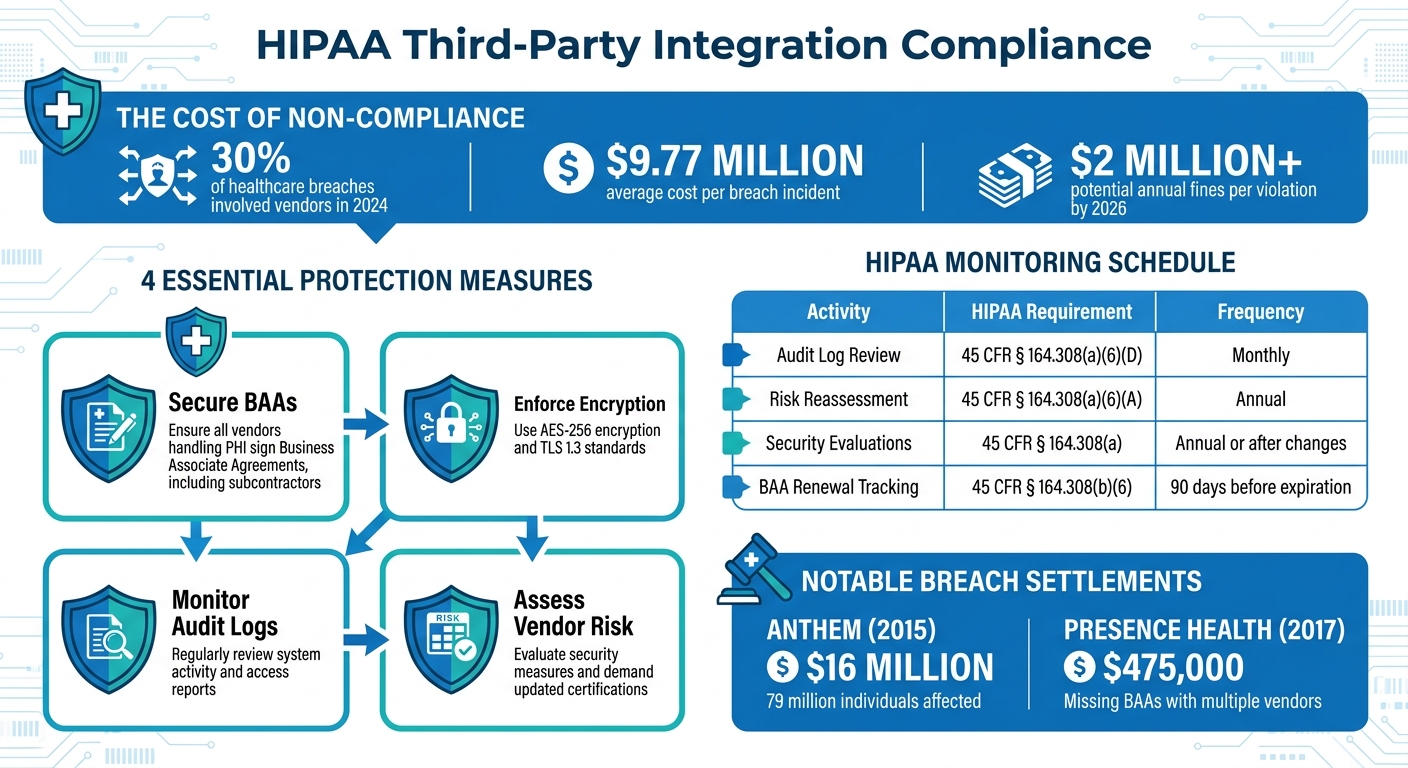
HIPAA Third-Party Compliance Statistics and Risk Assessment Schedule
Common HIPAA Compliance Problems in Third-Party Integrations
Bringing third-party systems into your operations can open the door to compliance risks, particularly when it comes to protecting PHI. Spotting these risks early is essential to putting safeguards in place.
Missing or Incomplete Business Associate Agreements (BAAs)
HIPAA's Privacy Rule (§ 164.502(e)) requires that you have written BAAs with any vendor handling PHI - whether they’re creating, receiving, maintaining, or transmitting it. However, many practices treat BAAs as a formality, skipping the deeper vetting process. This oversight often extends to the subprocessor chain, where vendors share PHI with their subcontractors. If one link in this chain fails, your practice could end up liable. For instance, if a payment processor works with a cloud storage provider, both entities must have BAAs in place.
Without a valid BAA, your practice bears full responsibility if a vendor mishandles PHI. These agreements also need to include breach notification requirements within a 60-day window to avoid additional penalties. Enforcement actions by the OCR increasingly focus on whether covered entities perform proper due diligence - not just on whether a BAA was signed.
Weak Data Encryption and Security Measures
HIPAA requires ePHI to be encrypted both during transmission and when stored. Outdated encryption protocols (like anything older than TLS 1.2), unencrypted credentials such as OAuth tokens or API keys, and logging unprotected PHI into debugging tools like Datadog or CloudWatch are direct violations. By December 2024, TLS 1.3 or higher is expected to become the minimum standard.
Third-party middleware can also create hidden risks by storing and forwarding PHI, effectively creating shadow databases. If these vendors lack strong security measures, they expand your exposure to breaches. Weak points like shared API keys, anonymous endpoints, or the absence of Multi-Factor Authentication (MFA) are common entry points for unauthorized access. Remember, HIPAA’s "addressable" safeguards are not optional - if a third party doesn’t use encryption, you must document why and implement an alternative or risk penalties for neglect.
Missing Audit Logs and Monitoring
HIPAA regulation 45 CFR § 164.308(a)(1)(ii)(D) requires regular reviews of system activity, including audit logs, access reports, and security incident tracking. Unfortunately, many third-party systems lack detailed logging or make it difficult to trace who accessed PHI and how it was used.
Without regular log reviews, unauthorized access could go unnoticed until it’s too late. Relying on outdated risk assessments only adds to the danger, as security threats evolve over time. The OCR's expanded enforcement initiatives planned for 2026 will place even greater scrutiny on risk management practices.
Poor Vendor Oversight
Relying solely on a vendor’s certifications without verifying their claims can leave your practice vulnerable.
OCR enforcement actions have increasingly focused on whether covered entities performed adequate due diligence before and during Business Associate relationships - not just whether they signed a BAA.
When vendors fail to communicate clearly, it can delay your awareness of security incidents. Without a designated point of contact, you might not even hear about breaches promptly.
The lack of ongoing monitoring is another major pitfall. Many practices perform a one-time assessment when onboarding a vendor but fail to revisit it. This neglect ignores changes like vendor ownership, service updates, or new regulatory requirements that could introduce new risks.
With these challenges in mind, the next section will guide you through a systematic approach to verifying HIPAA compliance in third-party integrations.
sbb-itb-02f5876
Reading about the problem? See how Prospyr solves it in one platform.
Book a DemoHow to Check HIPAA Compliance in Third-Party Integrations
Understanding the risks is only the first step. To ensure third-party vendors adhere to HIPAA requirements, you need a clear and systematic approach. Here’s how you can confirm compliance and protect your practice from potential liabilities.
Verify Business Associate Agreements (BAAs)
Before granting access to Protected Health Information (PHI), make sure a signed BAA is in place. This agreement must include the 12 provisions outlined in 45 CFR § 164.504(e), which cover permitted uses, safeguards, and breach reporting requirements.
Pay attention to breach notification timelines. Instead of vague terms like "promptly", specify clear timeframes, such as 5–10 business days. This ensures you have enough time to meet the federal 60-day notification deadline if an incident occurs.
"Covered entities remain liable for Business Associate violations if they fail to execute proper BAAs or exercise reasonable oversight." - Newf Technology
Additionally, confirm that your vendor requires downstream BAAs from any subcontractors handling PHI. For example, if a payment processor relies on a cloud provider, both parties must have BAAs in place. Store all agreements in a centralized location, like SharePoint, so you can quickly produce them during an OCR audit - ideally within two minutes. Set alerts for 90, 60, and 30 days before BAA expirations to prevent lapses.
Past cases highlight the importance of this step. In 2015, Anthem faced a $16 million settlement after a breach affecting 79 million individuals, partly due to inadequate BAAs and insufficient risk analysis. Similarly, Presence Health (now AMITA Health) paid $475,000 in 2017 for missing BAAs with multiple vendors and poor documentation.
Once BAAs are secured, the next step is verifying that vendors meet strict encryption and access control standards.
Check Encryption Standards and Access Controls
Ensure your vendor uses AES-256 encryption for data at rest and TLS 1.2 or higher for data in transit. For the strongest protection, look for TLS 1.3 and AES-256 cipher suites. Remember, HIPAA’s "addressable" encryption designation doesn’t mean it’s optional - it must be implemented or an alternative documented.
"Healthcare organizations that fail to encrypt protected health information (PHI) face substantial regulatory exposure and lose access to one of the most valuable protections available under federal law - the breach notification safe harbor." - Danielle Barbour, Kiteworks
Evaluate the vendor’s key management system. A "Hold Your Own Key" (HYOK) model offers the highest level of security since the cloud provider never has access to the decryption keys. If encryption keys are compromised alongside data, you lose breach notification safe harbor protections.
Access controls should follow the "minimum necessary" principle. Confirm that vendors use Role-Based Access Control (RBAC) and implement technical safeguards such as unique user identification, emergency access procedures, automatic logoff, and encryption/decryption mechanisms. For high-risk vendors, Multi-Factor Authentication (MFA) should be mandatory for all access points.
After addressing encryption and access control, focus on ongoing monitoring through audit logging.
Set Up and Review Audit Logging
Regular system activity reviews are required under HIPAA regulation 45 CFR § 164.308(a)(1)(ii)(D). This includes monitoring audit logs, access reports, and security incident tracking. Your BAA should specifically require third parties to conduct regular activity reviews and share relevant reports with you.
While HIPAA doesn’t mandate exact timeframes, monthly log reviews and annual risk reassessments are widely regarded as best practices for vendors with PHI access. Use the following guidelines to structure your monitoring schedule:
| Monitoring Activity | HIPAA Requirement | Recommended Frequency |
|---|---|---|
| Audit Log Review | 45 CFR § 164.308(a)(1)(ii)(D) | Regular review on a documented, risk-based schedule |
| Risk Reassessment | 45 CFR § 164.308(a)(1)(ii)(A) | Reassess as risks and operational conditions change; set a documented review schedule |
| Security Evaluations | 45 CFR § 164.308(a)[undefined] | Annual or after changes |
| BAA Renewal Tracking | 45 CFR § 164.308(b) | 90 days before expiration |
Set up automated alerts to detect unusual access patterns or unauthorized attempts. Periodically run breach scenarios with your vendors to assess their responsiveness and ensure they understand how to report incidents as outlined in the BAA.
Perform Vendor Risk Assessments
Even with a signed BAA, you need to evaluate whether a vendor can effectively safeguard PHI. A comprehensive risk assessment ensures ongoing compliance with HIPAA standards.
"OCR enforcement actions have increasingly focused on whether covered entities performed adequate due diligence before and during Business Associate relationships - not just whether they signed a BAA." - ThirdProof
Use standardized risk assessment questionnaires to gather information about the vendor’s cybersecurity measures, PHI sharing practices, and data protection protocols. For high-risk vendors, request SOC 2 Type II reports or HITRUST certifications annually instead of relying on self-attested claims.
If the vendor uses subcontractors, such as a software provider relying on AWS for hosting, confirm that BAAs extend to these subprocessors. Request updated lists of subprocessors each year and verify that downstream BAAs are in place.
Consider using Third-Party Risk Management (TPRM) software to centralize vendor data, automate evidence collection, and track compliance over time. This simplifies the process of demonstrating oversight during an OCR audit.
How Prospyr Handles HIPAA Compliance
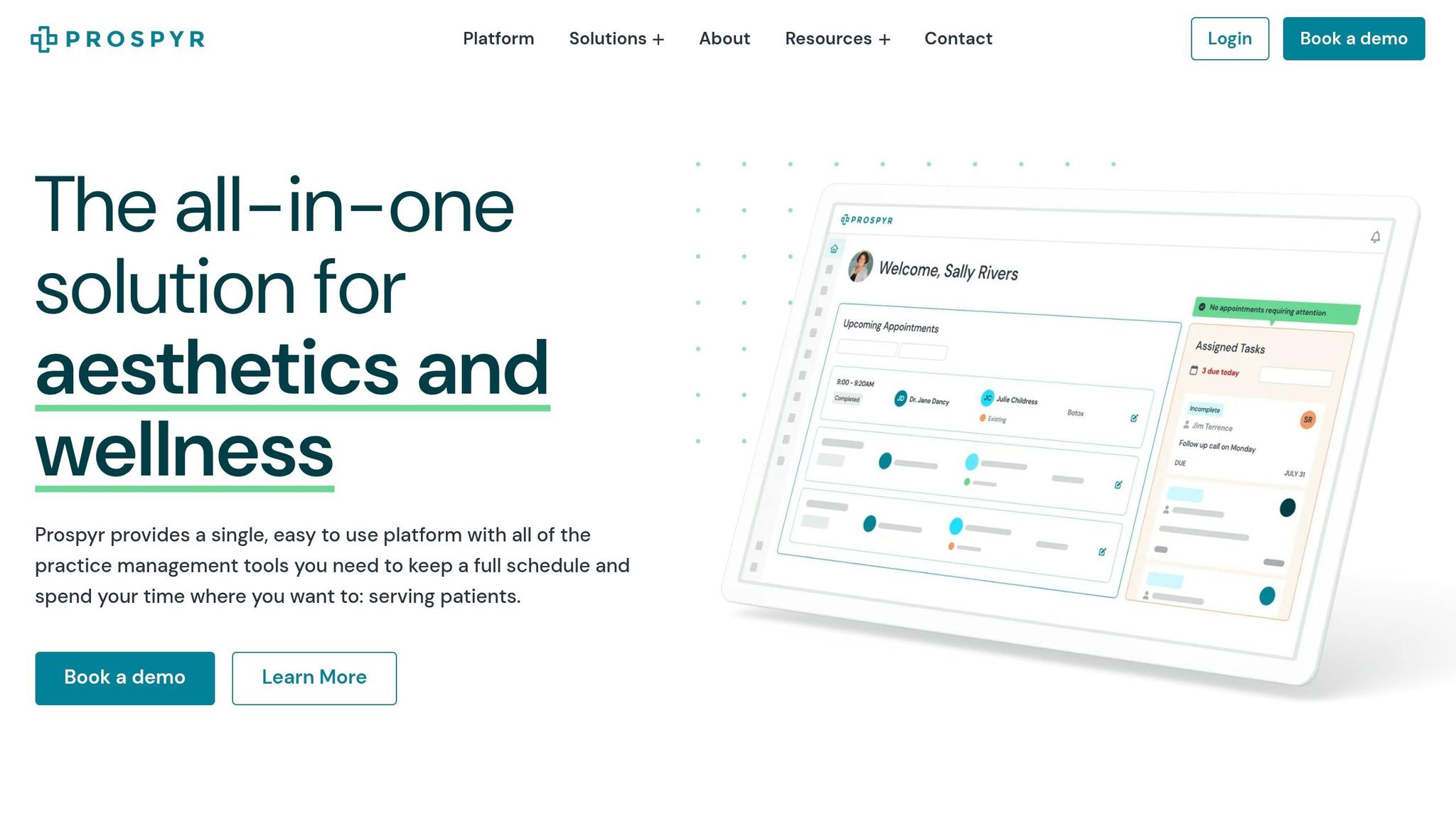
Prospyr takes the complexity out of managing HIPAA compliance by embedding it into every aspect of its platform. Instead of juggling multiple vendors and tools that might not meet compliance standards, Prospyr provides an integrated solution that simplifies the process while maintaining strict safeguards.
HIPAA Compliance Built Into All Features
Prospyr ensures compliance by requiring a Business Associate Agreement (BAA) before handling any Protected Health Information (PHI). The platform includes features like strict access controls, robust connectivity standards, and regular security updates to address common issues such as missing BAAs or inadequate safeguards. It also supports periodic data backups and enables regular audits, giving practices the tools to monitor which employees access sensitive information.
Reducing Third-Party Risks with Native Integrations
By offering native modules for CRM, EMR/charting, telehealth, e-prescribing, and lab ordering, Prospyr reduces the need for third-party tools. This all-in-one approach helps minimize the compliance risks that come with external vendors, each of which would otherwise require its own security evaluation. Prospyr also follows a shared responsibility model: while the platform ensures infrastructure security, providers are responsible for safeguarding login credentials and ensuring their staff adhere to HIPAA-compliant workflows.
Tools for Aesthetics and Wellness Practices
Prospyr is tailored to meet the needs of aesthetics and wellness clinics. It includes features like media archives for before-and-after photos, 2-way SMS communication, digital intake forms, and patient portals - all built on a HIPAA-compliant foundation. Additional tools for marketing automation, social media management, and review management ensure secure communication for tasks like appointment reminders and promotional emails. Before migrating patient data, clinics should confirm that their hardware, browsers, and operating systems meet Prospyr's requirements.
This integrated and secure approach makes compliance easier without compromising on safety or functionality.
Conclusion
HIPAA compliance in third-party integrations goes far beyond simply signing contracts - it's about maintaining constant vigilance and implementing strong technical safeguards. While a BAA provides legal protection, real compliance requires ensuring that vendors enforce measures like encryption, access controls, and audit trails. The OCR has increasingly focused on whether organizations conduct thorough due diligence both before and during their vendor relationships - not just whether a contract is in place. This means keeping a detailed inventory of Business Associates, documenting security assessments, and conducting annual reviews for high-risk vendors.
The risks of noncompliance are steep, both financially and reputationally. Data breaches, especially those involving third parties, are frequent and costly, highlighting the importance of consistent oversight.
Managing vendors effectively means overseeing the entire subprocessor chain. Every partner handling PHI, even indirectly, must meet compliance standards. To ensure this, ask vendors for their subprocessor lists and confirm that compliance requirements extend to all levels. This kind of thorough oversight lays the groundwork for integrated solutions that make compliance easier to manage.
Prospyr offers a streamlined approach to compliance by embedding HIPAA safeguards directly into its platform. With built-in modules for CRM, EMR, telehealth, and e-prescribing, you can cut down on the number of third-party vendors that need separate evaluations. This approach not only reduces compliance risks but also boosts efficiency - such as achieving 7–11% fewer no-shows through automated reminders and saving 20% in administrative time with digital intake forms.
Compliance should always be seen as an ongoing effort. Regular monitoring, detailed vendor evaluations, and tools that integrate compliance into daily operations are key to protecting patient trust and improving efficiency.
FAQs
Which vendors actually need a BAA?
Vendors handling Protected Health Information (PHI) for healthcare organizations are required to have a Business Associate Agreement (BAA). This applies to a wide range of entities, including medical service providers, subcontractors, telehealth companies, and those engaged in hybrid arrangements. The BAA ensures these vendors adhere to HIPAA regulations when managing sensitive patient information.
What should I demand in a vendor’s breach notice timeline?
Make sure the vendor outlines a specific timeline for notifying your organization in the event of a security breach. This should include a clear deadline for when they will inform you after identifying an incident. Having this in place allows for a swift response and helps maintain compliance with HIPAA regulations.
How can I identify PHI leaks in third-party logs or tools?
Keeping a close eye on logging practices is essential to avoid PHI (Protected Health Information) leaks. Here’s what you should focus on:
- Limit PHI in Logs: Ensure logs never contain raw or de-identified PHI unless it's explicitly authorized and meets HIPAA compliance standards.
- Audit Regularly: Make it a habit to review logs, especially after enabling debugging features, as these can inadvertently capture sensitive information.
- Secure Third-Party Tools: Double-check the configuration of any third-party tools to ensure they’re not capturing PHI unintentionally.
By consistently reviewing and auditing your logs, you can reduce compliance risks and safeguard sensitive data from potential breaches.