Hiring Compliance Checklist for Med Spas
Med spa hiring must follow strict ownership, licensing, role definition, and documentation rules to avoid penalties and protect patients.

When hiring for a med spa, compliance isn’t optional - it’s essential. From verifying licenses to defining roles, every step must align with federal and state regulations to protect your business, patients, and staff. Missteps like misclassifying employees or allowing unqualified staff to perform procedures can result in penalties, lawsuits, or even loss of licensure. Here’s a quick breakdown of what you need to know:
- Pre-Hire Essentials: Verify business ownership rules (e.g., Corporate Practice of Medicine laws), confirm staff credentials, and outline job roles clearly.
- Licenses and Background Checks: Use official state boards to validate licenses and check for disciplinary actions. Conduct thorough background checks and document everything.
- Employment Contracts: Define worker classification (W-2 vs. 1099), compensation terms, confidentiality clauses, and scope of practice in detail.
- Onboarding: Provide HIPAA and OSHA training, complete I-9 forms, and ensure employees sign policy acknowledgments.
- Ongoing Compliance: Track license renewals, continuing education requirements, and regularly update employment agreements to reflect current laws.
Staying compliant isn’t just about avoiding penalties - it ensures your med spa operates safely and ethically. Tools like Prospyr can simplify tracking and documentation, keeping your business organized and audit-ready.
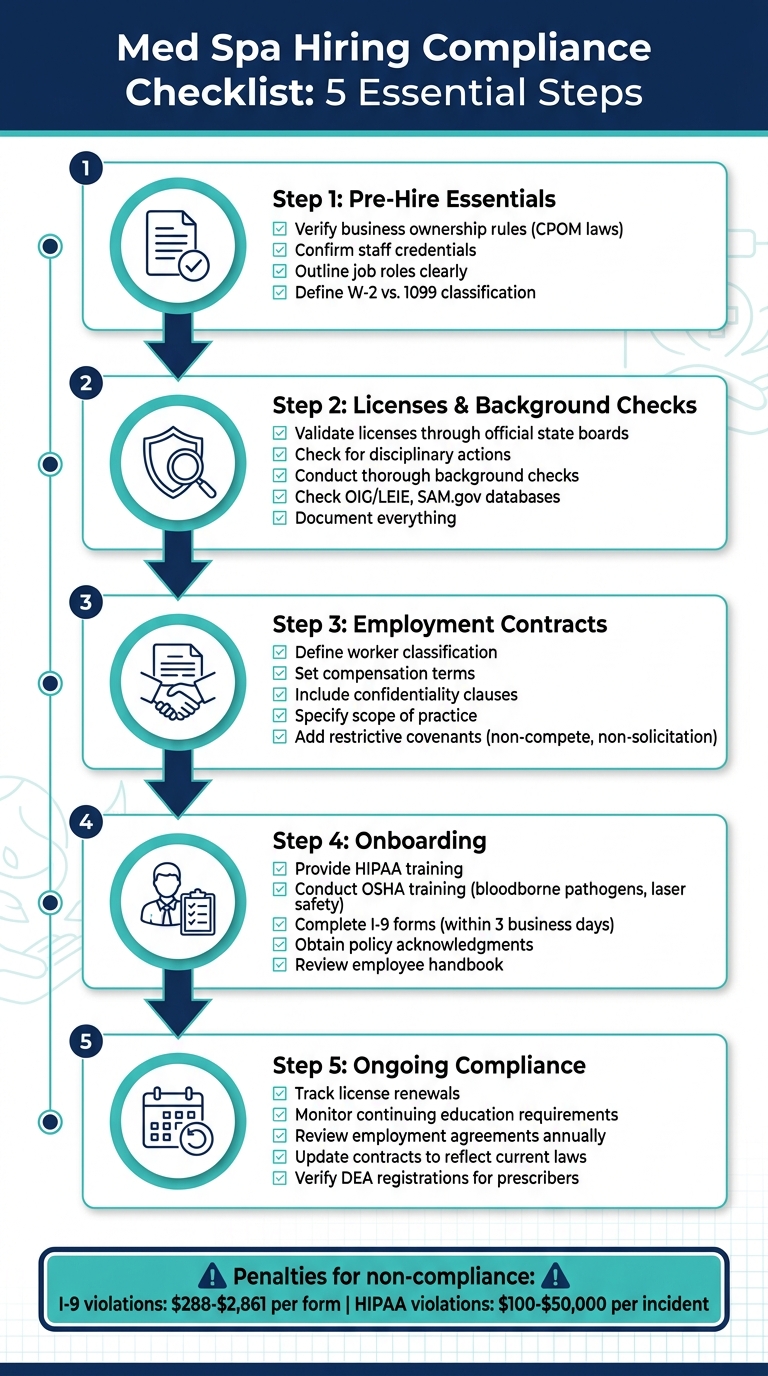
Med Spa Hiring Compliance Checklist: 5 Essential Steps
Pre-Hire Compliance Requirements
Before bringing new staff on board, med spa owners must navigate a maze of legal and regulatory requirements to ensure their hiring practices align with state laws. These steps aren't just bureaucratic red tape - they're essential to avoid hiring staff who aren’t legally qualified to perform specific services or creating employment structures that might violate state ownership laws.
Verify Business Entity and Licensing Requirements
In states with Corporate Practice of Medicine (CPOM) laws, like New York and Michigan, only licensed physicians are allowed to own businesses that provide professional medical services. For non-physician owners in these states, the solution often lies in setting up a Management Services Organization (MSO). This model separates clinical and administrative functions: a "friendly physician" owns the professional entity employing medical staff and overseeing clinical services, while the MSO handles tasks like marketing, billing, and facility management. To ensure compliance, it's crucial to consult legal counsel familiar with your state's specific requirements.
The ownership model you choose will also determine which entity employs your staff and signs employment contracts. Once this is clear, you can move on to defining roles that align with both legal guidelines and your operational goals.
Define Roles and Responsibilities
Start by outlining key positions such as medical director, nurse injectors, laser technicians, licensed estheticians, patient coordinators, and operations managers. Each role should have a detailed job description specifying clinical duties, supervision requirements, and performance expectations. This clarity helps prevent issues like job misclassification and ensures that each hire operates within their legally defined scope of practice.
The services your med spa offers will dictate the licenses and certifications required by law. For instance, offering injectables means hiring professionals like physicians, physician assistants, nurse practitioners, or registered nurses with the appropriate credentials. Laser treatments, on the other hand, may require different certifications based on your state’s regulations. Health law attorney Kathryn Hickner of BMD LLC emphasizes:
"Each type of licensed professional (e.g., a physician, physician assistant, nurse practitioner, registered nurse, licensed professional nurse, esthetician, or medical assistant) will have its own scope of practice dictated by state law".
Additionally, decide whether each worker will be classified as a W-2 employee or a 1099 contractor. Misclassification can lead to hefty penalties, so it’s worth getting this right from the start.
Understand Medical Director Oversight
After defining roles, you’ll need to ensure your supervision structure complies with state mandates. Supervision requirements vary widely - some states require on-site physician oversight for certain procedures, while others allow remote supervision. Understanding these rules is critical to creating a legally sound staffing plan.
The medical director plays a pivotal role in determining which procedures each licensed professional can legally perform. In CPOM states, the medical director or a physician-owned professional entity may even need to directly employ clinical staff. Early involvement of the medical director is key to reviewing role definitions and ensuring compliance. As Medical Director Co. explains:
"A medical director for a med spa helps review role definitions, confirm scopes of practice, and ensure your hiring plan aligns with state regulations and safe clinical standards".
Clear delegation protocols should also be established during onboarding to define boundaries for new hires. These measures not only protect patient safety but also ensure the med spa operates within legal and regulatory frameworks, minimizing risks and potential liabilities.
sbb-itb-02f5876
Credential Verification and Documentation
After defining roles and setting up supervision structures, the next critical step is verifying that every candidate has the credentials they claim. This process is crucial to shield your med spa from regulatory penalties, lawsuits, and the risks of employing unqualified individuals for medical procedures.
License and Certification Verification
Rely on official state licensing board lookup tools to verify credentials - don’t just trust resumes or physical copies. Courts have held employers liable for negligent hiring when they failed to perform checks that a reasonable employer would have conducted. Make sure each license is active and unrestricted. Avoid hiring anyone with licenses that are inactive, expired, suspended, revoked, or under probation.
During the application process, collect the candidate’s license number, issuing state, and expiration date. Use this information to search the state board database to confirm the license's status and check for any disciplinary actions. For prescribers, also verify their DEA registration and any state-specific controlled substance licenses.
Once license verification is complete, move on to an in-depth background review.
Background and Employment History Checks
Perform background checks covering at least five years of employment and relevant criminal records. Be sure to check exclusion databases like the OIG/LEIE at oig.hhs.gov, SAM.gov, and the National Sex Offender Registry while following FCRA guidelines. Obtain written consent from candidates and ensure you provide any necessary pre-adverse and adverse action notices.
With credentials and background verified, the next step is to document everything thoroughly.
Document All Credential Checks
Keep a detailed record of all verification results, including the date and source URL. Store these records in the employee’s file for future audits or legal reviews. Health Law Attorney Kathryn Hickner of BMD LLC emphasizes:
"The compliance policies and procedures should include state licensure and scope of practice requirements and should also address recordkeeping requirements for medical records and other documents".
Consider using a centralized tracking tool like Prospyr (https://prospyrmed.com) to manage expiration dates and send automated reminders 90, 60, and 30 days before credentials expire. When licenses are renewed, re-verify them through the state board database and update the employee file with the latest documentation. Proper recordkeeping not only ensures compliance but also simplifies audits and reduces administrative stress.
Reading about the problem? See how Prospyr solves it in one platform.
Book a DemoEmployment Contracts and Offer Letters
Once credentials are verified and background checks are complete, it’s time to formalize employment details. This step is critical for protecting both your med spa and its team, ensuring clear communication of expectations, responsibilities, and legal obligations.
Employment Status and Compensation Terms
One of the first decisions to make is how to classify workers: will they be W-2 employees or 1099 independent contractors? Misclassifying an employee can lead to hefty penalties.
The key difference lies in control. Employees follow your direction, adhering to set schedules and protocols, while independent contractors operate independently, deciding their own methods and timing. For W-2 employees, you’ll need to specify whether they’re paid hourly, on salary, or through commission, and remember that your business will handle payroll taxes, Social Security, and Medicare deductions. For independent contractors, the agreement should outline service fees or commission terms, making it clear they’re responsible for their own taxes and benefits.
| Feature | W-2 Employee | 1099 Independent Contractor |
|---|---|---|
| Control | Employer dictates hours, shifts, and protocols | Contractor determines schedule and methods |
| Compensation | Hourly, salary, or commission-based | Paid per service or commission |
| Taxes | Employer handles payroll taxes (Social Security, Medicare, etc.) | Contractor pays all self-employment taxes |
| Exclusivity | Can require exclusive work | Free to work for multiple entities |
In addition to compensation, it’s vital to safeguard your med spa’s proprietary practices and client relationships.
Restrictive Covenants and Confidentiality Clauses
To protect your business, include provisions for confidentiality, non-solicitation, non-compete, and non-disparagement in employment contracts. These clauses are especially relevant in the aesthetics industry, where client loyalty and specialized techniques are key revenue drivers. Keep in mind, however, that the enforceability of such provisions varies by state, so it’s essential to consult a healthcare attorney to ensure compliance with local laws.
Confidentiality is particularly important when it comes to patient records. For instance, "before and after" photos are considered part of a patient’s medical record. Using these images for marketing or social media requires explicit written consent from the patient.
Define Scope of Practice
Each role in your med spa has unique compliance requirements, so it’s crucial to clearly define duties and supervision protocols. For example, the responsibilities of an injector differ significantly from those of an esthetician or medical assistant. Contracts should reflect these distinctions and include any necessary supervision guidelines, particularly for nurse practitioners, physician assistants, and registered nurses who may require oversight from a medical director.
If your med spa operates in states with Corporate Practice of Medicine (CPOM) laws - such as Michigan or New York - keep in mind that only licensed physicians are permitted to own med spas.
Onboarding Compliance Procedures
A strong onboarding process goes beyond pre-hire credential checks and signed contracts. It’s a critical step for maintaining compliance and setting employees up for success. Not only does this safeguard your med spa legally, but it also plays a big role in employee retention. Companies with effective orientation programs retain 69% of their staff for at least three years and report 50% higher productivity among new hires.
Employee Handbook and Policy Acknowledgment
The employee handbook sets the tone for workplace expectations. It outlines everything from anti-harassment policies to time-off procedures and pay schedules. Sending this document to new hires before their first day allows them to review it ahead of time. On day one, make sure they sign an acknowledgment confirming they’ve received and read it. Without this signed acknowledgment, enforcing policies in legal disputes becomes much harder.
To avoid overwhelming new hires, focus on the essentials during the initial paperwork phase. Key documents include the offer letter, W-4, I-9, direct deposit authorization, handbook acknowledgment, and at-will acknowledgment. Schedule an orientation session within the first week to go over major policies, and assign a mentor to answer any questions during the early days. Once workplace expectations are clear, shift to compliance training in key areas like HIPAA and data privacy.
HIPAA and Data Privacy Training
Even if your med spa primarily operates on a cash-only basis, adhering to HIPAA privacy and security standards is a smart move. The penalties for HIPAA violations start at $100 per incident and can climb to $50,000 per violation category per year, making proper training a must.
During onboarding, provide documented training on data privacy. Cover topics like safe handling of patient records, securing system logins, and responding to data breaches. Have employees sign a HIPAA training completion acknowledgment and store it in a separate medical file - never in their general personnel file, as this could violate ADA regulations. Also include OSHA training on topics like bloodborne pathogens, laser safety, and emergency evacuation procedures.
Aside from privacy and safety training, new hires must complete federally required work eligibility verifications.
New Hire Reporting and I-9 Forms
Federal law mandates that all employees complete Form I-9 to verify their work eligibility. Employees must fill out Section 1 by their first day, while employers must complete Section 2 within three business days of the start date. Failing to comply can result in penalties ranging from $288 to $2,861 per form, so accuracy is critical.
Additionally, make sure to follow your state’s new hire reporting requirements. This typically involves submitting employee information to a state directory within a specific timeframe.
| Onboarding Category | Actions |
|---|---|
| Legal/Regulatory | Complete Form I-9; State new-hire reporting; Verify professional licenses. |
| Policy & Conduct | Handbook acknowledgment; Anti-harassment training; Confidentiality agreements. |
| Safety (OSHA) | Bloodborne pathogen plan; Laser safety training; Emergency evacuation review. |
| Data Privacy | HIPAA compliance training; Computer system/login security protocols. |
| Administrative | Payroll/benefits enrollment; Review of pay periods and time-off policies. |
For a smoother process, consider using tools like Prospyr (https://prospyrmed.com). This platform is tailored for aesthetics and wellness clinics, offering features to automate documentation, track training, and handle regulatory reporting. It can help your med spa stay organized and compliant with ease.
Maintaining Compliance Over Time
Hiring employees who meet all compliance standards is just the beginning - keeping up with ongoing monitoring and documentation is where the real work begins. State boards frequently update their requirements, and missing a renewal deadline could leave your med spa operating with unlicensed staff, exposing you to serious legal risks.
License and Certification Renewals
Professional licenses don’t renew themselves, and keeping track of expiration dates can quickly become overwhelming. Each role - whether it’s a physician, esthetician, or nurse - has a renewal cycle dictated by state regulations. If an employee misses their renewal deadline, they are legally unable to perform their duties until their license is reinstated.
State boards can also change their reporting schedules without much notice. For instance, Ohio now requires RNs and APRNs to complete continuing education (CE) credits between July 1 and June 30 of odd-numbered years. To stay ahead, check state board websites every few months for updates and set calendar alerts for each employee’s renewal deadlines.
In addition to tracking license renewals, make sure you’re staying on top of continuing education requirements, as they’re often tied to maintaining licensure.
Continuing Education Tracking
Continuing education requirements differ by profession and state. For example, a registered nurse’s CE obligations won’t be the same as those for a physician assistant or esthetician. Beyond just logging hours, you’ll need to ensure that the CE credits align with the procedures your team performs. This might include OSHA-mandated training on laser safety or bloodborne pathogens.
"Compliance policies and procedures should include state licensure and scope of practice requirements and should also address recordkeeping requirements for medical records and other documents."
- Kathryn Hickner, Health Law Attorney, BMD LLC
Keep both digital and physical copies of CE certificates as a safeguard for audits. If your med spa operates under a Management Services Organization (MSO) model, these organizations often offer credentialing support to help keep providers compliant. If you’re managing compliance internally, consider investing in a centralized compliance management system like Prospyr. These systems can help you track deadlines, required hours, and completion dates in one place.
But compliance doesn’t stop at licenses and education - it also needs to be reflected in employment agreements.
Review Employment Agreements Regularly
Monitoring licenses and education is only effective if it’s backed up by updated employment agreements. Regularly reviewing these contracts ensures they align with current legal and operational standards, which may have evolved since the employee was hired.
Employment agreements should be treated as dynamic documents, updated at least once a year to reflect shifts in laws and job roles. With federal and state governments increasingly cracking down on med spas, staying proactive with contract updates is critical.
| Priority Area | Key Focus for Review |
|---|---|
| Worker Status | Confirm W-2 vs. 1099 classification to avoid IRS penalties. |
| Compensation | Ensure management fees meet Fair Market Value (FMV) standards. |
| Scope of Practice | Align roles with the latest state delegation and supervision requirements. |
| Restrictive Covenants | Update non-compete and non-solicitation clauses to comply with current state laws. |
| CE Compliance | Track new reporting cycles (e.g., Ohio's March 2026 update). |
Pay particular attention to scope of practice clauses. As state laws evolve, especially regarding delegation and supervision for roles like PAs, NPs, and RNs, employment agreements must keep pace. Additionally, confirm that prescribers maintain active DEA and state-specific controlled substance registrations. If you’re using an MSO model, ensure that management fees remain within fair market value and are adjusted no more than once annually.
Conclusion
This checklist highlights the essential steps needed to maintain compliance in med spa operations. Ensuring hiring compliance is an ongoing process that demands careful attention at every stage. State laws governing med spa staffing differ widely and are constantly changing, making it critical to stay vigilant and have systems in place to adapt.
Key areas like distinguishing between employees and independent contractors, understanding the scope of practice for each role, and meeting oversight requirements for medical directors are crucial. Misclassifying workers can lead to IRS penalties, and allowing staff to work beyond their authorized scope may result in serious consequences, including state board sanctions.
To navigate these challenges, many med spas turn to Prospyr. Tailored for aesthetics and wellness clinics, Prospyr provides HIPAA-compliant tools to simplify credential tracking, staff scheduling, and record organization - all within a single platform. With features like task management, practice analytics, and automated reminders, it helps ensure deadlines for renewals, continuing education, and employment agreement reviews are never missed. Using a centralized tool like Prospyr supports every compliance step outlined in this checklist.
FAQs
Do I need an MSO to open a med spa in my state?
In some states, opening a med spa requires navigating specific legal structures. Take California, for instance: non-physicians must adhere to regulations that mandate the use of a physician-owned Professional Corporation (PC) paired with a Management Services Organization (MSO) to remain compliant with state laws. Always check your state's rules to determine if an MSO is necessary.
Who can legally perform injectables or laser treatments at a med spa?
Licensed professionals such as physicians, nurse practitioners, physician assistants, and estheticians are legally permitted to perform injectables and laser treatments at a med spa. However, they must strictly adhere to their scope of practice and meet all relevant licensing regulations.
How do I avoid misclassifying staff as 1099 contractors?
To stay on the right side of the law, it's crucial to understand the distinctions between employees and independent contractors. For instance, California law assumes workers are employees unless they satisfy the ABC test. This test requires that workers:
- Operate independently, free from the control of the hiring entity.
- Perform tasks that are not part of the company's primary business activities.
- Maintain an established trade, occupation, or business of the same nature as the work performed.
Failing to properly classify workers can result in penalties as steep as $25,000 per violation. To ensure compliance, it's wise to consult with legal professionals who specialize in employment law.