5 Common Laser Consent Form Mistakes
Learn five common laser consent form errors and how tailored forms, clear risk disclosure, and digital workflows reduce legal risk.
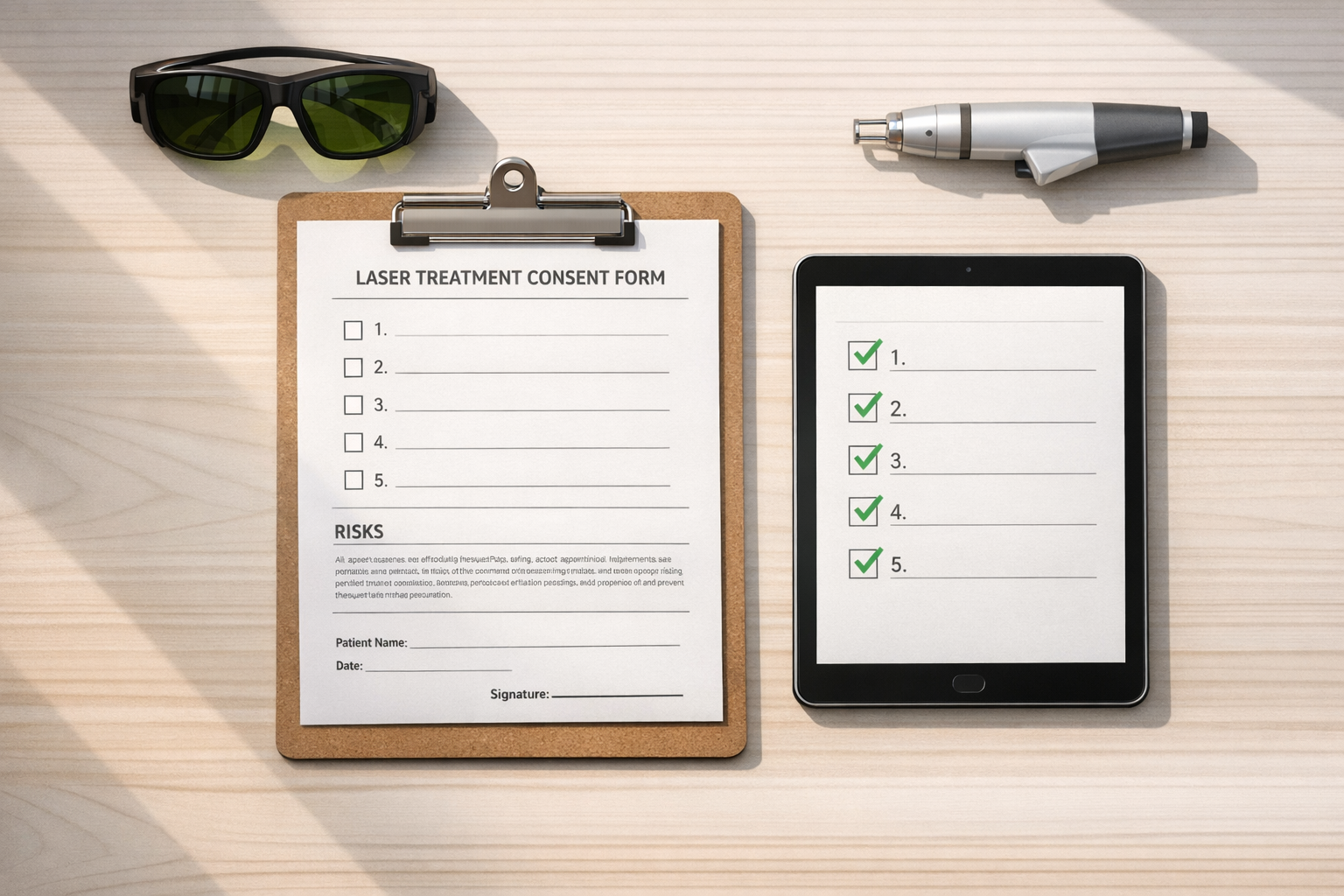

Laser consent forms are often overlooked but are critical for patient safety and legal protection. Many clinics make errors like using generic forms, omitting key risks, or failing to address alternatives and expected outcomes. These mistakes can lead to malpractice claims, regulatory issues, and financial losses. For example, clinics using incomplete consent forms face a 74% higher financial risk in malpractice settlements. Here's what you need to know:
- Generic forms fall short: Every laser procedure has unique risks that generic forms don't cover.
- Key risks are often missed: Severe complications like burns or scarring must be disclosed.
- Alternatives and realistic outcomes: Patients need clear expectations and options.
- Regulatory compliance matters: Federal and state laws require specific documentation.
- Disconnected workflows hurt: Digital forms sent before appointments improve understanding and reduce errors.
Fixing these issues involves using tailored forms, ensuring proper risk disclosure, and integrating consent into clinical workflows. Tools like digital platforms can automate and streamline this process, reducing errors and improving patient trust.
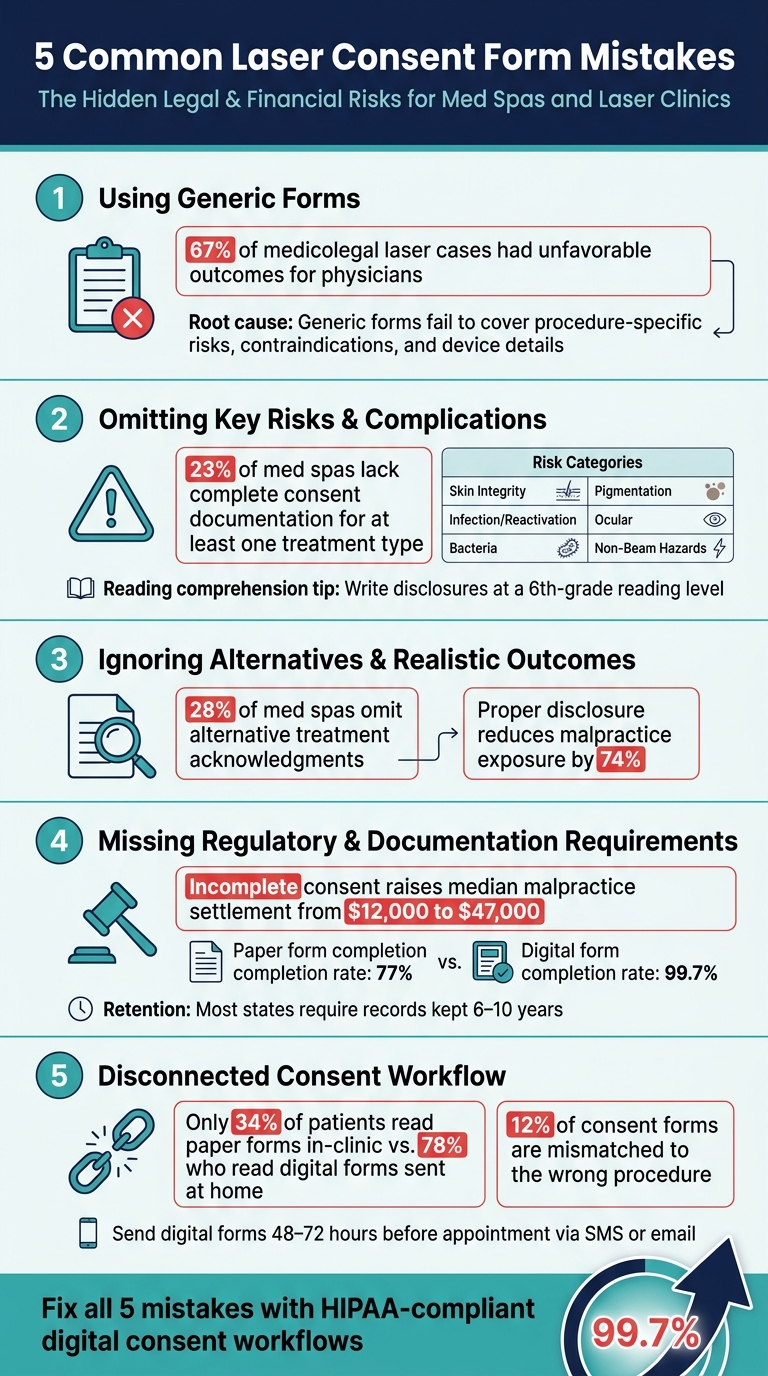
5 Laser Consent Form Mistakes: Key Stats & Risks
1. Using a Generic Form Instead of a Procedure-Specific One
When it comes to laser treatments, relying on a generic consent form is a major misstep. Sure, a generic form might include the basics - like a name, signature, and a catch-all liability clause - but it fails to address the unique details that are crucial for specific laser procedures.
Every laser treatment comes with its own set of risks and requirements. For instance, the potential complications of laser hair removal are entirely different from those of fractional skin resurfacing or IPL treatments for vascular concerns. Each of these procedures requires its own contraindication screenings and risk disclosures. A one-size-fits-all form simply doesn't cut it. This approach not only jeopardizes patient safety but also puts practices at odds with regulatory expectations.
"A single generic consent form is legally insufficient - each treatment category requires specific risk disclosures, contraindication acknowledgments, and alternative treatment descriptions." - US Tech Automations
The consequences of using inadequate consent forms are significant. In a review of 120 medicolegal cases involving laser therapies, 67% ended with unfavorable outcomes for the physicians involved. The top issue? Insufficient consent discussions. Beyond legal risks, regulatory bodies can take disciplinary action against practitioners who fail to use proper consent documentation.
The fix is simple: use tailored consent forms for every laser treatment offered. Each form should clearly spell out the specific risks, include a contraindication checklist, and provide customized pre- and post-care instructions. Additionally, they should document essential details like the device name and treatment settings. Tools like Prospyr make this process easier by automating digital intake workflows, ensuring that the correct form is presented when a treatment is scheduled. This reduces the chances of errors during patient check-in and keeps practices compliant.
sbb-itb-02f5876
2. Leaving Out Key Risks and Complications
Using generic consent forms is already a risky move, but failing to include complete details about potential complications takes things to another level. Even when clinics use forms tailored to specific procedures, they often fall short. For example, they might only mention mild side effects like redness or swelling, leaving out more severe risks such as burns, scarring, hyperpigmentation, or even herpes reactivation. This lack of transparency not only puts patients in harm’s way but also leaves clinics exposed to serious legal and financial consequences.
Signed and thorough consent forms are a critical line of defense against malpractice claims. In fact, they significantly reduce liability. Yet, a troubling 23% of med spas still fail to provide complete consent documentation for at least one type of treatment.
"The consent form does not prevent the adverse outcome, but it dramatically changes the legal standing when an adverse outcome occurs." - US Tech Automations
It’s not just the obvious risks that need to be addressed. Some hazards are less apparent but no less dangerous. For instance, Class IV lasers, commonly used in aesthetic treatments, can cause permanent retinal damage in a fraction of a second if protective eyewear isn’t properly used. Similarly, alcohol-based prep solutions can create fire risks, and inhaling laser plume can pose additional health dangers.
Here’s a breakdown of key risk categories and the complications that should be disclosed:
| Risk Category | Complications to Include |
|---|---|
| Skin Integrity | Burns, blistering, scarring, thermal stacking |
| Pigmentation | Hyperpigmentation, hypopigmentation, permanent changes |
| Infection/Reactivation | Herpes simplex reactivation, active skin infections |
| Ocular | Retinal injury, photothermal damage, vision loss |
| Non-Beam Hazards | Fire risk from prep solutions, laser plume inhalation |
Clear communication is the key to addressing these risks effectively. One way to ensure patients understand the risks is to write disclosures at a 6th-grade reading level. This makes the information easier to digest and helps patients feel more informed. Another effective strategy is to send digital consent forms 48–72 hours before the appointment. When patients review forms at home, 78% of them read the entire document, compared to only 34% when given paper forms at the clinic.
Ultimately, comprehensive risk disclosure isn’t just about checking a box - it’s part of a broader effort to educate patients, meet regulatory standards, and ensure better outcomes for everyone involved. Pairing detailed consent forms with consistent documentation practices strengthens both patient safety and legal protection.
Reading about the problem? See how Prospyr solves it in one platform.
Book a Demo3. Not Addressing Alternatives, Limitations, or Expected Results
Even the most customized consent forms can fall short if they skip over alternative treatments or set expectations that aren't realistic. These gaps can lead to serious legal and financial issues. For instance, proper disclosure has been shown to reduce malpractice exposure by 74%. Yet, a surprising 28% of med spas fail to include acknowledgments of alternative treatment options in their consent forms.
Consent forms should go beyond simply listing risks - they need to clearly define the limitations of the treatment. Generic forms often leave out critical details, but procedure-specific forms should address what a treatment cannot promise and outline available alternatives. Take laser hair removal as an example: the form should explain that 6–8 sessions are usually needed and that results will vary depending on the patient’s skin type, which can be documented using the Fitzpatrick scale. Instead of promising "permanent hair removal", describing the outcome as "reduced hair growth" sets a more honest expectation. Including policies for touch-ups and exclusions in pricing can also help prevent misunderstandings down the line.
"Informed consent forms must demonstrate that patients have been fully informed of the procedure, its potential risks, benefits, expected outcomes, and their right to ask questions or decline treatment." - Pabau
To make this clearer, here’s a breakdown of what major treatment categories should cover in this part of the consent form:
| Treatment | Alternatives & Limitations to Address |
|---|---|
| Laser Hair Removal | Right to decline, alternative methods (e.g., waxing or shaving), session requirements, skin type considerations |
| Laser Resurfacing | Options like chemical peels, microneedling, or topical treatments; risks such as hyperpigmentation or hypopigmentation |
| Neurotoxins (Botox) | Policies for touch-ups, expected duration of results, and realistic outcomes (e.g., softening lines rather than full elimination) |
| Dermal Fillers | Reversal options (e.g., hyaluronidase), different filler types, and non-injectable alternatives |
It’s also important to include a section confirming the patient’s right to decline treatment at any time. Platforms like Prospyr can help automate the delivery of digital consent forms and integrate them seamlessly into your practice workflow. These steps ensure that consent forms are not just informative but also help patients fully understand what to expect.
4. Missing Regulatory and Documentation Requirements
Consent form documentation isn't just about listing procedure details - it must also comply with both federal and state regulations. Falling short on compliance can lead to regulatory scrutiny and increased malpractice settlement costs. For instance, incomplete consent documentation raises the median malpractice settlement from $12,000 to $47,000.
At the federal level, HIPAA compliance is non-negotiable. Signed consent forms must be stored in systems that meet HIPAA standards. If you're using tools like digital form builders or e-signature platforms, you also need a Business Associate Agreement (BAA) with the vendor. Without a BAA, your practice risks falling out of compliance.
State-specific regulations add another layer of complexity. For example:
- Georgia: Consent forms must include the practitioner's name, degrees, licenses, and a consulting physician's emergency contact.
- Kansas: Licensees must review and authenticate patient records within 14 days of a light-based treatment, and the consent form must define the procedure as a "medical and surgical procedure".
- Iowa: Forms must include a statement confirming that the patient's questions were answered before treatment.
These examples highlight how state mandates can vary widely, making it critical to tailor documentation to meet local requirements.
"Failure to obtain informed consent shall be grounds for disciplinary action against the license of any cosmetic laser practitioner." - Georgia Board of Physician Assistants
Beyond meeting regulatory demands, the quality of documentation is equally important. A simple signature isn't enough. Electronic records must include details like timestamps, IP addresses, and version histories to pass audits. Digital systems have a significant advantage here: while paper-based processes have a completion rate of 77%, digital platforms enforce required fields, achieving a 99.7% completion rate. Solutions like Prospyr help bridge this gap by offering HIPAA-compliant digital intake forms that integrate seamlessly with patient records, ensuring documentation is always audit-ready.
Finally, keep in mind that most states require medical records and consent forms to be retained for at least 6 to 10 years. Proper documentation isn't just about compliance - it's about safeguarding your practice and ensuring patient trust.
5. Disconnecting Consent Forms from Clinical Workflow and Patient Education
When it comes to procedure-specific consent, how forms are delivered can significantly influence how well patients understand them. Handing a consent form to a patient on a clipboard in a noisy waiting room? That’s a recipe for confusion and missed details. These kinds of logistical missteps don’t just inconvenience patients - they directly impact their ability to make informed decisions and, ultimately, their safety.
Here’s a telling statistic: only 34% of patients actually read paper consent forms in the clinic. Compare that to the 78% who review digital forms sent to them at home, and the difference in comprehension becomes crystal clear.
Disconnected workflows don’t just harm patient understanding - they also increase the risk of administrative errors. For example, manually selecting forms for patients can lead to mistakes. In fact, 12% of consent forms end up mismatched, meaning the form signed doesn’t align with the actual procedure performed. It gets worse: an audit of a multi-location medspa uncovered that 23% of consent files were incomplete - missing initials, signatures, or correct treatment details. Garrett Mullins, an expert at US Tech Automations, summed it up perfectly:
"Each incomplete form represented a procedure performed with deficient informed consent - a legal vulnerability that no amount of clinical excellence could mitigate."
So, what’s the solution? It’s simple: send consent forms 48–72 hours before the appointment via SMS or email. This gives patients the time they need to carefully review the information, ask any questions, and show up to their appointment already informed. Combine this with a digital system that automatically assigns the correct form based on the scheduled procedure, and you eliminate the risk of manual errors entirely.
Platforms like Prospyr make this process seamless. They integrate HIPAA-compliant digital forms with scheduling tools and automated communication via SMS or email. The result? A 99.7% consent completion rate, compared to just 77% with paper forms. By weaving consent forms into the clinical workflow, you not only ensure compliance but also strengthen patient education. That’s a win for everyone involved.
Conclusion
Laser consent forms are a clear reflection of your clinic's dedication to both patient safety and legal compliance. The five missteps highlighted in this article - relying on generic forms, leaving out critical risks, ignoring alternatives and realistic outcomes, overlooking regulatory requirements, and failing to align forms with clinical workflows - are all pitfalls that can be avoided with careful planning. This is especially critical when opening a med spa and establishing standard operating procedures.
As discussed, incomplete consent documentation poses a serious malpractice risk. To minimize exposure, consider conducting annual audits of your consent forms. Randomly review 10 patient charts to identify missing initials, outdated risk descriptions, or inconsistencies between procedures and documentation. Use this process to update your forms in line with current clinical guidelines, any adverse events from the past year, and changes in legal or regulatory standards. Transitioning to digital platforms like Prospyr can further streamline this process. Prospyr offers HIPAA-compliant digital intake forms that integrate with scheduling systems and automatically send the correct consent form to patients 24–48 hours before their appointment. This ensures compliance while simplifying workflows.
"Every incomplete consent form is a liability time bomb." - Garrett Mullins, Experienced Operator, US Tech Automations
FAQs
What should a laser consent form include for my specific treatment?
A laser consent form needs to be customized for the specific procedure being performed. It should include a clear description of the treatment, expected results, potential alternatives, and possible risks such as burns, scarring, or changes in pigmentation. Screening questions are also essential, covering factors like Fitzpatrick skin type, history of keloid formation, recent sun exposure, active infections, and the use of photosensitizing medications. Additionally, it should address the patient’s medical history, provide detailed pre- and post-care instructions, and require the patient’s signed acknowledgment to ensure understanding and promote safety.
How can clinics prove a patient actually understood the consent?
Clinics can ensure patients understand procedures by using the teach-back method - asking patients to explain the process and risks in their own words. To make things clearer, written forms can be paired with visual aids such as diagrams or 3D models. Tools like Prospyr take this further by incorporating electronic signatures and timestamped audit trails. This ensures patients engage with each section of treatment-specific forms instead of simply signing off on a generic document.
What documentation details matter most in a consent audit?
A consent audit focuses on ensuring that all necessary elements are in place for proper documentation and patient understanding. Some of the critical components include:
- Treatment-specific risk disclosures: Clearly outlining any potential risks associated with the procedure.
- Contraindication screening: Ensuring the patient is suitable for the treatment and identifying any conditions that might pose risks.
- Proof of patient understanding: Verifying that the patient comprehends the information provided.
Consent forms should cover several essential areas, such as:
- Patient identification: Accurate details to match the form with the correct individual.
- Procedure explanations: A clear description of the treatment being performed.
- Alternative treatment options: Information on other available approaches.
- Pre- and post-care instructions: Guidance to ensure the patient knows how to prepare for and recover from the procedure.
- Photo release permissions: Authorization for using images if needed.
From a legal standpoint, the forms must include dated, witnessed signatures from both the patient and the provider. This ensures accountability and compliance with regulatory standards.
To streamline the process, digital tools like Prospyr can be used. These tools help maintain compliance by timestamping consent and blocking incomplete submissions, reducing the risk of errors or missing information.