Consent Form Trends in Aesthetics
Digital, procedure-specific consent forms boost patient comprehension, ensure HIPAA-safe records, and reduce malpractice exposure in aesthetic clinics.
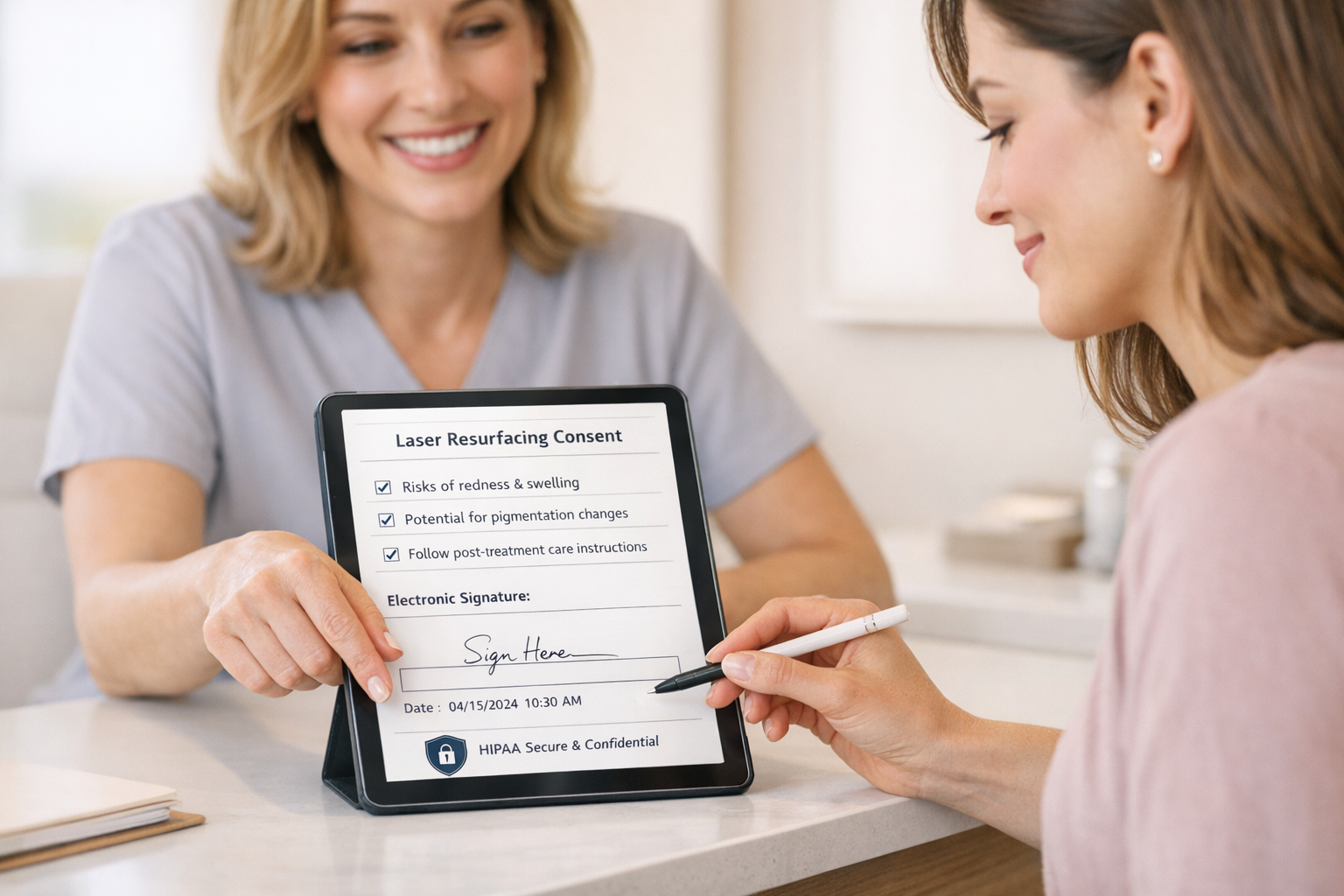

In the aesthetics industry, consent forms are no longer just legal paperwork - they're critical for patient understanding, safety, and minimizing malpractice risks. Here's what you need to know:
- Digital consent forms outperform paper: 78% of patients read digital forms sent in advance, compared to only 34% for paper forms handed out on-site. Digital systems also achieve a 99.7% completion rate, significantly reducing liability.
- Regulations are tightening: Federal and state laws now require clearer, more patient-friendly consent forms. For example, Rhode Island's new Medical Spas Safety Act mandates stricter documentation and training standards.
- Tailored forms are key: Generic consent forms are being replaced with procedure-specific documents that highlight risks, alternatives, and patient rights.
- Photo consent must be explicit: Marketing-related photo use now requires separate, HIPAA-compliant consent to protect patient privacy.
- Malpractice savings with digital systems: Practices using digital consent tools see malpractice settlements drop from $47,000 to $12,000 on average, with potential insurance premium reductions of 6-10%.
Switching to digital platforms simplifies compliance, improves patient comprehension, and reduces legal risks. Practices that prioritize clear, thorough consent processes are better equipped to meet evolving industry standards.
Regulatory and Legal Shifts in Consent Forms
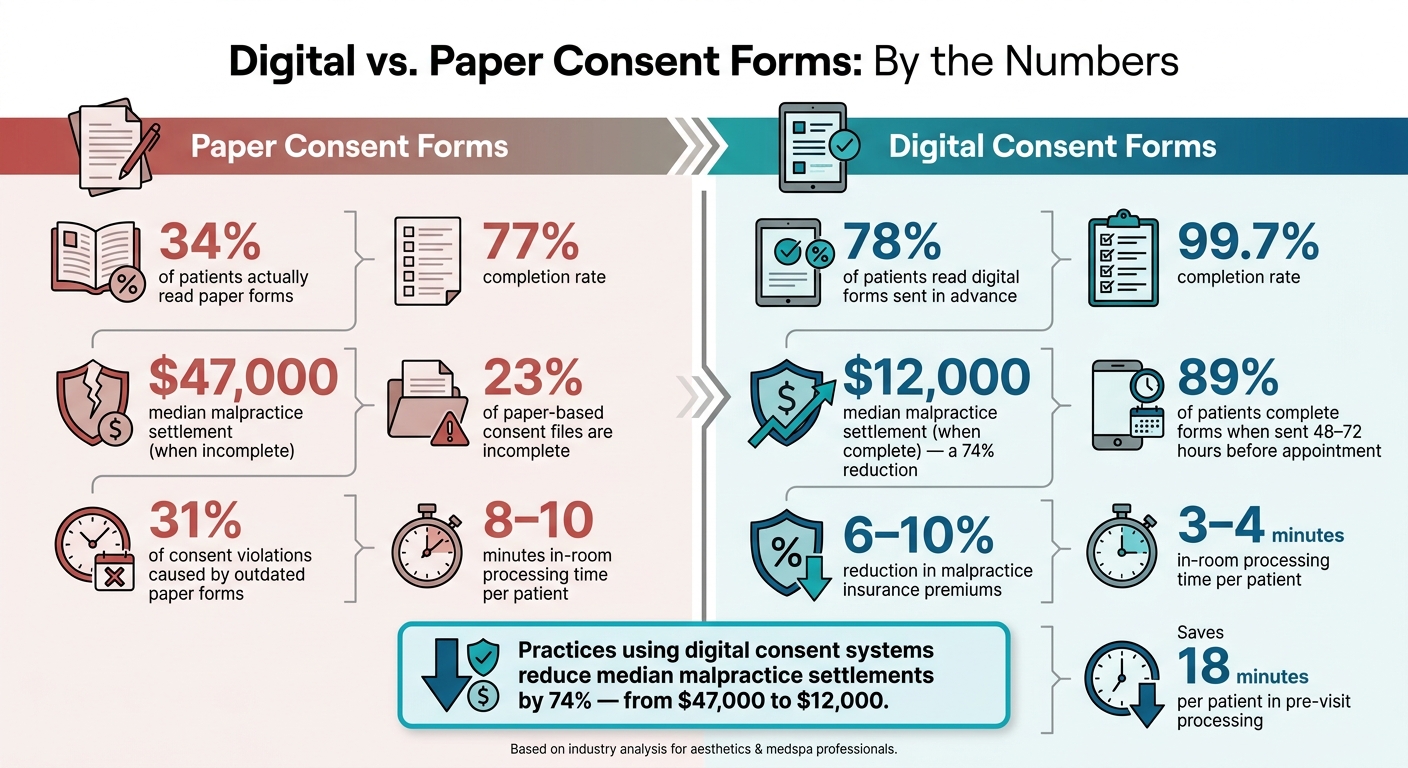
Digital vs. Paper Consent Forms: Key Stats for Aesthetics Practices
The rules surrounding consent in the aesthetics industry are becoming stricter. Both federal and state regulators are demanding higher standards for informed consent, and if your practice hasn’t updated its forms in the past few years, you could already be falling behind.
Federal and State Compliance Requirements
On the federal side, the U.S. Department of Health and Human Services (HHS) has released draft guidance urging that consent forms start with a clear, concise summary of crucial information. This approach moves away from heavy legal jargon and reflects updates to the Common Rule, which prioritizes providing patients with the key details they need before agreeing to a procedure.
States are also stepping up. For example, in July 2025, Rhode Island Governor Daniel McKee signed the Medical Spas Safety Act into law. This legislation requires medical spas to be licensed as healthcare facilities, employ licensed medical directors, and adhere to strict documentation and training standards by July 2026. As Nixon Peabody LLP explained:
"The Medical Spas Safety Act represents a shift toward increased state oversight of cosmetic medical practices in Rhode Island."
These changes signal the need for aesthetics practices to revisit their consent forms. Updating forms to include clear risk disclosures and proper documentation can help ensure compliance and prepare for emerging digital protocols.
HIPAA and Data Privacy in Consent Management
Digital systems for managing consent must also comply with HIPAA regulations. In 2024, the HHS Office for Civil Rights resolved 22 investigations involving small and mid-sized providers, resulting in penalties or settlements due to HIPAA violations. For aesthetic clinics, this means storing patient health information (PHI) in encrypted systems with controlled access, rather than relying on unsecured storage. Adopting secure digital systems aligns with the broader push for better consent documentation across the industry.
Malpractice Trends and Risk Reduction
One of the biggest risks in aesthetics is incomplete consent documentation, which is often avoidable. A compliance audit of a medspa chain with three locations and $4.2 million in annual revenue revealed that 23% of its consent files were incomplete, exposing the business to significant legal risks. The numbers tell a clear story: practices with fully completed, signed consent forms face a median malpractice settlement of $12,000, while those with incomplete documentation see that figure jump to $47,000. Moreover, practices using digital consent systems with audit trails often qualify for 6–10% reductions in malpractice insurance premiums because insurers recognize the reduced liability associated with detailed digital records.
| Documentation Type | Completion Rate | Median Malpractice Settlement |
|---|---|---|
| Paper consent forms | 77% | $47,000 (when incomplete) |
| Digital consent forms | 99.7% | $12,000 (when complete) |
These statistics underscore the financial and legal advantages of adopting digital consent solutions. Transitioning to secure, digital systems not only reduces liability but also helps practices stay ahead in an increasingly regulated industry.
sbb-itb-02f5876
Reading about the problem? See how Prospyr solves it in one platform.
Book a DemoEmerging Trends in Consent Form Content and Structure
As regulations become more stringent, the design and content of consent forms are evolving to ensure patients clearly understand their treatments while reducing legal risks for providers. Aesthetics practices are moving away from one-size-fits-all consent forms, opting instead for tailored documents that resonate with patients and meet updated compliance standards. This shift is not going unnoticed.
Procedure-Specific and Device-Specific Consent Forms
Gone are the days of generic consent forms. Practices are now creating targeted, procedure-specific documents that detail the actual risks, benefits, and alternatives for each treatment. This change addresses a significant issue: 12% of medspa liability claims stem from mismatched consent forms. By aligning consent forms with specific procedures, practices can better protect themselves and their patients.
Solicitor Oscar Bole highlights this approach:
"A clinician must establish the patient's goals and should then compile a list of all possible ways of achieving them (always including the option to do nothing) based on their clinical expertise."
Digital consent workflows are also gaining traction. These systems close compliance gaps that paper forms often miss. For example, a medspa chain achieved a 100% consent completion rate in early 2026 by requiring patients to fill out digital, treatment-specific forms before their appointments. This not only streamlines the process but ensures that risks and alternatives are clearly documented.
Clearer Risk Disclosure and Treatment Alternatives
Consent forms are becoming more patient-friendly, using straightforward language to explain risks and treatment options. Dense legal jargon is being replaced with plain text that patients can easily understand. Nurse prescriber Jen Vittanuova underscores the importance of this shift:
"True informed consent is a clinical process, not a clerical task."
Research shows that digital forms improve patient comprehension compared to traditional paper forms. This improvement is critical when patients later claim they were unaware of a risk. Additionally, forms now emphasize discussions about alternatives, including the choice to decline treatment entirely. This ensures patients are fully informed before proceeding.
Photography and Social Media Consent
Before-and-after photos play a key role in aesthetic marketing, but when tied to a patient’s identity, they qualify as Protected Health Information (PHI) under HIPAA. Practices can no longer bundle photo consent into general treatment forms. Instead, they must create separate sections that clearly outline how images will be used - whether for clinical records, marketing materials, or social media.
CureCast emphasizes this point:
"Informed consent must be explicit: Generic consent is no longer acceptable. Patients must sign off on how their photos will be used - clinical records, marketing, website, or social media."
These dedicated sections, written in plain language, provide transparency for patients and shield practices from potential HIPAA violations. Considering that the average cost of a healthcare data breach reached $9.77 million in 2024, having well-structured consent processes in place is not just a legal safeguard but a financial one as well.
Digital Tools in Consent Form Management
Switching from paper to digital consent forms addresses compliance issues that paper systems often fail to resolve. For instance, 23% of paper-based consent documentation remains incomplete for at least one treatment type. Digital platforms eliminate this problem by requiring patients to complete every section, including initialing risk disclosures and signing all necessary areas, before submitting the form. Below, we’ll explore how digital tools improve consent collection, version control, and documentation.
Using Digital Platforms for Consent Collection
Sending digital consent forms 48–72 hours prior to an appointment significantly boosts both completion and comprehension rates - 89% of patients complete the forms, and 78% take the time to read them. This ensures patients arrive informed, rather than rushing through paperwork in the treatment room.
Digital platforms also create a detailed audit trail, logging every submission with a timestamp, IP address, and device ID. This produces a legally sound record that is far more reliable than handwritten signatures. Tools like Prospyr streamline these processes by integrating digital forms with HIPAA-compliant storage and CRM/EMR systems. This means completed consent forms are automatically added to patient records, eliminating the need for manual filing. Thanks to the federal ESIGN Act and UETA legislation, electronic signatures are legally equivalent to ink signatures in all 50 states. Notably, having complete, timestamped digital consent records reduces the median malpractice settlement from $47,000 to $12,000 - a 74% decrease.
"Digital consent automation achieves what paper processes cannot: 100% completion, 100% treatment-matching, 100% retrievability, and zero filing errors." - Garrett Mullins, Experienced Operator, US Tech Automations
Automated Updates and Version Control
Digital tools also simplify version control, ensuring practices always use the most current consent forms. This is critical because 31% of medspa consent violations stem from outdated forms that reference old product information or fail to include new risks. When regulations change - such as updated state medical board requirements or revised FDA product labels - paper-based systems require staff to manually replace old forms, a process prone to mistakes and delays.
With digital platforms, a single template update is instantly applied across all locations, and the system keeps a record of which version each patient signed. This eliminates the risks of version drift. As ZibaDesk highlights:
"When a complaint is raised two years later, proving exactly which version of the consent the patient signed becomes nearly impossible [with paper]."
While quarterly template audits are still advisable, digital systems make these reviews quick and efficient, taking minutes instead of days. This ensures ongoing compliance while reducing the risk of errors.
Documenting Consent Conversations in Digital Systems
Modern digital platforms go beyond simply collecting signatures - they also allow clinicians to document critical treatment details, such as product volumes, injection sites, device settings, and any concerns expressed by the patient. This enhances the medical record and integrates the consent process into the clinical workflow.
For repeat procedures like neurotoxin treatments, SMS-based re-confirmation flows replace the need for patients to fill out the entire form again, maintaining thorough documentation while minimizing hassle. Similarly, for add-on treatments discussed during consultations, tablet-triggered consent forms cut in-room processing time from 8–10 minutes to just 3–4 minutes. On average, this approach saves 18 minutes per patient in pre-visit processing, a significant time gain that can improve scheduling efficiency. Together, these practices ensure compliance while making the consent process more seamless for both patients and providers.
Best Practices and What to Expect Next
Updating Consent Forms for New Treatments and Devices
When introducing new injectables, devices, or off-label protocols, it's crucial to update consent forms immediately. Gone are the days when generic templates sufficed - each treatment comes with its own specific risks. For example:
- Dermal fillers: Consent forms should mention vascular occlusion risks and reversal options.
- Laser treatments: These must address considerations like Fitzpatrick skin types and restrictions on sun exposure.
- Microneedling: Forms should include details about the risk of herpes reactivation and the impact of recent retinoid use.
"Review consent forms quarterly and update whenever FDA labeling changes, state medical board guidance updates, or your treatment protocols change." - Garrett Mullins, Experienced Operator, US Tech Automations
State-specific regulations add another layer of complexity. For instance, California requires a medical director disclosure, Texas mandates credential transparency for non-physician injectors, Florida enforces a 24-hour reflection period for certain procedures, and New York has its own risk disclosure addendum. Using a digital system that automatically applies jurisdiction-specific rules can simplify the process and reduce errors. To ensure compliance, audit your most recent 50 consent packets to spot missing initials, outdated references, or mismatched forms. These updates are essential for weaving consent seamlessly into patient care.
Weaving Consent into the Patient Journey
Incorporating consent into every step of the patient journey enhances both compliance and patient care. Consent should be more than just a form handed over at the last minute - it should be a clinical conversation that starts early and continues throughout the process. During the initial consultation, document alternative treatment options and the patient’s right to decline. Digital consent forms sent via SMS or email 48–72 hours before the appointment allow patients to review them at their own pace. This approach has a noticeable impact: 78% of patients read digital forms compared to just 34% for paper forms.
At check-in, a consent status indicator can confirm that all necessary forms are completed before rooming the patient. For treatments added during the appointment, tablet-based systems can capture additional consent on the spot. This seamless integration of digital consent ensures compliance with legal requirements while prioritizing patient safety and engagement. By embedding consent into the entire patient experience, it becomes more than just a box to check - it becomes a meaningful part of care.
"A signed form means very little in the absence of clear, contemporaneous records showing that the discussion took place and was understood." - Jen Vittanuova, Nurse Prescriber and Expert Witness
Using Data to Improve Consent Processes
Digital platforms like Prospyr offer valuable insights into where consent processes might break down. For example, data can reveal if certain forms have higher drop-off rates, signaling that the language might be too complex or the form too lengthy. Real-time flagging for issues like patient allergies or hesitations has also become a standard feature.
Beyond improving patient communication, these platforms can have financial benefits. Practices that maintain complete digital audit trails often see 6–10% reductions in malpractice insurance premiums, as insurers recognize the reduced liability risks. Over time, the data generated by these systems can guide improvements in patient education, helping practices refine how they communicate risks and alternatives. This ensures that the consent process evolves with each interaction, staying relevant and effective as legal standards shift. By using these insights, practices can create a more dynamic and patient-centered approach to consent.
Conclusion
The days of relying on generic paper consent forms in aesthetics practices are behind us. The new standard is customized, digital, and fully compliant, and the difference between practices that have embraced this shift and those that haven't is often reflected in their financial performance. Digital consent processes significantly lower malpractice risks, offering clear financial and legal advantages. The key takeaways from this guide are straightforward: send forms early, tailor them to specific treatments, enforce their completion, and ensure thorough documentation. Whether it's creating separate forms for neurotoxins and lasers, implementing standalone photo consent, or incorporating state-specific language for places like California, Texas, or Florida, the goal remains the same - patients need clear, transparent information, and practices require reliable protection.
Unlike paper-based systems, digital consent automation provides treatment-specific, fully retrievable records without the risk of filing errors. Platforms like Prospyr seamlessly integrate these features into scheduling and patient management systems, eliminating manual processes that can lead to mistakes - an essential tool for practices handling increasing patient volumes.
Practices that prioritize consent as a critical part of patient care - not just a legal formality - are the ones fostering stronger trust, maintaining accurate records, and achieving better outcomes. As regulations evolve and patient expectations grow, those investing in robust, efficient consent processes are setting the foundation for long-term success when opening a med spa.
FAQs
What should a procedure-specific consent form include?
A procedure-specific consent form needs to cover several key elements to ensure clarity and thoroughness. It should include clear patient identification, a detailed description of the procedure, and outline potential risks as well as available alternatives, including the option to decline treatment. Additionally, it’s important to document the patient’s medical history, allergies, current medications, and any contraindications such as pregnancy.
The form should also secure voluntary authorization marked with a timestamped e-signature, include photo release permissions if relevant, set recovery expectations, and provide a transparent breakdown of costs. Tools like Prospyr make this process easier by offering digital intake forms to streamline compliance and simplify documentation.
How do digital consent forms stay HIPAA-compliant?
Digital consent forms play a key role in maintaining HIPAA compliance by safeguarding protected health information (PHI). They achieve this by encrypting PHI during storage and transmission, ensuring data remains secure. Additionally, these forms offer secure storage solutions, detailed access logs for auditing, and adhere to state-specific retention rules.
To ensure compliance, clinics are required to sign a Business Associate Agreement (BAA) with their software provider. This agreement confirms that the provider handles PHI in line with HIPAA regulations. Tools like Prospyr streamline this process by securely managing digital consent workflows while keeping sensitive patient information protected.
When should a clinic update its consent forms?
Clinics need to keep consent forms current to account for new treatments, procedures, or medical updates. Changes become necessary when the FDA releases updated risk information, medications are revised, or state laws shift. To stay compliant, it's wise to conduct regular reviews of these forms alongside healthcare attorneys. For patients undergoing repeat procedures, having them sign updated forms each year ensures any health changes are properly documented. Tools like Prospyr make this process easier by offering streamlined digital intake and management solutions.