Skin Tone Considerations in Aesthetic Training
Standardize Fitzpatrick typing, conservative settings, clear charting, and strict escalation to lower PIH and burn risk in darker skin.
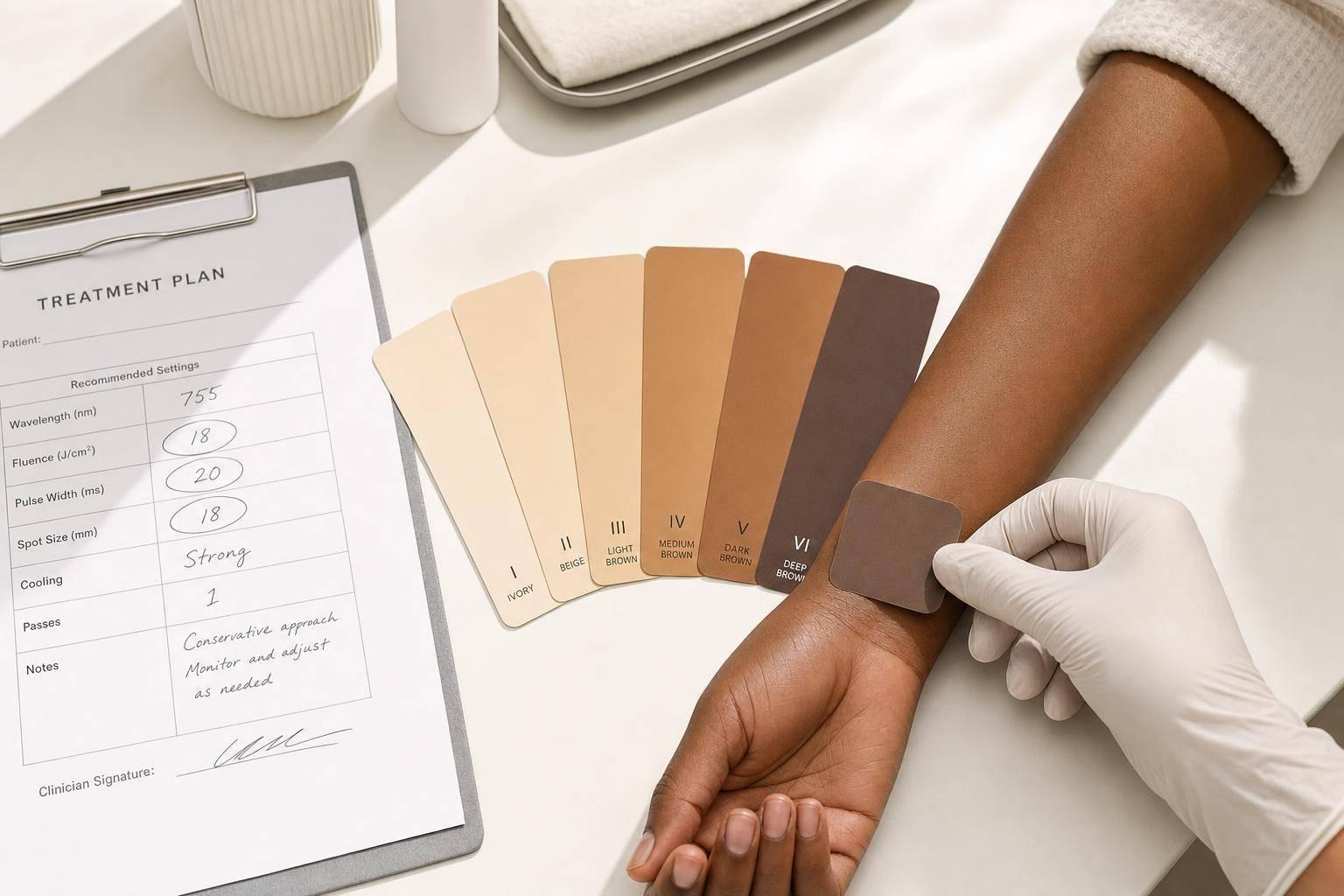

Skin tone changes treatment risk, so staff training has to change with it. If a clinic skips Fitzpatrick typing, pigment history, test spots, and tighter follow-up, the chance of burns, PIH, hypopigmentation, and scarring goes up - especially in Fitzpatrick IV–VI skin.
Here’s the short version:
- I’d make Fitzpatrick type part of every consult
- I’d require intake questions on PIH, keloids, prior reactions, meds, and recent sun exposure
- I’d train staff to use neutral language and document skin findings under the same lighting each time
- I’d use lower starting laser settings, superficial peels, and more spacing between sessions for higher-pigment skin
- I’d chart exact device settings, peel strength, passes, photos, and aftercare
- I’d give plain aftercare steps like mineral SPF 30+, no heat, no actives, and clear warning signs
- I’d set firm escalation rules for blistering, slate-gray darkening, severe pain, fast color change, or delayed healing
One stat says a lot: after ablative procedures, PIH risk can reach 45%–75% in Fitzpatrick V–VI skin, compared with 3%–8% in Fitzpatrick I–II. That’s why skin tone is not a side note in training. It changes consults, settings, charting, and follow-up from start to finish.
| Area | What staff should do |
|---|---|
| Intake | Record Fitzpatrick type, PIH history, keloids, meds, and sun exposure |
| Exam | Check baseline pigment, erythema, melasma, scars, and barrier status |
| Treatment | Use more cautious settings and test spots when pigment risk is higher |
| Charting | Log settings, passes, photos, counseling, and follow-up timing |
| Aftercare | Give written steps, SPF guidance, and same-day call triggers |
| Escalation | Stop and refer for burns, pigment shifts, suspicious lesions, or eye symptoms |
If I were building an aesthetic training program, I’d treat skin tone as a standard safety step - not an extra topic.
Consult Protocols That Standardize Skin Tone Assessment
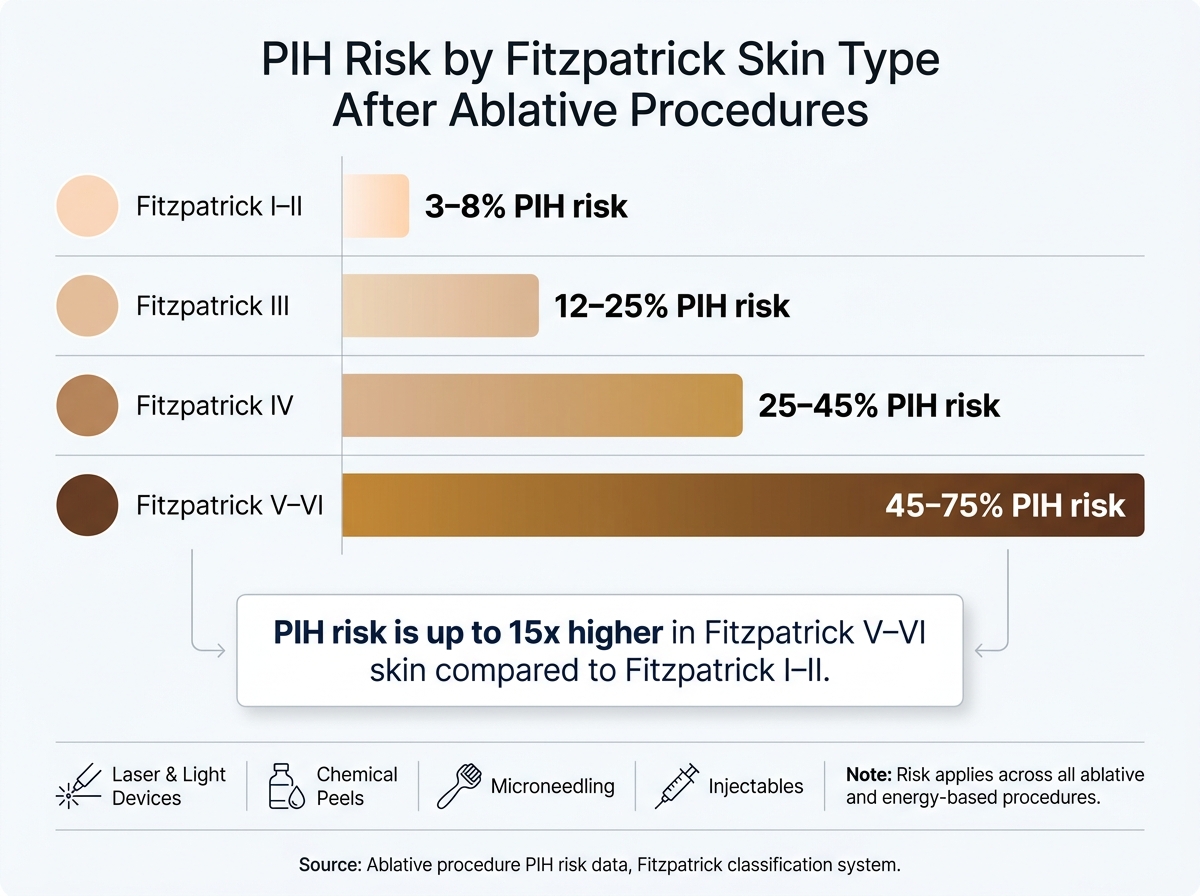
PIH Risk by Fitzpatrick Skin Type After Ablative Procedures
A standard consult protocol helps every patient get the same skin tone assessment, no matter who handles intake. That matters. When front-desk staff, nurses, and treatment providers all collect the same details, the clinical team can make safer, better-informed calls before treatment starts.
Required History: PIH, Keloids, Prior Procedures, and Medications
Make these intake fields required:
- PIH history: Ask about dark marks left after acne, waxing, or cosmetic procedures.
- Keloids and abnormal scarring: Ask about personal and family history of keloids or thickened scars, including after piercings, surgery, C-sections, or burns.
- Prior procedures and reactions: Document the exact device or peel used and any adverse reaction.
- Medications: Document current or recent isotretinoin, photosensitizing antibiotics like doxycycline, immunosuppressants, and systemic steroids.
- Sun exposure: Recent tanning, outdoor work, or vacations in the past 4–6 weeks increase PIH risk and may call for treatment changes.
It’s not enough to have the fields sitting in the EMR. Staff need training on how to ask these questions the same way every time. Scripted questions, role-play exercises, and periodic chart audits help front-desk and nursing teams keep documentation consistent before treatment orders close.
History points to risk. Visual assessment shows what the skin is doing right now.
Visual Assessment and Respectful Communication
Use a structured visual exam to confirm baseline pigment, inflammation, and existing PIH. Staff should check for active acne or rosacea flares, melasma patterns (centrofacial, malar, mandibular), signs of barrier compromise, and hypopigmented scars, all under consistent lighting. Intake history can tell you what happened before. This step shows what’s visible today.
Language matters here too. Use neutral clinical terms like “post-breakout pigmentation” or “brown cheek patches” instead of “problem areas” or “bad skin.” Keep the discussion centered on safety and the patient’s goals. Avoid assumptions tied to ethnicity or appearance. That kind of phrasing doesn’t just sound better - it can affect whether patients share the history your team needs to plan treatment safely.
Training should include plain examples of stigmatizing language to avoid, along with better substitute phrases staff can use in the room.
Use these findings to shift consult priorities by Fitzpatrick group.
Consult Priorities by Fitzpatrick Group
| Category | Fitzpatrick I–III (lighter skin tones) | Fitzpatrick IV–VI (medium–deep skin tones) |
|---|---|---|
| History focus | Sunburns, photosensitivity, prior aggressive peels or lasers, skin cancer history | PIH after acne or procedures, keloids or hypertrophic scars, pigment changes after prior treatments |
| Exam priorities | Erythema, telangiectasia, photodamage, barrier status | Baseline pigmentation patterns, existing PIH or melasma, subtle erythema, textural changes |
| Communication points | Photoaging, sensitivity, realistic expectations for redness reduction | Pigment response risk, PIH prevention, strict sun protection adherence |
| Common treatment precautions | Avoid over-resurfacing inflamed or barrier-impaired skin; monitor for excessive peeling | Conservative energy settings; avoid high-strength peels initially; plan longer intervals and mandatory test spots |
Ablative procedures can produce PIH in up to 75% of patients, particularly those with Fitzpatrick III–V skin. Approximate PIH risk by skin type after ablative procedures: Fitzpatrick I–II: 3–8%; Fitzpatrick III: 12–25%; Fitzpatrick IV: 25–45%; Fitzpatrick V–VI: 45–75%.
These differences are easier to teach through case reviews than rote memorization. The goal is simple: use them to shape treatment planning, charting, and patient counseling.
Practices using Prospyr can make Fitzpatrick type, PIH history, keloid history, medications, and recent sun exposure required intake fields.
Reading about the problem? See how Prospyr solves it in one platform.
Book a DemoRisk Review, Treatment Planning, and Charting Standards
Use Fitzpatrick type, pigment history, and a medication review to set energy, depth, number of passes, and follow-up timing. What you find in the consult should flow straight into the procedure settings and the chart. In plain terms, the consult note, treatment plan, and procedure documentation should all match.
Procedure Adjustments for Lasers, Peels, Microneedling, and Injectables
Match energy, depth, and passes to pigment risk. Keep the plan simple, then use the table below for the full setup.
For lasers and light devices, lean toward longer wavelengths, such as 1064 nm Nd:YAG. Start fluence 10%–30% below your usual setting, lengthen pulse duration, do a test spot before treating larger areas, and stretch treatment intervals to 6–8 weeks for Fitzpatrick V–VI.
For chemical peels, begin with superficial peels and use fewer passes. Medium-depth peels need physician oversight. In higher-pigment skin, avoid stacking retinoids or treating too soon after a laser session or peel.
For microneedling and RF, use shallower depth, lower energy, and fewer passes. Avoid same-day combinations in higher-risk patients. For injectables, reduce trauma, control injection depth, and tell patients that bruising can lead to temporary PIH.
What Staff Must Chart for Skin Tone-Related Risk
Every chart should include:
- Fitzpatrick type
- Personal and family history of PIH, melasma, keloids, or vitiligo
- Current medications and topicals
- Recent sun exposure
- Baseline photos taken under the same lighting
During the procedure, record the exact settings and treatment details: wavelength, fluence, pulse duration, spot size, cooling method, peel type and concentration, number of passes, needle depth, RF energy, and the test spot location and response. After treatment, chart the aftercare instructions given, any written materials provided, the patient’s documented understanding, and the follow-up date with the reason for that timing.
Prospyr can make Fitzpatrick type, pigment history, and device-parameter fields required in intake and procedure notes.
That documentation should then guide the counseling and follow-up plan covered in the next section.
Procedure Category vs. Skin Tone Considerations
Use this matrix to keep planning and charting consistent by procedure type.
| Procedure Category | Major Risks in Higher-Pigment Skin | Typical Adjustments | Required Charting Fields |
|---|---|---|---|
| Lasers and light devices | Epidermal burns, PIH, hypopigmentation, scarring | Longer wavelengths (e.g., 1064 nm Nd:YAG), lower starting fluence, extended pulse duration, strong cooling, test spots, 6–8 week intervals | Fitzpatrick type, device model, wavelength, fluence, pulse duration, spot size, cooling method, test spot location and response, passes, pre/post photos, pigment risk counseling, follow-up plan |
| Chemical peels | PIH, hypopigmentation, prolonged erythema, textural changes, scarring | Superficial peels only (low-concentration AHAs/BHAs/salicylic), fewer passes, pre-treatment pigment-control regimen, avoid high-strength TCA or phenol without physician oversight, 4–6 week intervals | Peel type and concentration, number of passes and layers, visible endpoints, pre-conditioning regimen, contraindications reviewed, post-care instructions, planned interval |
| Microneedling and RF | PIH, linear or grid scarring, delayed healing, keloid risk | Shallower depths, lower energy and fewer passes, no same-day combinations, extended intervals, reinforced post-care | Device and tip type, needle depth per area, RF energy settings, passes, topical agents used, photo documentation, pigment-related counseling |
| Injectables | Bruising leading to PIH, visible filler under thin skin, nodules, scarring at injection sites | Minimize trauma, careful depth, cold compress use, conservative volume in thin-skinned areas, bruise and pigment risk counseling | Products and lot numbers, injection sites and planes, total volume per area, cannula vs. needle, immediate reactions, aftercare plan |
Use case reviews to show how treatment and charting shift when pigment risk is higher.
Patient Education and Follow-Up by Risk Level
Use the charted risk factors to set home care. Then teach patients the exact steps that fit their risk level. That matters, because vague advice like “take it easy” or “avoid the sun” leaves too much room for guesswork.
Pre- and Post-Treatment Counseling Patients Can Follow
Before any procedure, staff should explain PIH in plain language. Be direct: darker skin tones have a higher risk of PIH after inflammation. Consent should also spell out the main risks in plain English, including temporary or permanent darkening or lightening, possible scarring, expected downtime, and reasons to call right away, such as blistering, fast-spreading redness, severe pain, or signs of infection.
Pre-treatment instructions should be written, clear, and specific. Patients should avoid tanning and unprotected sun exposure for at least 2 weeks before treatment. They should also stop retinoids, exfoliants, and acids 3 to 5 days before treatment, based on clinician direction. After treatment, the first 7 days are the key window for PIH prevention. During that time, patients should:
- Use daily mineral SPF 30+
- Reapply sunscreen every 2 hours when outdoors
- Avoid hot showers, saunas, and intense exercise for at least 24 to 72 hours
- Stick to a gentle, fragrance-free cleanser and a plain moisturizer
Education Materials and Image Libraries That Reflect All Skin Tones
Staff can only explain normal healing well if their materials show it across different skin tones. One audit of patient education images in a dermatology department found that Fitzpatrick V–VI skin tones appeared in only 5% of images. That’s a problem. If patients never see their own complexion in before-and-after photos or handouts, it becomes much harder to tell whether healing looks normal or off.
Clinics should build or update image libraries with clinically accurate photos of erythema, bruising, PIH, and textural changes across a range of Fitzpatrick types. Staff should know how to use these images during consults and aftercare review, not just keep them in a folder no one opens. Prospyr can send aftercare instructions by email or SMS and schedule follow-up reminders.
Education Points by Risk Level
Match counseling to risk.
| Risk Level | Risks to Explain | Aftercare Priorities | Follow-Up Cadence |
|---|---|---|---|
| Low (Fitzpatrick I–II, no PIH or keloid history, low-risk procedure) | Mild redness, swelling, temporary sensitivity | SPF 30+ daily, gentle cleanser, avoid sun and friction during early healing | Check-in within a few days to 2 weeks, or as needed |
| Moderate (Fitzpatrick III–IV, some pigment history, standard procedure) | PIH risk, longer redness, possible uneven tone during healing | Strict SPF 30+ with reapplication, avoid heat and sun during early healing, no actives until cleared | Follow-up at 1–2 weeks; earlier if pigment changes or prolonged redness appear |
| High (Fitzpatrick V–VI, prior PIH or keloids, higher-risk or resurfacing procedure) | PIH, hypopigmentation, delayed healing, scarring, possible need for staged sessions | Mineral SPF 30+ reapplied every 2 hours outdoors, strict heat avoidance for 1–2 weeks, barrier-focused skincare only, no actives until cleared | Follow-up within 1 week; call the office the same day for blistering, severe pain, or rapidly spreading discoloration |
Staff should repeat the key points both verbally and in writing. People forget a lot once they leave the office, especially after a procedure.
Move any blistering, worsening discoloration, or delayed healing to the escalation criteria below.
Referral Thresholds, Internal Escalation, and Key Takeaways
When healing falls outside the expected range, the job changes. At that point, staff shouldn't just watch and wait. They need to escalate.
When to Escalate to NP, PA, or Physician Review
Stop treatment and escalate right away for any concerning change. Staff should notify a supervising NP, PA, or physician if they see blistering, burns, or unexpected pigment change during or after laser, IPL, or peel treatments. In darker skin tones, immediate darkening or gray or slate-gray discoloration after a laser pass can signal overtreatment.
Other clear reasons to escalate include active inflammatory skin disease in the treatment area, an atypical pigmented lesion or changing pigment pattern, a history of severe PIH or keloids before a higher-risk procedure, signs of vascular compromise after filler injections, and worsening pain, swelling, itching, or pigment change within 24–72 hours. Ocular symptoms after procedures near the eyes - pain, decreased vision, or photophobia - also call for immediate escalation.
For the handoff, document the basics that matter most:
- Fitzpatrick type
- Procedure performed
- Symptom onset
- Prior PIH or keloid history
- Observed change
When to Refer Out for Advanced Clinical Evaluation
Some findings are not the kind of complications you monitor. They are diagnoses you need to rule out.
Refer out when a lesion or condition needs dermatologic diagnosis, biopsy, or systemic management. Suspicious pigmented lesions - such as those with asymmetry, irregular borders, color variation, diameter ≥6 mm, or evolution over time - should stop treatment in that area until dermatology evaluates them. In skin of color, acral and mucosal melanoma can be easy to miss, and pigmented basal cell carcinoma may look harmless at first glance.
Refer out when a patient has uncontrolled dermatoses needing systemic therapy, nodulocystic acne with early keloidal scarring, recurrent or progressive dyspigmentation that does not fit a clear benign pattern, or systemic symptoms after a procedure. The referral package should include time-stamped notes, baseline and follow-up photos, device settings or peel type and strength, and a short summary of the patient's Fitzpatrick type, pigment history, and all treatments performed.
Key Takeaways for Training Programs
Skin tone should not sit in the margins of a training manual. It needs to be part of the main workflow.
That means standardized Fitzpatrick typing at every consult, a complete pigment-risk history at intake, cautious treatment settings for Fitzpatrick IV–VI, detailed charting with photos, and written escalation thresholds that staff review during onboarding and annual competency checks. Fitzpatrick type is the main patient-level risk factor for energy-based complications because more epidermal melanin absorbs more laser energy.
Prospyr can support this workflow with required intake fields, escalation prompts, automated follow-up reminders, and time-stamped note and image storage. In plain terms, that helps turn a training protocol into a repeatable, auditable process instead of one that depends on staff memory alone.
Training is complete only when staff can spot risk, document it, and escalate it the same way every time.
FAQs
Why does skin tone affect treatment risk?
Skin tone affects treatment risk because melanin changes how skin reacts to lasers and some chemical treatments. That matters a lot in practice. If settings aren’t adjusted with care, some patients may have a higher chance of hyperpigmentation, hypopigmentation, or scarring.
Staff training helps lower that risk. Good training supports proper consults, accurate charting, clear patient education, and informed consent. And when a patient’s skin characteristics or condition fall outside the provider’s scope or experience, the right move is to refer them for advanced clinical review.
Which treatments need the biggest adjustments for Fitzpatrick IV–VI skin?
Laser procedures and chemical peels usually call for the biggest adjustments in Fitzpatrick IV–VI skin. The main reason is simple: these treatments carry a higher risk of pigment changes in darker skin tones. Safe, effective treatment often takes training that goes beyond standard instruction.
Their risk profiles and recovery needs also differ, so practices shouldn't rely on one-size-fits-all paperwork or workflows. They should use custom consent forms and clear clinical protocols for each treatment type. Staff also need training to spot complications early and protect patient safety.
When should staff escalate or refer a complication?
Staff should escalate immediately under established practice protocols for any complication or near-miss.
Common triggers include:
- Allergic reactions
- Burns
- Equipment failures
- Protocol deviations
- Suspected post-procedure infections
- Any incident requiring medical intervention or hospitalization
Clinical staff should report these incidents to the designated medical director or facility owner for formal follow-up and any required regulatory reporting.