Leasing vs. Buying Clinic Equipment: Pros and Cons
Compare leasing vs buying clinic equipment — pros, cons, costs, tax implications, upgrades, and maintenance to guide your choice.


When deciding whether to lease or buy clinic equipment, the choice depends on your financial situation, growth plans, and how often you need to upgrade technology. Leasing spreads out costs, offers flexibility for upgrades, and may include tax benefits. However, it can cost more over time, and you don’t build ownership. Buying requires a high upfront investment but lowers long-term costs and gives you full control over the equipment. Here's a quick breakdown:
- Leasing: Lower upfront costs, easier upgrades, but higher total cost and no equity.
- Buying: Higher upfront costs, long-term savings, and ownership, but risks obsolescence and requires maintenance.
Quick Comparison
| Factor | Leasing | Buying |
|---|---|---|
| Upfront Cost | Lower | Higher |
| Long-Term Cost | Higher | Lower |
| Ownership | No | Yes |
| Technology Upgrades | Easier | Harder |
| Tax Benefits | Full deduction of payments | Depreciation benefits |
| Maintenance Responsibility | Often included | Full responsibility |
| Flexibility | Higher | Lower |
To make the best choice, analyze your clinic’s finances, service goals, and how often you need to update equipment. A balanced approach - leasing for fast-changing technology and buying stable, high-demand tools - can optimize your investments.
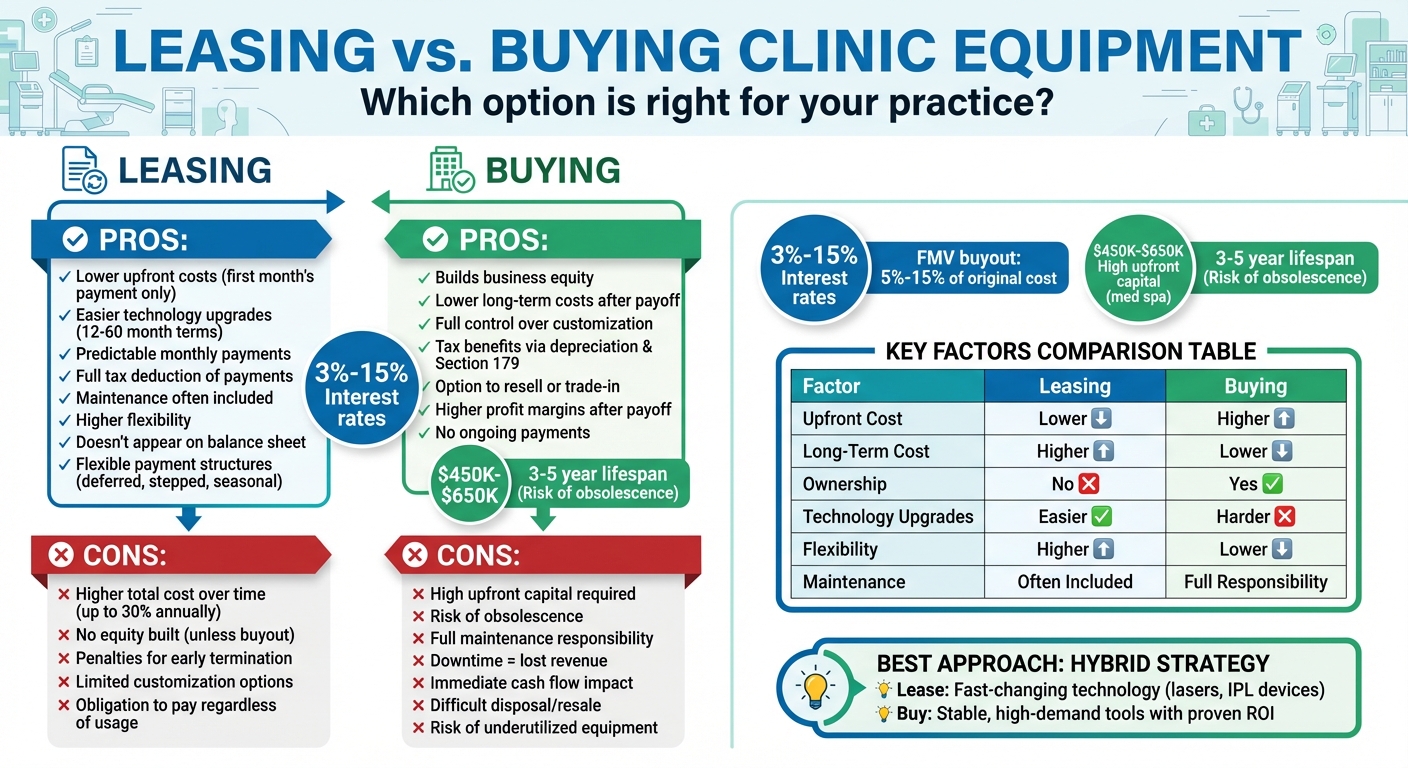
Leasing vs Buying Medical Equipment: Complete Comparison Guide
Leasing Medical Equipment: Pros and Cons
Benefits of Leasing
Leasing medical equipment can help reduce upfront expenses, as it typically requires just the first month's payment to get started. This can free up funds for other critical needs like hiring staff, marketing, or setting up your space. To put it into perspective, opening a med spa can cost anywhere from $450,000 to $650,000.
Leasing keeps you current with technology. Equipment like lasers and IPL devices can quickly become outdated as advancements in the field continue to accelerate. Leasing allows you to upgrade to newer technology once your lease ends, avoiding the risk of owning equipment that no longer meets industry standards. As MedSpaFinancing.com explains:
Leasing removes the risk of your getting caught with obsolete medical spa equipment because you can upgrade or add equipment to meet the growth of your med spa.
Another advantage is that operating leases are often fully tax-deductible, which can help reduce your taxable income. Plus, leasing can include additional expenses like delivery, installation, taxes, and staff training, simplifying your financial planning. Since operating leases usually don't appear as long-term liabilities on your balance sheet, they can make your practice look more financially appealing if you're considering selling it.
Flexible payment structures - such as deferred, stepped, or seasonal payments - can also improve cash flow. This flexibility is particularly helpful for new clinics where patient volume might be unpredictable in the early stages.
Drawbacks of Leasing
While leasing spreads out costs, the total expense can be higher in the long run. Monthly payments may seem manageable, but interest rates and finance fees can add up. Depending on your credit history, interest rates for medical equipment leases can range from 3% to 15%. In some cases, the annual lease cost may equal about 30% of the equipment's original purchase price.
You won't build equity unless you buy out the lease. At the end of the lease, you'll need to either return the equipment, pay a Fair Market Value (FMV) buyout - typically 5% to 15% of the original cost - or enter into a new lease agreement.
Lease agreements also tend to lack flexibility. Most contracts are medium-to-long-term and can be expensive or difficult to terminate early. You're locked into fixed monthly payments regardless of how often the equipment is used or changes in patient demand, which can create financial strain if your clinic's revenue fluctuates.
Customization may not be an option. Since you don't own the equipment, you might not be allowed to modify it to suit your specific needs. On top of that, managing lease agreements, renewals, and end-of-term logistics can add to your administrative workload.
Leasing Pros and Cons at a Glance
| Pros | Cons |
|---|---|
| Lower initial cash outlay and preserved capital | Higher total cost over the life of the equipment |
| Easier and more frequent technology upgrades | No equity or ownership rights (unless bought out) |
| Predictable monthly payments | Potential penalties for early termination |
| Payments are often fully tax-deductible | Limited ability to customize or modify equipment |
| Maintenance and training can often be bundled | Obligation to pay regardless of equipment usage |
sbb-itb-02f5876
Reading about the problem? See how Prospyr solves it in one platform.
Book a DemoBuying Medical Equipment: Pros and Cons
Benefits of Buying
Owning medical equipment outright provides long-term value by turning it into a business asset. This not only boosts your clinic's valuation but also builds equity, which can be used to secure loans or improve your financial standing if you decide to sell your practice.
Once the equipment is fully paid off, operating costs drop significantly, allowing each treatment to contribute directly to your profits. For example, high-end aesthetic laser systems may require an initial investment of tens of thousands of dollars, but over time, ownership often proves less expensive than leasing.
Ownership also gives you full control. You can customize, maintain, and use the equipment to fit your clinic’s specific needs. Additionally, purchased equipment qualifies for depreciation, which can offer tax benefits over time. When it's time to upgrade, you can sell or trade in the equipment, helping to recover part of your original investment.
However, these benefits come with their own set of challenges.
Drawbacks of Buying
The biggest hurdle is the high upfront cost, which can strain cash flow, especially for newer clinics. On top of that, rapid advancements in medical technology can make your investment obsolete sooner than expected.
Technology in the aesthetics industry evolves quickly. Most medical equipment has an economic lifespan of just three to five years. Dr. Willis from Indiana University School of Medicine highlights this issue:
If colonoscopy replaces flexible sigmoidoscopy as the procedure of choice for colon cancer screening, purchasing sigmoidoscopy equipment would not be a good investment.
This same logic applies to aesthetic devices - if trends shift or newer technology emerges, you might be left with equipment that no longer meets industry standards.
Ownership also means taking full responsibility for maintenance, repairs, and downtime. As CME Corp Staff explains, "Downtime is one of the biggest hidden costs in healthcare. A broken scanner means lost revenue and delayed patient diagnoses". Beyond the purchase price, you’ll need to budget for consumables, energy costs, repairs, and even facility upgrades like specialized wiring or HVAC systems.
Finally, reselling or disposing of outdated equipment can be a slow process, often yielding little financial return.
Buying Pros and Cons at a Glance
| Pros | Cons |
|---|---|
| Builds business equity through ownership | Requires significant upfront capital |
| Lower long-term costs after payoff | Risk of rapid technological obsolescence |
| Full control over customization and usage | Responsibility for maintenance and repairs |
| Option to resell or trade-in equipment | Disposal or resale can be challenging |
| Tax benefits via depreciation | Immediate cash flow impact |
| Higher profit margins after payoff | Risk of underutilized equipment ("shelf-ware") |
What to Consider When Choosing
Your Financial Situation
Take a close look at your cash flow. For clinics just starting out or planning to expand, leasing can be a smart way to conserve capital for critical expenses like payroll, marketing, or inventory. Instead of locking up $450,000–$650,000 in equipment, leasing allows you to keep funds available for other priorities.
On the other hand, buying equipment makes sense if you have strong cash reserves and want to avoid ongoing payments. Once the equipment is fully paid off, every treatment you perform directly adds to your profit. But if a large upfront purchase could leave you financially stretched, leasing offers a safer alternative. Many medical spas manage to break even within six months, and flexible leasing options - such as deferred payments for 90 days to six months - can help you navigate cash flow during that critical early period. Your financial situation will be a key factor in deciding between leasing and buying.
Technology Upgrade Frequency
Financial considerations aside, staying technologically relevant is crucial in the fast-moving aesthetics industry. Equipment like lasers, IPL machines, and microdermabrasion tools can become outdated quickly. According to Aesthetic Medicine News, leasing is often the better option for assets that lose value rapidly.
Leasing shifts the risk of obsolescence to the lessor. At the end of a lease term - usually 12 to 60 months - you can upgrade to the latest technology instead of being stuck with older equipment. For example, the Harvard Center for Biological Imaging adopted a 2–3 year refresh cycle for leased microscopes, which helped them grow their user base from fewer than 200 to over 700 individuals annually between May 2010 and June 2020. If staying ahead in offering cutting-edge treatments is a priority for your clinic, leasing can help you stay competitive without the financial burden of owning outdated equipment.
Growth and Expansion Plans
Your growth strategy also plays a big role in the decision. Think about your clinic’s expansion timeline. Leasing is a great way to lower upfront costs when exploring new treatment options, and it keeps leases off your balance sheet. This flexibility is especially helpful when testing out new modalities. On the other hand, purchasing equipment works well for stable practices focused on building equity. A balanced approach - leasing newer, unproven technology and buying reliable, established systems - can help you grow while managing risk and maximizing returns.
Tax and Compliance Factors
Tax implications are another important consideration. Lease payments are fully deductible, while purchased equipment qualifies for depreciation, including Section 179 benefits. Additionally, operating leases don’t show up as liabilities on your balance sheet, unlike capital leases. Fair market value (FMV) buyouts typically range from 5% to 15% of the equipment’s cost. To make the most informed decision, consult with your tax advisor to ensure your choice aligns with your financial strategy and compliance requirements.
How to Choose the Right Option for Your Clinic
Calculate Total Costs
Understanding the full lifecycle costs is key when deciding between purchasing or leasing equipment. Buying equipment outright uses after-tax dollars, which means you’ll need to earn more pre-tax income to cover the expense. For example, a $100,000 laser system might seem straightforward, but the actual cost is higher when factoring in taxes. On the other hand, leasing allows you to use pre-tax dollars and often bundles additional expenses - like delivery, installation, taxes, and training - into a single monthly payment. For instance, a $100,000 laser leased at $2,500 per month over 48 months, plus a Fair Market Value (FMV) buyout of $5,000 to $15,000, may end up costing more than buying outright. However, purchasing ties up capital that could be invested in other areas, such as marketing, hiring, or expanding your services.
It’s essential to compare these costs and align them with your clinic’s broader financial and strategic goals.
Align Equipment Decisions with Your Goals
Your equipment choices should reflect your clinic’s long-term objectives. Leasing is often a better fit for assets that depreciate quickly, while purchasing makes sense for items that retain their value over time. If selling your clinic is part of your future plans, operating leases can be particularly advantageous. They don’t show up as long-term liabilities on your balance sheet, which can improve your liquidity ratios and make your financials more appealing to potential buyers.
Using financial tools can further streamline these decisions and help you stay on track.
Using Prospyr for Financial Planning
Once you’ve chosen between leasing and buying, tools like Prospyr can help you monitor your equipment’s performance and ensure it’s generating sufficient revenue. For instance, if you’re leasing a laser for $3,000 per month, Prospyr’s real-time analytics can confirm whether your treatments are covering the lease costs. By integrating payment processing, financial tracking, patient scheduling, and membership management, Prospyr gives you a complete view of your clinic’s operations. This insight helps you decide whether to upgrade leased equipment, purchase it outright at the lease’s end, or allocate your capital toward other growth opportunities.
Conclusion
Key Points Recap
Leasing offers the advantage of preserving working capital, predictable monthly payments, and the flexibility to upgrade rapidly depreciating equipment. On the other hand, buying equipment builds equity, reduces long-term expenses, and provides full control over maintenance. An added benefit of operating leases is that they don't appear on your balance sheet, which can improve liquidity ratios - especially useful if you're planning to sell your clinic.
Tax benefits differ as well. Purchased equipment qualifies for depreciation deductions and Section 179 provisions. Many successful clinics adopt a hybrid approach - leasing cutting-edge, newer technologies to remain competitive while purchasing core, reliable systems that consistently generate revenue. This approach strikes a balance between staying innovative and building long-term assets.
These considerations serve as the foundation for making an informed decision.
Next Steps
Here’s how to put these insights into action. Start by assessing your clinic’s financial situation and growth objectives. If you’re a startup or an expanding practice, leasing can help manage cash flow during the critical early stages. For established clinics with steady revenue, buying high-demand equipment may provide better long-term returns.
Align your decision with your clinic’s overall strategy and operational needs. Consider the technology lifecycle - lease equipment likely to depreciate rapidly and purchase systems with stable, proven technology. Also, calculate the total cost of ownership for both options. Keep in mind factors like lease buyouts (usually 5% to 15% of the original cost), ongoing maintenance responsibilities, and the opportunity cost of tying up capital.
Lastly, consult a tax advisor to determine whether an operating lease or capital lease aligns better with your tax planning. Tools like Prospyr can help monitor equipment performance, ensuring that your investments - whether leased or purchased - deliver the revenue needed to support your clinic’s growth and profitability.
FAQs
When does buying cost less than leasing?
When owning equipment, the overall expenses tend to be lower in the long run compared to leasing. This is especially true if the equipment is used for many years without needing frequent upgrades. By spreading the initial purchase cost over time, ownership becomes more economical. It's also a better option when the equipment is durable and the business has enough funds to avoid the recurring costs of lease payments.
Which devices should I lease vs. buy?
When weighing the choice between leasing or buying equipment, think about factors like how long the equipment will last, how quickly it loses value, and how often it needs updates.
For items like lasers, IPL machines, and cellulite reduction tools - devices that tend to lose value quickly and require frequent upgrades - it’s often better to lease. Leasing allows you to stay current with the latest technology without a hefty upfront investment.
On the other hand, equipment with a longer lifespan and minimal depreciation can be a smarter choice to buy, especially if you plan to use it extensively over time. Buying provides long-term value and eliminates the recurring costs associated with leasing.
What should I watch for in a lease contract?
When you're going over a lease contract for clinic equipment, it's crucial to pay attention to the details that could impact your practice. Start by examining the end-of-term options - can you purchase the equipment, or return it without penalties? Look into who handles maintenance responsibilities and whether there are early termination fees that could catch you off guard.
Don't forget to review the payment terms, including any buyout options, as well as the insurance requirements outlined in the agreement. Taking the time to carefully evaluate these elements can help you steer clear of unexpected expenses and ensure the lease fits both your clinic’s budget and operational goals.