5 Legal Steps for Terminating Staff in Clinics
Five legal steps to terminate clinic staff: review contracts, document issues, hold a meeting, issue final pay, revoke access.


Terminating an employee in a clinic requires careful legal steps to avoid lawsuits and compliance issues. Here’s a quick guide to protect your practice:
- Review Contracts and Policies: Check employment contracts, handbooks, and legal requirements to ensure the termination process aligns with federal and state laws.
- Document Performance Issues: Keep detailed records of incidents, warnings, and corrective actions to justify the termination.
- Conduct a Termination Meeting: Hold a private meeting with a witness present, using clear communication and providing necessary documents like termination letters.
- Handle Final Pay and Benefits: Issue the final paycheck promptly, including earned wages and unused PTO, while complying with state laws.
- Secure Clinic Assets: Recover keys, IDs, and equipment, and revoke digital access to protect sensitive data.
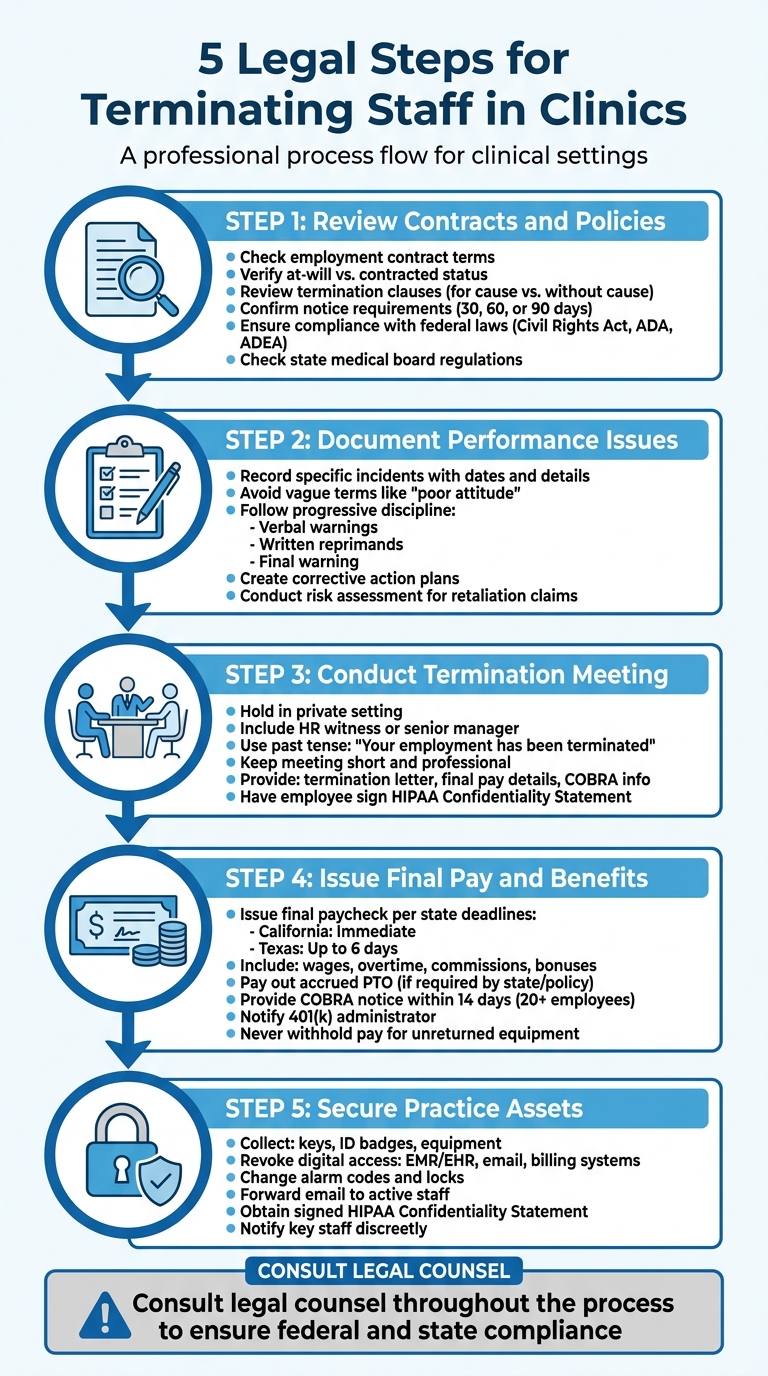
5 Legal Steps for Terminating Clinic Staff Infographic
1. Review Employment Contract and Policies
Before moving forward with terminating an employee, take the time to thoroughly review their employment contract and status. In the U.S., most clinic employees work under "at-will" arrangements, which means they can be let go for any lawful reason. However, if the employee has a signed employment contract, that agreement could impose specific conditions that override the standard at-will terms. As Scope Talent explains:
If the clinician is working under a contract, the terms of that contract may dictate the conditions under which termination is permissible.
Pay close attention to clauses that distinguish between "termination for cause" and "termination without cause." For-cause terminations often involve issues like misconduct or clinical incompetence, while without-cause terminations may require advance notice - commonly 30, 60, or 90 days. Some contracts also outline progressive discipline steps, such as verbal warnings, written warnings, and final notices. Skipping these steps could leave your clinic vulnerable to wrongful termination claims.
Make sure the contract complies with federal anti-discrimination laws, such as the Civil Rights Act, ADA, and ADEA, to confirm the termination is lawful. Additionally, ensure the decision isn’t retaliatory - activities like filing for Workers' Compensation, whistleblowing, or serving on a jury are legally protected, even in at-will states. If the employee is a licensed clinician, check state medical board regulations, as terminations tied to clinical competence might require mandatory reporting to the licensing board.
Don’t forget to review your clinic’s employee handbook. Even if there’s no formal employment contract, the handbook could create an "implied contract" that restricts at-will rights. If the handbook outlines specific disciplinary steps, follow them to the letter.
Finally, consult with legal counsel to clarify your obligations regarding severance pay, unused vacation payouts, and post-termination confidentiality. This step ensures your clinic stays compliant with regulations and avoids unnecessary legal risks. Once you’ve confirmed the contractual and legal requirements, you can begin documenting performance issues and preparing to provide notice.
sbb-itb-02f5876
2. Document Performance Issues and Provide Notice
Once you've reviewed the employment contract, the next step is to carefully document every performance issue. According to the Practice Management Institute, this means recording the specifics: what actions were taken, what counseling was provided, and any corrective measures that were implemented. Keeping thorough records helps protect against wrongful termination claims.
Your documentation should include precise details like dates, locations, and the names of individuals involved in each incident. Avoid general terms such as "poor attitude" or "unprofessional behavior." Instead, focus on specific examples - missed patient appointments, violations of protocols, or conflicts with coworkers. For licensed clinicians, make sure to document any issues related to clinical competence, as these might need to be reported to your state medical board. Clear, factual records not only protect your clinic legally but also ensure transparency in addressing performance concerns.
Follow a progressive discipline process to handle these issues. Start with verbal warnings, then move to written reprimands, and finally, issue a last warning if necessary. Each step should include a corrective action plan that lays out clear goals for improvement, realistic deadlines, and the consequences of not meeting those expectations. This process shows that the employee was given a fair chance to address the problems before termination. Additionally, ensure you adhere to any notice requirements outlined in the employment contract.
In most states, at-will employment means no advance notice is required unless specified in the contract. However, Montana is an exception, requiring "good cause" for termination once an employee has completed their probationary period. If the contract or employee handbook promises a notice period - commonly 30, 60, or 90 days - you must honor that commitment.
Before proceeding, conduct a risk assessment to confirm the termination won't be interpreted as retaliatory. For example, check whether the employee recently filed for Workers' Compensation, took FMLA leave, or participated in other protected activities. Ensure your documentation aligns with anti-discrimination laws and the terms of the contract to minimize legal risks. With all records in order and notice requirements clarified, you can move forward with the termination meeting confidently.
Reading about the problem? See how Prospyr solves it in one platform.
Book a Demo3. Conduct a Termination Meeting with Witnesses
After completing your documentation and risk assessment, the next step is to plan and carry out the termination meeting. This meeting should always take place in a private setting, like a manager's or physician's office, to protect confidentiality and avoid unnecessary disruptions to your clinic's workflow.
Having a witness present is crucial. Ideally, this should be an HR representative, as they are trained to handle compliance and documentation. If your clinic doesn’t have an HR department, a senior manager or physician can step in as the witness. As Advanced Scope Talent emphasizes:
It is essential to have a witness present - usually a member of the HR department - to document the conversation and ensure fairness.
The role of the witness is to document the discussion, confirm that the process was respectful, and provide legal protection in case of a wrongful termination claim.
Preparation is key. Develop a straightforward script to keep the message clear and concise. Use past tense phrases like, "Your employment has been terminated," to convey finality. Stick to the facts and refer to the documented performance issues. Gino Benedetti, a trial lawyer and shareholder at Miller, Alfano & Raspanti, PC, advises:
Your tone should be firm but compassionate, and your message should clearly indicate that you have made your decision and it will not be changed.
Avoid using emotional language, assigning blame, or making personal comments. Keep the meeting short and professional. Be sure to have all necessary documents ready, such as the termination letter, final paycheck details, and COBRA information. For clinicians, it’s a good idea to have them sign a HIPAA Confidentiality Statement during the meeting to reinforce their ongoing responsibility to protect patient information. Allow the employee a brief, professional response, but keep the discussion from turning into a debate.
4. Issue Final Pay and Handle Benefits
Once the termination meeting is over, it’s time to handle compensation and benefits quickly to stay compliant with the law. Start with the final paycheck. Under the Fair Labor Standards Act, you must issue this by the next regular payday, but state laws can set stricter deadlines. For example, California requires immediate payment, while Texas allows up to six calendar days. The timeline can also depend on whether the employee was fired or resigned, so check your state’s laws for specifics.
The final paycheck should include all wages earned through the last day of work, such as overtime, commissions, and bonuses. Accrued vacation or PTO must also be paid out if required by state law or your clinic’s written policy. In states like California and Colorado, accrued vacation is treated as earned wages and must be paid regardless of your policy. Natalie Soltero, SHRM-CP at Stratus HR, emphasizes:
Without a written policy, courts may interpret vacation or PTO as earned wages, potentially requiring payout even if you didn't intend to.
Take a moment to review your employee handbook to ensure your PTO policy is clearly defined.
If your clinic has 20 or more employees, you’ll need to provide COBRA continuation details. The plan administrator must send an election notice within 14 days, and the former employee has 60 days to decide whether to opt in. For smaller clinics, check your state’s "mini-COBRA" laws to see what applies.
For retirement plans, notify your third-party administrator immediately. They’ll need to send out notices about distribution rights and rollover options. Foley & Lardner LLP highlights this as a key step:
The most critical action item for HR professionals when an employee is terminated is to promptly notify the 401(k) plan's third-party administrator of the termination.
Vested balances should be made available for distribution or rollover, no matter the reason for termination. If the employee has an outstanding 401(k) loan, explain repayment options and what happens if they default.
One critical point: do not withhold the final paycheck to recover unreturned equipment or uniforms. In California, failing to pay final wages on time can lead to waiting-time penalties - one day’s wages for each day of delay, up to 30 days. Handle equipment recovery separately, following your termination checklist. This process is easier if you use inventory management software to track clinic assets assigned to each staff member.
5. Provide Termination Letter and Secure Practice Assets
This final step ensures your clinic is legally protected and its assets remain secure.
The termination letter serves as official documentation of the decision, outlining final compensation and benefits. According to Advanced Scope Talent:
Ensure that all financial obligations to the clinician are met, including severance pay (if applicable), unused vacation days, and any other contractual benefits.
Before issuing the letter, review it with your HR team and legal counsel to ensure it aligns with performance records and complies with labor laws.
Once the termination letter is complete, shift your attention to securing clinic assets. Use a termination checklist to collect all clinic property, such as keys, ID badges, and equipment. The Practice Management Institute highlights:
This checklist ensures that the employee can no longer access practice property and reduces the risk of retaliation.
Digital security is equally critical. Immediately revoke the employee's access to electronic systems, including EMR/EHR, billing platforms, email accounts, and communication tools. If your clinic uses a platform like Prospyr, update user permissions to disable their credentials across all integrated systems. Forward their email to an active staff member to manage any incoming patient or vendor communications.
Physical security measures should also be updated. Change alarm codes and locks if the employee had after-hours access. During the exit process, have the employee sign a HIPAA Confidentiality Statement to reinforce their ongoing responsibility to safeguard patient information. Lastly, notify key staff members discreetly to maintain confidentiality while ensuring smooth patient care operations.
Conclusion
Letting staff go in aesthetics and wellness clinics requires careful attention to legal and professional protocols. Following the five outlined steps - reviewing employment contracts, documenting performance issues, conducting termination meetings with witnesses, handling final pay and benefits, and securing practice assets - is essential for protecting your clinic from potential lawsuits and legal risks. As the Practice Management Institute advises:
Knowing your legal responsibilities and rights will ensure you avoid a lawsuit and penalties. Above all, make sure your process follows Federal and State guidelines for proper termination.
These actions not only help your clinic stay legally compliant but also maintain operational stability. Keeping detailed documentation is key to defending against wrongful termination claims. A well-organized record of performance issues and corrective actions can demonstrate that the termination decision was based on legitimate reasons, not on unlawful grounds like discrimination or retaliation.
In addition to legal safeguards, a secure exit process ensures that your clinic continues running smoothly while protecting sensitive patient data. Quickly securing both digital and physical assets - such as updating user permissions through tools like Prospyr - helps maintain compliance with HIPAA and other regulations.
The process doesn’t end with the termination meeting. Ensuring all paperwork is finalized, providing COBRA information, and obtaining a signed HIPAA Confidentiality Statement from the departing employee are crucial final steps. Consulting legal counsel throughout the process ensures your clinic meets both federal and state requirements, minimizing risks of penalties or lawsuits. By following these measures, your clinic can navigate terminations effectively while adhering to industry and legal standards.
FAQs
What counts as wrongful termination in a clinic?
Wrongful termination in a clinic happens when an employee is let go in a way that violates federal or state laws. This could involve firing someone due to discrimination, retaliation, breaching an employment contract, or not adhering to the required legal procedures and documentation. Clinics must follow these laws carefully to minimize the risk of legal trouble.
Do I have to report a clinician termination to the medical board?
Whether you need to report a clinician's termination to the medical board depends on the rules in your state. For instance, states like California require licensed physicians to inform the board about changes in their employment. To stay compliant and avoid penalties, check with your state’s medical board or regulatory authority to see if reporting is required in your area.
What should I do if the employee won’t return keys or devices?
If an employee doesn't return keys or devices, it's crucial to keep detailed records of every interaction and attempt to recover the items. Start by sending a formal written request for their return. If they still fail to comply, you may need to take steps like changing locks or disabling digital access to safeguard your clinic's security. Tools like Prospyr can assist by managing updates and notifications throughout this process, helping you maintain proper documentation and clear communication.