Medical Waste Disposal Rules for Med Spas
Med spa guide to safe disposal of sharps, biohazardous and pharmaceutical waste — covers segregation, staff training, documentation, and state/federal compliance.
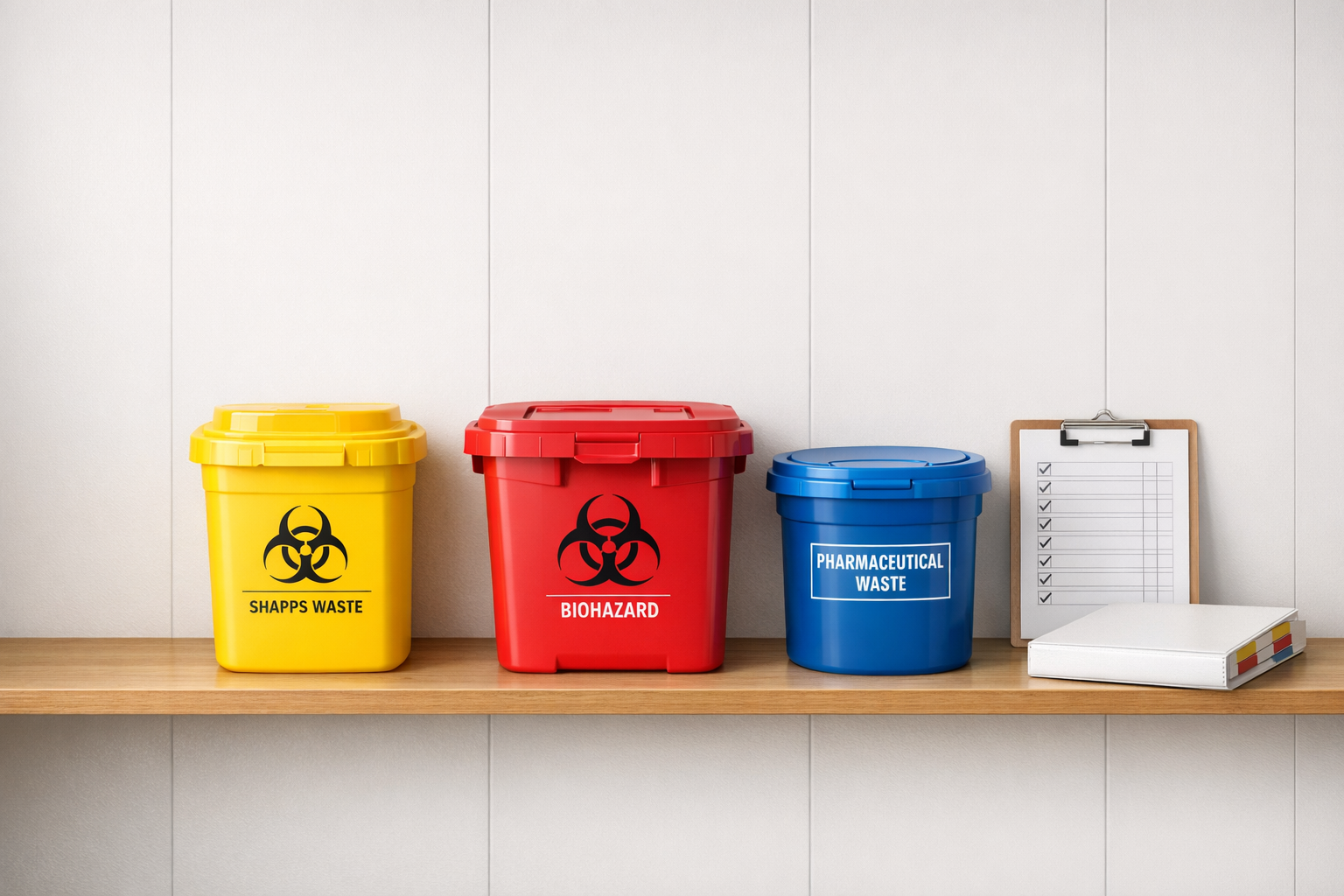

Med spas generate regulated medical waste, including sharps, biohazardous materials, and pharmaceutical waste, requiring strict disposal protocols to ensure safety and compliance. Mishandling waste can lead to sharp injuries, environmental harm, and hefty fines - up to $75,000 per violation or $25,000 per day. Compliance involves proper waste segregation, staff training, and meticulous documentation under federal and state regulations. Here's what you need to know:
- Types of Waste: Sharps (needles, syringes), biohazardous (blood-soaked materials), pharmaceuticals (expired or unused medications), and pathological (human tissue).
- Key Regulations: OSHA mandates sharps containers; EPA oversees hazardous waste; DOT regulates safe transport.
- Cradle-to-Grave Rule: Med spas are accountable for waste from creation to destruction, even after vendor collection.
- Fines and Risks: Non-compliance penalties and sharps injuries can cost businesses thousands annually.
- Tips for Compliance:
- Use puncture-resistant sharps containers and biohazard bags as part of your inventory management protocols.
- Train staff annually on waste handling and safety.
- Maintain records (manifests, training logs) for at least 3 years.
- Partner with licensed waste disposal services.
Types of Medical Waste in Med Spas
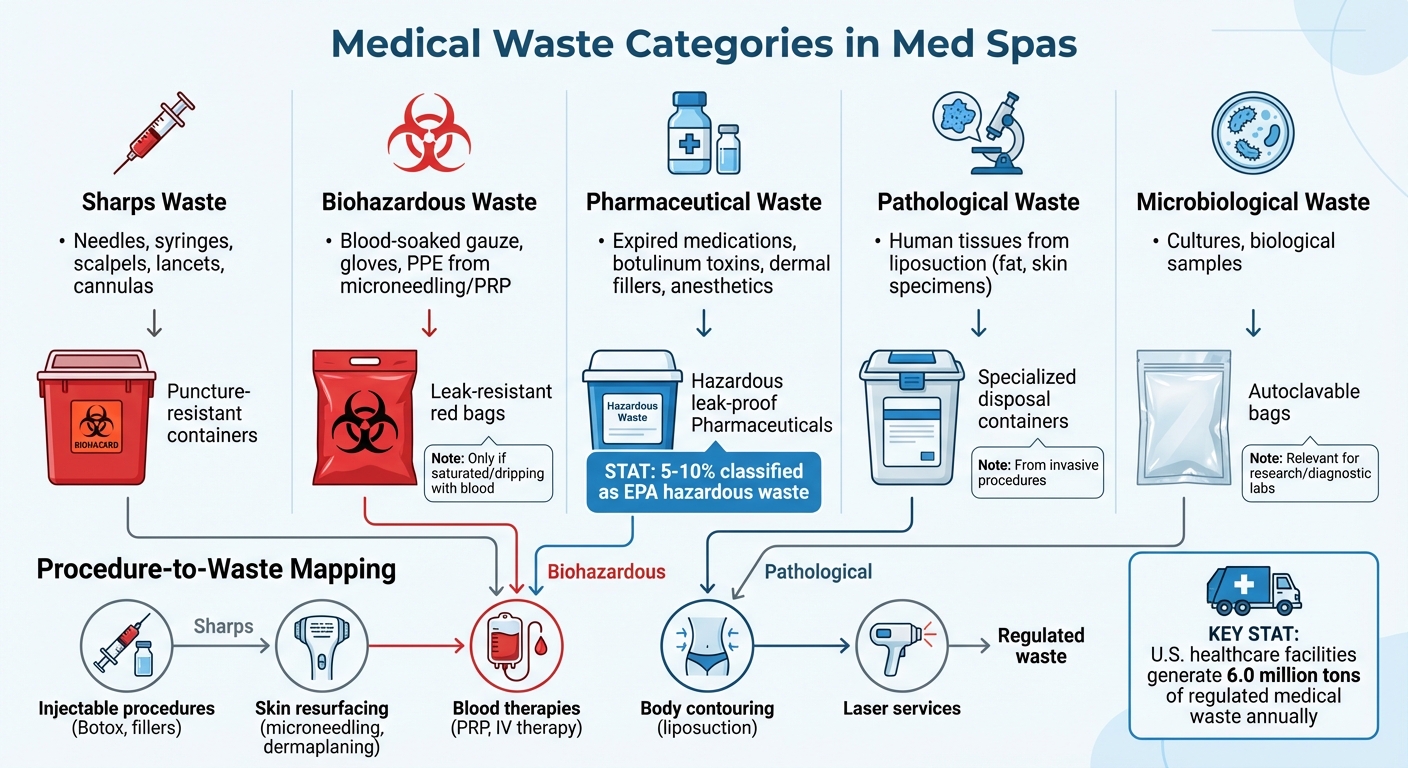
5 Types of Medical Waste in Med Spas and Disposal Requirements
Common Medical Waste Categories
Med spas produce five key types of regulated medical waste, each requiring specific disposal methods. Sharps waste includes items like needles, syringes, scalpels, lancets, and cannulas. These must be disposed of in puncture-resistant containers to prevent injuries.
Biohazardous waste covers blood-soaked materials such as gauze, gloves, and PPE used in procedures like microneedling or PRP treatments. Pharmaceutical waste includes expired, unused, or partially used medications and vials - examples being botulinum toxins, dermal fillers, and anesthetics. Interestingly, 5% to 10% of pharmaceutical waste falls under the EPA's "hazardous waste" category.
Pathological waste refers to human tissues or specimens from invasive procedures, such as fat or skin removed during liposuction. Lastly, microbiological waste involves cultures or biological samples, which are more relevant if your facility has a research or diagnostic lab component.
Properly identifying these waste types is essential for regulatory compliance and maintaining a safe environment for staff and clients. The type of waste generated often depends on the specific aesthetic procedures performed.
Waste from Aesthetic Procedures
Different aesthetic treatments produce varying types of medical waste. Injectable procedures - like Botox, dermal fillers, sclerotherapy, and vitamin injections - create both sharps and pharmaceutical waste. Skin resurfacing treatments, including microneedling, dermabrasion, dermaplaning, and chemical peels, generate biohazardous materials like blood-contaminated gauze, cotton swabs, and gloves.
Blood-based therapies, such as PRP treatments (commonly called vampire facelifts) and IV therapy, result in significant biohazardous waste due to handling blood specimens. Body contouring treatments, like liposuction and CoolSculpting, produce pathological waste that demands specialized disposal. Even laser services, such as hair removal and vein therapy, contribute to regulated waste.
"Aesthetic procedures may be elective, but medical waste compliance is not." - Biosafe
Improper sorting of waste can drive up disposal costs. Setting up sharps containers and biohazard bags right where procedures take place ensures waste is categorized correctly from the start. Understanding these distinctions is a crucial step toward creating an effective waste management plan, which is discussed further in this guide.
sbb-itb-02f5876
Federal and State Regulations
Federal Requirements
Med spas operate under a detailed federal framework aimed at protecting public health and ensuring safe handling of medical waste. Several federal agencies play a role in setting these standards. For example, the Occupational Safety and Health Administration (OSHA) requires med spas to use puncture-resistant sharps containers at the point of use and leak-resistant biohazard bags for contaminated materials to prevent accidents and contamination risks. The Environmental Protection Agency (EPA) oversees the Resource Conservation and Recovery Act (RCRA), which establishes protocols for managing solid waste, including certain medical waste. Additionally, the Department of Transportation (DOT) regulates the proper packaging, labeling, and transportation of medical waste to ensure safe transit. Meanwhile, the Centers for Disease Control and Prevention (CDC) offers guidelines focused on environmental infection control and sharps safety to minimize health risks.
It’s worth noting that the federal Medical Waste Tracking Act, which once centralized medical waste regulation, expired in 1991. Since then, oversight has shifted primarily to individual states. As the EPA explains:
"Medical waste is primarily regulated by state environmental and health departments. EPA has not had authority, specifically for medical waste, since the Medical Waste Tracking Act (MWTA) of 1988 expired in 1991".
While federal agencies set foundational rules, state and local governments often impose stricter requirements, as detailed below.
State and Local Guidelines
State regulations for medical waste management can vary widely, often exceeding federal standards. For instance, what one state classifies as regulated medical waste might be treated as general trash in another. These differences extend to storage timeframes, treatment methods, and documentation requirements. Some states might mandate weekly waste pickups, while others allow up to 90 days for small waste generators.
Given this variability, med spas should contact their state’s environmental protection agency and health department to understand their specific obligations. States frequently enforce stricter rules than those outlined by federal agencies, and non-compliance can lead to hefty fines - up to $75,000 per violation or $25,000 per day at the federal level. Staying informed about state-specific mandates is essential for maintaining compliance and ensuring safe operations.
Reading about the problem? See how Prospyr solves it in one platform.
Book a DemoMedical Waste Management Procedures
Sharps Disposal
Proper handling of sharps starts the moment they are used. Never attempt to recap, bend, or break needles by hand. Instead, place them directly into an FDA-cleared, puncture-resistant container right after use. These containers must be rigid, leak-proof, and clearly marked with the universal biohazard symbol for safety.
Position sharps containers at eye level and within easy reach to minimize the risk of handling exposed needles. Avoid placing them in areas where they could be easily tipped over, such as near doors, light switches, or under sinks. Keep an eye on the fill level - containers should be sealed and removed when they reach three-fourths full. Overfilling or compressing waste inside the container is dangerous. The FDA advises:
"To prevent injury to health care personnel, do not open, empty, or manually clean full sharps disposal containers."
Once sealed, store these containers in a designated, well-ventilated area that is off-limits to the public and pests. Arrange for collection by a licensed medical waste service or consider a mail-back program like SafeDrop™ for smaller waste volumes. This approach is especially useful for med spas with limited waste output. Additionally, it’s crucial to maintain strict protocols for pharmaceutical waste management.
Pharmaceutical Waste Disposal
Pharmaceutical waste, including expired Botox, unused injectables, and topical anesthetics, requires careful handling. To determine if a pharmaceutical is hazardous, check its characteristics - such as ignitability or reactivity - or verify if it’s listed by the EPA. If classified as hazardous, notify your EPA Regional Administrator by submitting Site Identification Form 8700-12 to comply with Subpart P regulations.
Use leak-proof containers designed for medication storage and secure them to prevent unauthorized access. Each container should be labeled clearly as "Hazardous Waste Pharmaceuticals." Flushing these medications down sinks or toilets is strictly prohibited, and healthcare facilities cannot use consumer take-back programs or mail-back envelopes for disposal.
Hazardous pharmaceutical waste can be stored on-site for up to one year. To track this, mark containers with the date the medication became waste, maintain an inventory, or designate a specific accumulation area with a clear date. Retain copies of waste manifests for at least three years from the date the waste is handed over to the transporter.
Biohazardous Waste Handling
Biohazardous waste requires immediate segregation at the point of generation to prevent mixing it with general trash. Use sturdy, leak-resistant red bags marked with the universal biohazard symbol for containment. The CDC states:
"A single, leak-resistant biohazard bag is usually adequate for containment of regulated medical wastes, provided the bag is sturdy and the waste can be discarded without contaminating the bag's exterior."
If a bag is punctured or its exterior is contaminated, double-bagging is necessary to ensure safe containment.
Only waste that is saturated or dripping with blood qualifies as biohazardous. According to OSHA, materials with minor blood spots are generally classified as general waste. Misclassifying waste can significantly increase disposal costs, especially given that U.S. healthcare facilities generate about 6.0 million tons of regulated medical waste annually.
Store biohazardous waste in well-ventilated, clearly labeled areas that are inaccessible to pests. Be mindful of state-specific storage limits - for instance, California allows a maximum of 7 days for certain generators, while other states permit up to 30 days. For smaller clinics with 1–5 providers, disposal services typically cost between $100 and $200 per month for weekly or bi-weekly pickups, which generally include sharps containers and red biohazard bags.
Documentation and Staff Training
Required Documentation
Using digital intake to keep accurate records isn’t just a good habit - it’s a legal safeguard. Proper documentation protects your med spa from penalties and demonstrates compliance with federal and state regulations. Federally, medical waste records must be kept for at least three years, though some states extend this timeframe. Training records, on the other hand, should be retained throughout an employee’s tenure and for three years after their departure.
You’ll need to maintain several key documents, including waste manifests, certificates of destruction, and a written waste management plan. This plan should outline segregation protocols, labeling, storage, and emergency procedures. It’s a good idea to review the plan annually, especially if new procedures or products are introduced to your facility. Additionally, keep copies of generator registrations, EPA identification numbers, and facility-specific permits readily available on-site. Before working with disposal services, verify transporter licenses and insurance certificates to avoid compliance issues.
Here’s a quick breakdown of essential documents and their retention requirements:
| Document Type | Required Information | Retention Period |
|---|---|---|
| Waste Manifests | Generator info, transporter details, waste type/quantity, destination | Minimum 3 years (varies by state) |
| Training Records | Employee names, dates, topics, trainer qualifications, test results | Employment duration + 3 years |
| Certificates of Destruction | Manifest number, treatment date, method, facility certification | Minimum 3 years |
| Waste Management Plan | Segregation protocols, labeling, storage, emergency response | Review/Update annually |
Ensuring staff are fully trained to follow these documentation protocols is just as crucial as maintaining the records themselves.
Employee Training Programs
Good documentation goes hand in hand with effective staff training. Both are essential for complying with medical waste regulations. Employees should receive initial and annual training on topics like waste segregation, labeling, safe sharps handling, and spill response. For those handling hazardous materials, DOT-specific training is required, with retraining every three years.
Training logs should capture all relevant details, including employee names, job titles, training dates, topics covered, trainer qualifications, and competency assessments. Assigning a compliance officer to oversee medical waste procedures can also help ensure everything runs smoothly.
Comprehensive training programs not only reduce compliance risks but also help prevent costly incidents. For example, sharps injuries alone cost the healthcare industry over $1 billion annually, with each case averaging $3,000 in investigation and treatment costs.
To reinforce training, develop clear standard operating procedures (SOPs). These should include step-by-step instructions for waste segregation, container handling, and equipment maintenance. Visual aids can make the material easier to understand, and requiring employee signatures ensures accountability. Regular internal audits are another effective way to identify documentation gaps and stay on top of compliance requirements.
Using Practice Management Software for Compliance
After establishing solid documentation practices and staff training protocols, incorporating technology can make managing compliance much easier.
Compliance Tracking with Prospyr
Relying on manual methods to track compliance can lead to costly mistakes. In 2026, fines for non-compliance could reach $75,000 per violation or $25,000 per day. To avoid these penalties, med spas need dependable tools to monitor documentation and training. This is where Prospyr's task management and analytics features come into play.
Prospyr's task management tools help schedule recurring audits and even automate reminders for waste pickups. This is especially critical for states like Florida and Illinois, which enforce a 30-day storage limit for biomedical waste. For instance, the countdown begins the moment a sharps container is sealed or the first non-sharps item is bagged. Missing this deadline could result in fines as high as $50,000 per day in Illinois.
The platform also includes an analytics dashboard that tracks staff training in real time, ensuring compliance with annual OSHA/EPA refresher requirements. During inspections, missing documentation - even if waste is managed safely - can lead to penalties. Prospyr simplifies this by centralizing all critical records, such as training logs, shipping manifests, certificates of destruction, and disposal logs, which must be retained for three to five years.
Med spas are held accountable under the cradle-to-grave rule, meaning they remain responsible for waste until it is fully destroyed - even when third-party vendors are involved. Prospyr stores key documents like operating plans and disposal records digitally, ensuring you have everything inspectors might request. This is particularly important in states like Florida, where 50,000 facilities generating biomedical waste face inspections every one to three years.
By digitizing these processes, Prospyr integrates compliance tracking with other essential administrative tasks.
Additional Prospyr Features
Prospyr offers more than just compliance tools. Its HIPAA-compliant platform streamlines various administrative tasks, allowing staff to prioritize patient care. Features like an integrated CRM and EMR system manage patient records efficiently, while digital intake forms and automated email/SMS communication reduce manual workload.
The platform also handles payment processing, scheduling, and membership management - including automated renewals - all from a single dashboard. These tools not only enhance operational efficiency but also ensure your team can focus on delivering exceptional patient experiences while meeting the rigorous documentation standards required for medical waste compliance.
Conclusion
Managing medical waste is about more than just following regulations - it's about safeguarding your staff, patients, and the reputation of your business. Under the cradle-to-grave rule, you're legally accountable for every piece of medical waste, from the moment it's generated to its final destruction. This means your responsibility doesn’t end when the waste hauler drives off.
The stakes are high, both financially and in terms of safety. Sharps injuries alone cost the healthcare industry over $1 billion each year, with each incident averaging $3,000 in investigation and treatment costs. Non-compliance penalties can be steep, with fines reaching up to $75,000 per violation or $25,000 per day. Beyond monetary risks, improper disposal endangers workers by exposing them to bloodborne pathogens like Hepatitis B, Hepatitis C, and HIV. It can also harm the environment - pharmaceutical waste that enters drains has the potential to contaminate water supplies.
The good news? Effective waste management is within reach. Start by properly segregating waste into sharps, biohazardous, and pharmaceutical categories. Provide annual training for your staff on handling procedures and OSHA standards, and keep detailed records for three to five years. These steps are the foundation of compliance and safety.
To make the process even smoother, modern technology can be a game-changer. For example, Prospyr's HIPAA-compliant platform simplifies compliance by centralizing documentation, automating reminders for critical 30-day storage limits (required in some states), and tracking staff training. By integrating compliance management with scheduling, patient care, and analytics, platforms like this allow you to stay focused on what truly matters: providing outstanding care while meeting every regulatory standard.
FAQs
What makes medical waste “regulated” in a med spa?
Medical waste in a med spa is considered "regulated" when it contains or has been contaminated by blood, body fluids, or other infectious materials. This category includes items like sharps, materials tainted with blood, and pharmaceutical waste. These must be managed and disposed of following strict safety protocols and compliance guidelines established by health and environmental agencies.
How do I know if a medication counts as hazardous pharmaceutical waste?
A medication falls under hazardous pharmaceutical waste if it appears on the EPA's hazardous waste lists (such as the P-List or U-List) or exhibits hazardous traits like being toxic, flammable, or corrosive. Additionally, it must no longer have a legitimate purpose, meaning it can't be used, reused, or reclaimed in any way. For a deeper understanding of what qualifies as hazardous waste, consult the EPA's guidelines.
What should I do if my state’s medical waste rules differ from federal guidance?
If the medical waste regulations in your state differ from federal guidelines, always follow your state-specific rules. State regulations take priority, and adhering to them not only helps you stay compliant but also ensures you're managing medical waste correctly according to local laws.