How Revenue Forecasting Drives Practice Growth
Learn how clinics use revenue forecasting to align staffing, marketing, and services, optimize profitability, and plan for growth.


Revenue forecasting is the process of predicting your clinic's future income based on historical data, sales trends, and market conditions. It’s essential for making informed decisions about staffing, marketing, and investments. Without accurate forecasts, practices risk overspending or missing opportunities for growth. Here’s why it matters:
- Operating costs are rising: Non-surgical clinics see expenses growing twice as fast as revenue. Forecasting helps manage resources efficiently.
- Improves profitability: Aligns patient demand with provider availability and identifies high-margin services.
- Supports strategic decisions: Guides hiring, equipment purchases, and marketing during peak seasons.
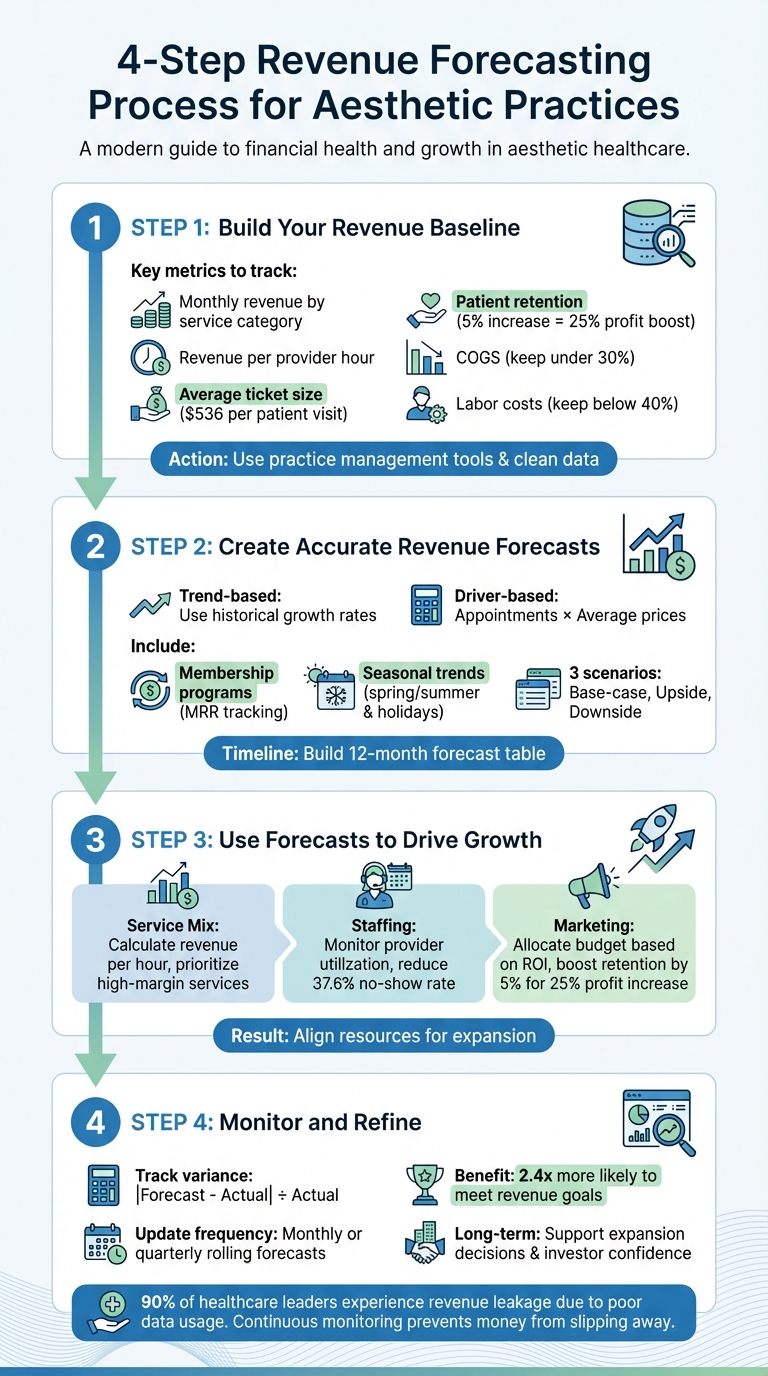
4-Step Revenue Forecasting Process for Aesthetic Practices
Step 1: Build Your Revenue Baseline
Understanding your practice's current performance is the first step toward growth. A revenue baseline gives you a clear picture of your financial trends by organizing historical data. This snapshot will guide decisions like staffing adjustments or investments in new equipment.
Identify Key Practice Metrics
Start by tracking the metrics that directly influence your bottom line. Break down your monthly revenue by service category - separating income into areas like injectables, laser treatments, facials, retail products, and memberships. This breakdown helps pinpoint which services are most profitable.
Next, calculate revenue per provider hour to evaluate performance. If there are gaps in productivity, it might signal the need for additional training or operational tweaks. Also, monitor your average ticket size - for reference, the average U.S. aesthetic practice sees about $536 per patient visit.
Keep an eye on patient retention. Boosting retention by just 5% can increase profits by 25%. Measure your repeat appointment rate - practices that track this metric tend to see higher repeat business. For membership programs, calculate churn rates and track Monthly Recurring Revenue (MRR) to identify inactive accounts.
Finally, establish your operational capacity baseline by calculating your "Maximum Potential." Multiply the revenue per hour for each service by the total number of staffed hours. For example, knowing the revenue per hour and available hours for a service helps estimate its potential weekly earnings. Also, keep tabs on Cost of Goods Sold (COGS), which should stay under 30% of revenue, and labor costs, which should remain below 40%.
Use Practice Management Tools
Manually tracking metrics across various systems can be time-consuming and error-prone. Practice management platforms simplify this by combining scheduling, payments, and analytics into one system, offering accurate data for forecasting.
Prospyr is one example, integrating CRM, EMR, scheduling, and payment processing into a HIPAA-compliant platform. It provides real-time analytics without needing to export data from multiple sources. Its built-in reporting tools eliminate manual errors and offer transaction-level details for every appointment, making trend analysis and baseline calculations much easier.
"Having access to all the information, transaction lists, and dashboards has helped us make critical business decisions throughout the quarters and years." – Bailey Ames, Co-Founder of Lash + Company
This level of insight changes how you view and manage your practice's financial health.
Clean and Organize Data
Raw data needs to be cleaned and standardized before it’s useful for forecasting. Train your front desk staff to use consistent revenue codes during intake and payment processing to avoid discrepancies. For instance, if one staff member logs "Botox", another writes "Botox Cosmetic", and a third uses "Injectable Treatment", your reports will fragment a single category.
Create a standardized system for naming and grouping services to match your business operations. A "dictionary" outlining how each service should be recorded - including SKU-level details for products - ensures consistency. If you offer injectables, tracking usage per unit instead of per syringe can help identify waste that eats into profits.
Reconcile your data with financial records. Audit membership billing monthly by comparing recorded member counts with actual bank deposits - failed payments or chargebacks can cost practices 2% to 4% of revenue. Compile a baseline summary sheet covering at least 12 months of data, broken down by month, to identify seasonal patterns and reliable trends.
This clean, organized dataset lays the groundwork for precise financial planning and sets the stage for creating accurate revenue forecasts in the next step.
sbb-itb-02f5876
Reading about the problem? See how Prospyr solves it in one platform.
Book a DemoStep 2: Create Accurate Revenue Forecasts
Once you've established your revenue baseline, the next step is to craft forecasts that guide decisions on hiring, marketing, and expanding services. To do this effectively, transform your historical data into projections that account for your practice's specific dynamics and market trends. Leveraging data-driven methods ensures these forecasts are as precise as possible.
Use Data-Driven Forecasting Techniques
For aesthetic practices, two forecasting methods stand out. Trend-based forecasting uses historical growth rates to project future revenue. For instance, if your practice has grown 15% annually, you might use this rate to estimate future growth. On the other hand, driver-based forecasting focuses on multiplying expected appointments by average service prices. For example, if you anticipate performing 80 laser treatments next month at $450 per session, your forecast for that category would be $36,000.
To get a clear picture, build a 12-month forecast table broken down by service category and month. Start with "Month Zero", which reflects your ending cash balance from the prior period, ensuring your cash flow projections are grounded in reality. Next, calculate revenue per hour for each service line (e.g., injectables, lasers, facials) and multiply it by the maximum number of staffed resource hours available. This provides a "maximum potential" revenue figure, showing the upper limit of what your practice can generate with current capacity.
Include Aesthetic-Specific Revenue Drivers
Incorporate factors unique to aesthetic practices into your forecasts. For instance, membership programs provide predictable income streams. Track metrics like Monthly Recurring Revenue (MRR), renewal rates, and churn to estimate this revenue accurately. When launching new services, apply probability-weighted projections. For example, if you're 70% confident a new body contouring service will generate $15,000 monthly, you might forecast $10,500.
Seasonal trends also play a significant role. Spring and summer, driven by wedding season, often see increased demand for skin rejuvenation services. Meanwhile, the holiday season typically brings spikes in anti-aging treatments and gift card purchases. Use time-series analysis to identify these patterns in your historical data and fine-tune your monthly projections. Additionally, patient retention programs can have a big impact - boosting retention by just 5% can increase profits by 25%.
Plan for Different Scenarios
Uncertainty is inevitable, so it's essential to complement your forecasts with scenario planning. Develop three scenarios: Base-case (most likely outcome), Upside (best-case scenario with high demand), and Downside (a conservative estimate). This approach helps you prepare for external factors like economic shifts or new competitors.
"Revenue forecasting is much more than laying down a target number. The forecasting process should help you evaluate the status of your business, assess your opportunities and risks, and map out the best strategies for your success." – Alex Chan, Content Strategist, Oracle
When planning your upside scenario, ensure it's realistic and doesn’t exceed your operational limits. For example, if you have two treatment rooms and three providers working 160 hours a month, your revenue is capped by those constraints. The downside scenario, meanwhile, can guide you in scaling back expenses if patient volume decreases. To stay agile, update these scenarios monthly with actual data, allowing you to adapt quickly to changing trends.
Step 3: Use Forecasts to Drive Growth
Once you’ve nailed down accurate revenue forecasts, it’s time to turn those insights into actionable strategies for growth. These forecasts serve as a roadmap for making smarter investments in services, staffing, and marketing, ultimately improving both profitability and efficiency. With the groundwork from the previous step in place, you can now focus on aligning your resources to fuel expansion.
Fine-Tune Your Service Mix for Profitability
Start by calculating the revenue per hour for each service category - whether it’s injectables, lasers, facials, or body contouring. Compare these figures against your direct costs (like labor and supplies) and indirect costs (such as marketing and overhead). This analysis helps you pinpoint which services are genuinely profitable, as opposed to those that merely drive high revenue without delivering solid margins.
For example, services like body contouring and laser resurfacing often yield higher profit margins compared to basic facials. Once you’ve identified these high-margin services, set clear revenue goals by factoring in your available resources, such as treatment room availability and provider schedules.
"The first thing you need to know to build your forecast is your revenue per hour per category of service in your practice." – Terri Ross, CEO, Terri Ross Consulting
Consider strategies like tiered pricing or bundled packages to further boost profitability. For instance, pairing laser treatments with pre- and post-care retail products not only increases transaction values but also enhances patient outcomes.
Plan Staffing and Maximize Operational Capacity
Your revenue forecasts can also highlight when you’re approaching capacity limits, signaling the need to hire more staff or adjust clinic hours. Start by monitoring provider utilization - the percentage of booked clinical hours compared to total available hours. If this ratio consistently runs high, it could mean missed revenue opportunities due to limited availability.
Tools like Prospyr can simplify capacity planning by offering real-time analytics on appointment volume, provider schedules, and task assignments. These platforms help reduce downtime between appointments and cut down no-show rates, which account for nearly 37.6% of missed patient appointments in healthcare clinics. Cross-training your team to handle multiple roles can also provide flexibility, allowing you to adapt to demand changes without immediately increasing headcount.
"Scheduling is the backbone of healthcare delivery, and having a smooth, intricate, and connected calendaring system is central to clinical care delivery." – Rohan Siddhanti, Healthie
With staffing aligned to meet forecasted demand, your next step is to focus on refining your marketing strategy.
Use Forecasts to Guide Marketing Investments
Forecasting helps you avoid overspending during slow periods and ensures you’re not underinvesting during peak times. By using scenario planning, you can create flexible marketing budgets that adjust based on performance.
For high-margin services identified in your forecast, allocate more marketing dollars to promote those specific offerings. If a service generates significantly higher revenue per hour, your advertising should focus on filling those higher-value appointments. Use tools like regression analysis to measure how effectively your marketing spend translates into revenue growth, helping you identify the channels with the best return on investment.
Balance your efforts between attracting new patients and retaining existing ones. Research shows that improving patient retention by just 5% can boost profits by 25%. Platforms like Prospyr can assist with this by automating segmented marketing campaigns based on treatment history. Features like "Client Reconnect" send personalized reminders to lapsed patients, encouraging them to rebook.
Membership programs can also play a key role in your marketing strategy. These programs create steady, recurring revenue, smoothing out cash flow during slower months while fostering long-term patient loyalty. Use forecast data to set competitive membership pricing and benefits, then promote these programs through automated email and SMS campaigns. Track performance metrics like monthly recurring revenue (MRR) and churn rates to fine-tune your approach over time.
Step 4: Monitor and Refine Your Revenue Forecasts
Once you've built detailed revenue forecasts and outlined your growth strategies, the next step is to keep a close eye on how things are playing out. Monitoring and refining your forecasts is a continuous process, and it’s crucial for keeping your practice on track. Studies reveal that 90% of healthcare leaders experience revenue leakage due to poor data usage - essentially, the gap between forecasted and actual performance often highlights where money is slipping away.
Track Forecast vs. Actual Performance
To measure how accurate your forecasts are, calculate the variance. Take the absolute difference between your forecasted and actual revenue, then divide it by the actual revenue. For example, if you projected $50,000 for January but brought in $45,000, the variance would be $5,000 ÷ $45,000, or about 11%. This gives you a clear picture of whether you're close to your target or way off.
But accuracy isn’t the whole story. You also need to check for bias - are you consistently overestimating or underestimating? To do this, calculate the average of (Actual – Forecast) over several months. If you’re always falling short, your goals might be too ambitious. If you’re constantly exceeding them, you could be underestimating your potential and missing opportunities.
"By surfacing the variances between gross revenue forecasts and actual results, you define revenue leakage points." – MD Clarity
When you spot discrepancies, dig deeper to understand the root causes. These could include unexpected market changes, underperforming marketing campaigns, or higher-than-expected cancellation rates. For instance, a healthcare provider in Connecticut used variance analysis to evaluate the risks of opening a new ambulatory care center. By comparing their financial plans with actual results, they identified and fixed operational issues before launch. The result? Revenue exceeded expectations, and expenses stayed within budget.
Update Forecasts Regularly
To stay ahead, adopt a rolling forecast that you update monthly or quarterly, keeping a constant 12-month outlook. For practices experiencing rapid growth or operating in unpredictable markets, weekly updates might be more effective.
Each update should factor in new data, shifts in demand, and market changes. For example, if you introduced a new laser treatment in March and it’s generating more revenue than expected, adjust your projections accordingly. Similarly, if a new competitor opens nearby and you notice a drop in patient consultations, reflect that shift in your forecasts.
Regularly revisiting scenario plans is also essential as new data becomes available. This is particularly important as 74% of healthcare executives plan to increase their investment in predictive modeling and analytics in the coming year.
Use Forecasts for Long-Term Planning
Revenue forecasting isn’t just about managing day-to-day operations - it’s a key tool for making big strategic decisions, like opening new locations, acquiring other practices, or investing in high-cost medical equipment. When you consistently meet your forecasts, it builds trust with investors and lenders, showcasing your practice’s financial stability.
Platforms like Prospyr can help with long-term planning by breaking down data silos between your CRM and EMR systems. With features like real-time reporting on appointment trends, service profitability, and patient lifetime value, Prospyr provides the insights you need to refine your forecasts continually. Armed with accurate, updated data, you can make smarter choices about where to allocate resources for the best growth opportunities.
For practices looking to expand or attract investment, having a track record of accurate forecasting tells a compelling financial story. It demonstrates that you understand your revenue drivers and can reliably predict performance - qualities that inspire confidence in partners and stakeholders. This kind of long-term focus ties seamlessly into earlier strategies for optimizing services and fine-tuning staffing.
Conclusion
Revenue forecasting goes beyond just crunching numbers - it’s the backbone of every strategic move your aesthetic practice makes. Without accurate forecasts, making decisions about hiring, marketing budgets, or clinic expansion becomes a guessing game. As Revenue Grid aptly states: "Accurate revenue forecasting serves as the foundation for virtually all strategic business decisions. Without a clear picture of future revenue, companies struggle to allocate resources effectively, plan for growth, or respond to market changes." This clarity lays the groundwork for smarter investments across your practice.
Research shows that businesses with dependable forecasting systems are 2.4 times more likely to meet their revenue goals. This means you can better manage inventory, schedule providers efficiently, and confidently invest in new technologies. When you have a clear view of what’s ahead, you’re positioned to act proactively instead of scrambling to react.
Modern tools like Prospyr make this process even easier. By integrating data from your CRM and EMR, tracking appointment trends in real time, and analyzing service profitability and patient lifetime value, platforms like this streamline forecasting. Automation reduces repetitive data entry and delivers timely insights, allowing you to fine-tune forecasts as conditions evolve.
Use your data and forecasts to drive focused growth strategies. Practices that treat forecasting as a continuous, adaptive process consistently achieve their goals and scale effectively. Regularly reviewing and updating your forecasts ensures they stay aligned with changing market dynamics.
With the right tools and mindset, revenue forecasting becomes a powerful growth engine. By embedding it into every decision, you create a roadmap for success. It unites your team around shared objectives, minimizes costly missteps, and equips you with the confidence to seize opportunities when they arise.
FAQs
How can revenue forecasting help non-surgical clinics grow?
Revenue forecasting gives non-surgical clinics a solid grasp of their future income, allowing them to craft precise budgets and plan for steady growth. By analyzing revenue trends, clinics can better allocate resources such as staffing, marketing expenses, and cash flow, ensuring smooth operations even when costs shift.
This forward-thinking method helps clinics sidestep unexpected financial hurdles, spot opportunities for expansion, and make well-informed choices to grow their practice while staying profitable.
What are the best data-driven techniques for forecasting revenue in aesthetic practices?
Accurate revenue forecasting is essential for aesthetic practices aiming to predict growth and make informed decisions. Leveraging data effectively can make all the difference. Here are some key techniques that drive better projections:
- Pipeline analysis: Break down the booking process into stages - like inquiries, consultations, and treatments - and assign probabilities to each. This helps estimate potential revenue based on realistic conversion rates, giving you a clear picture of what to expect.
- Cohort tracking: Group patients into categories such as new clients, those opting for add-on services, or recurring treatments. Analyzing revenue patterns within these groups can uncover growth opportunities and pinpoint areas needing improvement.
- Time-series forecasting: Use historical data and account for seasonal trends - like higher demand during holidays - to create projections that align with real-world patterns.
- AI-driven insights: Machine learning can analyze appointment trends, lead sources, and even external factors to provide highly precise predictions. Plus, it minimizes manual errors, saving time and effort.
Integrating these techniques into a practice management platform can simplify operations and ensure consistent revenue forecasting. For instance, Prospyr offers tools that automate data collection, apply predictive models, and deliver AI-powered insights tailored to aesthetic and wellness practices - all while staying HIPAA-compliant.
How can revenue forecasting help aesthetic clinics improve services and staffing?
Revenue forecasting plays a key role in helping aesthetic clinics understand which treatments bring in the most income. By examining projected earnings for each service, clinics can prioritize popular, high-margin treatments while rethinking pricing or bundling strategies for those that underperform. This way, the service menu better reflects patient preferences and boosts overall profitability.
It also helps clinics plan their staffing more effectively. By predicting revenue during busier periods, clinics can ensure they have the right number of providers and support staff on hand to maintain seamless operations and deliver top-notch patient care. Tools like Prospyr make this process easier by turning forecasts into actionable plans, helping clinics fine-tune both their services and workforce. This thoughtful planning not only supports steady growth but also improves the patient experience.