Temporary vs. Provisional Medical Licenses in California
Mixing up California temporary and PTL licenses risks supervision errors, scheduling mistakes, and regulatory trouble.
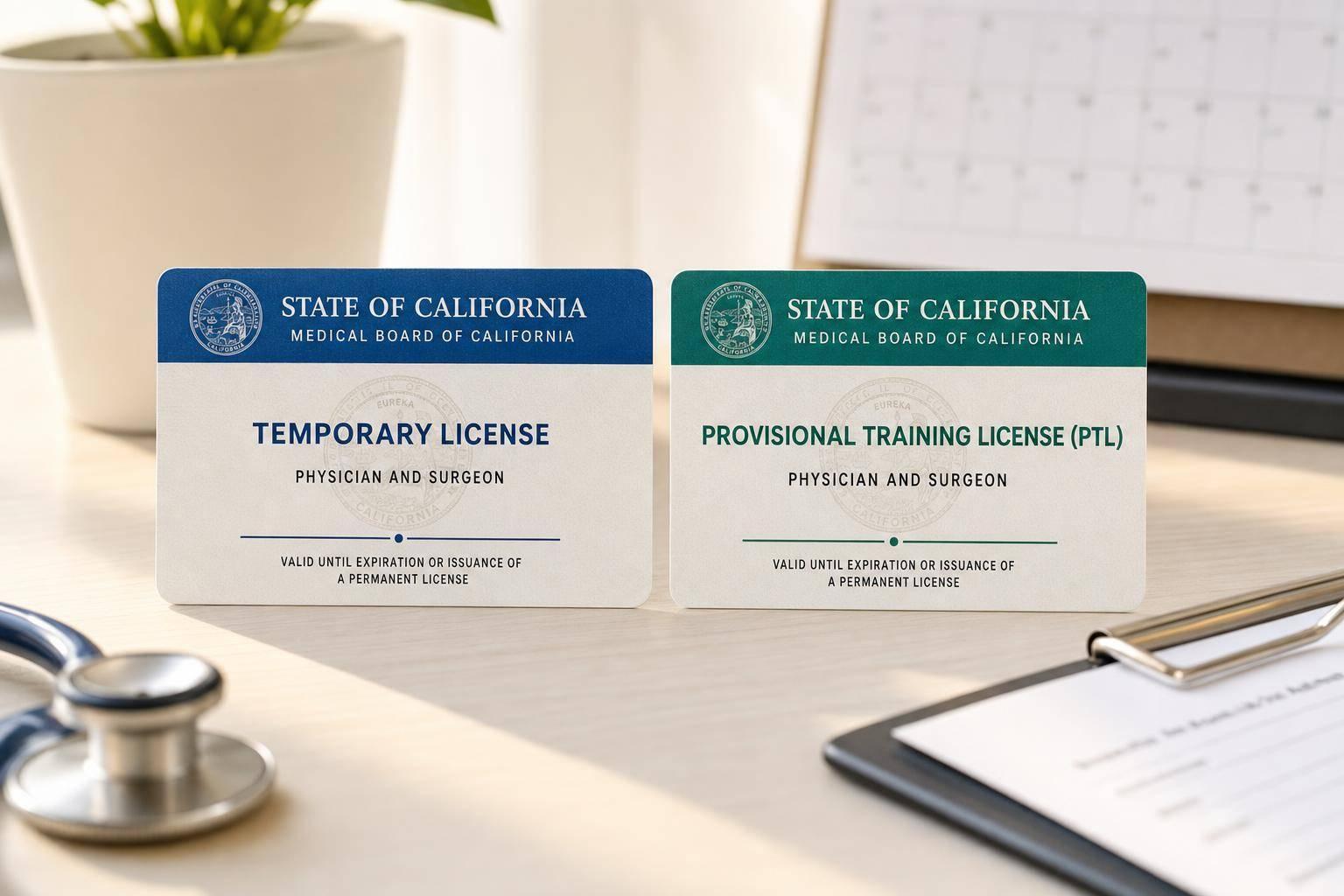

If you mix up a California temporary license and a PTL, you can mis-handle supervision, scheduling, and chart sign-off. The short version is simple: a temporary license is a short bridge for a narrow group of physicians and usually lasts up to 12 months. A Postgraduate Training License (PTL) is for residents and fellows only, must be issued within 180 days of training start, and lasts up to 36 months plus a 90-day window to move into full licensure.
Here’s what I’d keep top of mind:
- Temporary license: short-term practice authority, most often tied to the military-spouse route
- PTL: training-only license for supervised residency or fellowship
- Temporary license term: up to 12 months, no renewal
- PTL term: up to 36 months, no renewal, plus 90 days to apply for full licensure
- PTL setting: only inside a board-approved training program
- Clinic risk: wrong license setup can lead to bad delegation, expired privileges, and board trouble
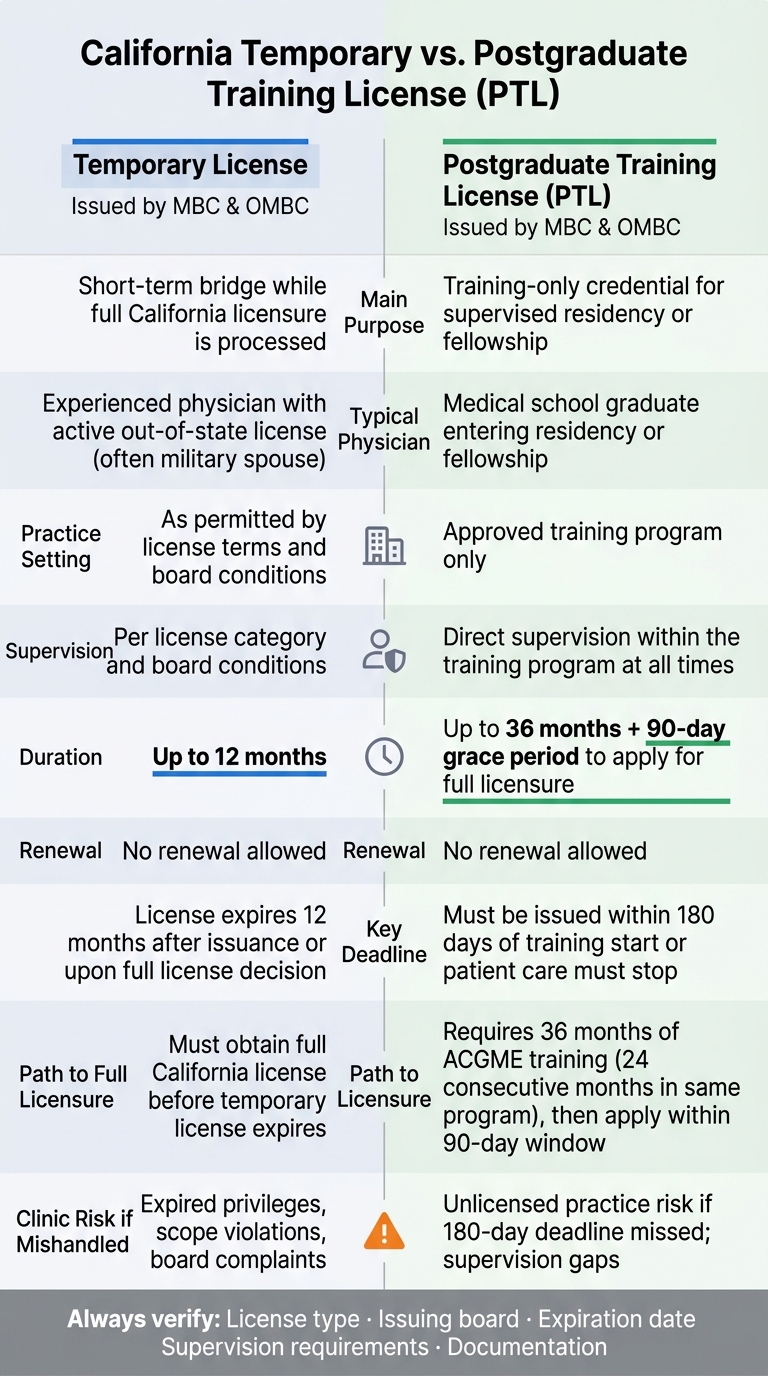
California Temporary vs. PTL Medical License: Key Differences at a Glance
Quick Comparison
| Point | Temporary License | PTL |
|---|---|---|
| Main use | Short bridge while full licensure is being finished | Supervised postgraduate training |
| Typical physician | Physician with an active out-of-state license who meets board rules | Resident or fellow |
| Where they can work | Only as allowed by the license and board rules | Only in the approved training program |
| Supervision | Based on license terms and board conditions | Supervised within the program |
| Time limit | Up to 12 months | Up to 36 months + 90 days |
| Renewal | No | No |
| Big clinic check | Expiration date and board limits | Supervisor, program status, and 180-day deadline |
In other words: a PTL holder is a trainee, not an independent clinic physician, while a temporary license holder may practice during the license term if the board’s rules are met. If I were onboarding either one, I’d verify the issuing board, status, dates, supervision rules, and documentation before putting that doctor on the schedule.
Temporary Medical Licenses in California
California’s temporary physician license mostly works as a short-term bridge for people who qualify and need legal authority to practice while the rest of the licensure process is still being finished. In California, the main temporary path is the military-spouse temporary license.
Purpose and Common Use Cases
The clearest temporary physician license path in California is the Medical Board of California’s P&S Temporary License. It is meant for spouses or domestic partners of active-duty U.S. Armed Forces members stationed in California. The Osteopathic Medical Board of California offers a similar temporary path for osteopathic physicians who meet military-spouse rules.
These licenses act as bridge credentials for physicians who need to start practicing before full California licensure is issued.
Assembly Bill AB 107, which took effect on July 1, 2023, requires DCA boards, including the MBC and OMBC, to provide expedited temporary authorization to practice for at least one year to qualifying military spouses with active, unrestricted out-of-state licenses. That sounds simple on paper, but clinics still need to check the expiration date, scope, and each board’s rules before bringing someone on.
Eligibility, Validity, and Renewal Limits
Eligibility usually includes:
- An active, unrestricted out-of-state license
- Background checks
- No disqualifying disciplinary history
Under this framework, temporary licenses are valid for up to 12 months and can’t be renewed. Under California Business and Professions Code § 115.6, the license expires 12 months after issuance, or when a standard California license, endorsement license, or expedited license is issued or denied, whichever happens first.
Once that temporary license ends, the physician must have full California licensure to keep practicing.
What Clinics Should Check Before Onboarding a Temporary License Holder
Before putting a physician with a temporary license on the schedule, verify the basics carefully.
| Item to Verify | Why It Matters |
|---|---|
| Exact license category and issuing board (MBC vs. OMBC) | Rules and scope can differ by board |
| Effective date and expiration date | Confirms the license is valid on the hire date |
| Out-of-state license status | Must be active, unrestricted, and in good standing |
| Practice restrictions or supervision requirements | Temporary authority may not fit every clinic setting |
| Disciplinary history | Disqualifying history can invalidate the credential |
It also helps to set a calendar alert before the expiration date and confirm full California licensure before privileges lapse. Missing that date can turn a valid temporary license into a compliance problem fast. Check license status directly with the MBC or OMBC, and keep that proof in the physician’s credentialing file.
Unlike a temporary license, a PTL is tied to supervised postgraduate training, not short-term practice authorization.
Reading about the problem? See how Prospyr solves it in one platform.
Book a DemoProvisional Pathways in California: The Postgraduate Training License (PTL)
The PTL is not a temporary license in the usual sense. In California, it is a training-only license for physicians who are in supervised postgraduate training.
Who Qualifies for a PTL and When It Is Required
Because the PTL is tied to training, you can only get one if you're in a residency or fellowship.
For MD applicants through the Medical Board of California, the main requirements are:
- Graduation from a Board-approved medical school
- Passing USMLE Step 1 and Step 2 CK
- Enrollment in a California ACGME-accredited residency program
For osteopathic physicians applying through the Osteopathic Medical Board, the route is a bit different. It requires graduation from a COCA-accredited medical school, passing COMLEX-USA Levels 1 and 2, and enrollment in an AOA- or ACGME-accredited PGY-1 program that includes at least four months of general medicine with direct patient care
Timing matters here. A PTL must be issued within 180 days of starting postgraduate training in California. If it isn't issued by day 180, the resident has to stop patient care until the PTL is issued. Going past that deadline can be treated as unlicensed practice.
Scope of Practice Under Supervision
A PTL holder may practice medicine only within an approved training program and under program supervision. That means procedures, clinical decisions, and documentation all sit inside that supervised setting.
Put simply, PTL holders are trainees, not independent physicians. The program and faculty decide how much independence, review, and delegation are allowed.
How PTL Holders Move to Full California Licensure
The PTL lasts 36 months and cannot be renewed. To move toward full licensure, the physician must complete 36 months of ACGME-accredited training, including at least 24 consecutive months in the same program.
After those 36 months of qualifying training, there is a 90-day grace period to apply for full California licensure. Still, the PTL by itself does not turn into a full license. The physician must also meet all other board requirements.
That setup is what creates the main differences in purpose, supervision, and compliance risk.
sbb-itb-02f5876
Temporary vs. Provisional Licenses: Key Differences
A temporary license fills a short licensing gap. A PTL is different: it's a training-only credential for residents and fellows.
Purpose, Applicant Profile, and Practice Setting
In most cases, a temporary license is for an experienced physician who is finishing the California licensing process. A PTL is for a medical school graduate starting supervised training. That one difference shapes everything else, especially supervision rules and where the physician can work.
At the day-to-day level, the gap between these licenses comes down to four things: purpose, setting, supervision, and duration.
| Category | Temporary License | Postgraduate Training License (PTL) |
|---|---|---|
| Regulatory purpose | Short-term licensure bridge | Training-only credential for supervised residency or fellowship |
| Typical applicant | Physician completing California licensure | Resident or fellow in a California-approved program |
| Practice setting | Limited to the circumstances authorized by the temporary license | Approved training program only |
| Supervision | Depends on the license category and board conditions | Direct supervision within the training program |
| Path to full licensure | May bridge while full licensure is processed | Training pathway toward full licensure once board requirements are met |
Duration, Supervision, and Compliance Risk
Supervision does not work the same way under these two licenses. PTL holders must practice under direct supervision inside their training program. Temporary license holders follow the supervision rules tied to that specific license type, along with any conditions the board has added.
Mixing them up can cause credentialing and supervision mistakes. In plain terms, the clinic's workflow has to match the license the physician actually holds.
That affects how a clinic credentials, schedules, and supervises the physician.
How License Type Affects Day-to-Day Clinic Operations
Credentialing and Scheduling Controls by License Type
These license differences need to show up in day-to-day clinic work. Put simply: license type should drive scheduling, supervision, and chart-access rules.
Each provider file should confirm:
- License type
- Issuing board
- Expiration date
- Any supervision limits
For PTL holders, the file should also include the supervising physician’s name, the supervision arrangement, and proof of enrollment in a California ACGME-accredited training program. Those details shape what that provider can and can’t do.
Scheduling needs to follow the same rules as credentialing. If someone holds a temporary license, schedule that person only for services the license clearly allows, and only during the period when the license is active. A PTL holder should work inside a supervised training setup, not as an independent clinician. Before the schedule goes live, confirm that supervisor coverage is in place. License verification should be documented on a set schedule, and each check should be timestamped.
Chart access should match those same limits. If a provider has supervised or restricted authority, that person should only access records tied to assigned duties. They should not have broad permission to sign final documentation or enter pending orders unless the license and supervision setup clearly allow it. When a temporary or provisional provider is involved, audit trails need to show final review by the correct clinician.
Set expiration alerts early. Leading credentialing organizations recommend automated reminders at 60 and 30 days before expiration. If a license lapses or its status changes, update scheduling systems, patient assignment lists, EMR permissions, and staff instructions right away.
Conclusion: Match Your Workflows to the License Held
Match scheduling, supervision, and chart access to the license held.
FAQs
Can a PTL holder work outside a residency or fellowship program?
No. In California, a Postgraduate Training License (PTL) lets a physician practice only within their board-approved, accredited residency or fellowship program.
If the PTL expires before the physician gets a full Physician's and Surgeon's Certificate, they must stop practicing until the full license is active.
What happens if a PTL is not issued within 180 days?
In California, residents in an approved training program must get a Postgraduate Training License (PTL) within 180 days of enrollment.
Miss that window, and the physician can't keep practicing medicine in the training program. Practicing without a valid license may lead to state regulatory action.
Can a temporary California medical license be renewed or extended?
No. A California Physician Training License (PTL) is a temporary, nonrenewable permit for residents in a California training program.
You need to track the expiration date yourself and apply for a full Physician and Surgeon's Certificate before your training authority ends. If you don’t, you can end up with a gap in your legal ability to practice.
Related Blog Posts
Free PDF guide + worksheets
Build your California opening file.
Get the state highlights, linked official sources, service-by-service licensing worksheet, ownership questions and opening checklist in one printable guide.
- ✓ State-specific decisions and next steps
- ✓ Credential and supervision worksheet
- ✓ A place to track approvals, owners and renewals