Texas Medical Licensing for Med Spa Owners
Explains Texas med spa ownership limits, CPOM rules, MSO structure, required TMB/TDLR/DSHS licenses, and staff credentialing.


Starting a med spa in Texas? Here's what you need to know:
- Ownership Rules: Only licensed physicians (MDs or DOs) can fully own med spas due to Texas's Corporate Practice of Medicine (CPOM) doctrine. Non-physicians can participate through a Management Services Organization (MSO) model, handling non-clinical tasks while physicians retain control over medical decisions.
- Licensing Agencies: Compliance involves working with three key agencies:
- Texas Medical Board (TMB): Regulates medical procedures like Botox and dermal fillers.
- Texas Department of Licensing and Regulation (TDLR): Oversees esthetic services like facials and laser hair removal.
- Department of State Health Services (DSHS): Manages laser and IPL device registrations.
- Staff Requirements: All staff must hold appropriate licenses. Medical treatments require physician delegation, while esthetic services are regulated by TDLR.
- Legal Structures: Physicians can use a Professional Limited Liability Company (PLLC) or Professional Association (PA). Non-physicians can operate through an MSO model or hold minority stakes in specific cases.
- Compliance Is Key: Proper documentation, informed consent, and adherence to licensing rules are critical to avoid penalties, fines, or closures.
Navigating these rules ensures your med spa operates legally and avoids enforcement actions. Let’s dive deeper into the details.
The Corporate Practice of Medicine Doctrine in Texas
What is the CPOM Doctrine?
In Texas, the Corporate Practice of Medicine (CPOM) Doctrine is a legal principle designed to keep medical decisions in the hands of licensed physicians. It prohibits non-physicians from owning, managing, or controlling medical practices. This rule ensures that patient care isn’t influenced by non-medical, profit-driven interests. Under CPOM, only licensed physicians - either MDs or DOs - are allowed to own entities that provide medical services.
The Texas Medical Board (TMB) enforces this doctrine to safeguard the independence of clinical decision-making. Non-physician entities, such as standard LLCs, are not permitted to employ physicians or interfere with their medical judgments.
How CPOM Affects Med Spa Ownership
In Texas, treatments like Botox, dermal fillers, and laser procedures are classified as medical practices. Because of this, the CPOM Doctrine places strict limits on who can own a med spa. Aestheticians, registered nurses (RNs), and entrepreneurs cannot own a majority stake or directly manage clinical operations. Violating these restrictions can lead to serious consequences, including investigations by the TMB, hefty fines, license suspensions, or even the closure of the business.
Med spas that fail to comply with CPOM risk enforcement actions from the TMB. For instance, breaches of scope-of-practice rules can prompt fines or shutdowns. The TMB has emphasized adherence to Rule 193.17 and, as part of a 2025 reorganization under 22 TAC Chapter 169, clarified delegation requirements while maintaining the CPOM restrictions.
For non-physicians who want to be involved in med spas, the Management Services Organization (MSO) model offers a workaround. In this setup, a physician-owned Professional Limited Liability Company (PLLC) provides the medical services, streamline digital patient intake, while a separate MSO - owned by non-physicians - handles non-clinical operations like marketing, billing and payments, and facility management. This structure allows non-physicians to participate legally without violating CPOM rules.
sbb-itb-02f5876
Choosing a Legal Ownership Structure for Your Med Spa
Once you're clear on CPOM restrictions, the next step is selecting an ownership structure that aligns with Texas law and your business goals. Texas offers several models, each catering to different roles - whether you're a licensed physician, physician assistant, or non-physician entrepreneur.
Physician Ownership Models
For licensed physicians (MDs or DOs), the path is relatively straightforward. You can own 100% of your med spa by establishing a Professional Limited Liability Company (PLLC) or a Professional Association (PA). These professional entities are tailored for licensed practitioners, allowing you to oversee both clinical and business operations.
The PLLC is especially popular because it provides liability protection and is relatively simple to manage. It enables you to hire clinical staff, oversee medical decisions, and handle billing, all under the guidance of the Texas Medical Board.
Management Services Organization (MSO) Model
For non-physicians, including registered nurses, aestheticians, and entrepreneurs, the MSO model is a practical solution. This structure keeps clinical services separate from administrative functions, ensuring compliance with CPOM laws. Here’s how it works:
- A licensed physician forms a PLLC to handle all medical services.
- A non-physician sets up a standard LLC to manage administrative tasks like marketing, payroll, billing, IT, and facility management.
- These two entities are connected through a Management Services Agreement (MSA), which defines the services provided by the LLC and the associated fees.
"The MSO model, with proper setup and implementation, has long been the gold standard as the model used when non-physicians are involved in a health care arrangement." - Jay Reyero, JD, Partner, ByrdAdatto
While this model allows non-physician involvement, the physician must retain full control over all clinical aspects, including patient care decisions, treatment protocols, and clinical staff management. To avoid legal issues, management fees should reflect fair market value, and financial records for the two entities must remain separate.
Minority Ownership for Non-Physicians
Texas law allows one exception to the rule against non-physician ownership: Physician Assistants (PAs) can hold a minority ownership stake in a med spa. However, a licensed physician must maintain majority ownership and overall control. This option is exclusive to PAs - nurse practitioners (NPs), for instance, cannot hold similar ownership stakes. While NPs can own professional nursing entities, their ability to perform med spa treatments depends on physician delegation.
If you're a PA considering this option, ensure that the physician partner has ultimate authority over all medical decisions and protocols. Structuring this type of ownership requires careful legal review to avoid CPOM violations.
With your ownership structure decided, the next step is ensuring your staff meet all licensing and credentialing requirements.
Reading about the problem? See how Prospyr solves it in one platform.
Book a DemoLicensing Requirements for Med Spa Staff in Texas
Once ownership structures and CPOM guidelines are defined, med spa owners must ensure every staff member holds the appropriate license for their role. In Texas, medical acts fall under the Texas Medical Board (TMB), while cosmetology services are regulated by the Texas Department of Licensing and Regulation (TDLR). Knowing the difference between these categories is crucial to avoid legal issues.
Medical Director Requirements
Med spas offering medical treatments must have a licensed physician serving as the medical director. This physician oversees clinical protocols, delegates medical procedures, and reviews patient records. They are responsible for ensuring the facility complies with healthcare regulations. Importantly, the physician retains full authority over medical decisions, which cannot be handed off to non-physicians.
Staff Licensing and Credentialing
In Texas, medical treatments such as Botox, dermal fillers, laser-assisted procedures, and deep chemical peels must be performed under a physician's delegation. The medical director must formally authorize these procedures for qualified staff, such as nurse practitioners or registered nurses, who can perform them within their professional scope.
For non-medical services, the TDLR takes over. Licensed estheticians and cosmetology operators can conduct facials, waxing, and light or superficial peels - procedures limited to removing dead skin cells from the epidermis without affecting the dermis. However, they are strictly prohibited from using hypodermic needles or performing medical-grade treatments like deep chemical peels. Laser hair removal requires a licensed laser technician under TDLR rules, while permanent makeup is regulated by the Department of State Health Services (DSHS).
| Service Type | Regulatory Body | Provider Requirements |
|---|---|---|
| Medical Acts (Botox, Fillers, Deep Peels) | Texas Medical Board (TMB) | Requires physician delegation |
| Cosmetology/Esthetics (Facials, Waxing, Light Peels) | Texas Dept. of Licensing & Regulation (TDLR) | Licensed Esthetician or Cosmetology Operator |
| Laser Hair Removal | TDLR | Licensed Laser Technician |
| Permanent Makeup | Dept. of State Health Services (DSHS) | Must comply with DSHS regulations |
If your med spa employs licensed estheticians or cosmetologists, you'll need a TDLR establishment license. This includes meeting health and safety requirements like having running water and restrooms, even if your facility primarily operates as a medical office.
Informed Consent and Record-Keeping Standards
Proper documentation is key to protecting both your patients and your practice. For all medical procedures, obtaining informed consent is mandatory. This document should outline the treatment, potential risks, and expected outcomes. Your medical director should create consent forms and establish record-keeping protocols that align with TMB regulations.
Categorize each service under the appropriate regulatory body - TMB, TDLR, or DSHS. This ensures compliance with the correct standards for consent, documentation, and staff qualifications. Staff members must strictly operate within the scope of their licenses, meaning estheticians, for example, may only perform peels that do not penetrate the dermis. When uncertain, consult the TMB for guidance on what qualifies as a medical act and how to delegate it properly.
These steps strengthen clinical oversight and demonstrate your commitment to regulatory compliance.
Texas State Agency Licensing Requirements
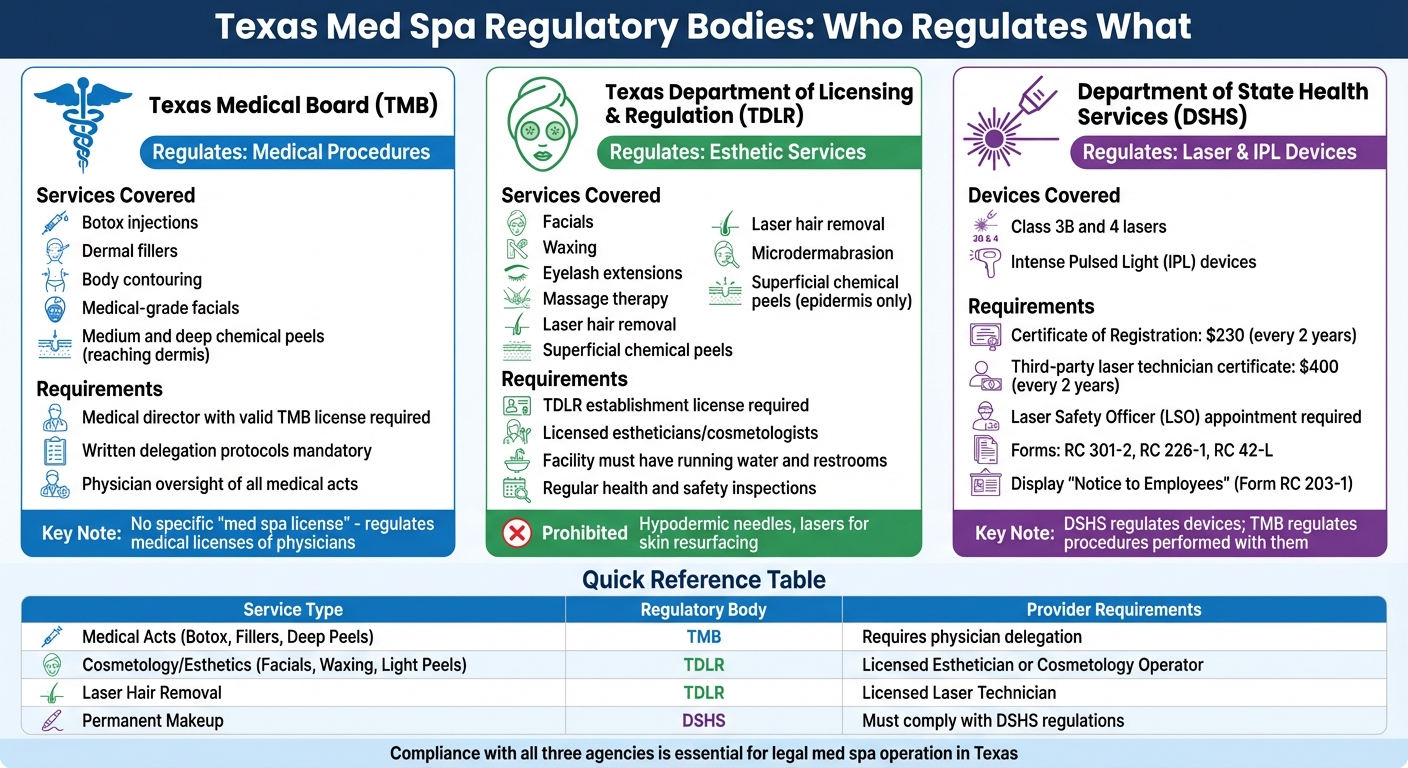
Texas Med Spa Regulatory Bodies and Service Requirements Guide
Operating a med spa in Texas involves working with three state agencies, each responsible for regulating specific aspects of your business. Knowing the role of each agency helps you avoid compliance issues and ensures your operations align with state regulations. Here's a detailed look at the requirements set by each agency.
Texas Medical Board (TMB)
The TMB oversees all medical procedures performed at med spas, such as Botox injections, fillers, body contouring, and medical-grade facials. While the TMB doesn’t issue a specific "med spa license", it regulates the medical licenses of physicians responsible for ordering and delegating medical treatments. Procedures like medium and deep chemical peels that reach the dermis are classified as medical acts and fall under strict TMB regulation.
Your med spa must have a medical director with a valid medical license issued by the TMB. This director can delegate medical procedures but not cosmetology services unless those services are classified as medical acts under TMB rules. According to the TDLR, "A doctor may delegate only medical procedures in accordance with the laws and rules relating to their medical license". To stay compliant, establish written delegation protocols that specify how non-physician staff are authorized to perform treatments. Next, consider how TDLR regulations apply to your esthetic services.
Texas Department of Licensing and Regulation (TDLR)

The TDLR regulates esthetic services like facials, waxing, eyelash extensions, massage therapy, and laser hair removal. If your med spa employs estheticians or cosmetologists, you need a TDLR establishment license as outlined in Chapter 1603 of the Texas Occupations Code. Both the facility and individual practitioners must hold the appropriate licenses.
Licensed estheticians are permitted to perform treatments such as facials, hair removal (using depilatories or tweezing), and eyelash extensions. They can also perform microdermabrasion and chemical peels, but these treatments must remain superficial, targeting only the epidermis without affecting deeper layers. Estheticians are not authorized to use hypodermic needles or lasers for skin resurfacing. The TDLR conducts regular inspections to ensure compliance with health and safety standards.
To apply for an establishment license, use the TDLR "Do It Online" portal or submit your application by mail. Your facility must meet health standards, including having running water and restrooms, as required by 16 TAC Chapter 83. If your spa offers microdermabrasion, confirm that the device doesn’t pierce the dermis; otherwise, it becomes a medical procedure requiring physician oversight. Additionally, review DSHS requirements for registering laser and IPL devices.
Department of State Health Services (DSHS)
The DSHS Radiation Control Program regulates Class 3B and 4 lasers and Intense Pulsed Light (IPL) devices used in medical settings. Operating these devices requires a Certificate of Registration from DSHS, which costs $230 every two years. Third-party laser service technicians must obtain a separate certificate, priced at $400 biennially.
Before applying, appoint a Laser Safety Officer (LSO) who meets state credentialing requirements. Submit the following forms along with the required fees: RC 301-2 (Laser Registration), RC 226-1 (Business Information), and RC 42-L (LSO Information). Additionally, display the "Notice to Employees" (Form RC 203-1) at your facility, as required by Title 25, Texas Administrative Code §289.301.
It’s important to note that while the DSHS regulates the devices, the TMB oversees the medical procedures performed with them, and the TDLR governs estheticians who may use these devices under proper delegation guidelines.
Using Technology for Compliance and Practice Management
Running a med spa in Texas involves juggling state agency regulations, staff credentials, and extensive documentation. If you're relying on separate software for scheduling, charting, and marketing, you risk missing critical renewals or compliance details. A centralized, HIPAA-compliant platform can simplify this by bringing all these functions together, reducing errors and ensuring compliance with the Texas Medical Board (TMB) and Texas Department of Licensing and Regulation (TDLR). This approach not only minimizes risks but also streamlines the management of staff credentials and licensing.
Managing Staff Credentials and Licensing
Keeping track of licenses, medical director credentials, and training updates becomes far easier when everything is stored in a single, unified system. Automated alerts for license expirations and other regulatory deadlines ensure you stay ahead of compliance requirements. This type of integration aligns perfectly with Texas's stringent regulatory standards, giving you a clear view of every credential and deadline.
In 2024, Dr. Daniel Lee, Founder of New Life Cosmetic Surgery, made the switch from multiple software systems to the Prospyr platform. This move streamlined his operations, leading to a 50% increase in revenue and a 40% boost in appointments booked.
"We've seen a 50% increase in revenue and a 40% increase in appointments booked since switching away from using several different point solutions to running our practice on Prospyr".
Improving Patient Care and Business Operations
Technology doesn't just simplify compliance - it can also elevate patient care and improve day-to-day operations. A comprehensive platform can handle everything from digital intake forms to integrated EMR/CRM systems, smart scheduling, and real-time analytics. For example, digital intake forms securely collect informed consent and patient histories in line with TMB standards. Meanwhile, real-time analytics provide insights into financial performance and compliance metrics, helping you make informed decisions.
SOM Aesthetics, founded by Dr. Saami Khalifian, launched their practice using the Prospyr platform in 2024. Within just two days, the practice generated $40,000 in revenue, and within two months, it exceeded $100,000 in monthly revenue.
"Their powerful platform and helpful support have enabled us to exceed our financial targets while delivering an unmatched experience for our patients".
Prospyr’s cloud-based, HIPAA-compliant system ensures data security, helping you avoid HIPAA breaches and protect against potential malpractice claims.
Conclusion
Running a med spa in Texas comes with specific legal and operational challenges, largely shaped by the Corporate Practice of Medicine (CPOM) doctrine. This framework requires non-physicians to use the MSO model for managing business operations, while licensed physicians maintain control over clinical decisions. Keeping this division clear is essential to comply with Texas law.
Careful attention to staff licensing, medical director qualifications, and proper supervision is non-negotiable. Regulatory bodies like the Texas Medical Board (TMB), Texas Department of Licensing and Regulation (TDLR), and the Department of State Health Services (DSHS) enforce these rules strictly. Neglecting even one license renewal or supervision requirement could put your entire business at risk. As T. Luquette explained, "one miss or find makes a huge difference in our success and ability to serve our patients and stay in business profitably".
Beyond staffing and supervision, compliance with HIPAA regulations, maintaining accurate informed consent documentation, and proper record-keeping are critical for protecting both your patients and your business from legal issues. Partnering with legal experts familiar with Texas healthcare laws can help you navigate these complexities and avoid costly errors.
Operational tools can also make compliance more manageable. Platforms like Prospyr, designed specifically for healthcare practices, simplify meeting CPOM and state agency requirements. By centralizing staff credential management, automating renewal reminders, and ensuring HIPAA-compliant record-keeping, these tools help med spa owners maintain compliance while streamlining day-to-day operations. When paired with a solid legal structure and consistent regulatory oversight, such tools can support a well-run, compliant med spa.
Although the regulatory landscape may seem daunting, these rules ultimately safeguard both practitioners and patients. With a strong legal framework and a commitment to compliance, med spa owners can achieve lasting success in Texas's competitive aesthetics industry.
FAQs
Can a non-physician legally own a med spa in Texas?
No, non-physicians cannot directly own a med spa in Texas. However, they can still participate in its ownership, management, and profits by creating a properly structured Management Services Organization (MSO). This setup allows non-physicians to handle the business side of operations while complying with state laws.
What’s the safest way to structure an MSO and management fees?
The best way to determine the management fee is by considering the medical entity's estimated profit and the value of services offered by the MSO. It's crucial to ensure that the fee structure aligns with all relevant legal and regulatory standards to prevent any compliance issues.
Which Texas licenses and registrations do I need before opening?
To open a med spa in Texas, you’ll need to secure the proper licenses and registrations from both the Texas Department of Licensing and Regulation (TDLR) and the Texas Medical Board. This includes obtaining licenses for professionals such as estheticians, cosmetologists, massage therapists, and medical providers who are qualified to perform treatments like Botox and fillers. Make sure every staff member has the necessary credentials for their specific role to comply with state regulations.
Related Blog Posts
- Texas Med Spa Licensing Requirements
- State-Specific Insurance Requirements for Med Spas
- Top 10 States for Medical Spa Provisional Licenses
- Georgia Licensing Requirements for Med Spas
{"@context":"https://schema.org","@type":"FAQPage","mainEntity":\[{"@type":"Question","name":"Can a non-physician legally own a med spa in Texas?","acceptedAnswer":{"@type":"Answer","text":"
No, non-physicians cannot directly own a med spa in Texas. However, they can still participate in its ownership, management, and profits by creating a properly structured Management Services Organization (MSO). This setup allows non-physicians to handle the business side of operations while complying with state laws.
"}},{"@type":"Question","name":"What’s the safest way to structure an MSO and management fees?","acceptedAnswer":{"@type":"Answer","text":"The best way to determine the management fee is by considering the medical entity's estimated profit and the value of services offered by the MSO. It's crucial to ensure that the fee structure aligns with all relevant legal and regulatory standards to prevent any compliance issues.
"}},{"@type":"Question","name":"Which Texas licenses and registrations do I need before opening?","acceptedAnswer":{"@type":"Answer","text":"To open a med spa in Texas, you’ll need to secure the proper licenses and registrations from both the Texas Department of Licensing and Regulation (TDLR) and the Texas Medical Board. This includes obtaining licenses for professionals such as estheticians, cosmetologists, massage therapists, and medical providers who are qualified to perform treatments like Botox and fillers. Make sure every staff member has the necessary credentials for their specific role to comply with state regulations.
"}}]}