How to Train Med Spa Staff in Customer Service
A practical guide to training med spa staff in service standards, onboarding, role-play, shadowing, feedback, and streamlined tools to improve retention.
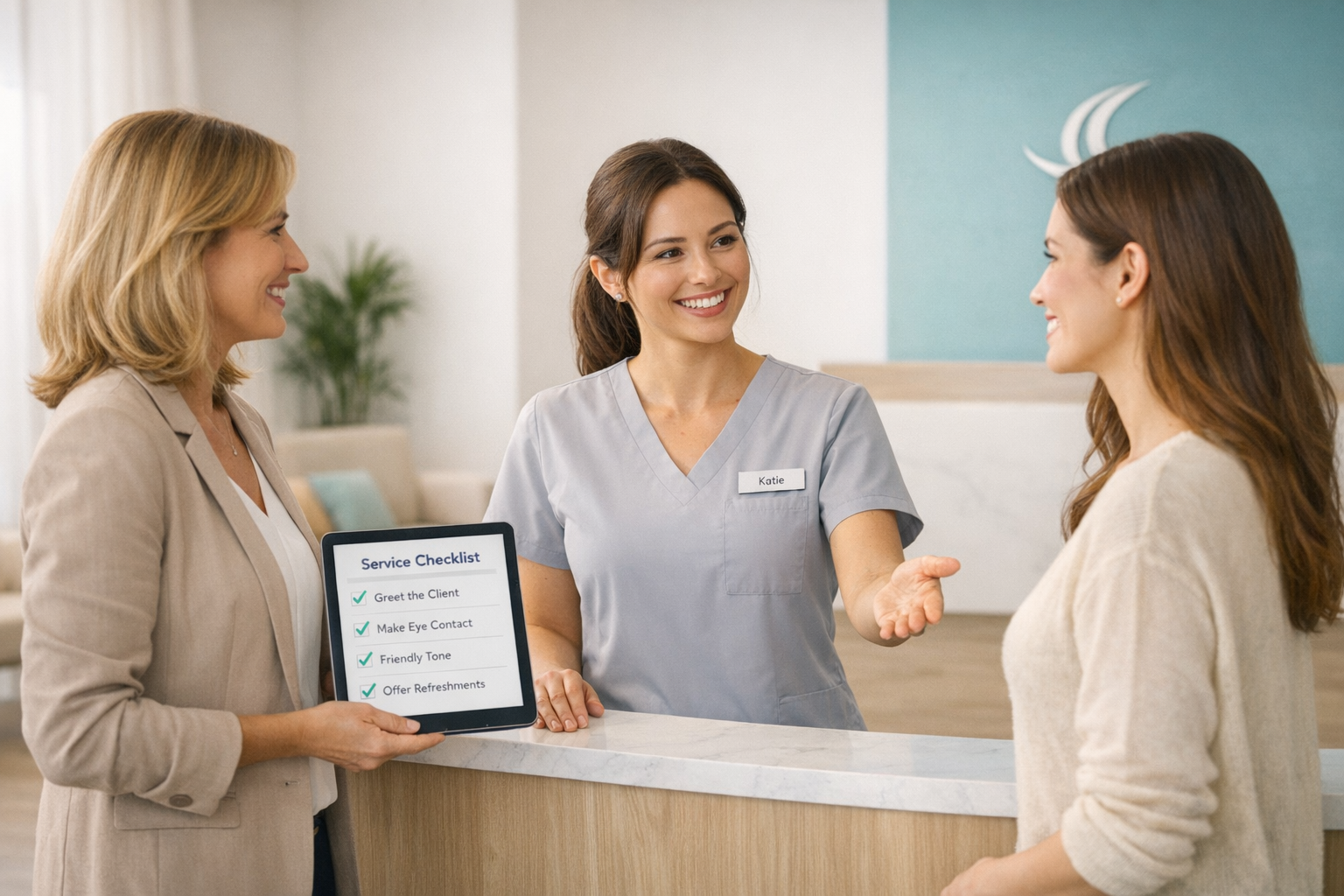

In med spas, customer service directly impacts client retention and revenue. With the global medical spa market reaching $14.6 billion in 2022, clients expect high-quality experiences from their first interaction. Training your team to deliver consistent, client-focused service is essential to meet these expectations. Here's how:
- Define Service Standards: Establish clear values and operating procedures (e.g., empathy, professionalism, timely responses). Use frameworks like LAER (Listen, Acknowledge, Explore, Respond) for handling client concerns effectively.
- Onboarding and Orientation: Immerse new hires in your spa’s mission, services, and daily routines. Pair them with mentors and provide detailed training on communication and courtesy.
- Role-Playing: Practice common scenarios (e.g., late arrivals, billing disputes) to build confidence and refine responses.
- Shadowing and Hands-On Training: Let staff observe experienced team members, then gradually transition to supervised practice.
- Feedback and Reviews: Schedule regular one-on-one sessions to address performance, track metrics like client retention and consultation conversion rates, and provide actionable feedback.
- Leverage Tools: Use platforms like Prospyr to simplify scheduling, communication, and analytics, reducing training complexity and improving consistency.
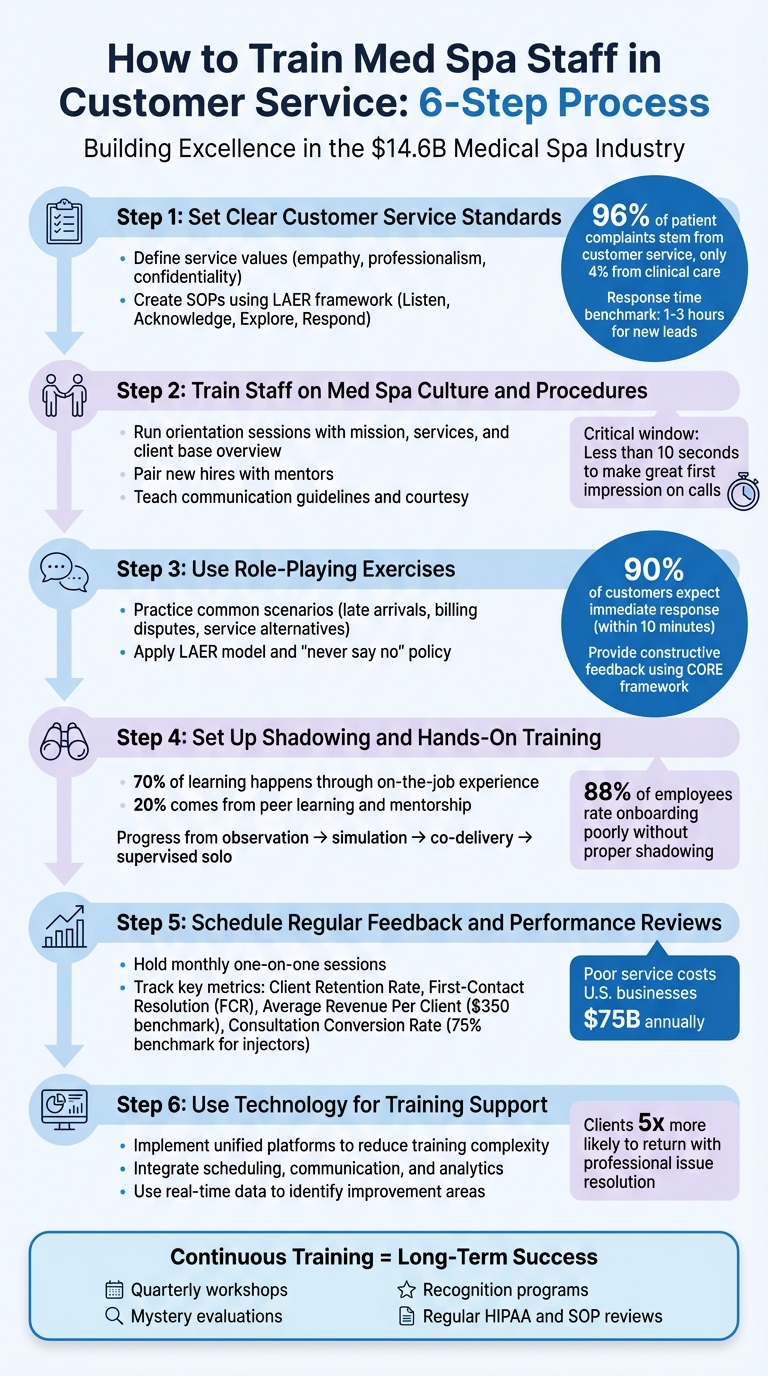
6-Step Med Spa Staff Customer Service Training Process
Step 1: Set Clear Customer Service Standards
Before training your team, you need to define what excellent service looks like. Clear standards remove any guesswork and ensure every team member understands how to interact with clients. Without these guidelines, you risk inconsistent client experiences, which can harm your reputation. These standards will also serve as the backbone for the training practices outlined in the following steps.
Define Your Service Values
Start by outlining the core values that should guide every client interaction. These values should align with your med spa's brand and meet your clients' expectations. For example, if you aim to position your spa as a luxury provider, focus on values like attentiveness, discretion, and personalized care. On the other hand, if you want to emphasize efficiency and accessibility, prioritize responsiveness, transparency, and convenience.
Terri Ross suggests deciding whether your service should reflect a "Four Seasons" level of care. This decision will influence everything - from how staff greets clients to how they handle complaints. Values like empathy, confidentiality, and professionalism are essential to ensure clients feel understood, secure, and respected.
Consider this: 96% of patient complaints stem from customer service, while only 4% relate to clinical care. This statistic highlights how clients judge your practice more on how they’re treated than the technical quality of your services. Your values should translate into specific behaviors, such as greeting clients promptly, addressing them by name, and maintaining a positive attitude - even during stressful moments. Once defined, formalize these values into your operational guidelines. This is a critical part of opening a med spa and building a sustainable business.
Create Standard Operating Procedures (SOPs)
After defining your values, translate them into detailed SOPs that cover all standard client interactions. These procedures should provide clear, step-by-step instructions for tasks like scheduling appointments, handling inquiries, resolving complaints, and conducting follow-ups. SOPs not only ensure consistency across your team but also serve as a critical training tool for new hires.
Incorporate proven communication frameworks into your SOPs. For instance, the LAER model (Listen, Acknowledge, Explore, Respond) helps staff thoroughly understand client concerns before offering solutions. Similarly, a "never say no" policy encourages staff to explore alternatives when a service isn’t available.
Set specific response time benchmarks as well. Studies show that responding to new leads through lead management within 1 to 3 hours dramatically increases conversion rates, as clients often contact multiple providers before deciding. For managing complaints, adopt the CARP method (Control the situation, Acknowledge the issue, Refocus the conversation, Problem solve) to give staff a structured way to handle dissatisfied clients.
Document these procedures in formats that match the complexity of each task. Use step-by-step instructions for simple processes, flowcharts for tasks with multiple decision points, and checklists to ensure no steps are missed during quality control.
sbb-itb-02f5876
Step 2: Train Staff on Med Spa Culture and Procedures
After setting your service standards, it's time to focus on integrating your team into your med spa's identity and operations. The first few weeks should go beyond just completing paperwork. Instead, aim to immerse new hires in your brand, core values, and daily routines. This groundwork ensures they can consistently deliver personalized experiences that reflect your business's identity. Start this process with a well-structured orientation program.
Run an Orientation Session
Kick things off with an orientation that outlines your med spa's mission, service offerings, and typical client base. Provide each new hire with a customized packet containing key policies, job descriptions, and workplace etiquette. This helps establish clear expectations from day one and minimizes uncertainty.
Give a guided tour of your facility, pointing out key services and what sets your med spa apart. Take the time to explain the details of each service you offer, reinforcing the standards you established in Step 1. This ensures your staff can confidently represent your brand.
Pair new hires with a mentor and schedule weekly check-ins during their first month to ease the transition. You might also organize a casual group lunch on their first day to encourage connections between new team members and existing staff, whether they're clinical or administrative.
Make sure your front office staff becomes well-versed in every product and service you offer. They need to understand how each treatment fits into a personalized plan for clients. This level of expertise is crucial because you have less than 10 seconds to make a great impression during an initial client call. Keep in mind that many clients have already done their research before reaching out.
Teach Communication and Courtesy Guidelines
Once orientation is complete, shift the focus to communication and courtesy. Train your staff to use positive language and active listening skills to build trust with clients right from the start. These communication techniques are essential for maintaining the service values and procedures you’ve laid out.
Encourage the use of open-ended questions like, "What’s a good day for you?" instead of closed ones like, "Would you like an appointment?" This helps create a more natural and engaging conversation.
Adopt a "never say no" policy. If a client asks for a service you don’t provide, train staff to redirect the conversation by asking about the client’s broader goals. This keeps the discussion solution-focused and positions your med spa as a helpful resource.
Ensure your team highlights your unique selling points during initial client interactions. For example, they might mention your provider’s qualifications or the number of successful procedures performed. Since clients are buying an intangible product based on trust and relationships, these details can make a big difference. To maintain consistency, create a training manual - either physical or digital - that staff can easily reference for guidance on brand voice and service standards.
Reading about the problem? See how Prospyr solves it in one platform.
Book a DemoStep 3: Use Role-Playing Exercises
Now that your team is familiar with your communication guidelines, it’s time to bring those skills to life. Role-playing exercises provide a safe environment where staff can practice real-world client interactions before dealing with them in actual scenarios. This is especially important in med spas, where nearly half of all service agents face challenges in managing difficult conversations. The aim here is to help your team build confidence and develop the ability to respond naturally, avoiding scripted or hesitant responses.
These exercises are also crucial for managing potential crises before they spiral out of control. They allow staff to respond instinctively and defuse tense situations effectively. Considering that 90% of customers expect an "immediate" response - defined by 60% of them as within 10 minutes - your team must be prepared to act quickly and with assurance.
Practice Common Client Scenarios
Tailor your role-playing sessions to reflect the everyday challenges your staff encounters. Focus on typical situations like addressing late arrivals, resolving billing disputes, or suggesting alternative services when a client inquires about something unavailable. Assign roles to make the exercises feel authentic: one person plays the client, while another takes on the role of receptionist or treatment coordinator. These scenarios provide a clear framework for practicing effective communication.
| Scenario Type | Med Spa Example | Training Focus |
|---|---|---|
| The Impatient Client | Client arrives 20 minutes late for a 30-minute facial and demands full service | Maintain schedule while offering solutions |
| The Angry Client | Client is upset about unexpected charges on their invoice | De-escalate tension and review billing together |
| The Frugal Client | Client wants Botox but says the price exceeds their budget | Justify value or suggest financing options |
| The Feature Request | Client asks for a treatment technology the spa doesn't have | Redirect to available alternatives |
During these exercises, use the LAER model: Listen, Acknowledge, Explore, and Respond. This approach ensures staff thoroughly understand client concerns before presenting solutions. Encourage the "no 'no's' allowed" rule, where staff avoid negative language like "I can't help with that." Instead, they should focus on understanding the client’s broader goals and offering alternatives. For instance, if a client requests a service you don’t provide, train staff to ask, “Are you looking for skin-tightening results?” and then recommend suitable treatments you offer. After practicing these scenarios, review performance to reinforce these skills and fine-tune their approach.
Provide Constructive Feedback
Once the role-playing exercises are complete, immediate feedback is key to cementing effective techniques and addressing areas for improvement. Feedback sessions should strike a balance, starting with what the staff member did well to create a positive and open atmosphere. This approach makes them more receptive to suggestions for growth. Focus on specific behaviors you observed rather than offering vague or subjective commentary.
"Getting and giving impromptu feedback is more like brushing and flossing than getting a root canal." - Kim Scott, Author and Co-founder, Radical Candor
For structured feedback, use the CORE framework: provide Context for the situation, share your Observations, explain the Result of their actions, and outline the Expected next steps. If someone struggles, ask questions to understand their challenges instead of assuming a lack of effort. Collaborate on an improvement plan, ensuring they feel involved in their development. Wrap up each session by reaffirming their strengths and scheduling a follow-up to track progress. This process not only builds their skills but also boosts their confidence and morale.
Step 4: Set Up Shadowing and Hands-On Training
Role-playing lays the groundwork, but shadowing brings those skills to life. Observing experienced team members gives new hires a chance to see how seasoned staff handle real client interactions, manage the booking system, and uphold your spa's standards. According to the 70:20:10 Framework, 70% of learning happens through on-the-job experience, while 20% comes from peer learning, such as shadowing and mentorship. This combination of structured observation and active participation reinforces the customer service principles discussed earlier, allowing new hires to learn by watching and gradually stepping into their roles.
A 2017 Gallup poll revealed that 88% of employees rate onboarding poorly. One common issue? New hires often lack exposure to daily operations. Shadowing addresses this by immersing them in your med spa's culture and workflows before they’re expected to operate independently. Research also shows that mastering a role can take up to 12 months, but structured shadowing can significantly shorten this learning curve.
Organize Shadowing Sessions
For shadowing to be effective, it needs structure. Random observation without purpose can waste time and lead to confusion. Instead, plan specific shifts with clear objectives. For instance, have a trainee shadow your front desk during the busy 5:00 p.m. rush to see how staff juggle overlapping appointments and walk-ins. Or, pair them with a senior esthetician during a consultation to observe how treatment options and pricing are discussed.
"Shadowing only works if there's a plan behind it. Letting someone trail a team member without context usually turns into aimless observation." - Pabau
Assign each new hire a mentor who not only knows the technical side of the job but also embodies the spa’s values and customer service standards. This mentor should model essential soft skills, like calming a nervous first-time client, explaining post-treatment care, or addressing billing questions with patience. Equip trainees with a checklist of behaviors to observe during shadowing sessions and schedule a debrief afterward to clarify any questions while the experience is still fresh.
This structured observation sets the stage for hands-on practice.
Allow Supervised Practice
Once new hires have observed enough, it’s time for them to transition from watching to doing. Start with co-delivery, where the trainee assists their mentor with tasks like greeting clients, explaining the digital intake form, or reviewing post-care instructions. The mentor stays involved to guide them and step in if needed, ensuring the trainee feels supported while minimizing risks to the client experience.
| Training Phase | Activity Type | Focus Area |
|---|---|---|
| Phase 1: Observation | Structured Shadowing | Brand voice, greeting etiquette, and workflow timing |
| Phase 2: Simulation | Role-Playing | Handling difficult callers, upselling, and payment errors |
| Phase 3: Co-Delivery | Assisted Practice | Jointly performing intake or setting up treatment rooms |
| Phase 4: Supervision | Supervised Solo | Managing real client interactions with mentor support |
As the trainee’s confidence grows, allow them to take on full client interactions under direct supervision. The mentor observes from a distance, ready to step in if needed. Introduce unexpected scenarios - like last-minute room changes or clients with specific allergies - to help them adapt to real-world challenges. After each session, provide immediate, constructive feedback to fine-tune their skills and address any issues before they become habits. This gradual approach ensures they’re fully prepared before handling clients on their own.
Step 5: Schedule Regular Feedback and Performance Reviews
Shadowing and supervised practice give new hires a solid start, but regular feedback ensures their skills stay sharp. Without consistent reviews, small issues can turn into major problems. Poor customer service costs U.S. businesses a staggering $75 billion annually, and replacing a single frontline employee can cost about $10,000, not to mention the productivity loss. Regular performance reviews help catch these problems early while reinforcing what’s already working well.
Feedback also fosters accountability. When employees see how their actions impact the business - whether through client retention, product sales, or appointment bookings - they’re more likely to take ownership of their roles. Over 90% of physicians report clinic efficiencies below 80%, with this gap costing $5,000 to $40,000 per month. Structured feedback sessions address these inefficiencies, ensuring everyone knows their responsibilities and how to meet expectations. These reviews also tie directly into ongoing training efforts.
Hold One-on-One Feedback Sessions
Set up informal one-on-one meetings each month to exchange feedback and identify any training gaps. Ask about their confidence in handling clients and upselling treatments to uncover specific areas where they might need support.
"The most important thing to know about a performance review is that it is a conversation." - SalonTarget
Strike a balance between positive reinforcement and constructive criticism. Publicly acknowledge team members who excel in client care to encourage similar behavior across the team. At the same time, address performance issues as soon as they arise to avoid a decline in client satisfaction. For example, if an employee frequently forgets to confirm appointments or rushes through consultations, address it promptly. Focus the discussion on future improvements to reduce stress and make the process productive.
Combining this feedback with measurable performance data creates a system for continuous improvement.
Track Performance Metrics
In addition to one-on-one sessions, use objective metrics to identify training needs and eliminate guesswork. These numbers provide clear insights into client service quality. For example, track the Client Retention Rate to see if clients are returning to the same provider. Monitor First-Contact Resolution (FCR) to measure whether staff can resolve issues without escalating them to a manager. Also, check Average Revenue Per Client (ARPC) - a common benchmark in the medi-aesthetic industry is $350. If an employee’s ARPC falls below this, they may need more guidance on treatment planning or upselling.
| Metric | What It Measures | Training Insight |
|---|---|---|
| Client Retention Rate | Percentage of clients returning to the same provider | Low retention could signal weak rapport or service quality. |
| First-Contact Resolution | Staff’s ability to resolve issues without escalation | Low FCR may indicate a lack of confidence or authority. |
| Average Revenue Per Client | Revenue generated per client visit | Falling below $350 could point to missed upselling opportunities. |
| Consultation Conversion Rate | Percentage of consultations turning into bookings | A strong benchmark for injectors is 75%. |
Review these metrics weekly to keep the team aligned. If patterns emerge - like an employee consistently missing conversion targets - schedule a one-on-one to address specific training needs. Clients are 5 times more likely to return when staff resolve issues professionally and create positive experiences. These metrics are a direct reflection of how well your team is trained in customer service and problem-solving.
Step 6: Use Prospyr for Training and Support
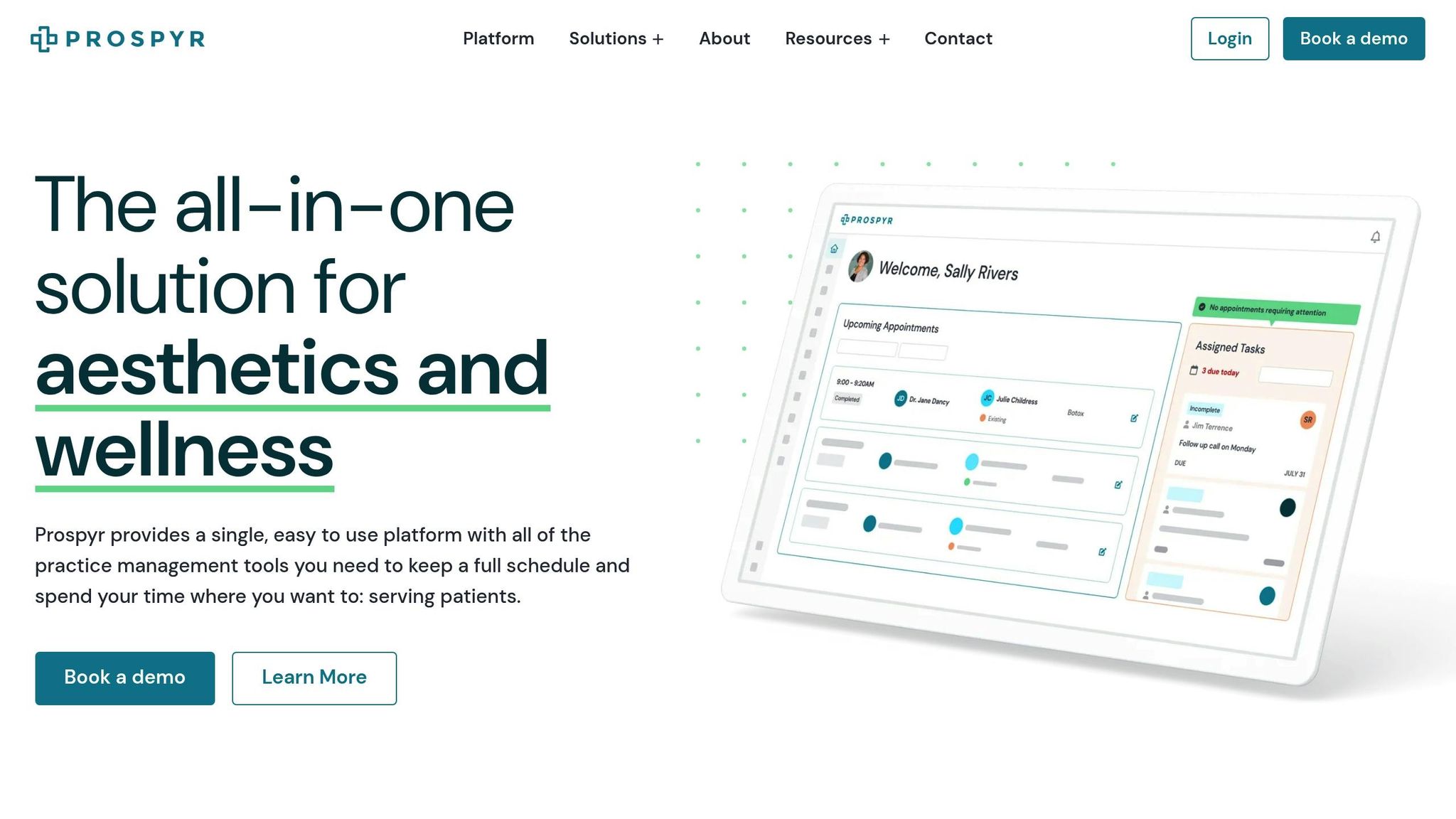
Managing multiple software systems can overwhelm even the most well-trained staff. Many med spas rely on up to seven different platforms for tasks like scheduling, CRM, EMR, and patient communication, making onboarding a long and error-prone process. Prospyr simplifies this by combining these tools into one cohesive platform, allowing your team to master a single system instead of juggling several. This streamlined approach helps reduce the complexity of training and minimizes the risk of mistakes.
The platform’s intuitive design shortens training time, enabling your staff to prioritize patient care. For instance, Dr. Daniel Lee transitioned New Life Cosmetic Surgery from four separate software systems to Prospyr, leading to a 40% boost in appointments and a 50% increase in revenue. With fewer technical hurdles, the team could focus more on client interactions. Similarly, SOM Aesthetics achieved over $100,000 in monthly revenue within just two months of opening, thanks to Prospyr’s ability to streamline their operations.
Improve Scheduling and Communication
Prospyr’s all-in-one scheduling and communication features eliminate the need to train staff on multiple systems. The platform’s built-in email and SMS tools ensure patient communications are consistent and aligned with the brand standards established in Step 1. Additionally, the integrated task management system helps organize daily activities, ensuring that no details are overlooked - especially during those critical early weeks of training.
"Setup your staff for success and ensure clients are well served with our integrated task system." - Prospyr
By consolidating these tools, Prospyr reduces training time and helps prevent staff burnout. When everyone works within the same platform for scheduling, intake forms, and follow-ups, training becomes simpler, and service delivery stays consistent. Beyond scheduling, the platform’s real-time analytics offer insights that further enhance team performance.
Use Analytics to Identify Improvement Areas
Just as earlier training steps focused on refining skills, Prospyr’s analytics tools help identify areas for improvement. These real-time insights reveal patterns in operations, such as staff members with lower consultation conversion rates or fewer repeat bookings, enabling you to provide targeted coaching where it’s needed most. The platform’s review management tool also tracks online client feedback, giving you specific examples to address during performance reviews.
"Prospyr has helped us launch SOM Aesthetics like a rocketship. Their powerful platform and helpful support have enabled us to exceed our financial targets while delivering an unmatched experience for our patients." - Dr. Saami Khalifian, Founder and CEO of SOM Aesthetics
Maintain and Improve Customer Service Over Time
Training shouldn’t stop after onboarding - it’s an ongoing process that ensures your team stays sharp and aligned with your med spa’s goals.
Offer Regular Training Sessions
Routine training sessions are essential for keeping your team on top of customer service basics and industry updates. Consider hosting quarterly workshops that focus on practical skills like handling common client concerns (e.g., "I’m afraid of looking fake"), mastering upselling strategies, and managing tough patient interactions. These sessions can also introduce new techniques and technologies, helping your staff stay current and confident.
Mystery evaluations are another great tool to assess client engagement and adherence to protocols. Use the insights from these evaluations as teaching moments to refine your team’s approach. Additionally, make it a point to revisit HIPAA regulations and your standard operating procedures regularly. This ensures compliance and reinforces the role-playing and feedback practices already in place.
Recognize Achievements and Address Problems
Acknowledging success and tackling challenges head-on is vital for maintaining high standards. Celebrate team members who excel - whether it’s converting consultations or earning glowing client feedback - during meetings to boost morale and inspire others. On the flip side, use group discussions and role-playing to address issues and learn from them.
Balancing recognition with constructive feedback is key. Highlight achievements publicly to motivate the team, but also address challenges quickly and monitor workloads to prevent burnout. When staff feel supported, valued, and equipped to succeed, they’ll deliver the exceptional care your clients expect. Regular training and recognition ensure your team stays aligned with your med spa’s customer service values.
FAQs
How long should customer service training take?
The length of customer service training for med spa staff can differ widely, usually spanning anywhere from a few hours to several days. Training is often broken into sessions or modules to tackle essential topics such as communication skills, professional etiquette, and handling client interactions. The goal is to strike a balance - providing enough depth to prepare staff effectively while minimizing disruptions to daily operations.
What should be in a med spa customer service SOP?
A med spa customer service SOP should outline clear steps for staff communication, appointment handling, and client interactions. Here are some key components:
- Front Desk Protocols: Establish guidelines to create a welcoming atmosphere and leave a positive first impression.
- Role-Playing Exercises: Use training scenarios to help staff practice handling various client situations effectively.
- Legal Compliance: Ensure adherence to HIPAA regulations and uphold ethical standards in all client interactions.
- Feedback Sessions: Regularly review client and staff feedback to identify areas for improvement and maintain service quality.
By focusing on these areas, your med spa can deliver consistent service, build trust, and strengthen client loyalty.
Which metrics best measure customer service success?
When it comes to gauging customer service success in med spas, a few key metrics stand out: patient satisfaction ratings, client retention and rebooking rates, and service quality indicators.
Patient satisfaction ratings are a direct reflection of how well a med spa meets its clients' expectations. Scores above 85% are considered a strong indicator of success, showing that the spa consistently delivers a positive experience.
Retention and rebooking rates are equally critical. In top-performing med spas, these figures typically range between 60-80%. High retention and rebooking rates suggest that clients feel valued and are drawn back by the level of care and personalized service they receive.
Other metrics, such as resolution time, can also provide insight into the quality of customer support. Faster resolution times often point to a well-organized, client-focused approach that enhances the overall experience.