Zoning Tips for Multi-Location Med Spas
Zoning and compliance guidance for multi-location med spas: permits, CPOM rules, ADA access, variances, and centralized documentation.
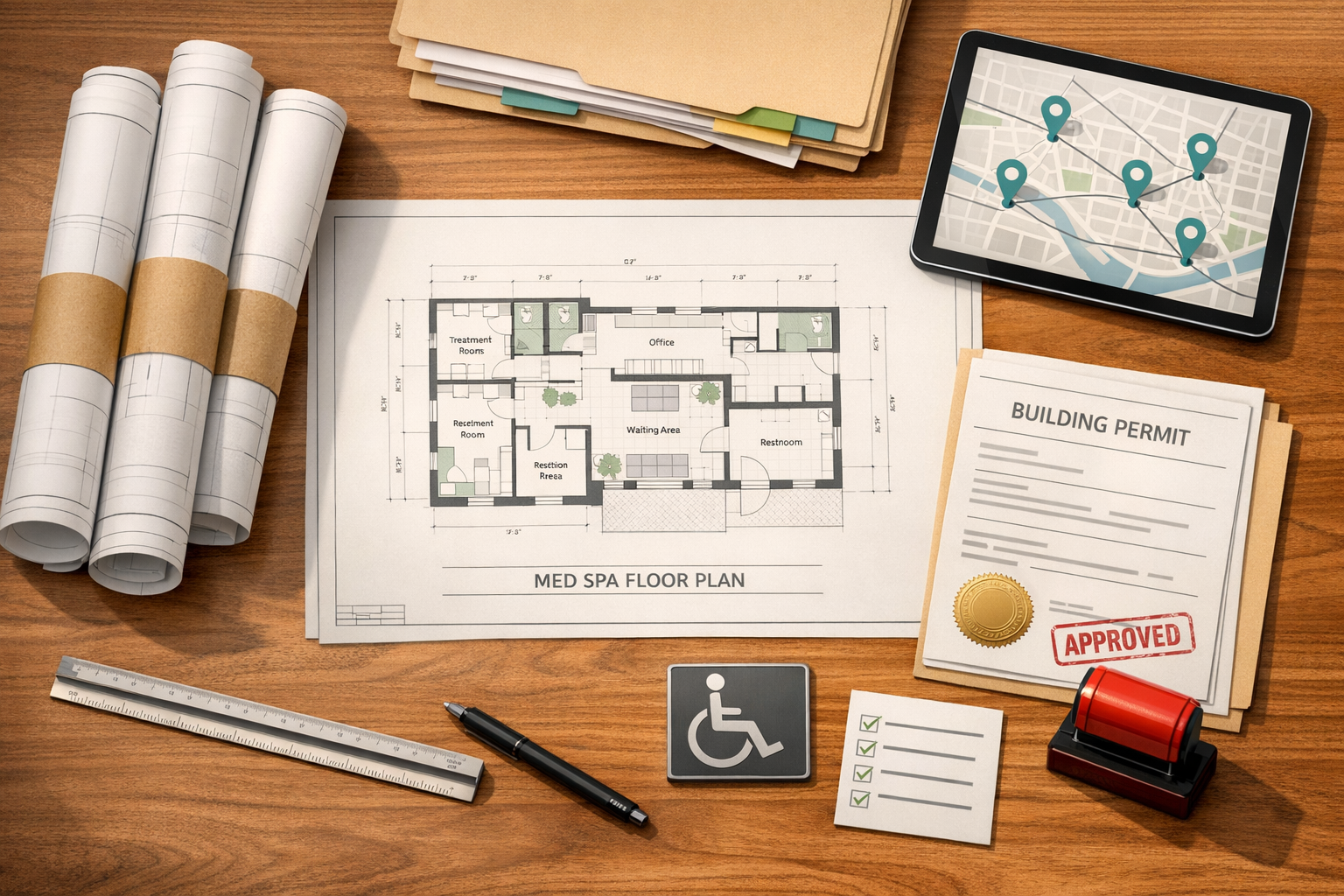

Zoning laws are critical when running a med spa, especially if you're expanding to multiple locations. Missteps can lead to fines, forced relocations, or even license suspensions. Here's what you need to know:
- Zoning Classifications: Med spas are often classified as "medical offices", requiring stricter permits compared to retail spas.
- State-Specific Rules: Ownership and licensing regulations vary by state. For example, New Jersey requires MDs or DOs to own med spas.
- Compliance Challenges: Each location may face unique zoning codes, such as parking, signage, and accessibility requirements.
- Key Permits: You'll need zoning approvals, Certificates of Occupancy, and possibly variances for non-compliant properties.
- ADA Compliance: Ensure facilities meet accessibility standards, including wheelchair access and clear signage.
Proactively researching local zoning codes, securing proper permits, and designing facilities to meet health and safety standards can save you from costly mistakes. For multi-location operations, consider using centralized systems to manage compliance and documentation efficiently.
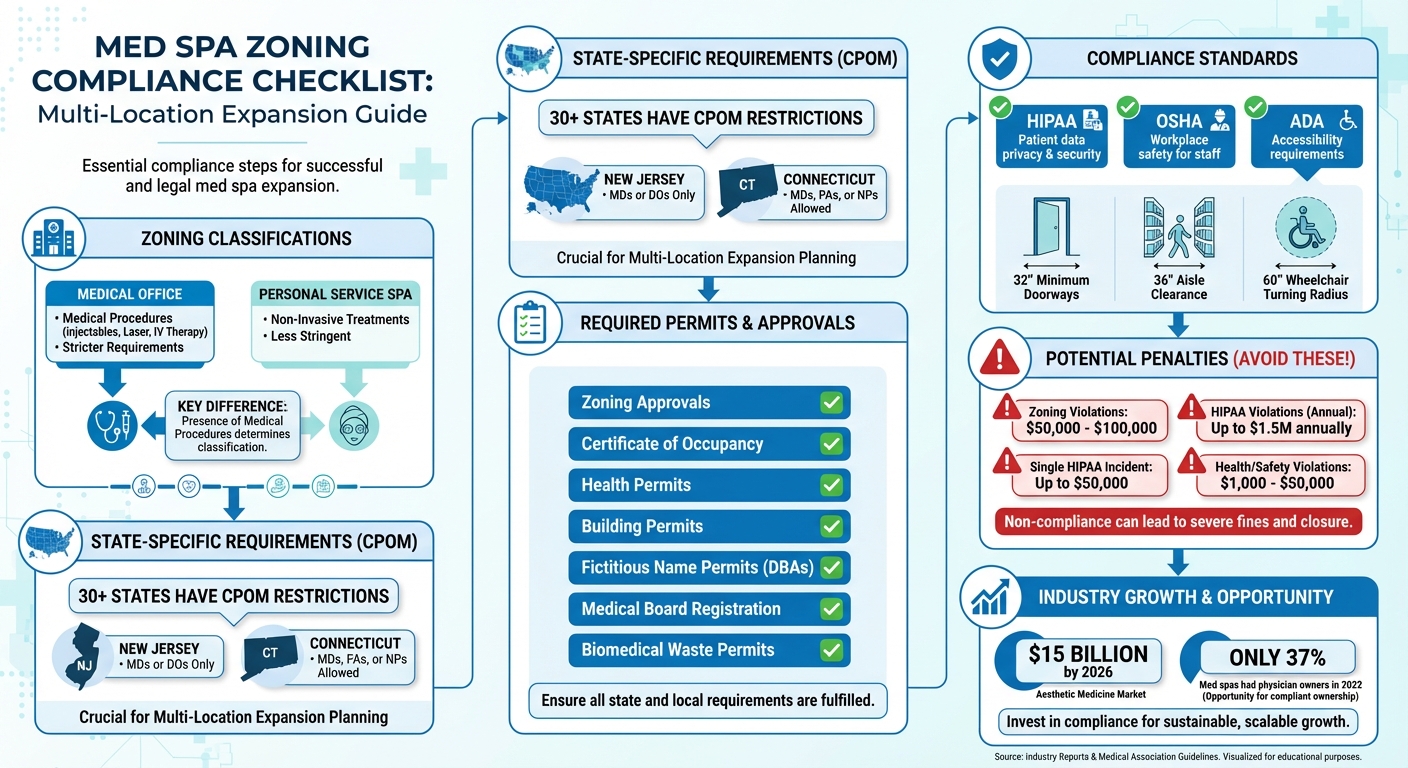
Med Spa Zoning Compliance Checklist for Multi-Location Expansion
Zoning Classifications and Regulations
Medical Office vs. Spa Zoning
When setting up a med spa, the main difference lies in whether it's classified as a "medical office" or a "personal service" spa. Since med spas often perform procedures considered medical - like injectables, laser treatments, and IV therapy - many municipalities categorize them as medical service providers. This classification comes with stricter requirements, including compliance with HIPAA for patient data privacy and intake and OSHA standards for workplace safety, such as handling sharps and needles properly.
Ownership rules also vary by state, particularly in places with strict Corporate Practice of Medicine (CPOM) doctrines. For example, New Jersey requires that only MDs or DOs own the clinical side of a med spa, while Connecticut allows ownership by MDs, Physician Assistants, or Nurse Practitioners. These differences directly impact whether your business will need a "Medical Office" or "Professional Office" zoning permit. More than 30 states, including New Jersey, New York, and Texas, have restrictive CPOM doctrines that influence how med spas are classified and owned.
"Medical aesthetic procedures, including Botox, fillers, microneedling, and IV therapy, are classified as medical services and must be overseen by a licensed physician." - Wellness MD Group
Common Zoning Restrictions
Med spas often face additional zoning restrictions based on their classification. Medical facilities typically must meet higher standards for parking availability, maintain specific distances from schools or other sensitive areas, and comply with ADA accessibility requirements and strict signage regulations. For instance, ADA compliance requires features like wheelchair-accessible exam rooms and restrooms. Additionally, medical facilities may face stricter rules on signage visibility and lighting compared to other commercial businesses.
Other requirements include obtaining biomedical waste permits, fictitious name permits (if applicable), and ensuring the facility layout includes private areas for patient evaluations or HIPAA-compliant telehealth rooms.
"Securing the correct use permit or variance often involves submitting floor plans, a business description, and proof of professional licensure to the planning or zoning board, and failure to do so can result in fines, cease‐and‐desist orders, or forced relocation." - Sukrti Thonse, Attorney, Greenbaum, Rowe, Smith & Davis LLP
Preparing for these zoning and regulatory hurdles is essential. Researching local codes and securing the right permits early can save you from costly fines or forced relocations down the line.
sbb-itb-02f5876
How to Verify and Secure Zoning Compliance
Researching Local Zoning Codes
Before committing to lease or purchase a property, reach out to your local city or county zoning office to confirm whether services like "medical spa" or "medical office" operations are allowed at that specific location. Zoning laws are not universal - they vary widely between municipalities. A property suitable in one city might not meet the requirements in another. Ask the zoning department to verify the property's current classification and confirm that your planned services, such as injectables, laser treatments, or IV therapy, align with the permitted use for that address.
You'll also need to secure a Certificate of Occupancy, which involves a local property inspection to confirm compliance with zoning regulations, as well as size and utility standards. Keep in mind that some states have specific rules about business structures. For instance, in California, med spas must operate as professional corporations rather than LLCs.
Don’t forget to schedule pre-opening inspections for fire safety and health compliance. These inspections ensure that your facility meets sanitation and safety standards. Non-compliance can lead to significant penalties, ranging from fines of $50,000 to $100,000, or even the suspension of a medical license.
Once you’ve verified zoning compliance, the next step is obtaining the necessary permits or variances to finalize your approval.
Submitting Permits and Variances
If the property doesn’t meet zoning requirements, you may need to apply for a variance or a special use permit. A variance allows exceptions to strict development standards, such as setbacks, building height, or parking requirements, especially when adhering to these standards would create unnecessary hardship due to the unique characteristics of the property. To be granted a variance, you’ll need to demonstrate that compliance creates undue hardship without negatively impacting the public or altering the neighborhood's character.
"A Variance is a request to allow a deviation from a development standard required by the Zoning Ordinance." – City of Phoenix
When submitting your application, include a comprehensive project plan. This should cover floor plans, a detailed business description, and proof of professional licensure. Some jurisdictions also require notifying nearby property owners, who may attend public hearings to share any concerns. To avoid boundary disputes, consider hiring a surveyor to clearly define property lines. Additionally, working with a healthcare attorney experienced in med spa regulations can help you navigate complex state-specific rules, including those tied to the Corporate Practice of Medicine doctrine.
Reading about the problem? See how Prospyr solves it in one platform.
Book a DemoDesigning Facilities for Compliance
Health and Safety Code Requirements
Once zoning approval is secured, it’s time to design your facility to meet the strict health and safety standards required for medical practices. These design choices aren’t just about functionality - they’re essential for maintaining compliance across multiple locations.
Set up dedicated sterilization areas equipped with autoclaves (capable of reaching 121°C to eliminate all microbes), chemical baths, UV stations, EPA-registered surface disinfectants, and clearly labeled medical waste disposal systems that meet OSHA standards. Treatment rooms should be HIPAA-compliant and soundproof, featuring HEPA filters to maintain air quality. Ensure safety exits are clearly marked and stocked with emergency equipment like AEDs, oxygen tanks, and epinephrine. All medical equipment must be FDA-approved, with detailed logs maintained for regular maintenance and calibration.
California law mandates that medical records be stored securely for at least 7 years. Whether you opt for digital or physical storage, it must comply with HIPAA standards. Health boards generally inspect facilities twice a year to confirm that sanitation logs, sterilization cycles, and equipment maintenance records are up-to-date. Falling short of these standards can lead to penalties ranging from $1,000 to $50,000, while HIPAA violations can result in fines as high as $1.5 million annually.
Besides meeting clinical protocols, it’s equally important to ensure your facility complies with strict access and safety standards for all visitors.
Parking and Accessibility Standards
Compliance with the Americans with Disabilities Act (ADA) is non-negotiable, as medical spas are considered public accommodations. This means you’ll need to meet specific requirements, such as:
- Doorways with a minimum width of 32 inches
- Aisles with at least 36 inches of clearance
- Treatment rooms with a 60-inch wheelchair turning radius
- Adjustable treatment tables for safe transfers
- Obstacle-free entry points with inclusive signage, including large fonts and braille
- Accessible parking spaces designated according to local regulations
It’s a good idea to audit your facility annually and after any renovations to ensure ongoing compliance with ADA regulations and local zoning laws. You can also enhance accessibility by adding tactile surfaces and clear pathways to help clients with visual impairments navigate to reception and treatment areas. These updates aren’t just about meeting legal requirements - they create a welcoming environment for all clients while safeguarding your business from expensive fines.
Zoning Strategies for Multi-Location Expansion
Analyzing Locations for Zoning and Market Fit
Expanding to multiple locations involves more than just replicating your existing business model. It requires a legal framework that adjusts to the unique demands of each market. Before committing to a lease, it's critical to conduct a comprehensive review of the target market's specific medical board requirements and local ordinances.
The aesthetic medicine industry, projected to reach $15 billion by 2026, presents its own set of challenges. For example, many states enforce CPOM (Corporate Practice of Medicine) laws, which limit med spa ownership to licensed physicians. In such cases, a Management Services Organization (MSO) model can work well. In this arrangement, a non-physician entity manages administrative operations while a physician-owned entity oversees clinical services. Licensing requirements for facilities also vary widely from state to state.
"Scaling a med spa isn't just about replicating your business model - it's about building legal infrastructure that can support sustainable growth while managing the unique risks inherent to the aesthetic medicine industry."
– Adam Witkov, Attorney, Michael Best & Friedrich LLP
These considerations form the foundation for creating a compliance system that supports growth across multiple locations.
Building a Compliance Checklist
To simplify operations across locations, create a compliance checklist that balances flexibility with consistency. This checklist should be adaptable to the regulatory requirements of different states while ensuring uniform quality. Key items to include are:
- Zoning approvals
- Health permits
- Certificate of Occupancy (covering zoning, utilities, and size)
- Building permits for renovations
- Fictitious name permits (DBAs)
- Medical board registration
- Seller's permits for retail skincare products
Centralized software can help manage staff credentials, permits, and other records across all locations, making them readily auditable. Additionally, establish a system to monitor changes in federal, state, and local regulations in each area where you operate. Keep in mind that even a single HIPAA violation could result in fines of up to $50,000 per incident, highlighting the importance of diligent compliance management.
Working with Zoning Professionals
Once your compliance checklist is in place, consulting with zoning professionals can help address complex legal and regulatory requirements. Before signing leases or finalizing expansion plans, seek guidance from legal and zoning experts. These professionals can help you navigate CPOM laws, which may require ownership by licensed physicians or the creation of Professional Limited Liability Companies (PLLCs). They can also assist in developing standardized operating procedures that ensure quality while meeting varying regulatory standards.
Zoning experts are invaluable for understanding the regulatory differences between states, including labor and employment laws, which can vary significantly.
"The difference between expansion that fuels long-term success and expansion that creates costly problems often comes down to understanding the legal landscape before making commitments."
– Adam Witkov, Attorney, Michael Best
How Prospyr Supports Zoning and Operations Management
Managing Documentation and Compliance Tracking
As businesses expand, keeping track of zoning documents across multiple locations can quickly become a logistical headache. Prospyr's Media Archive takes the chaos out of the equation by centralizing all site-specific zoning permits, variances, certificates of occupancy, and compliance documents in one place. This means no more scrambling to find critical files during municipal inspections - it’s all right there when you need it.
Prospyr also simplifies compliance with its Digital Intake and Streamline Charting tools. These features standardize medical records and consent forms, ensuring they align with the zoning classifications of each location. Plus, they help maintain proper documentation for OSHA and air quality standards, which are often required for occupancy certificates. Need to keep everything organized? Create a "Compliance Folder" for each site to store zoning variances, health permits, business licenses, and other essential facility documents.
What makes this even better is how seamlessly Prospyr integrates these tools with its broader operational features. By organizing documentation efficiently, you not only meet regulatory requirements but also make day-to-day management a lot smoother.
Improving Efficiency Across Multiple Locations
Running operations across multiple locations can be a juggling act, but Prospyr makes it easier with its Multi-Location Scheduling and Analytics tools. These features let you oversee operations across jurisdictions from a central hub. Whether it’s coordinating provider rotations or ensuring each facility meets local staffing and supervision rules, Prospyr has you covered.
The analytics dashboard is another game-changer. It allows you to compare how different zones - like retail versus medical - perform in terms of operational efficiency. This insight helps you identify which zoning classifications offer the best return on investment, providing valuable data for planning future expansions.
Prospyr also tackles location-specific needs with its Inventory Management and Lab Ordering tools. For example, medical offices can ensure they always have the supplies and equipment required to meet zoning regulations. And with integrated payment processing and automated rebooking reminders, administrative work becomes less of a burden. This means you can focus less on managing paperwork and more on scaling your business effectively.
Conclusion
The Importance of Zoning Management
Zoning compliance is more than just a regulatory requirement - it's the backbone of growth for the med spa industry. The tricky part? Compliance doesn't follow a one-size-fits-all model. What works in one location may need serious adjustments in another. Expanding to new areas increases exposure to risks like professional liability, premises liability, and heightened regulatory oversight. Without a solid zoning framework in place from the start, you could face costly hurdles that slow down your progress.
Mistakes in zoning classifications or ownership structures can ripple through your operations, affecting everything from advertising strategies to delegation protocols and consent documentation. Considering that only 37% of med spas had physician owners in 2022, understanding how zoning laws intersect with ownership regulations is more critical than ever.
These complexities highlight the importance of taking a proactive approach to compliance and leveraging the right tools to manage growth effectively.
Using Technology for Better Operations
Technology offers a way to simplify zoning compliance and streamline operations. Platforms like Prospyr provide centralized solutions to keep your permits, licenses, and compliance documents organized and easily accessible. This ensures you're always inspection-ready and eliminates the last-minute scramble during audits. With these systems in place, you can focus on scaling your business while maintaining consistency and quality across multiple locations.
FAQs
How do I confirm a med spa is allowed at a specific address before signing a lease?
Before committing to a lease, make sure the property is permitted for medical spa use. Start by reviewing local zoning laws, which you can do by contacting your local planning or zoning department or examining zoning maps and ordinances. It's crucial to secure zoning approval ahead of time to stay compliant and steer clear of legal complications. Tools like Prospyr can simplify the process by helping you manage permits and ensure ongoing compliance.
When do I need a variance or special use permit for a med spa location?
If your med spa's intended use doesn't align with current zoning requirements or requires additional approval, you'll need a variance or a special use permit. This typically comes into play when unique location factors or specific zoning district rules are involved. To avoid unnecessary delays, make sure to review local regulations thoroughly and ensure everything is in compliance.
How do CPOM rules affect med spa ownership across different states?
CPOM (Corporate Practice of Medicine) rules play a key role in determining who can own or control medical practices, including med spas. In many states, these laws prevent non-physicians from owning or managing such practices to ensure medical decisions stay in the hands of licensed professionals.
For example, states like California and Texas have strict regulations, including the Doctor-Only Rule. This rule limits ownership to licensed physicians or, in some cases, specific healthcare professionals. These restrictions are designed to prioritize patient care over business interests.
If you're managing med spa locations across multiple states, it's critical to understand how these rules differ from one state to another. Staying compliant with these laws is not just a legal necessity - it’s a fundamental part of operating responsibly in the industry.