Legal Standards for Aesthetic Consent Forms
Checklist for defensible aesthetic consent: procedure-specific risks, timing, signatures, secure storage, and audit-ready digital records.
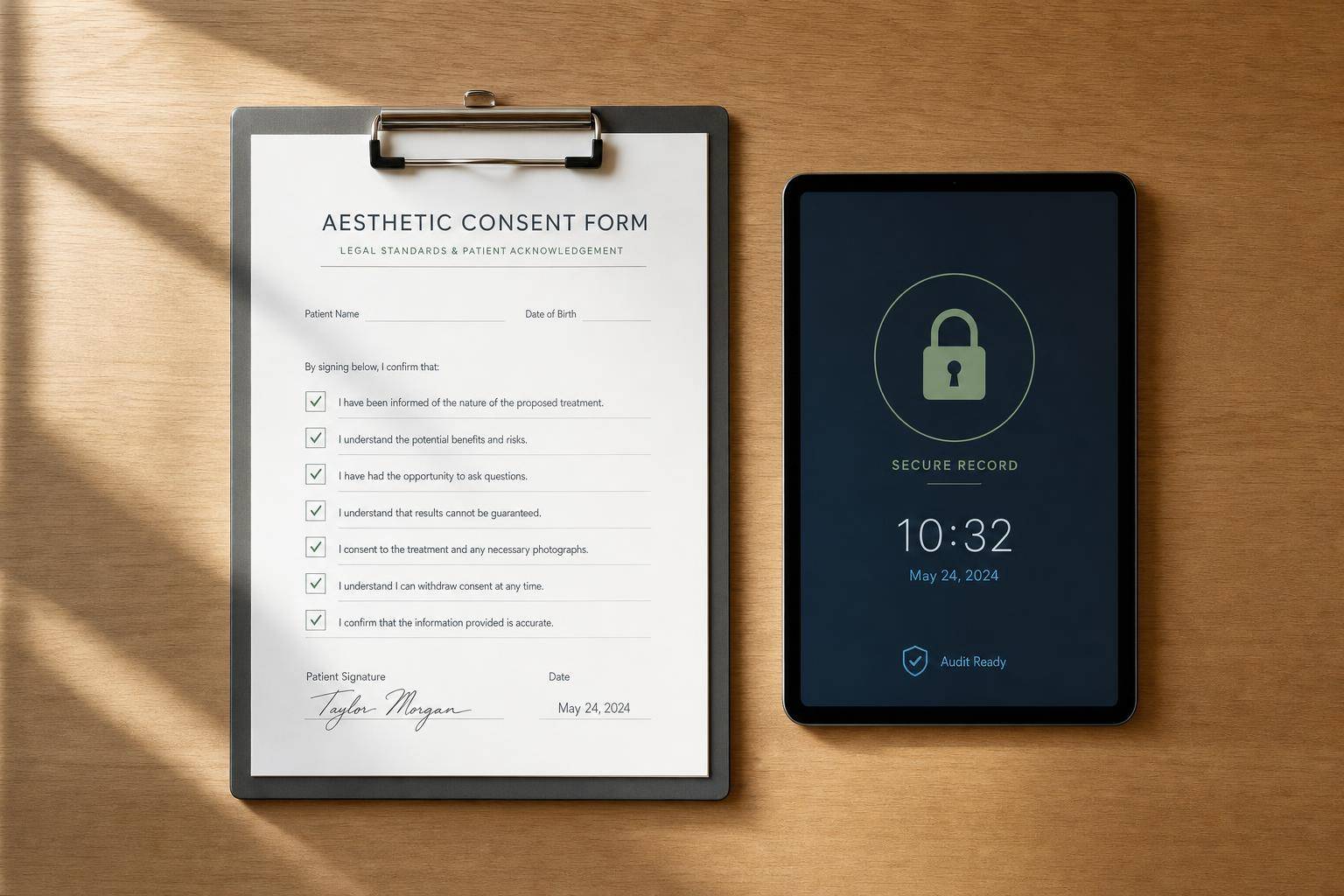

A signed form alone does not prove informed consent. In U.S. aesthetic care, the record needs to show that the patient got clear details on risks, benefits, other options, and the choice to do nothing before treatment started.
Here’s the short version:
- Consent is a process, not just a signature
- One form should match one procedure
- Risk disclosures should match the treatment
- Timing matters: consent signed on 06/29/2026 at the last minute can be challenged
- Photo use needs separate permission
- Records must be stored and kept under HIPAA and state retention rules
- Digital consent works only if the patient portal system shows identity, timestamp, and version history
I’d boil the legal standard down to this: if a practice cannot show what was explained, who explained it, when the patient agreed, and which form version was signed, the consent record is weak.
A few hard facts stand out:
- Adult records are often kept for at least 7 years
- Minor records are often kept until age 21 or 7 years, whichever is longer
- High-risk treatments like fillers, lasers, neurotoxins, peels, and weight-loss injections each need their own risk language
- HIPAA applies to consent forms, intake records, and patient photos when they contain identifiable health data
What matters most is simple:
- Use plain language
- List treatment-specific risks
- Document questions and answers
- Get signatures before treatment
- Store the exact signed record in a secure system
If I were summarizing the whole article in one line, it would be this: the safest consent form is the one that matches the real conversation and can be produced later without gaps.
What Informed Consent Means in U.S. Aesthetic Care
In U.S. aesthetic care, providers have to give patients enough information to make a voluntary, informed choice before treatment starts. Put simply, the patient needs the facts that matter before anything is done.
What a Patient Must Understand Before Treatment
Under U.S. practice standards, patients are generally expected to receive five main disclosures before any aesthetic procedure:
- Nature and purpose of the procedure, explained in plain language
- Material risks, including common side effects and serious complications
- Expected benefits and realistic outcomes
- Reasonable alternatives, including no treatment
- Aftercare, activity restrictions, and downtime
Those risk disclosures should fit the treatment itself. For neurotoxins, that includes eyelid or eyebrow ptosis and spread beyond the injection site. For dermal fillers, it includes vascular occlusion, tissue necrosis, and vision loss. For lasers and IPL, providers should document the patient’s Fitzpatrick skin type and disclose the risk of burns, scarring, and pigment changes.
General Consent, Procedure-Specific Consent, and Assumption of Risk
Not all consent forms do the same job. A general intake form may cover office policies and broad permission, but it does not satisfy informed consent.
What carries legal weight is procedure-specific consent. That means the form and discussion should deal with the risks tied to one treatment, not a bundled list of everything a practice happens to offer.
Assumption-of-risk wording doesn’t fix weak disclosure. A patient can’t legally accept a risk they were never told about.
Capacity, Voluntariness, and Rules for Minors
Valid consent requires an adult who has decision-making capacity and is acting voluntarily.
Timing matters more than many practices think. If consent is obtained right before a procedure, while the patient is already on the treatment table, or during numbing, it can be challenged as rushed or pressured. A better approach is to send the forms ahead of the visit so the patient has time to read them and ask questions.
For patients under 18, a parent or legal guardian must give authorization. The consent form should document the guardian’s identity, the guardian’s relationship to the minor, the patient’s date of birth, and the date and time of signing. The same rules also apply to how the form is written and signed.
sbb-itb-02f5876
Reading about the problem? See how Prospyr solves it in one platform.
Book a DemoWhat a Legally Sound Aesthetic Consent Form Should Include
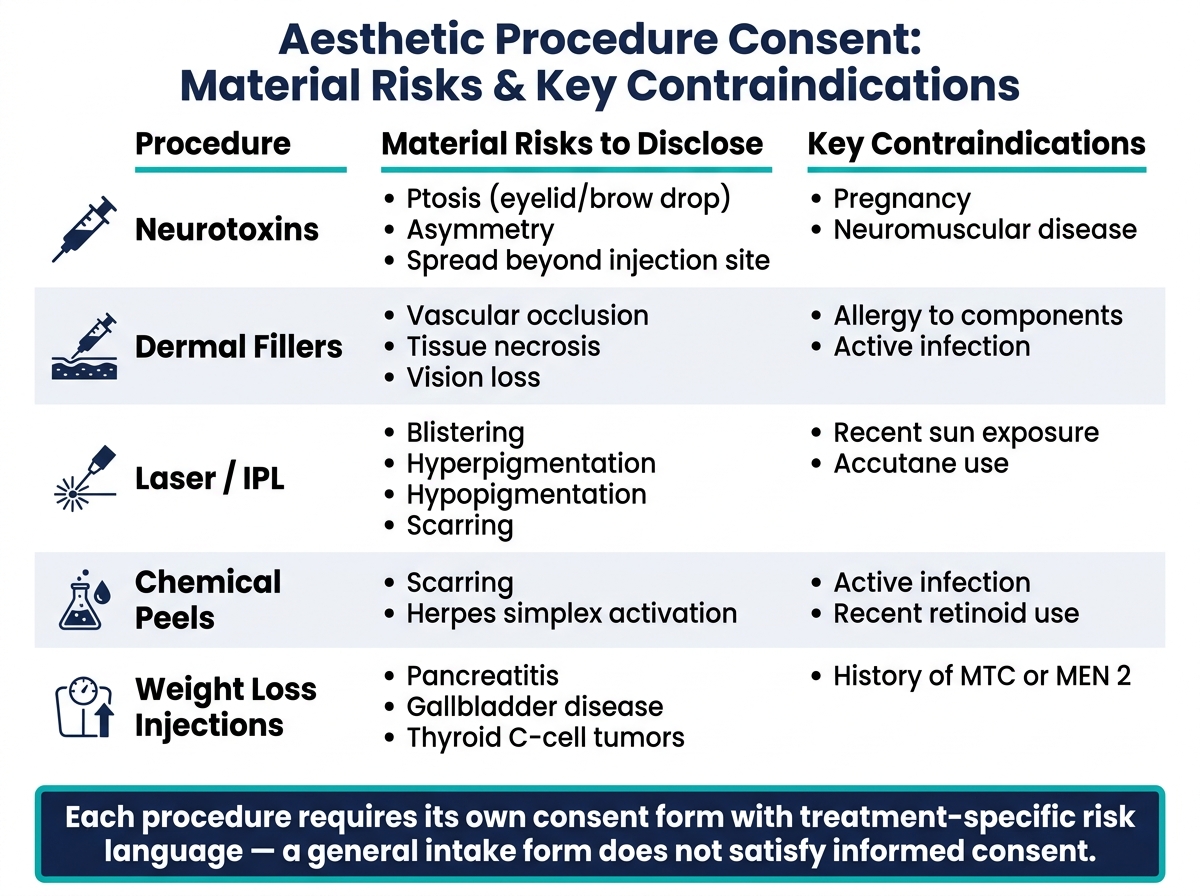
Aesthetic Consent Form: Procedure-Specific Risks & Legal Requirements
A defensible form should show four basic things: who got treated, what was done, what was explained, and when the patient agreed.
Patient, Provider, Procedure, and Risk Disclosures
Start with clear identifiers. That means the patient's full legal name, date of birth, the date consent was obtained, and the name and credentials of the provider doing the treatment. Those details connect the form to the right patient, the right provider, and the right date.
Procedure details matter just as much. The form should name the exact product, the treatment area, and the dose. A form that says "injectable treatment" leaves too much room for doubt. A form that names the specific neuromodulator and the exact treatment area is much stronger.
Risk disclosures also need to fit the treatment. In plain terms, the form should match what the patient is actually getting.
| Procedure | Material Risks to Disclose | Key Contraindications |
|---|---|---|
| Neurotoxins | Ptosis (eyelid/brow), asymmetry, spread beyond injection site | Pregnancy, neuromuscular disease |
| Dermal Fillers | Vascular occlusion, tissue necrosis, vision loss | Allergy to components, active infection |
| Laser/IPL | Blistering, hyper/hypopigmentation, scarring | Recent sun exposure, Accutane use |
| Chemical Peels | Scarring, herpes simplex activation | Active infection, recent retinoid use |
| Weight Loss Injections | Pancreatitis, gallbladder disease, thyroid C-cell tumors | History of MTC or MEN 2 |
The form should also explain the expected benefits in clear words, while stating that results vary and aren't guaranteed.
Alternatives, Off-Label Use, and Pre-Treatment Evaluation
After risks, the form should make it clear that the patient had options. List reasonable alternatives to the proposed treatment, including no treatment at all, along with the risks and benefits of each. That matters because consent isn't much of a choice if only one path is shown.
Off-label use should be stated plainly too. U.S. law doesn't always require that disclosure, but many see it as best practice when a device or medication is used outside its FDA-approved indication. Say it in simple language, not legal jargon.
The form should also show that screening happened before the patient signed. Document the pre-treatment evaluation, including that the patient was screened for contraindications like pregnancy, active infections, or medical history tied to the procedure, before consent and treatment.
Signatures, Timing, and Plain-Language Wording
The form should include the patient's signature plus either the provider's signature or a witness co-signature. A witness isn't required in every state, but it can add one more layer of legal support by showing the signing was observed. If consent is digital, the record should include a timestamp.
Plain language matters. A dense, legal-heavy form defeats the point. If a patient can't follow what they're reading, then the informed part of informed consent starts to fall apart. If an interpreter was used, document that too. For remote consultations, ensure your telehealth platform supports secure document sharing and verification.
It also helps to include a clear attestation stating that the patient had the chance to ask questions and got answers before treatment. The form should read like a record of the actual consent discussion, not just a blanket waiver.
Common Consent Form Defects and Their Legal Consequences
Documentation Mistakes That Most Often Weaken Consent
A form can look complete on the surface and still fall apart if the process behind it was rushed.
Blanket consent forms are weak from a legal standpoint because they don't spell out risks tied to the specific procedure. Consent can also be challenged when it's obtained on the treatment table, after numbing, by staff who aren't allowed to obtain it, or through forms with blank fields, missing dates, no version control, or missing co-signatures. Each of those problems makes it harder for a practice to show that valid informed consent actually happened.
Why a Signed Form Alone Does Not Prove Valid Informed Consent
This matters because the record has to connect what was said with what can be proven.
A signature shows only that a form was signed. It does not show that the patient understood the risks, benefits, and alternatives. If a material risk was left out, consent can fail even when the form carries the patient's signature.
The chart should back up the form. Document the discussion, including the questions the patient asked, the answers given, and the patient's consent to move forward.
Photo and Video Consent as a Separate Legal Issue
Photo use needs its own authorization. Treatment consent does not cover image use.
Clinical, training, marketing, and social use each call for separate permission. A standalone photo authorization works best, with separate yes/no choices for:
- clinical records
- training
- marketing
- social media
When those permissions are bundled into a treatment consent form, HIPAA risk can follow if images are later shared or stored outside the scope the patient agreed to.
Regulatory Standards, Recordkeeping, and Digital Consent Workflows
HIPAA, Retention, and Secure Storage of Consent Records
Once consent is in hand, the next legal issue is simple: Can your practice store it, find it, and prove it later? Consent forms are part of the medical record, so they follow the same privacy and retention rules. If your practice sends health information electronically, HIPAA applies to consent forms, intake forms, and identifiable photos.
The HIPAA Notice of Privacy Practices and a procedure-specific consent form are not the same thing. The NPP explains how patient information is used and protected. The consent form records the risks, benefits, and alternatives tied to a specific treatment. Those documents should be signed separately.
Most U.S. states require adult records to be kept for at least 7 years. For minors, records are usually kept until the patient turns 21 or for 7 years, whichever is longer. Records should be stored in encrypted digital systems or locked physical files. Unencrypted shared drives, personal email, and unprotected messaging apps are not acceptable. And if a vendor stores or processes PHI, that vendor must have a signed BAA before getting the data.
That storage piece matters for one reason above all: a consent form only helps if the practice can show the exact record the patient signed.
Electronic Signatures, Audit Trails, and Digital Consent Forms
Under the federal E-SIGN Act and UETA, electronic signatures are usually valid when the system records a timestamp, signer identity, and audit trail. A record you can stand behind should show the signing time, signer identity, and audit trail.
Version control matters here too. If a dispute comes up, the practice needs to produce the exact consent version signed on that date. Each consent template should include a version number and review date in the footer. Digital forms can also cut down on incomplete charts by requiring every field and signature before submission. Patients should have a chance to review the full form before signing. If a system pushes them past key terms too fast, that can weaken the form’s validity.
A digital signature, by itself, doesn’t prove informed consent. The stronger record shows what was shared, when it was signed, and which version the patient received.
Using Prospyr to Standardize Consent Documentation Across the Practice
A standard workflow helps cut down on missing signatures, wrong forms, and version-control mistakes. Prospyr can standardize digital consent workflows by linking the right form to the patient record and storing it with the chart.
Conclusion: The Minimum Standard for Defensible Aesthetic Consent
In aesthetic care, informed consent is a process. It includes the discussion, the disclosure, the signature, and the way the record is stored.
For consent to hold up, you need a real conversation, procedure-specific disclosure, signatures collected before treatment, and secure HIPAA-compliant storage. A conversation with no record is weak. A signed form with no discussion is even weaker. The record is what turns consent into something you can defend.
The minimum standard is simple:
| Element | What It Requires |
|---|---|
| Scope | One procedure per form |
| Content | Risks, benefits, alternatives, no-treatment option |
| Timing | Before treatment, with time for questions |
| Language | Plain language |
| Signatures | Patient and provider or witness |
| Storage | Encrypted HIPAA-compliant storage |
| Retention | Per state law; longer for minors |
Update forms when services, products, or state rules change. Add a version number and review date. Prospyr can centralize digital intake forms and HIPAA-compliant consent storage.
In aesthetic care, the safest consent form is the one that matches the actual conversation, not the template.
FAQs
Who should obtain informed consent?
The healthcare provider performing the procedure must obtain informed consent.
That matters because informed consent is a process, not just a form. The provider doing the treatment is responsible for making sure the patient understands:
- the treatment
- the possible risks
- the expected benefits
- the available alternatives
This applies to licensed providers in aesthetic and wellness settings.
When should patients sign consent forms?
Patients should sign a procedure-specific consent form before each treatment.
A one-time signature at intake isn't enough. Informed consent is an ongoing process, which means each procedure needs its own discussion and its own documentation.
It also helps to give patients the form well ahead of time. That gives them a fair chance to read through the details, think it over, and ask questions before treatment.
Are electronic consent forms legally valid?
Yes. Under the ESIGN Act and UETA, electronic consent forms and signatures are legally valid in aesthetic practices, as long as the patient intends to sign and agrees to use electronic records.
That said, legal validity is only one part of the picture. To stay compliant, these forms also need to meet HIPAA security standards. That includes encryption, strong user authentication, tamper-proof audit trails, and secure storage.