How to Align Aesthetic Services with Seasonal Trends
Plan treatments, packages, staffing, and marketing around seasonal demand to boost bookings and revenue.

Aligning your aesthetic services with seasonal trends can boost bookings and revenue. The key is planning ahead based on patient needs throughout the year. Here’s how:
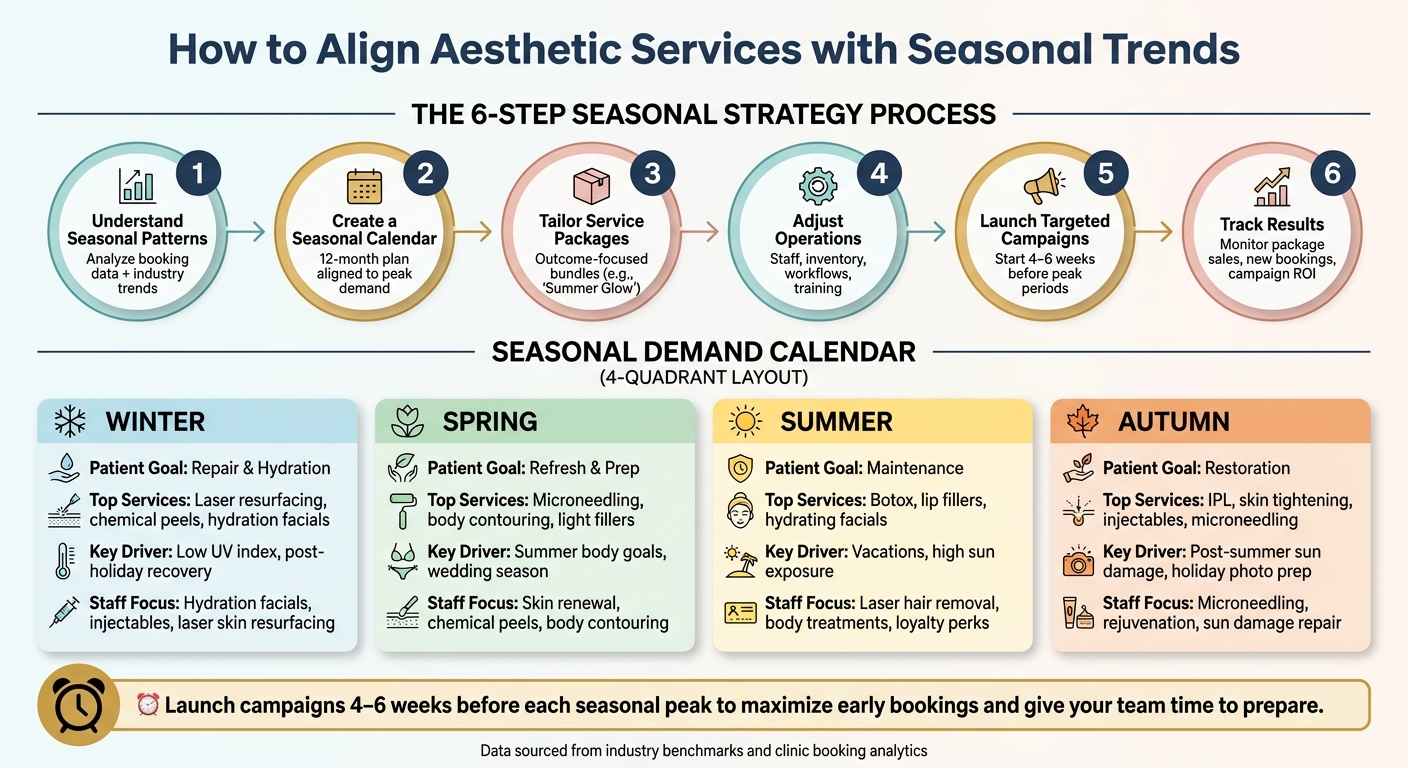
- Understand Seasonal Patterns: Analyze your clinic’s booking data and compare it with industry trends. For example, winter is ideal for laser treatments due to lower UV exposure, while spring focuses on body contouring for summer prep.
- Create a Seasonal Calendar: Map out a 12-month plan, aligning treatments like hydration facials in winter and sun damage repair in autumn with peak demand periods.
- Tailor Service Packages: Offer outcome-focused bundles tied to seasonal goals, such as a “Summer Glow” package starting in spring to maximize results by summer.
- Adjust Operations: Schedule staff, inventory, and workflows to match demand shifts. Train your team on seasonal protocols and ensure consistent communication.
- Launch Targeted Campaigns: Begin marketing 4–6 weeks before peak periods. Highlight why specific treatments are ideal for the season to drive early bookings.
- Track Results: Monitor metrics like package sales, new bookings, and campaign ROI to refine your strategy.
Seasonal Aesthetic Services Calendar: Year-Round Strategy Guide
Analyzing Seasonal Trends in Aesthetic Demand
Understanding the yearly demand patterns at your clinic can take you from guessing to knowing exactly when patients are likely to seek specific treatments - and why. This insight helps you plan services, promotions, and resources more effectively.
Using Historical Practice Data
Your clinic’s booking history is the best place to start. Analyze appointment volumes, revenue, and service-specific data from the past two to three years. Look for trends: Which months bring the most new bookings? Are there particular services that surge in Q4 but slow in Q1?
Break down your data by service type - injectables, lasers, body treatments, facials - to pinpoint true demand. Be sure to separate prepaid sessions from actual new bookings to get an accurate picture of spikes and dips in interest.
"Review historical data, apply seasonal adjustment factors, and refresh forecasts regularly." - Phoenix Strategy Group
Tracking both package sales and new bookings as separate performance indicators can help you differentiate between promotions that genuinely boost growth and those that just fill up your schedule without long-term impact.
Use these insights to compare your clinic’s trends against larger industry patterns.
Identifying External Seasonal Patterns
Once you've reviewed your internal data, compare it to broader industry trends across the U.S. Aesthetic demand often follows predictable seasonal rhythms:
| Season | Primary Patient Goal | Recommended Services | Key Driver |
|---|---|---|---|
| Winter | Repair & Hydration | Laser resurfacing, chemical peels, hydration facials | Low UV index, post-holiday recovery |
| Spring | Refresh & Prep | Microneedling, body contouring, light fillers | "Summer body" goals, wedding season |
| Summer | Maintenance | Botox, lip fillers, hydrating facials | Vacations, high sun exposure |
| Autumn | Restoration | IPL, skin tightening, injectables | Post-summer sun damage, holiday photo prep |
For example, summer often sees a shift toward low-downtime treatments like Botox, as patients are busy traveling and avoiding procedures that require sun avoidance. By autumn, demand for sun damage repair skyrockets, with services like IPL and microneedling becoming top choices as patients address pigmentation issues and prepare for holiday photos.
Check if your local market follows these national patterns. In some areas, demand for body contouring may start as early as February, while in others, the spring surge might not hit until April.
"The smart move is to treat these trends as a starting point, not gospel. Let your own booking data do the talking, then tweak your service menu to match." - Katy Piper, Content Writer, Pabau
By merging these external trends with your internal data, you can create a complete picture of seasonal demand.
Building a Seasonal Demand Calendar
Combine your internal insights with industry benchmarks to develop a 12-month calendar that aligns services with demand peaks. Assign each month a primary service focus, estimate demand levels (peak, steady, or slow), and plan marketing efforts accordingly.
Start campaigns 4 to 6 weeks before each seasonal peak. This gives your team time to prepare and allows patients to book appointments before the rush. For example, if body contouring demand spikes in May, launch your campaign by late March. Tools like Prospyr can help you track trends and automate campaign scheduling.
Don’t forget to account for gift card redemptions - often sold in Q4 but redeemed in January - to avoid overloading your schedule.
sbb-itb-02f5876
Reading about the problem? See how Prospyr solves it in one platform.
Book a DemoDesigning Seasonal Service and Pricing Strategies
To make the most of seasonal trends, align your services and pricing with shifts in market demand.
Creating Seasonal Service Packages
Instead of promoting individual treatments, focus on outcome-driven packages. The e-FILLERS team explains it best:
"Single sessions yield inconsistent outcomes and fragment patient journeys. Packages create clarity and structure. Instead of selling a syringe or a session, clinics sell a result."
Consider structuring packages with three layers: foundation (like hydration injectables), refinement (such as microneedling), and maintenance. For example, a "Summer Glow" package launched in mid-March allows clients 8 to 12 weeks for collagen stimulation and recovery before summer hits. Use booking data to guide your offerings - if body sculpting peaks in May, ensure it's featured prominently during that time.
Setting Seasonal Pricing, Promotions, and Memberships
Rather than relying on discounts, add value to protect your margins. Offer complimentary follow-up assessments, skincare support, or maintenance plans. This shifts the conversation from per-session costs to the overall results. Launch promotions early enough - before peak demand - to give clients time to make decisions and book.
Different pricing strategies come with their own advantages and challenges:
| Strategy | Pros | Cons |
|---|---|---|
| Limited-Time Offers | Creates urgency and drives quick bookings | Poor timing can lead to last-minute pressure |
| Bundled Pricing | Encourages compliance and generates predictable revenue | Prepaid revenue may cause cash flow gaps later |
| Membership Perks | Retains clients during slow periods; provides steady income | Requires consistent value delivery to keep clients engaged |
| Dynamic Pricing | Optimizes margins during peak times and fills slow slots | Managing it can be complex without proper tools |
Membership programs are especially helpful in maintaining momentum during slower periods like Q1. Clients who prepaid during the Q4 holiday season can help keep your schedule filled even when new bookings are slower. Tools like Prospyr simplify membership management and automate seasonal offers, ensuring timely communication without manual effort.
Once your pricing and packages are set, fine-tune your clinical protocols to match these seasonal offerings.
Adjusting Clinical Protocols and Inventory
Your clinical operations should also adapt to seasonal demands. In spring and summer, prioritize low-downtime treatments, as patients often avoid procedures with long recovery times due to social commitments and increased UV exposure. Focus on glow-enhancing options and stock up on hyaluronic acid, Vitamin C serums, and high-SPF products. In fall and winter, reintroduce more intensive resurfacing treatments and volumizing options, while ensuring you have richer hydration products for the colder months.
Plan inventory changes 3–6 months ahead to manage sourcing and staff training. Use seasonal language in your marketing - terms like "refresh" and "glow" for spring or "nourish" and "repair" for fall - to emphasize the importance of timing. This not only boosts booking rates but also improves treatment compliance.
Preparing Operations for Seasonal Demand
Once your seasonal packages and pricing are ready, the next step is ensuring your practice can deliver them seamlessly. How well you manage staffing, workflows, and training will determine if your seasonal strategy results in happy clients or unnecessary chaos.
Planning Staffing and Schedules
Staffing should align with seasonal peaks and slower periods. For aesthetic practices, Q4 tends to be the busiest, while Q1 often feels quiet - even if schedules look full - because much of the revenue comes from prepaid holiday packages rather than new bookings.
"Q4 is usually the strongest stretch, with higher demand, bigger sales, and less need to push marketing. It's the window where med spas can lift margins, grow their client base, and stockpile reserves for leaner months ahead." - Pabau
To handle demand effectively, match provider availability to the season. For example, winter is ideal for scheduling laser specialists since reduced sun exposure makes treatments like skin resurfacing safer. On the other hand, spring may call for more body contouring appointments as clients prepare for summer. Use slower periods to cross-train staff, so they’re ready to adapt when demand spikes.
Standardizing Seasonal Patient Workflows
When your clinic is at its busiest, consistency is critical. Digital tools can simplify patient workflows and reduce the strain on your team. Platforms like Prospyr combine lead management, automated communication, and scheduling into a HIPAA-compliant system, ensuring no client inquiries slip through during high-volume periods.
To make things easier for both staff and clients, group services into seasonal categories - like "Skin Renewal Programs" for spring or "Holiday Glow Packages" for Q4. This approach minimizes decision fatigue for clients. Additionally, implementing a waitlist feature can help fill last-minute cancellations, keeping your providers’ schedules full.
These streamlined processes not only improve efficiency but also create a foundation for consistent staff training and communication.
Training Staff on Seasonal Protocols
Start preparing your team 4–6 weeks before each seasonal shift. Training should focus on treatments that are in demand, their seasonal relevance (e.g., microneedling for sun damage in autumn), and how to communicate effectively with clients - without relying on discounts.
Front-of-house staff should also be aligned with your messaging across email, social media, and in-clinic signage. Mixed messages can erode trust, so use slower periods, like the summer lull, to fine-tune consultation scripts and prepare for the next busy season. This proactive approach helps reinforce the seasonal packages and pricing strategies you've put in place.
Here’s a quick breakdown of seasonal priorities for staff training and client motivation:
| Season | Staff Training Priority | Client Motivation |
|---|---|---|
| Winter | Hydration facials, injectables, laser skin resurfacing | Festive events; recovery without sun exposure |
| Spring | Skin renewal, chemical peels, body contouring | Getting ready for summer |
| Summer | Laser hair removal, body treatments, loyalty perks | Maintaining results between vacations |
| Autumn | Microneedling, rejuvenation, sun damage repair | Repairing summer damage; holiday photo prep |
Running Seasonal Marketing and Tracking Results
With your operations running smoothly, it’s time to focus on seasonal marketing that aligns with your schedule and goals. The objective is to deliver your seasonal offer on time and determine if it’s hitting the mark.
Building Seasonal Marketing Campaigns
Start your seasonal campaigns 4–6 weeks before the key dates to give yourself enough time for preparation and to encourage early bookings. Keep your messaging consistent across all channels - whether it’s email, SMS, or social media. Every platform should reflect the same theme and message. For example, if your Q4 campaign promotes a "Holiday Glow" package, make sure that name and offer appear everywhere, from Instagram posts to in-clinic signage. Highlight why winter is ideal for treatments like laser skin resurfacing (e.g., reduced sun exposure aids recovery).
Another effective idea: themed gift cards. Offering options like "Holiday Glow" or "Spring Refresh" early in the season can bring in immediate revenue while locking in future appointments.
If you’re looking for an easier way to manage this, Prospyr offers marketing automation tools that allow you to set up email and SMS campaigns triggered by the time of year or a patient’s treatment history. This makes it simple to stay on top of your seasonal outreach.
Tracking Seasonal Performance Metrics
Once your campaign is live, dive into the data to see how specific services perform rather than just focusing on overall revenue. For instance, if an autumn microneedling promotion outpaces a chemical peel bundle, you’ll know which service is driving interest. Breaking performance down by treatment category gives you a clearer picture of what’s resonating with your audience.
Key metrics to monitor during a seasonal campaign include package sales, new bookings, and campaign ROI. ROI, in particular, is essential - it shows whether your marketing spend is generating real profit or just filling lower-margin time slots. Also, keep an eye on gift card redemptions. While these represent revenue collected earlier, they can skew your current cash flow analysis.
| Metric | Why It Matters |
|---|---|
| Package Sales | Reflects upfront revenue and future appointments |
| New Bookings | Shows how well your campaign attracts new clients |
| Service-Specific Volume | Highlights trending treatments for the season |
| Gift Card Redemptions | Tracks when prepaid revenue turns into service time |
| Campaign ROI | Measures marketing spend against revenue from the offer |
Tools like Prospyr’s practice analytics make it easier to monitor these metrics in real time. This allows you to quickly identify and address underperforming campaigns before the season wraps up. Use this data to tweak and improve your next seasonal campaign.
Refining Seasonal Strategies Over Time
Once the season ends, take a close look at what worked and update your demand calendar accordingly. For instance, if body contouring inquiries consistently spike in late March, consider launching that campaign by mid-February next year. Analyzing trends year over year turns seasonal planning into a predictable, repeatable process.
Don’t just rely on the numbers - patient feedback is equally important. If clients say a package feels confusing or overpriced, use that insight to simplify the offer or adjust its perceived value. By refining your strategy each season based on performance and feedback, you can ensure your services stay aligned with what your clients need throughout the year.
Conclusion: Key Steps for Aligning Services with Seasonal Trends
Aligning aesthetic services with seasonal trends is a smart way to boost client engagement and revenue. It’s not just about reacting to busy or slow periods - it’s about planning ahead using your booking data as a guide.
"The smart clinics don't wait to be caught off guard. They map out seasonal demand, set prices with intent, and shape promotions around real client needs instead of throwing out discounts just to fill space." - Pabau
The process boils down to a few key steps: start by analyzing your historical data to uncover demand patterns. Then, create a seasonal calendar that matches your services to what clients are likely looking for at different times of the year - think winter hydration and lasers, spring renewal, summer maintenance, and autumn repair. Build packages and set pricing to align with these trends. Make sure your staffing, inventory, and workflows are prepared to handle shifts in demand smoothly. Begin your campaigns 4–6 weeks before peak seasons, monitor performance by specific service (not just overall revenue), and use those insights to refine your approach each year.
This strategy ties directly into every part of your clinic’s operations. Tools like Prospyr can simplify the process by integrating marketing, analytics, and scheduling - making seasonal planning a consistent and effective way to engage clients and grow revenue.
FAQs
Which treatments should I promote each season?
Tailoring treatments to match seasonal needs can make a big difference for your clients - and your business. Here's a quick guide to what works best throughout the year:
- Winter: This is the perfect time to focus on hydration facials, injectables, and laser treatments. The cooler weather and reduced sun exposure make it ideal for these skin-revitalizing options.
- Spring: As clients prepare for warmer weather, chemical peels and body contouring become popular. These treatments help refresh and tone the skin after the harsh winter months.
- Summer: Laser hair removal is a go-to during this season, along with offering loyalty promotions to keep clients engaged. Summer is all about convenience and maintenance.
- Autumn: With the holidays around the corner, facials, microneedling, and injectables are in demand to help clients look and feel their best.
Don’t just offer these treatments - educate your clients about their seasonal benefits. This not only builds trust but can also increase bookings and revenue.
How do I build a 12-month seasonal calendar from my data?
Creating a 12-month seasonal calendar starts with digging into your historical booking data. Look for patterns, such as peak periods or seasonal demand for specific treatments - think injectables being popular in the winter or body contouring sessions ramping up during the summer.
Take it a step further by using predictive analytics to forecast future demand. This helps you plan everything from promotions and staffing to inventory, ensuring you're prepared for what’s ahead. Keep the calendar dynamic by updating it regularly with fresh data. This way, your services stay in sync with seasonal trends, keeping clients engaged and boosting revenue throughout the year.
Which metrics best prove seasonal campaign ROI?
When running seasonal campaigns, keeping an eye on the right metrics can make all the difference. Here are some key areas to focus on:
- Treatment-specific revenue: This helps pinpoint which services perform best during specific seasons, offering insights into what resonates with clients.
- Campaign performance: Keep tabs on conversion rates and return on ad spend (ROAS) to evaluate how well your marketing dollars are working for you.
- Booking patterns: Monitoring appointment fill rates and waitlist activity reveals trends in demand and scheduling efficiency.
- Service utilization: Dive into room occupancy and appointment volume to understand how resources are being used.
- Client engagement: Look at lead response times and social media interactions to gauge how well you're connecting with your audience.
By tracking these metrics, you’ll gain a comprehensive view of both financial outcomes and operational effectiveness.