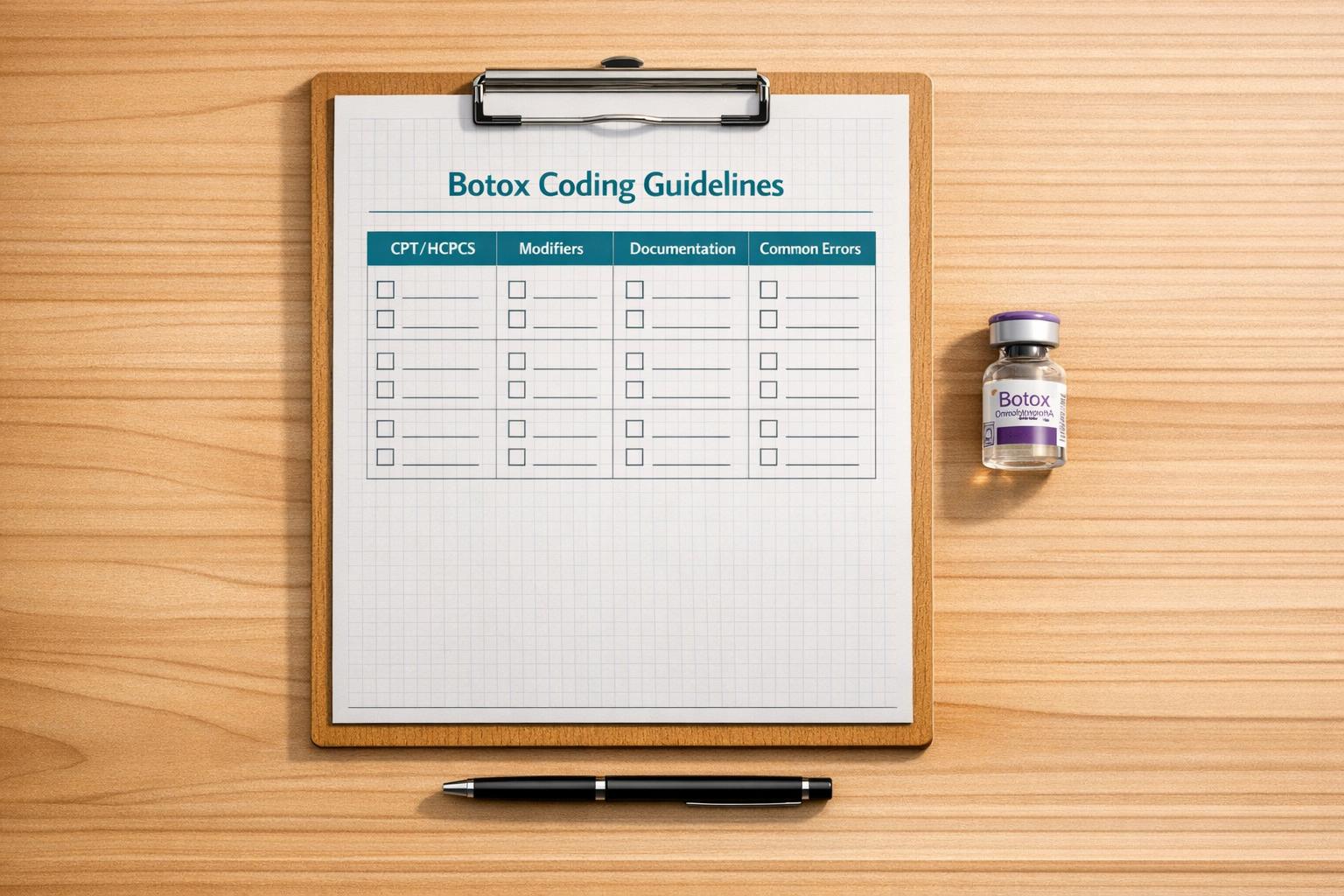

When billing for Botox treatments, using the correct CPT codes is essential for accurate reimbursement and compliance. Botox is used for both medical and cosmetic purposes, but insurance only covers treatments deemed medically necessary. Here's what you need to know:
-
CPT Codes for Chemodenervation:
- 64612: Unilateral facial muscle injections (e.g., blepharospasm). Use Modifier -50 for bilateral treatment.
- 64615: Chronic migraines. Requires documentation of headaches on more than 15 days/month.
- 64616: Neck muscle injections for conditions like cervical dystonia. Use Modifier -50 for bilateral treatment.
-
Hyperhidrosis Treatments:
- 64640: Severe underarm sweating.
- 64650: Hyperhidrosis in other areas (hands, feet, etc.).
-
Drug Codes (HCPCS):
- J0585: Botox (onabotulinumtoxinA).
- Ensure correct dosage and include modifiers JW (drug wastage) or JZ (no wastage).
-
Documentation Requirements:
- Link CPT codes to ICD-10 diagnosis codes to prove medical necessity.
- Record injection sites, dosage, and prior treatments.
-
Common Errors to Avoid:
- Billing multiple codes for the same site.
- Missing modifiers or exceeding dosage limits.
- Improper code bundling (e.g., 64612 and 64615 together).
Using tools like Prospyr can streamline documentation, automate code pairing, and reduce errors, ensuring smoother billing and fewer denials.
Primary CPT Codes for Botox Procedures


CPT Codes for Botox Procedures: Quick Reference Guide
When billing for Botox, two types of codes are used: HCPCS codes (e.g., J0585 for onabotulinumtoxinA) for the drug itself and CPT codes for the injection procedure. The choice of CPT code depends on the treatment site and the condition being addressed, and accurate selection is crucial to avoid claim denials. Proper inventory management of the drug units used is also essential for accurate billing.
Therapeutic Botox treatments, which address medical conditions like chronic migraines, dystonia, or hyperhidrosis, require specific CPT codes and thorough documentation of medical necessity. On the other hand, Botox procedures for cosmetic purposes, such as treating facial wrinkles, are not covered by insurance under Section 1862(a) of the Social Security Act. These cannot be billed using therapeutic codes.
Chemodenervation CPT Codes
Here are some commonly used CPT codes for chemodenervation procedures:
- CPT 64612: This code applies to injections into unilateral facial muscles, used for conditions like blepharospasm or hemifacial spasm. If both sides of the face are treated, a -50 modifier must be added to indicate bilateral treatment.
- CPT 64615: This code is specific to chronic migraine treatment, covering bilateral injections into the facial, trigeminal, and cervical regions. Documentation must confirm the patient experiences headaches on more than 15 days per month, with at least 8 days being migraines. Avoid reporting 64615 alongside 64612, as this is considered unbundling and could lead to claim denials.
- CPT 64616: This code is used for injections into neck muscles to manage conditions like cervical dystonia (spasmodic torticollis) or spasticity. It is a unilateral code, so a -50 modifier is necessary for bilateral treatment. However, this code excludes injections into the laryngeal area - use 64617, 31570, or 31573 for vocal cord treatments instead.
| CPT Code | Treatment Area | Specific Conditions | Unilateral/Bilateral |
|---|---|---|---|
| 64612 | Facial muscles | Blepharospasm, hemifacial spasm | Unilateral (use -50 for both sides) |
| 64615 | Facial, trigeminal, and cervical regions | Chronic migraine | Bilateral (inherent) |
| 64616 | Neck muscles | Cervical dystonia, spasticity | Unilateral (use -50 for both sides) |
Hyperhidrosis and Gland Treatment Codes
For gland-related conditions, the following codes apply:
- CPT 64640: This is the primary code for addressing severe axillary hyperhidrosis (excessive sweating in the underarm area). It covers chemodenervation of eccrine glands and requires documentation of medical necessity.
- CPT 64650: Use this code for treating hyperhidrosis in areas other than the underarms, such as the hands, feet, or scalp. Like 64640, insurance typically requires proof that conservative treatments, such as prescription antiperspirants, were ineffective.
Drug Reimbursement and Dosage Guidelines
The maximum reimbursement for onabotulinumtoxinA (J0585) is $5.67 per unit. Additionally, the cumulative dosage should not exceed 600 units within a 90-day period. When billing, ensure the correct HCPCS J-code is paired with the procedure:
sbb-itb-02f5876
Documentation and Billing Requirements
Accurate documentation is essential to link each CPT code to a payer-approved ICD-10-CM diagnosis. This connection is critical to demonstrate medical necessity. Without proper alignment, even clinically sound claims can be denied.
Medical Necessity and ICD-10 Code Matching
Each Botox claim must include an ICD-10 code that supports the billed CPT code. For example, CPT 64617 should align with Group 9 ICD-10 codes, while CPT 64650 matches Group 8 ICD-10 codes. Always review your payer's local coverage articles - like Noridian's A57186 - to confirm that your ICD-10-CM diagnosis code is in the correct group for the CPT code you're using.
Recent updates, effective March 5, 2026, have modified the list of acceptable codes. For instance:
- ICD-10 code G24.8 has been removed from Group 13.
- New CPT codes (31570 and 31573) for laryngoscopic therapeutic injections have been added to Group 9.
Ensure your billing system reflects these updates to avoid claim denials.
For chronic migraine claims using CPT 64615, documentation must include:
- Evidence of headaches occurring more than 15 days per month and lasting at least 4 hours.
- Records showing the failure of conservative treatments.
For ongoing treatments, show the clinical effectiveness of the two previous consecutive treatments before the current procedure. Injections are typically administered every 12 weeks to meet standard criteria.
Starting March 5, 2026, include Modifiers JW (for drug wastage) and JZ (to confirm full vial usage) in your documentation. Clearly record both the administered dosage and any wastage when applying these modifiers.
Accurate pairing of codes and diagnoses lays the groundwork for proper modifier use.
Modifiers and Payer-Specific Requirements
Detailed documentation is only part of the equation - using the correct modifiers is equally important for compliant billing. Proper modifier application helps prevent denials and ensures smoother compliance.
Modifier requirements vary based on the procedure and the facility setting. For bilateral procedures using CPT 64612, the approach changes depending on the setting:
- In Hospital Outpatient Departments (HOPD), use Modifier 50 to indicate bilateral treatment.
- In Ambulatory Surgical Centers (ASC), avoid Modifier 50. Instead, report the code on separate lines with LT and RT modifiers.
"CPT codes 64612 and 64615 are meant to be 'either/or' and would not be expected to be reported/requested together for a single service, date of service (DOS), or unique tracking number (UTN)."
– First Coast Service Options
When billing J0585 with CPT 64612 or 64615 in ASC or HOPD settings, secure prior authorization. Keep in mind that CPT 64612 has a Medically Unlikely Edit (MUE) of 1, meaning it is strictly a unilateral code. For bilateral reporting, use the appropriate modifiers.
Always document:
- The muscle sites injected.
- The dosage administered to support medical necessity.
If electromyography (EMG) is used to determine injection sites, explicitly document its necessity alongside the toxin injection.
Common Billing Mistakes and Prevention
Billing errors can throw claims off course, leading to denials and compliance issues. Successful billing requires not just selecting the right codes but also steering clear of frequent administrative missteps. Recognizing these common mistakes can help you avoid claim rejections and stay aligned with payer guidelines.
Unit Calculation and Site-Specific Errors
One common error involves billing for multiple injections within a single contiguous site. A "site" refers to an area of muscles within one continuous anatomical region - like a limb, eyelid, face, or neck. Regardless of how many needle sticks are performed, only one injection code should be billed per site.
For instance, if multiple muscles in the face are injected during one session, you should bill a single code for the facial site. Separately billing for each muscle group in the same area is a mistake and often results in claim denials.
Additionally, ensure that dosage limits are respected. For example, the dosage should not exceed 600 units within a 90-day period. Always include the full 11-digit National Drug Code (NDC) formatted as "UN1" and apply the UD modifier for 340-B purchases when applicable. Claims exceeding dosage thresholds or missing these details are likely to be denied.
Unbundling and EMG Code Pairing Errors
Another frequent issue stems from improper code bundling. Unbundling occurs when providers incorrectly bill multiple codes that should be grouped together. For example, CPT codes 64612 and 64615 are mutually exclusive and should never be reported together for the same service or date.
Errors also arise with electromyography (EMG) guidance codes. For each injection site, only one EMG code - either 95873 (electrical stimulation guidance) or 95874 (needle EMG guidance) - can be reported. These add-on codes must be listed separately from the primary chemodenervation code and are limited to one unit per site. Billing multiple units of EMG guidance for the same site will result in denials, so it’s crucial to document the necessity of EMG .
| CPT/HCPCS Code | Description | Common Error | Prevention |
|---|---|---|---|
| J0585 | OnabotulinumtoxinA, per unit | Missing 11-digit NDC or incorrect unit format | Report the NDC as "UN1" and include the full 11-digit code |
| 64612 | Facial nerve chemodenervation (unilateral) | Billing bilaterally without proper modifiers | Use Modifier 50 (HOPD) or LT/RT modifiers; MUE is 1 |
| 95873/95874 | EMG guidance codes | Billing multiple units per site | Limit to one EMG code per injection site |
| UD Modifier | 340-B program indicator | Omitting modifier for 340-B drugs | Append the UD modifier for all 340-B purchases |
How Prospyr Simplifies Botox Billing
Prospyr takes the complexity out of Botox reimbursement by combining automation with built-in compliance checks. Botox billing demands accuracy - whether it’s documenting injection sites or aligning CPT codes with ICD-10 diagnoses. Prospyr’s practice management platform addresses these challenges by automating documentation workflows and embedding compliance checks into the billing process. The result? Fewer claim denials and quicker reimbursements.
Automated Documentation and Code Pairing
The foundation of accurate Botox billing lies in thorough clinical documentation. Prospyr’s Smart Note system makes this process faster and easier, enabling providers to document up to 80% more efficiently. Key details like injection sites, dilution ratios, administered units, waste amounts, and prior authorizations are all captured seamlessly. Plus, digital intake forms allow patients to complete their paperwork ahead of time, saving clinics an average of 16 hours.
Prospyr’s integrated EMR and CRM systems go a step further by automating code pairing. As providers document Botox treatments, the platform suggests the correct CPT and ICD-10 code combinations based on the condition and treatment site. This automation minimizes the risk of coding errors that can lead to rejected claims. These features work hand-in-hand with compliance checks, significantly reducing billing mistakes.
"Their powerful platform and helpful support have enabled us to exceed our financial targets while delivering an unmatched experience for our patients." - Dr. Saami Khalifian, Founder and CEO, SOM Aesthetics
Compliance Checks and Error Reduction
Prospyr’s compliance tools are designed to catch common billing mistakes before they become costly problems. The platform ensures unit calculations are accurate and flags missing modifiers, such as the JW modifier required for drug waste, which is a frequent cause of denials. It also integrates task management to track billing follow-ups and offers real-time analytics for reimbursement rates and revenue trends.
With Prospyr, clinics are three times less likely to encounter data entry errors, leading to cleaner claims and better cash flow. For example, Dr. Daniel Lee of New Life Cosmetic Surgery saw a 50% revenue boost after consolidating multiple systems into Prospyr’s all-in-one platform. This is a clear testament to how automation and precision can transform Botox billing efficiency.
Conclusion
Getting CPT coding right for Botox procedures is crucial for ensuring compliance and securing proper reimbursement. By accurately pairing drug and injection codes, practices can prevent claim denials and meet Medicare's Prior Authorization standards. Detailed treatment documentation further ensures that claims align with Local Coverage Determinations and ICD-10 diagnoses.
Thorough documentation is key. Include site-specific details, treatment history, and outcomes to demonstrate medical necessity. Overlooking even small details - like EMG documentation - can lead to claim denials and payment delays.
Integrated practice management solutions can simplify billing. Prospyr, for instance, automates code pairing, incorporates compliance checks, and streamlines clinical documentation. Its EMR and CRM systems suggest appropriate CPT and ICD-10 combinations based on treatment details, while compliance tools flag missing modifiers and verify unit calculations before submission. This automation minimizes errors, saves time, and ensures faster reimbursements.
For aesthetic and wellness clinics handling Botox treatments, a robust practice management platform transforms billing into a smooth, efficient process. With these tools in place, clinics can focus on delivering exceptional patient care while maintaining financial stability.
FAQs
How do I pick the right CPT code for a Botox session?
To choose the right CPT code for a Botox session, start by determining the injection procedure and dosage. The code J0585 is used for onabotulinumtoxinA (Botox), representing 1 unit of the drug. For injection procedures, commonly used codes include 64612 for targeting nerves in the face or neck and 64615 for injections into facial or neck muscles. Make sure to document the injection site, dosage, and whether electromyography guidance was used. These details are essential for accurate billing and may also be needed for prior authorization.
What documentation is needed to prove medical necessity for Botox?
When establishing the medical need for Botox, it's essential to provide clear and thorough documentation. Here's what you should include:
- Patient’s condition and symptoms: Outline the patient's diagnosis, symptom history, severity, and how long they've experienced the condition. Make sure the clinical features align with the diagnosis.
- Previous treatments: Include details of treatments that were tried but didn’t work. This helps demonstrate why Botox is the next step.
- Injection specifics: Document the exact injection sites and the dose administered during treatment.
- Informed consent: Ensure the patient’s informed consent is recorded.
- Adjunct therapies: If other therapies are being used alongside Botox, include those details.
- Electromyography (if applicable): Note if electromyography (EMG) was used as part of the treatment process.
Finally, make sure all records are complete and adhere to proper billing practices. Accuracy and thoroughness are key to supporting a claim effectively.
When should I use modifiers -50, LT/RT, JW, or JZ?
- -50: Use this for bilateral procedures that are performed during the same session.
- LT/RT: Apply these to specify the left (LT) or right (RT) side for unilateral injections.
- JW: This modifier is for documenting drug wastage or any unused medication.
- JZ: Use when the drug cost is included in the procedure payment, with no separate reimbursement for the drug.
Always double-check the specific requirements with your payer to ensure proper usage.