Location Feasibility Checklist for Med Spas
Step-by-step site checklist for med spas: zoning, demand, access, build-out costs, and breakeven signals.
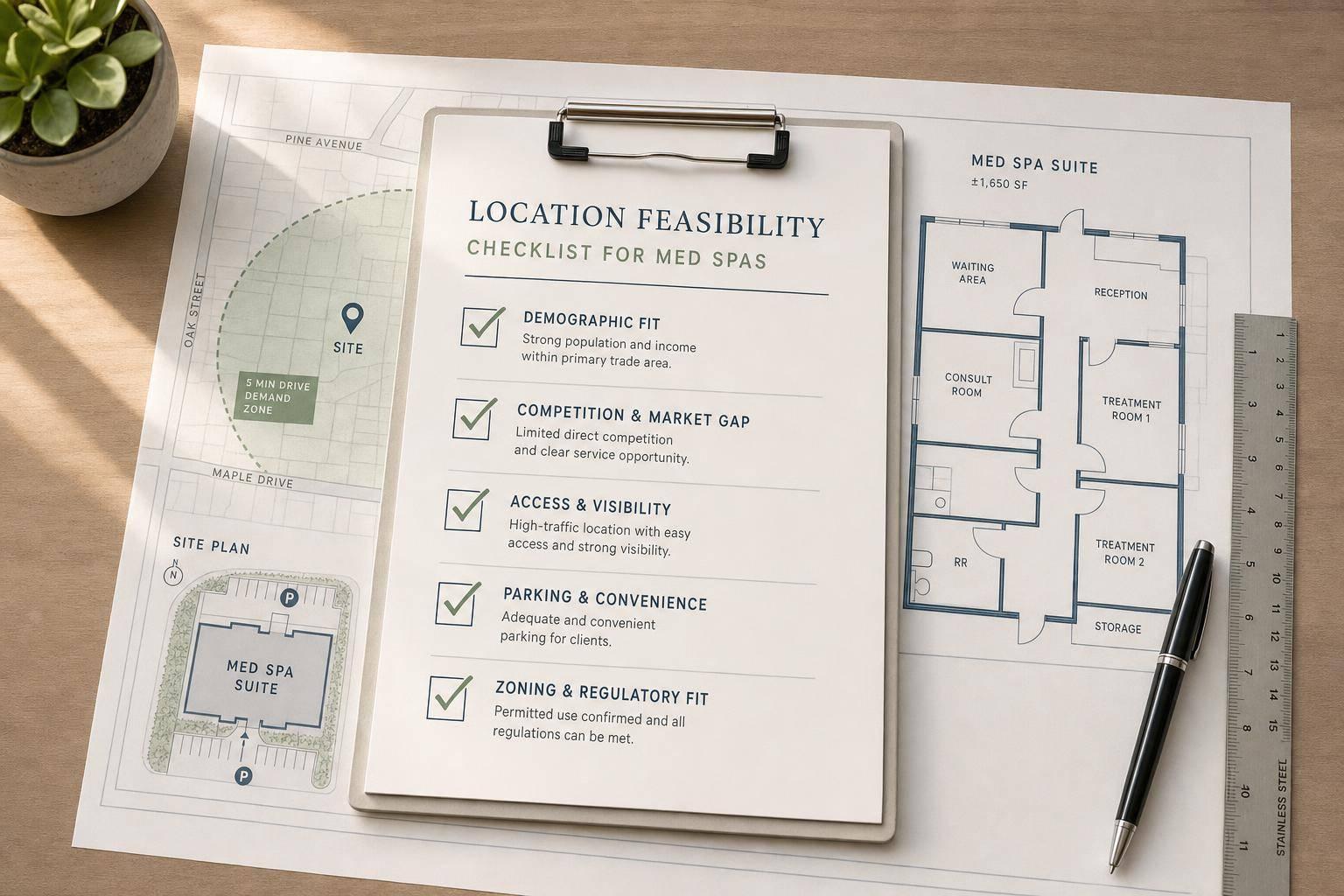

A bad med spa location can burn through $250,000 to $500,000 before you open. So before I opening a med spa and spending on equipment, staff, or design, I first check five things: legal fit, local demand, access, space needs, and the numbers.
Here’s the short version:
- Start with zoning and permits. If medical use is not allowed at the exact address, I stop there.
- Check the market. I look for at least 50,000 women ages 25–65 within a 15-minute drive and median household income above $100,000.
- Study competition. Fewer than 8 med spas per 100,000 residents is a good sign. More than 12 is a warning.
- Review access and setup. Parking, signage rights, room layout, sinks, HVAC, and electrical load all matter.
- Run the math. Build-out can hit $175 to $200 per square foot, and many new med spas need 12 to 18 months to reach steady profit.
If I had to sum up the checklist in one line, it would be this: a site has to work legally, fit the local patient base, support treatment flow, and still make sense on paper.
A few fast deal-breakers stand out right away:
- Zoning does not allow medical use
- Power capacity cannot support lasers
- The site cannot meet ADA, plumbing, or privacy needs
- The model only works under best-case revenue assumptions
Quick comparison
| Check | Good sign | Warning sign | No-go |
|---|---|---|---|
| Zoning | Medical use confirmed | Pending approval | Not allowed |
| Income | Above $100,000 | $75,000–$100,000 | Below $75,000 |
| Female population, 25–65 | 50,000+ | 25,000–50,000 | Under 25,000 |
| Competition | Under 8 per 100K | 8–12 per 100K | Over 12 per 100K |
| Search demand | Rising | Flat | Falling |
Below, I’ll walk through the checklist in the same order I would use it for a live site review, so it’s easy to make a go, renegotiate, or walk-away call.
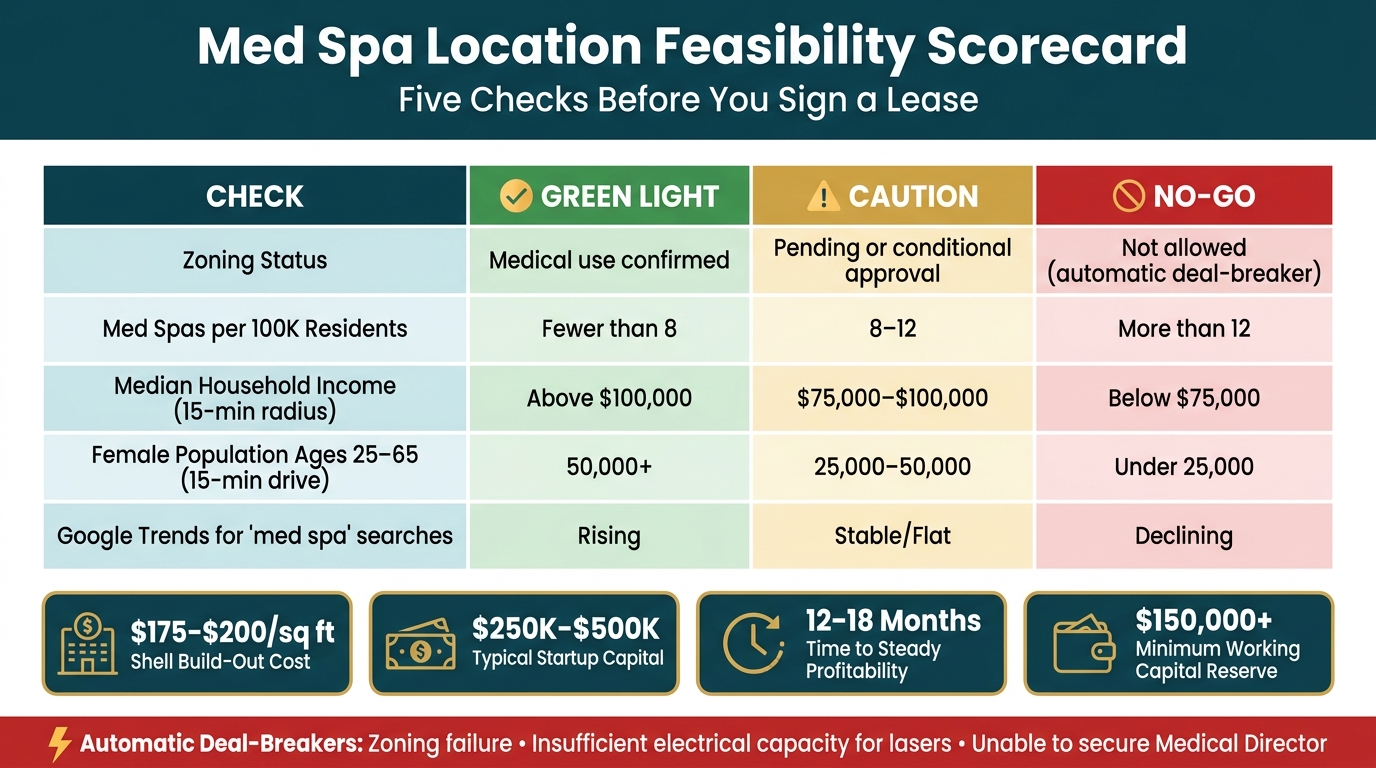
Med Spa Location Feasibility Scorecard: Go vs. No-Go Signals
1. Confirm Regulatory and Zoning Fit First
Use this section to make sure the site can legally operate as a med spa before you look at demand or start thinking about layout.
Verify Zoning Designation and Allowed Medical Use
Cities don't all treat med spas the same way. Some see them as medical offices. Others place them under retail or personal services. That one label affects a lot, from parking rules to whether you can legally run laser equipment.
Call the city or county planning department and confirm that medical aesthetic services are allowed at the exact parcel address. Also confirm that the current Certificate of Occupancy already covers medical use. If it doesn't, changing it after build-out can get expensive fast.
Your lease should also include a contingency clause that gives you a way out if the site fails zoning review or can't be permitted for medical use.
If the parcel clears zoning, the next step is licensing and building-code review.
Check Licensing, Building Code, and ADA Requirements
State rules on ownership and supervision can vary a lot, and they can make or break a site. Check them before you sign anything.
On the physical side, treatment rooms need at least 100–120 sq ft, non-porous medical-grade flooring, and hands-free sinks either inside the room or directly next to it. Laser equipment usually draws 30–60 amps per device. If the building's electrical panel can't handle that load, upgrades can cost $10,000 to $30,000.
Have a licensed electrician check the building's capacity before you lock in the deal. Facility licensing usually takes 4 to 12 weeks, and laser registration can add another 2 to 8 weeks.
Review Local Business Permits and HIPAA-Ready Infrastructure
HIPAA applies from the first patient encounter. That means the site needs private consult rooms, secure storage for before-and-after photos, space for sharps and medical waste, and secure internet for EMR. Medical waste, including sharps, must go into FDA-cleared containers and cannot be thrown out with regular trash.
Initial HIPAA compliance setup usually costs $2,000 to $10,000, and medical waste hauler contracts tend to run $50 to $200 per month. Prospyr offers HIPAA-compliant CRM/EMR integration, scheduling, intake forms, and patient communication.
Confirm that this parcel can support all of those needs before you move ahead.
After the legal and infrastructure checks, assess whether the market can support the site.
sbb-itb-02f5876
2. Measure Local Demand and Competitive Fit
After a site passes regulatory review, the next step is simple: figure out whether enough of the right patients live nearby to support the business.
Define the Target Patient Profile for the Location
Typical med spa patients skew female, ages 35 to 54, with household income above $75,000. A strong site should serve at least 50,000 women ages 25 to 65 within a 15-minute drive and show a median household income above $100,000. If median household income falls below $75,000, treat that as a caution flag.
Not every patient behaves the same way, though. High-net-worth clients may drive farther for luxury services. Busy professionals usually want something close and easy. So it helps to look at the area through a practical lens: does it serve affluent residents, commuters, or a mix of both?
If the reachable patient base looks solid, the next step is to see how crowded the market is.
Analyze Neighborhood Demographics and Competitor Concentration
Use a 15-minute drive-time area, not a simple mile radius, to measure the patient base you can actually reach. Then review the basics inside that area:
- Population size
- Age mix
- Household income
After that, check search demand with Google Trends and Keyword Planner for terms like "Botox [city name]" or "med spa [city name]". This gives you a better sense of whether people nearby are actively looking for these services.
Next, map every competitor inside that same 15-minute drive-time area and compare the total count to the local population. Don’t rely only on database listings. Those are often out of date, so it’s worth verifying each competitor manually. Use this benchmark:
| Med Spas per 100K Residents | Signal |
|---|---|
| Fewer than 8 | Green light |
| 8–12 | Proceed with caution |
| More than 12 | Red flag |
Ratings matter too. Competitor ratings between 3.5 and 4.2 usually suggest there’s room to win share. If most nearby players sit at 4.5+, standing out gets harder.
If the area still looks open enough, then it’s time to see whether nearby businesses can send patients your way.
Assess Referral Potential and Nearby Complementary Businesses
The right neighbors can help more than people think. A good location near plastic surgery offices, dermatology practices, high-end gyms, salons, and wellness centers can create referral opportunities and incidental traffic.
That said, clustering can cut both ways. Affluent corridors often pull several med spas onto the same block or retail strip. That may look attractive at first, but it can also mean more direct competition. A smarter move is often to place the site on the outer edge of an affluent corridor. You can still reach the same patient base without stepping into the thick of the crowd.
If demand looks healthy and referral potential is there, the next filter is access, visibility, and treatment-room fit.
Reading about the problem? See how Prospyr solves it in one platform.
Book a Demo3. Evaluate Access, Visibility, and Physical Space
Once demand looks good, the site still has to clear a simple test: can patients find it, get there without a hassle, and feel at ease when they walk in?
Use the same 15-minute drive-time area from the demand review to check access, parking, and visibility.
Confirm Visibility, Parking, and Patient Access
After demand, the next step is simple: make sure patients can find the place, get inside, and park without frustration.
Where your med spa sits matters more than many owners think. A retail strip center gives you street visibility and some walk-in potential. A medical office building (MOB) often comes with lower rent, but it leans much more on digital search than foot traffic. Most patients now look for a med spa through search terms like "med spa near me" or "injector near me", so clear signage and an easy arrival often matter more than people strolling past.
No matter what kind of property you're looking at, confirm signage rights with both the landlord and local ordinances before signing. Exterior signage is one of the lowest-cost ways to build your brand. Losing that option after the lease is signed can be a nasty surprise.
Parking is just as important. Aim for at least 5 spaces per 1,000 square feet. Patients want parking that feels easy and close, and the entrance should be well lit and easy to use during early morning and evening hours.
For med spas, easy arrival matters more than walk-by traffic.
Measure Foot Traffic and Booking-Hour Fit
Foot traffic matters less than simple access during lunch, evening, and weekend booking hours.
Do a drive-by during those peak times. See how hard it is to turn into the lot from the main road. Check whether the area feels safe after dark. For urban patients, look at whether ride-share drop-off or nearby public transit makes sense. If the area goes quiet by 5:00 p.m. or feels cut off on Saturday mornings, that should factor into the decision. Tracking these patterns alongside location-based analytics helps confirm if the site matches your target patient's schedule.
Inspect Treatment Room Layout and Utility Capacity
Once the site is easy to reach, make sure the building can support patient care without a big retrofit bill.
Layout shapes patient flow and digital intake, privacy, and where equipment can go. Any room with large laser equipment or treatment carts needs enough clearance to stay usable and comfortable for patients and staff.
Room count is only part of the picture. The building's utility setup needs a close look before you sign. Lasers pull 30 to 60 amps per device and put off a lot of heat. If the electrical panel can't handle dedicated circuits, or the HVAC system can't manage the added heat load, retrofits can cost $10,000 to $30,000. Plumbing is another common issue. Most standard office or retail spaces were not built with sinks in every room, and med spas need them.
| Utility | Med Spa Requirement |
|---|---|
| HVAC | Zone-controlled cooling to offset laser heat |
| Acoustics | Sound insulation between rooms for patient privacy |
Bring in a licensed electrician and plumber before negotiations get too far. If the space needs a shell build-out, expect 10 to 12 months from lease signing to opening day.
4. Test Financial and Operational Viability
After access and layout, the next step is simple: make sure the site works on paper.
A space can look perfect and still be a bad deal if rent, construction, and ramp-up costs eat through your cash before revenue has time to catch up.
Calculate Occupancy, Build-Out, and Operating Costs
Base rent is just the starting point. In many leases, NNN charges add $10+ per square foot on top of base rent, and in competitive markets, base rent can climb past $30 per square foot per year.
Then comes the build-out. This is where budgets can get hit hard.
For a med spa, shell space usually starts at $175 to $200 per square foot. That means a 2,000-square-foot location may need $350,000 to $400,000 in construction costs alone before you see a single patient. A built-out medical space can cut that number, but those spaces are harder to find.
When you negotiate the lease, push hard on the Tenant Improvement (TI) allowance. Landlords often offer about one year of base rent, while seasoned brokers may push for double that amount.
You also need room in the budget for:
- Equipment
- Insurance
- At least $150,000 in working capital during ramp-up
Typical startup capital usually lands between $250,000 and $500,000, and some full build-outs end up in the $500,000 to $700,000 range.
Project Patient Volume, Revenue, and Breakeven Timing
Most new med spas begin at around 10% capacity and need 12 to 18 months to hit steady profitability.
That’s why it helps to work backward from breakeven. If a location needs 35 treatments per week to break even, and your consultation-to-booking rate is 60%, then you need about 58 consultations a week just to stay even.
"Most new med spas take 12 to 18 months to reach consistent profitability. If your model only works when every treatment room is full from month one, your model is wrong." - Matt Watson, Founder, Pronk MedSpa Marketing
This is the gut check. If the numbers only work under best-case conditions, the site probably doesn’t work.
Confirm the Site Can Support Day-to-Day Operations
Even a profitable location can struggle if the day-to-day setup is messy.
A platform like Prospyr can bring HIPAA-compliant EMR/CRM, scheduling, intake, payments, messaging, memberships, and analytics into one system. That matters more than people think. When the front desk, providers, and patient records all live in different places, small problems pile up fast.
You’ll also want to start marketing 60 to 90 days before opening. The goal is to build a waitlist so your schedule isn’t empty on day one.
Staffing costs need to be in the model early too. A Medical Director usually costs $100,000 to $250,000 per year, medical estheticians often earn $50,000 to $85,000, and front desk staff generally cost $20 to $25 per hour. Hire the practice manager first so one person can own the systems during build-out.
Use these numbers in your final location score.
5. Score the Location and Make a Go/No-Go Decision
Use this scorecard to judge each site the same way. That matters. If you change the standard from one location to the next, it gets easy to talk yourself into a bad deal.
The table below pulls the checks from Sections 1–4 into one decision tool.
| Category | Green Light (Go) | Proceed With Caution | Red Flag (No-Go) |
|---|---|---|---|
| Zoning Status | Confirmed medical use | Pending/conditional approval | Prohibited |
| Med spas per 100K population | Under 8 | 8–12 | Over 12 |
| Median household income (15-min radius) | Above $100K | $75K–$100K | Below $75K |
| Female Population (25–65) within 15 min | 50,000+ | 25,000–50,000 | Under 25,000 |
| Google Trends for "med spa" searches | Rising | Stable | Declining |
Once you score the site, use that result to decide whether to negotiate harder or leave the deal.
Mostly green = go. If you see caution scores, use them as leverage. Ask for better lease terms or lower fixed costs. In many cases, that means pushing for a TI allowance of $30–$80 per square foot and at least 3–6 months of rent abatement during build-out.
A few issues are automatic no-go items:
- Zoning failure
- Insufficient electrical capacity for lasers
- Inability to secure a Medical Director
It also helps to keep a zoning-contingency exit clause in the lease. That gives you a way out if approvals fall through.
If a site clears all deal-breakers and comes back mostly green, move ahead. If the score is mixed, renegotiate. If it fails any deal-breaker, walk away.
FAQs
How do I verify zoning before signing a lease?
Review local zoning codes on your city or county website, or stop by the clerk’s office in person. Then call the planning or zoning department to double-check that your exact services, like laser treatments or injectables, are allowed under the property’s current zoning classification.
You don’t want to assume a space works for a med spa just because it looks right. A landlord may say the property is fine, but the zoning office is the one that matters.
Also, make sure your lease includes a contingency clause. That gives you a way out if the space fails zoning review or can’t be approved for medical use.
What if a great site has weak power or plumbing?
Before signing a lease, make sure the site’s infrastructure can handle equipment like lasers, autoclaves, and medical sinks. A med spa usually needs strong water service and enough electrical capacity. If you miss that before construction starts, you could end up paying for expensive retrofits later.
It also helps to line up those site needs with your lease terms. That way, you can see whether the landlord offers improvement allowances that may help cover required upgrades.
How much cash should I reserve before opening?
Reserve cash for both startup costs and working capital. For a mid-range med spa with 3 to 4 treatment rooms, first-year investment costs can range from $1,237,588 to $2,026,176.
Startup costs are only part of the picture. You’ll also want enough working capital to cover 6 to 12 months of operating expenses while you build your client base.