Training Pay Rules: What Clinics Must Follow
When must clinics pay for staff training? Covers the DOL 4-part test, HIPAA/OSHA, onboarding, shadowing, and state risks.

If training is required, job-related, done during work hours, or includes any work, I should treat it as paid time. That is the core rule for U.S. clinics under the FLSA. For nonexempt staff, unpaid training is allowed only when all 4 DOL tests are met. Miss just 1 test, and the time usually must be paid.
Here’s the short version:
- Pay for it if the training is required
- Pay for it if it helps the employee do their current job
- Pay for it if it happens during normal work hours
- Pay for it if the employee does even small tasks during training or shadowing
- Do not assume after-hours modules, onboarding forms, EMR setup, HIPAA, or OSHA training can be unpaid
There’s also money risk. A willful wage claim can reach back 3 years, and liquidated damages can mean 2x the unpaid wages. State law can add more penalties, including fixed fines or extra damages.
A few points stand out:
- HIPAA and OSHA training for nonexempt staff are usually paid
- Shadowing is unpaid only when the person is just observing
- Working interviews must be paid when the person does patient or office work
- A lower training rate may be allowed, but only with written notice in advance and pay of at least minimum wage
- Some state rules go further than federal law, so one clinic policy may not fit every location
Below, I’ll walk through the rule in plain English, where clinics slip up, and what records I’d keep to cut wage-and-hour risk.
The Federal Rule: When Training Must Be Paid
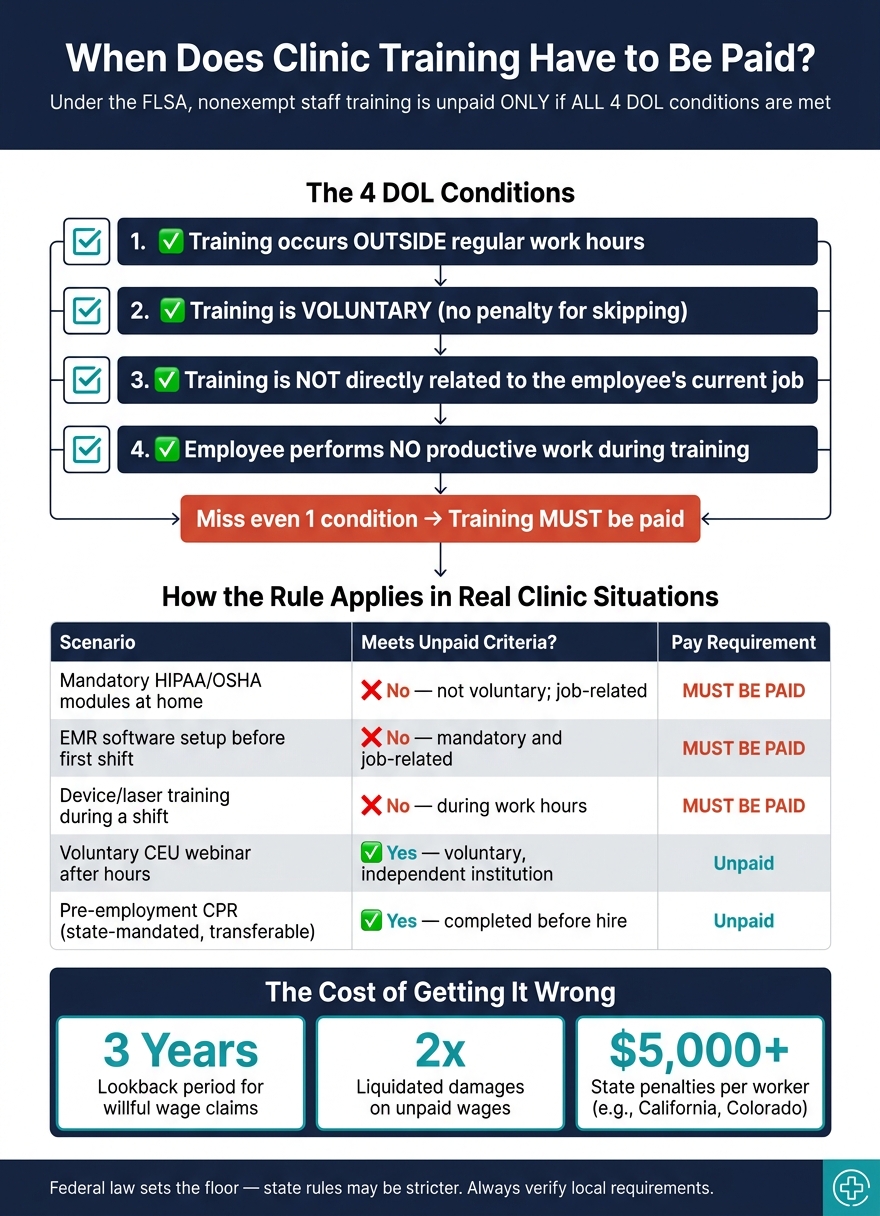
When Is Training Paid? The 4-Part DOL Test for Clinics
The 4-Part DOL Test for Unpaid Training
Nonexempt clinic staff can go unpaid for training only if all four DOL conditions are met: the training happens outside regular work hours, attendance is voluntary, the training is not tied to the employee’s job, and the employee does no productive work during it. In most clinics, that means required onboarding and shadowing time must be paid.
The two points that trip clinics up most are voluntary and directly related.
“Voluntary” has a plain meaning here: the employee can say no without facing any downside. As Epstein Becker Green attorneys put it:
"If an employer takes an adverse action against the employee as a result of her failure to attend the training, attendance clearly is not voluntary and the employee must be compensated." - Paul DeCamp, Adriana S. Kosovych, and Jeffrey H. Ruzal, Epstein Becker Green
“Directly related” means the training helps the employee do their current job better. It does not mean training for some future position. In a clinic, that usually covers EMR training, scheduling systems, patient portal walkthroughs, and device instruction.
Common Clinic Scenarios and How Pay Rules Apply
These examples show how the rule tends to play out in clinic settings.
| Scenario | Meets Unpaid Criteria? | Likely Pay Requirement |
|---|---|---|
| Mandatory HIPAA/OSHA modules completed at home | No - not voluntary; job-related | Must be paid |
| EMR software setup/training before first shift | No - mandatory and job-related | Must be paid |
| New laser or device instruction during a shift | No - during work hours | Must be paid |
| Voluntary CEU webinar taken after hours | Yes - if voluntary and through an independent institution | Unpaid |
| Pre-employment CPR certification (state-mandated, transferable) | Yes - if completed before hire and transferable | Unpaid |
There’s one small but important wrinkle with voluntary CEU training. It can be unpaid only when it is voluntary, takes place after hours, and matches courses offered by independent bona fide institutions of learning, even when the subject matter connects to the employee’s work.
What Recent DOL and Court Activity Shows
Recent agency and court action gives clinics a clearer picture of where things stand.
In February 2024, the National Labor Relations Board announced a settlement with a medical spa that required lower-level employees to sign agreements saying they would repay training costs if they left within two years of being hired. The NLRB said those terms chilled employee rights and limited worker mobility.
A separate and narrow exception appeared in September 2025. In Wade v. JMJ Enterprises, LLC, the U.S. District Court for the Middle District of North Carolina ruled that a residential mental health company did not have to pay for pre-employment CPR and first aid training. The court said the certifications were transferable to other healthcare employers and mainly benefited the trainees. That ruling turned on a few specific facts: the training was state-mandated, transferable, and completed before the employment relationship started.
That point matters most for mandatory HIPAA and OSHA training, which the next section addresses.
sbb-itb-02f5876
Reading about the problem? See how Prospyr solves it in one platform.
Book a DemoMandatory Compliance Training: HIPAA, OSHA, and Job-Related Requirements
Required HIPAA and OSHA training counts as paid time for nonexempt staff because it is job-related under the FLSA. In plain English, if the training is required for the job, it usually belongs on payroll, not under the unpaid training exception.
HIPAA and Privacy Training for New Hires and Policy Refreshers
Required HIPAA training, including policy refreshers, is compensable for nonexempt staff because it ties directly to the job. The same goes for other mandatory clinic safety training.
OSHA and Safety Training Clinics Cannot Skip Paying For
Required OSHA safety training, including bloodborne pathogens instruction, is work time. If a clinic misclassifies required training, it can face wage claims and OSHA penalties.
Clinics can pay a lower training rate, but only if they tell employees ahead of time and the rate stays at or above minimum wage.
The mistakes show up most often during digital intake onboarding, shadowing, and after-hours modules.
Where Clinics Commonly Get It Wrong: Onboarding, Shadowing, and Remote Modules
The biggest compliance gaps tend to show up during orientation, shadowing, and pre-start remote work. That’s where clinics often run into trouble with the DOL test, especially around whether the time was voluntary and whether it was tied to the job. In plain English: these are the moments when unpaid training can turn into a wage claim.
Orientation Days, Shadow Shifts, and Working Interviews
If a clinic tells a new hire to review policies, set up required software, or complete safety protocols, that time counts as paid work.
Shadowing is unpaid only when the person is just watching and does no productive work at all. The moment they help with a task, even something small like intake support, the time becomes compensable. The same rule applies to working interviews: if the applicant is doing actual patient care or other productive work, they need to be paid.
| Activity | Description | Typical Pay Treatment |
|---|---|---|
| Orientation | Clinic-directed onboarding | Paid (mandatory/job-related) |
| Shadowing | Observation only | Unpaid if strictly observational |
| Working Interview | Real patient work | Paid (productive work) |
| Remote Modules | Required pre-start training | Paid if required and tied to the job |
After-Hours E-Learning, Paperwork, and Pre-Start Tasks
For hourly, nonexempt staff, required pre-start tasks count as paid time. That includes modules, quizzes, policy acknowledgments, paperwork, and required software setup.
A lower training rate can be used, but only if the clinic gives advance written notice and still meets minimum wage rules.
Treat these hours the same way you treat shift time. If you track hours worked in one system and training time in someone’s head or inbox, that’s where problems start.
Documentation, State-Law Differences, and Key Takeaways
Records That Support Compliance and Reduce Disputes
Keep timestamps, attendance records, job-duty notes, and payroll codes. Those basics can save you a lot of trouble later.
If you use a reduced training rate, disclose it in writing before training starts. That step matters. It shows the employee knew the pay setup ahead of time, instead of finding out after the fact.
It also helps to use a HIPAA-compliant system to keep training dates, attendance, and payroll coding in one place. When records are scattered across email threads, spreadsheets, and paper files, disputes get messy fast. A central system makes it easier to show what happened and when.
These records matter even more in multi-state clinics, where state wage rules may be stricter than federal law. This is especially critical when opening a med spa and establishing your initial compliance framework.
State-Law Differences and the Article's Main Conclusions
Federal law sets the floor. States can go further, with tighter limits and tougher penalties.
| State | Key Difference from Federal Law | Penalty for Violations |
|---|---|---|
| California | Strict TRAP limits (AB 692, effective Jan. 1, 2026) | Actual damages or $5,000 per worker, whichever is greater |
| New York | "Trapped at Work Act" restricts training repayment agreements | $1,000–$5,000 per violation |
| New Jersey | Wages due twice monthly; strict 10-working-day payment window | Up to 200% liquidated damages |
| Colorado | Repayment only for "distinct" training, not on-the-job instruction | $5,000 penalty + actual damages |
| Pennsylvania | Wage Payment and Collection Law; unpaid wages are recoverable | Unpaid wages + 25% liquidated damages |
The big point is simple: mandatory, job-related training is usually paid time. Unpaid training is a narrow exception, not the default. And if your records are thin, it gets much harder to defend your position if a claim comes up.
For clinics, the safer path is plain enough: standardize onboarding records, match payroll coding to the training involved, and check state rules before rolling out one policy across every location.
FAQs
Who counts as nonexempt staff?
Under the Fair Labor Standards Act, nonexempt employees are workers who do not meet the federal rules for exemption. That means they must get overtime pay for hours worked over 40 in a workweek.
In a medical practice, most staff are usually nonexempt. This often includes nurses (RNs and LPNs) and medical assistants. One point trips people up all the time: paying someone a salary by itself does not make that person exempt. They also have to meet the salary level test and the duties test.
Does paid training count toward overtime?
Yes. Training hours count toward overtime when they qualify as compensable work time under the Fair Labor Standards Act.
So if a non-exempt employee works more than 40 hours in a workweek after you add in required training time, the extra hours must be paid at the overtime rate. Some states, including California, have stricter rules and also require overtime after 8 hours in a single day.
What records should clinics keep for training pay?
Clinics should keep accurate records of every hour worked by non-exempt employees during training, including any work-related travel time. They should also document the agreed pay rate for training or travel time and make sure employees know that rate before training begins.
If training repayment agreements are used, keep an itemized estimate of the actual training costs, along with all signed compensation and repayment agreements. That paperwork can matter during IRS, Department of Labor, or state agency audits.