2025 ICD Updates for Aesthetic Practices
Overview of 252 ICD-10 code changes affecting aesthetic clinics: skin/hair, wound care, obesity, SDOH Z codes, documentation, and billing.


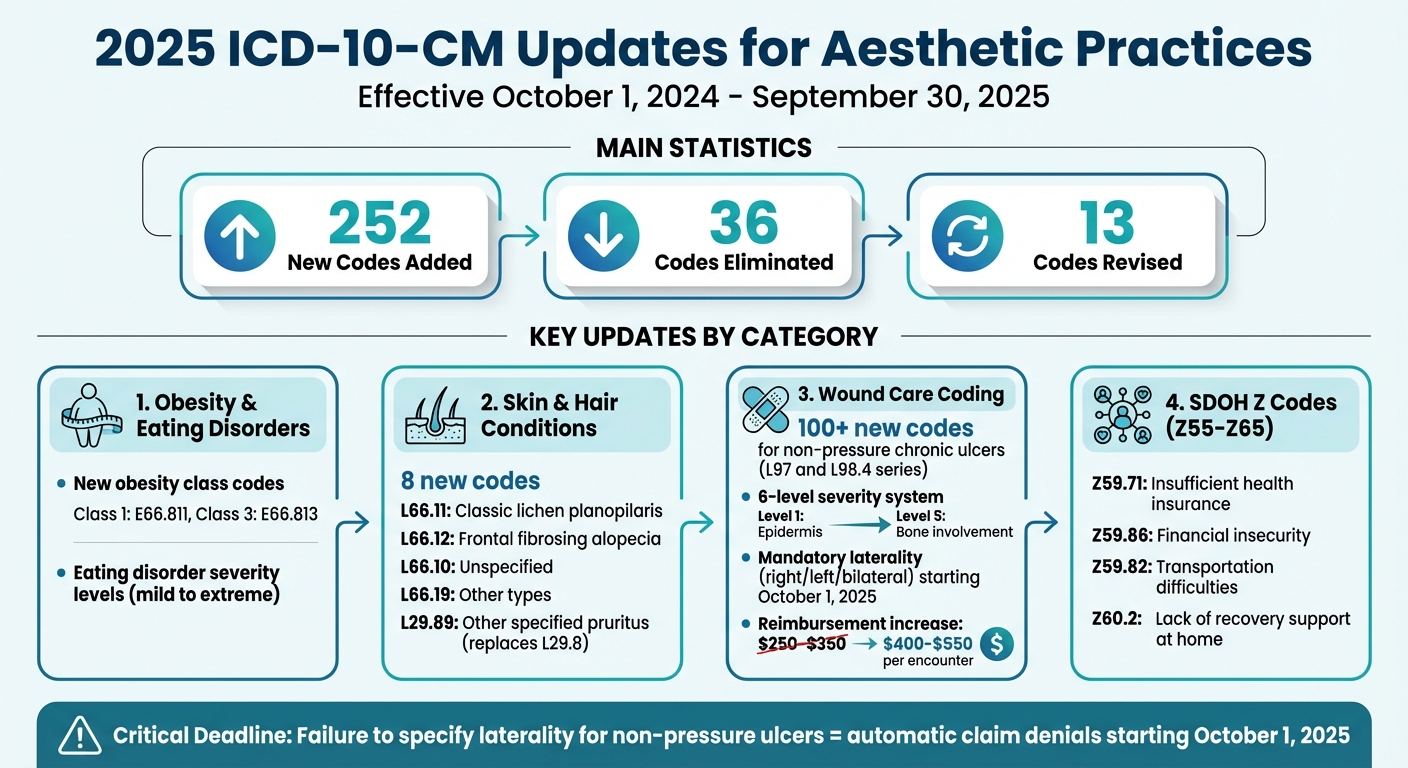
The 2025 ICD-10-CM updates bring 252 new codes, eliminate 36, and revise 13 existing ones, effective from October 1, 2024, to September 30, 2025. These changes focus on improving diagnostic detail for conditions like obesity, eating disorders, skin conditions, and wound care. For aesthetic practices, precise coding is now essential to avoid claim denials, ensure compliance, and maintain revenue flow.
Key highlights:
- New codes for obesity classes (e.g., Class 1: E66.811, Class 3: E66.813) and eating disorder severity (mild to extreme).
- Expanded skin condition codes (e.g., L66.12 for frontal fibrosing alopecia) and pruritus refinements (L29.89 for specified itching types).
- Detailed wound care coding now includes laterality and a 6-level severity system.
- Social Determinants of Health (SDOH) Z codes (e.g., Z59.71 for insufficient health insurance) to document socioeconomic factors affecting care.
Accurate documentation and tools like Prospyr can help practices navigate these updates, streamline workflows, and reduce claim issues. Practices must update templates and billing systems to align with these changes.
2025 ICD-10-CM Updates for Aesthetic Practices: Key Changes and New Codes
Major ICD-10 Changes for 2025 in Aesthetic Practices
The 2025 ICD-10 updates bring eight new codes to Chapter 12, addressing conditions frequently encountered in aesthetic practices, such as hair loss treatments, post-procedure symptom management, and wound care billing.
New Codes for Skin and Hair Conditions
The previously broad code L66.1 has been replaced with more specific options: L66.11 (classic lichen planopilaris), L66.12 (frontal fibrosing alopecia), L66.10 (unspecified), and L66.19 (other types). Practices should update their billing systems immediately to avoid claim rejections.
When treating hair restoration patients, it’s critical to document precise diagnoses. For instance, if a patient receives PRP treatment for frontal fibrosing alopecia, the correct code is L66.12, provided the documentation supports this diagnosis. Using a generic code like L66.10 could lead to reimbursement issues.
These updates also extend to pruritus coding, ensuring that even post-procedure symptoms are documented with greater accuracy.
Changes to Pruritus and Related Condition Codes
The pruritus coding system has been refined as well. The previous code L29.8 ("Other pruritus") has been replaced with L29.89 ("Other specified pruritus"). This change emphasizes the need for practices to document the specific type of itching rather than defaulting to a general category.
Dermatoscopes.com highlights the importance of this shift:
"Payers may now expect L29.89 to be used when documentation supports 'other specified' types of pruritus. Using the correct, more specific code reduces the risk of claim denials or audits for insufficient coding".
For example, if a patient experiences itching after laser treatments or chemical peels, the specific nature of the pruritus should be detailed in clinical notes. Using L29.89 instead of the more generic L29.9 (unspecified) can help prevent claim denials and audits.
Updates to Ulcer and Wound Care Coding
Wound care coding now requires even greater precision, especially for laterality and severity. The L97 and L98.4 series has expanded to include over 100 new codes for non-pressure chronic ulcers, categorized by anatomical site and severity. Starting October 1, 2025, specifying laterality - right, left, or bilateral - will be mandatory for all non-pressure ulcer codes.
Victory RCM underscores the importance of this change:
"Failure to specify laterality (right/left/bilateral) for ALL non-pressure ulcers will result in automatic claim denials from Medicare and commercial payers starting October 1, 2025".
Additionally, the new 6-level classification system defines tissue breakdown from the epidermis (Level 1) to bone involvement (Level 5). This update not only improves coding accuracy but also enhances reimbursement rates, increasing from $250–$350 to $400–$550 per encounter. Aesthetic practices treating post-surgical dehiscence or offering advanced wound therapies should revise their EMR templates to include these specific details.
sbb-itb-02f5876
Reading about the problem? See how Prospyr solves it in one platform.
Book a DemoUsing Social Determinants of Health (SDOH) Z Codes in Aesthetic Practices
The inclusion of SDOH Z codes (Z55-Z65) in aesthetic practices provides a way to better understand and address patient challenges. These codes capture socioeconomic and psychosocial factors that influence patient outcomes. For aesthetic practices, they can highlight barriers like insufficient health insurance (Z59.71), financial insecurity (Z59.86), or transportation difficulties (Z59.82) - factors that might prevent patients from completing treatments or attending follow-ups. Importantly, these codes differ from traditional medical diagnoses because they can be documented by any clinician involved in patient care, such as nurses, intake coordinators, or case managers. Even patient-reported information, when included in the medical record, can justify the use of these codes.
Benefits of Using SDOH Codes
SDOH codes play a pivotal role in supporting higher Evaluation and Management (E/M) service levels by illustrating more complex Medical Decision Making (MDM). For example, documenting financial struggles or a lack of post-procedure care using specific Z codes can help practices defend their billing during audits. This is particularly important as insurers like Aetna are increasing retrospective audits starting September 1, 2025, while other insurers are also tightening their scrutiny of high-level E/M claims.
Christine Geiger, MA, RHIA, CCS, CRC, from ICD10monitor, highlights the flexibility of these codes:
"Code assignment may be based on medical record documentation from clinicians involved in the care of the patient who are not the patient's provider since this information represents social information, rather than medical diagnoses".
For aesthetic practices, this means staff can document challenges such as a patient’s inability to afford post-procedure medications (Z59.71) or their lack of recovery support at home (Z60.2). Assigning as many relevant SDOH codes as necessary ensures that all risk factors impacting the patient’s care are fully documented.
To maximize these benefits, practices need tools and processes that streamline SDOH documentation.
Tools for Accurate Documentation of SDOH Codes
Accurate documentation of SDOH codes requires integrating standardized systems into daily workflows. Start by updating intake forms to include questions about health insurance, transportation, and financial concerns. Patient self-reports, once reviewed by a provider, are valid for coding.
Platforms like Prospyr simplify this process with HIPAA-compliant digital intake forms and AI-powered note creation tools that automatically incorporate social determinants into patient records. With CRM/EMR integration, these platforms ensure that SDOH documentation flows seamlessly into billing systems, minimizing manual errors and improving audit readiness. Additionally, built-in analytics can reveal trends - such as high no-show rates tied to Z59.82 (transportation insecurity) - enabling practices to implement targeted solutions like telemedicine options or flexible scheduling.
Lisa Wolf, BSN, RN, NI-BC, from Wolters Kluwer, underscores the broader potential:
"We believe using Z codes can truly contribute to better health and outcomes".
Using Prospyr for the 2025 ICD-10 Transition
Navigating the addition of 252 new ICD-10 codes can feel overwhelming without the right tools. Prospyr offers aesthetic and wellness clinics a streamlined solution, automating coding updates and ensuring both accuracy and compliance.
Simplifying Documentation and Coding
Prospyr uses AI-powered tools to make documentation and coding more efficient. Its note creation and transcription features analyze clinical notes and automatically suggest ICD-10 codes, cutting down manual work by up to 80%. These suggestions come with source-text justifications, which help build a defensible audit trail. For example, if a patient mentions struggles with transportation during intake, the system identifies the relevant social determinants of health code and integrates it directly into the billing process. These capabilities fit seamlessly into your existing workflow, making day-to-day tasks far more efficient.
Improving Practice Efficiency with Prospyr
Prospyr doesn’t just automate coding - it also enhances overall practice efficiency. Its CRM/EMR integration links diagnoses directly to exam findings, eliminating the need for manual data entry and reducing errors that can lead to claim denials. Additionally, the platform includes automated pre-checks to catch issues like missing modifiers or incorrect code pairings before claims are submitted, helping to avoid payment delays. Real-time claim tracking and analytics further improve the process by identifying patterns in denials and refining documentation for faster resolutions.
Maintaining Data Security and Compliance
Patient data security is a top priority for Prospyr. The platform is fully HIPAA-compliant, ensuring sensitive information stays protected throughout the billing process. It also provides a comprehensive audit trail, documenting every code suggestion and modification, which can be invaluable during retrospective audits. By cross-referencing clinical notes with payer rules, Prospyr identifies instances of under-coding and ensures compliance with billing regulations.
Conclusion: Preparing Your Aesthetic Practice for 2025 ICD Updates
The 2025 ICD-10-CM updates - introducing 252 new codes, 36 deletions, and 13 revisions - require immediate attention from aesthetic practices. Effective as of October 1, 2024, these updates directly influence reimbursement accuracy and compliance with regulations. To navigate these changes, focusing on precise coding and streamlined workflows is critical. Detailed clinical documentation is a must for accurate billing. Your notes should include specifics like severity, anatomical details, and connections between conditions. Additionally, templates need to align with the detailed requirements of the updated codes.
Technology can make this transition smoother. Tools like Prospyr simplify the coding process with features such as AI-driven suggestions and automated pre-checks. Together, these strategies ensure a seamless adjustment to the new standards while improving overall efficiency.
Key Takeaways for Practice Success in 2025
By combining precise documentation and modern tools, your practice can stay ahead. Focus on these essentials: verify the complete structure of codes, understand the difference between "Excludes 1" and "Excludes 2" notes, and follow proper sequencing for etiology and manifestation codes. Remove outdated codes from superbills to avoid automatic rejections. Most importantly, adopt compliant technology - advanced billing platforms can cut denials by up to 75% and secure insurance approvals up to a week before appointments. Pairing detailed documentation with effective tools ensures both financial stability and operational success.
FAQs
What should my clinic update before October 1, 2024?
Your clinic needs to update its coding practices to incorporate the new ICD-10-CM codes that take effect on October 1, 2024. Staying current with these changes is essential for maintaining accurate documentation, ensuring compliance, and securing proper reimbursement. This is especially important given the notable updates introduced for 2025. Prioritize reviewing and applying these updates to address coding requirements tailored to aesthetic and wellness practices.
How specific do my notes need to be for the new skin and pruritus codes?
When documenting clinical conditions related to skin and pruritus, it's crucial to provide precise and thorough details. The 2025 ICD updates highlight the importance of capturing specific diagnoses to ensure proper coding and maintain compliance standards.
Focus on documenting the following:
- Type of Condition: Clearly identify the type of skin issue or pruritus (e.g., eczema, psoriasis, or idiopathic pruritus).
- Severity and Extent: Note the severity (mild, moderate, severe) and the extent of the condition (localized or generalized).
- Underlying Causes: Include any associated factors, such as allergies, infections, or systemic diseases.
- Symptoms and Duration: Describe key symptoms (e.g., itching, redness, scaling) and how long they’ve been present.
- Treatment Response: Document any treatments tried and the patient’s response to them.
By providing comprehensive and detailed notes, you not only ensure accurate ICD coding but also support better patient care and adherence to updated compliance guidelines.
How can SDOH Z codes help support higher E/M levels?
SDOH Z codes play a crucial role in justifying higher Evaluation and Management (E/M) levels. By documenting socioeconomic and psychosocial factors - like inadequate housing or limited health literacy - these codes emphasize the increased complexity of care and the additional resources required. This documentation helps ensure accurate and appropriate billing for the services provided.