Ultimate Guide to Competitor Content Distribution
Analyze competitors' content channels, metrics, and tools to find distribution gaps and boost bookings.


Want to stand out in a crowded industry? Understanding how your competitors distribute content is your key to success. This guide breaks down how to analyze their strategies, identify gaps, and refine your approach to reach untapped audiences.
Key Takeaways:
- Why it Matters: Competitor analysis helps you avoid trial-and-error by revealing what works in your market.
- Channels to Watch: Instagram, Facebook, TikTok, email, SMS, blogs, and paid ads are key platforms for the aesthetics industry.
- Metrics to Track: Engagement rates, audience growth, conversions, and share of voice give a clear picture of effectiveness.
- Tools to Use: Platforms like Hootsuite, Rival IQ, SEMrush, and Ahrefs streamline competitor tracking.
Start here: Audit 5–10 competitor accounts, track their posting habits, and analyze their engagement. Use these insights to create a focused strategy that drives real results.
Why Analyze Competitor Content Distribution
Understanding how competitors distribute their content can uncover effective strategies for engaging your audience. In the highly competitive aesthetics industry, pinpointing where competitors succeed in attracting and converting leads helps you avoid wasting resources on channels that don’t deliver results. By analyzing their efforts, you can discover where similar practices are successfully engaging patients and driving bookings. These insights are key to building a strong content distribution strategy.
Competitor analysis moves beyond guesswork to reveal actual client behavior. By tracking which platforms generate the most engagement - whether it’s Instagram, email campaigns, or SMS - you gain a clear picture of where your audience spends time and how they prefer to interact with content. Competitors often highlight the factors that resonate most with your shared audience, helping you determine which content formats are most effective. This approach ensures your decisions are backed by data and analytics, not assumptions.
"Sometimes the competitors who seem to be doing everything right on paper are missing the boat on certain platforms, which gives you a perfect opportunity to swoop in with your own optimized content." - Rachel Seiler, The Content Docs
Getting distribution right can have a big financial payoff. Practices that optimize their content distribution have reported a 50% increase in revenue and a 40% rise in appointments. Some have even surpassed $100,000 in monthly revenue within just two months.
Competitor analysis also highlights untapped opportunities and emerging trends. For example, top-performing practices might be combining automated email and SMS marketing with social media, or shifting to 2-way SMS for better patient retention. Spotting these trends early allows you to refine your strategy to meet or exceed industry benchmarks.
sbb-itb-02f5876
Step 1: Identify Competitor Content Channels
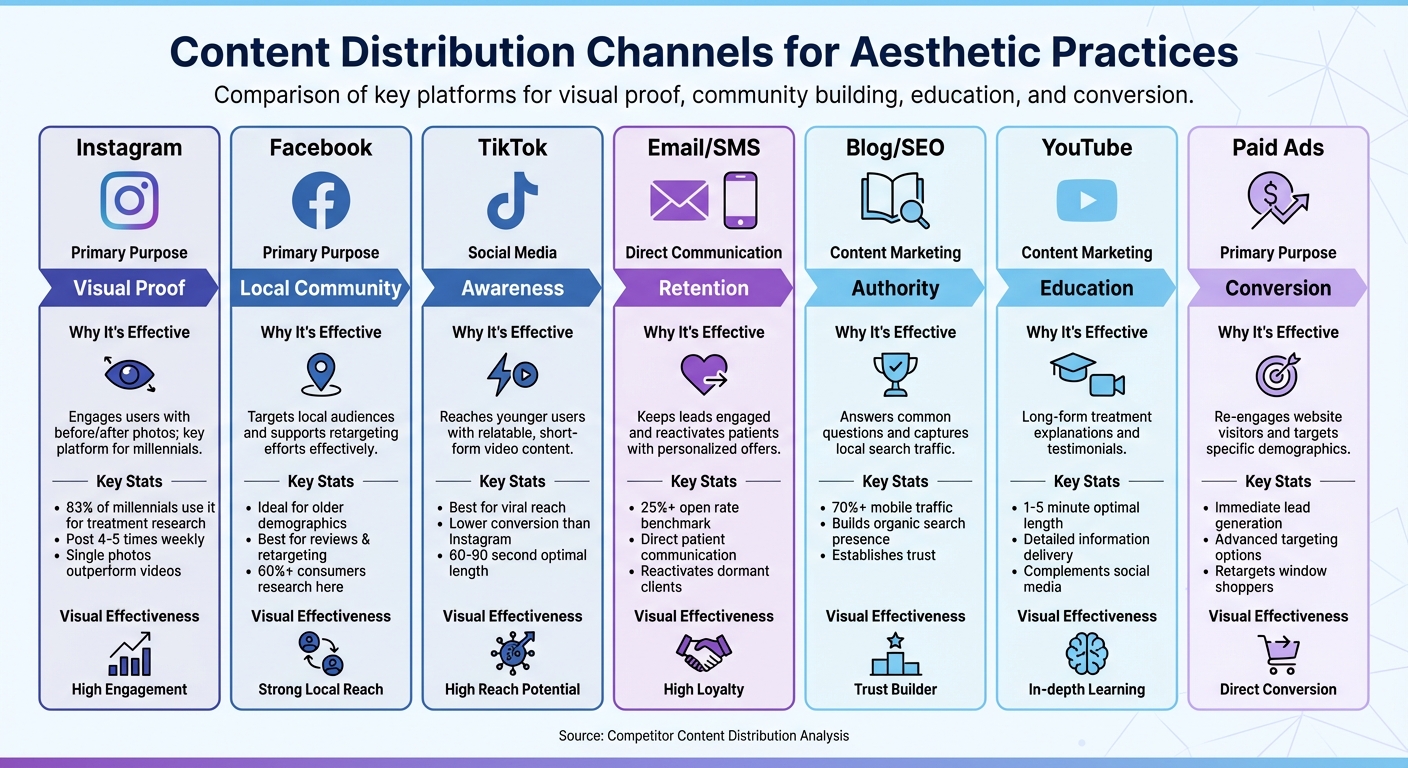
Content Distribution Channels Comparison for Aesthetic Practices
The first step in analyzing how competitors distribute content is figuring out which channels they use. Aesthetic practices rely on a mix of platforms to connect with potential clients during their decision-making journey. By understanding these channels, you can uncover not just where competitors post but also which platforms generate the most engagement for different demographics and treatments. This serves as a foundation for diving deeper into each channel's role in driving engagement.
Social Media Platforms
Instagram is a go-to platform for millennials, with 83% using it to research treatments. Posting 4–5 high-quality pieces of content weekly - like before-and-after photos, treatment reels, and educational carousels - can lead to strong engagement. Interestingly, single photos often outperform videos in engagement, especially for showcasing results.
Facebook, on the other hand, is ideal for connecting with local audiences, managing reviews, and running retargeting campaigns to re-engage website visitors. It appeals to a broader, often older audience compared to Instagram, making it a versatile option for practices targeting multiple age groups.
TikTok has become popular for reaching younger audiences through short, viral videos. Practices often use trending sounds, quick tips, and behind-the-scenes content to make procedures feel more approachable and boost brand visibility. While TikTok excels at building awareness, Instagram tends to perform better when it comes to monetization and conversions. Notably, over 60% of consumers turn to social media to research businesses before making decisions.
Email Newsletters and SMS Campaigns
Email and SMS marketing are key for maintaining relationships with patients. These channels allow practices to send tailored treatment reminders and re-engage patients who haven't visited in a while. In the aesthetics industry, a solid email open rate benchmark is 25% or higher. Competitors often integrate their social media campaigns with email and SMS, creating a seamless experience by sharing social proof and exclusive offers through these direct communication tools.
Websites, Blogs, and SEO Content
Websites and blogs play a critical role in capturing organic search traffic by answering common questions and establishing trust. With over 70% of aesthetic practice website visitors browsing from mobile devices, having a mobile-friendly site is non-negotiable. Competitors also use their Google Business Profiles to repost blog content, which helps improve search rankings and visibility.
YouTube complements these efforts by offering a space for long-form content like detailed treatment explanations and client testimonials. These videos provide more depth than typical social media posts, helping potential clients feel more informed and confident during their research phase.
Paid Ads and Retargeting Networks
Paid ads and retargeting campaigns are effective for reaching specific audiences and re-engaging potential clients who visited a website but didn’t book an appointment. Facebook, for instance, offers advanced targeting options that help practices focus on local demographics. Retargeting campaigns ensure that “window shoppers” continue seeing the practice’s content across the web, keeping it top-of-mind. Observing "sponsored" tags on competitor posts can also reveal which treatments they’re promoting and the demographics they’re targeting. While organic content builds trust over time, paid ads are often used to generate immediate leads.
| Channel | Primary Purpose | Why It's Effective |
|---|---|---|
| Visual Proof | Engages users with before/after photos; a key platform for millennials. | |
| Local Community | Targets local audiences and supports retargeting efforts effectively. | |
| Email/SMS | Retention | Keeps leads engaged and reactivates patients with personalized offers. |
| Blog/SEO | Authority | Answers common questions and captures local search traffic. |
| TikTok | Awareness | Reaches younger users with relatable, short-form video content. |
Reading about the problem? See how Prospyr solves it in one platform.
Book a DemoStep 2: Map Competitor Distribution Strategies
Once you’ve identified the channels your competitors use, the next step is to dig deeper into how they use them. This involves analyzing their strategies to understand what’s working for them and figuring out how to do it better.
Organic Posting Schedules and Frequency
Start by tracking how often competitors post and when. You can do this manually or use automated tools with APIs to gather data like timestamps, captions, and engagement metrics. From this, you can calculate how often they post daily or monthly and pinpoint the times they get the most engagement. Pay attention to the hashtags and keywords they use most often - these can give you clues about their key content themes and any seasonal trends they follow.
For email and SMS campaigns, tools like Owletter (starting at $29/month) can help by capturing competitor newsletters. This allows you to analyze their send times and frequency. According to research, 68% of marketers see competitive analysis as a core part of their strategy, and businesses that regularly analyze competitors grow 3.2 times faster than those that don’t.
Once you’ve mapped out their organic posting habits, it’s time to shift your attention to their paid strategies.
Paid Promotion Tactics
Understanding your competitors’ paid promotion strategies requires looking beyond the obvious “sponsored” tags. Start by creating a tracking table to log details like ad types, target audiences, and engagement levels. Note whether they prefer short videos, static images, or text-based ads - and which formats seem to perform best. If their ads are geo-targeted and not visible in your area, using a VPN can help you uncover them.
Dive into the comments on their paid posts to gauge audience sentiment. Positive comments can highlight successful tactics, while complaints might expose areas where they fall short. Tools like Mention (starting at $41/month) can notify you when competitors launch new campaigns or tweak their messaging. Additionally, measuring their share of voice - especially on platforms like Facebook - can give you an idea of how often they’re running ads.
After analyzing paid efforts, the next step is to examine how competitors use partnerships to extend their reach.
Partnerships and Influencer Collaborations
Competitor collaborations with influencers can offer valuable insights into their audience engagement. Don’t just focus on follower counts; instead, look at the quality of engagement, such as meaningful comments and shares on sponsored posts. User-generated content from these partnerships can also reveal how well their audience connects with the brand.
Watch how your competitors use cross-platform promotion to amplify their campaigns. Tools like ContentStudio, which provides a 7-day free trial, can help you track influencer collaborations and monitor hashtag performance. Additionally, observing how competitors and their partners handle customer feedback and public comments during campaigns can expose weak points in their approach. With global social media users spending an average of 2 hours and 21 minutes daily on these platforms, understanding these dynamics can highlight opportunities to improve your own strategy.
"Sprout Social allows us to monitor brand mentions, hashtags, keywords, and more across various platforms. It helps us gain insight into how consumers perceive our and competitors' brands."
- Simon Bacher, CEO and Co-founder, Ling
Step 3: Measure Channel Effectiveness Metrics
Once you've mapped out competitor distribution, it's time to evaluate the actual impact of their strategies. Metrics like follower counts and likes are secondary to measurable business outcomes. The growing importance of these evaluations is evident, with the global social media analytics market expected to jump from $13.8 billion in 2024 to $17.4 billion in 2025.
Engagement Rates and Audience Growth
To truly understand audience connection, go beyond surface-level metrics like likes. Focus on indicators such as comment depth, share velocity, and saves. These metrics reveal how engaged and invested an audience is. For example, a competitor with 100,000 followers but minimal comments likely isn't resonating with their audience.
Dive deeper by analyzing the tone of comments. Positive interactions suggest trust and connection, while negative feedback may highlight weak points in their messaging. In the aesthetics industry, brands like BTL and Ultherapy have achieved engagement rates as high as 14%. For perspective, BOTOX Cosmetic reached 8.5 million total video views by March 2023, while BTL achieved an impressive 54 views per follower, setting a strong efficiency benchmark.
Another critical metric is amplification velocity, which measures how quickly content spreads within its first 24–48 hours. This can help identify trending content styles. For instance, in early 2023, truSculpt (by Cutera) boosted its Instagram followers by 91%, growing from 11,000 to 21,000. Their strategy? Up-close treatment footage, tagging clinics and practitioners, and pairing posts with high-energy audio.
Finally, monitor share of voice (SOV) to gauge how much of the conversation a competitor owns in your category. This metric reveals whether their visibility stems from strong content or heavy ad spending. Understanding these dynamics helps pinpoint opportunities to differentiate your practice. Once these engagement metrics are in place, the next step is assessing how they translate into tangible business results.
Conversion Tracking and Lead Generation
While engagement metrics are valuable, conversion data reveals whether competitors are effectively growing their business. Look at website traffic, lead generation (e.g., form submissions, email signups), and appointments or bookings driven by their social media integration. Tools like SpyFu, SimilarWeb, and SEMrush can provide insights into competitor landing pages, conversion paths, and estimated ad spend.
Break down their content into stages: Awareness, Consideration, and Conversion. This segmentation helps identify which formats drive specific actions.
Take BOTOX Cosmetic’s "12 Days of BOTOX" campaign as an example. In December 2022, the campaign added 22,000 YouTube subscribers and 28,000 Instagram followers, directly contributing to patient conversions.
"Engagement is the lifeblood of social media success."
These insights lay the groundwork for benchmarking your performance against industry standards.
Benchmarking Metrics Against Industry Standards
After measuring engagement and conversion, compare your findings with industry benchmarks to uncover strategic gaps. In the aesthetics field, specific benchmarks can help determine whether a competitor's strategy is effective or just average.
| Metric Category | Key Metric | Aesthetics Industry Benchmark |
|---|---|---|
| Engagement | Average Engagement Rate | ~14% for top-tier brands (e.g., BTL, Ultherapy) |
| Activity | Posting Frequency | ~14 posts per month on Instagram; ~11 on Facebook |
| Video Performance | Views Per Follower | ~54 views per follower (high efficiency benchmark) |
| Content Mix | Educational Content | Recommended ~30% of total content distribution |
| Content Mix | Social Proof (Before & Afters) | Recommended ~25% of total content distribution |
Video content dominates the aesthetics industry. On Instagram, videos generate the highest average engagement and make up 63% of all posts. Top-performing YouTube videos for aesthetic brands tend to last between 1 to 5 minutes, while TikTok videos perform best at 60–90 seconds. If competitors are underutilizing video content or skipping key educational topics like treatment aftercare, this opens up opportunities for your practice.
Pay attention to the visual elements of successful content - hooks, pacing, and narrative structure - and refine your own approach accordingly. Also, note how quickly competitors respond to comments and questions. Poor response times can be an area for you to stand out with superior customer care.
"The goal isn't to copy your competitors, but to understand the competitor landscape well enough to differentiate your brand effectively while learning from proven strategies that work in your industry."
- Wasiq Naeem, ContentStudio
Step 4: Tools for Competitor Content Tracking
Once you’ve identified key metrics, the next step is to streamline your research process. Leveraging tools powered by AI can cut down research time by as much as 40% through advanced social listening and analytics.
Social Listening and Analytics Tools
Hootsuite, which incorporates Talkwalker, is a powerful tool for monitoring over 150 million websites and more than 30 social platforms. With the ability to track up to 20 competitors at once, it allows you to compare posting frequency and engagement rates side-by-side. Additionally, its sentiment analysis feature categorizes competitor mentions as positive, negative, or neutral, offering insights into potential service gaps.
"Talkwalker helps our brand monitor trending topics and mentions across the web. Our social media team is able to quickly and seamlessly pull reports, look at dashboards, and keep informed."
- Jacqueline M., Social Media Marketing Manager, Grand Canyon Education, Inc.
Rival IQ stands out for its in-depth competitive reports across platforms like TikTok, Instagram, Facebook, and Threads. It also offers real-time alerts, notifying you instantly when a competitor’s post performs exceptionally well - giving you the chance to analyze their strategies as they unfold. Meanwhile, Agorapulse provides up to 24 months of historical data, far surpassing other platforms that typically limit access to 7–13 months without upgrades. This extended data window is particularly useful for identifying long-term trends and seasonal patterns.
Another emerging area is tracking your Share of Voice in AI tools like ChatGPT, Gemini, and Claude. Keeping tabs on how competitors are featured in AI-generated responses is becoming increasingly important as more patients rely on these platforms for treatment recommendations.
Ad Intelligence Platforms
The Facebook Ad Library is a free resource that provides full visibility into active ads across Facebook and Instagram, including their start dates and creative variations. For deeper insights, HypeAuditor goes a step further by offering metrics on influencer partnerships, ad creatives, audience demographics, and estimated budgets. By calculating the Cost Per Engagement (CPE) of competitor campaigns, you can assess whether their influencer collaborations are delivering value.
These tools not only reveal what competitors are promoting but also how much they’re spending and which audiences they’re targeting. This is particularly vital in the aesthetics industry, where influencer campaigns can play a major role in attracting new patients.
SEO and Traffic Analysis Tools
Ahrefs is a go-to for SEO and traffic analysis, with a database that includes 18.6 billion pages and 35 trillion live backlinks, along with over a decade of historical data. Its Site Explorer tool helps you pinpoint which pages drive the most organic traffic for competitors, enabling you to replicate successful strategies. The Brand Radar feature also tracks how often competitors are mentioned in AI chatbot answers compared to your business.
SEMrush's Competitor Toolkit uncovers your competitors’ keyword strategies and highlights untapped opportunities. Meanwhile, SimilarWeb offers daily and weekly traffic updates, providing insights into not just traffic volumes but also the top sources driving visitors to competitor sites.
| Feature | Ahrefs | SEMrush | SimilarWeb | Hootsuite |
|---|---|---|---|---|
| Primary Focus | SEO & Backlinks | All-in-one Marketing | Traffic Intelligence | Social & Listening |
| Traffic Data | Organic & Paid Search | Organic & Market Traffic | Total Web Traffic | Web Mentions |
| AI Search Tracking | Brand Radar | AI Visibility Toolkit | N/A | LLM Share of Voice |
| Backlink Analysis | 35T Live Backlinks | Backlink Checker | N/A | N/A |
| Historical Data | 10+ years | Included | Included | 13–24+ months |
"A great advantage has been its competitive analysis tool, which has helped us create better and more detailed marketing strategies."
- Alejandra Perozo, Director, Brand Communications & Development Marketing, Eano Home Renovation
Most of these tools integrate seamlessly with CRM and web analytics platforms, allowing you to see whether a competitor’s social engagement translates into tangible results like website traffic or patient leads. By combining social metrics with business data, you can zero in on the most impactful strategies and refine your approach to stay ahead of the competition.
Step 5: Benchmark and Adapt for Your Practice
Channel Performance Comparisons
Now that you've analyzed competitor metrics, it's time to put those insights to work by benchmarking your practice's performance across key channels. Focus on areas like content themes, engagement quality, posting frequency, and platform priorities. Instead of getting caught up in vanity metrics like follower counts, dig deeper into engagement quality to understand real brand loyalty. For instance, a competitor with a massive, yet passive, audience may have less influence compared to one with a smaller but highly engaged following.
Take it a step further by mapping competitor content to the customer journey. During the awareness stage, look for strategies such as thought leadership pieces or engaging storytelling videos. In the consideration phase, you'll often find tutorials, product demos, or influencer-led explainers. At the conversion stage, expect to see tactics like testimonials, social proof, or time-sensitive offers.
"More data isn't always better. Top brands often get the best results by tracking just a few key metrics rather than trying to analyze everything." - Your Social Strategy
Use metrics that genuinely matter to evaluate your performance. Engagement rate can measure how well your content resonates and builds loyalty. Share of voice (SOV) helps you understand your market presence and control of the narrative. Sentiment trends reveal whether your brand is building trust or facing backlash. Also, consider the balance between paid and organic reach to determine if a competitor’s visibility stems from strong content or heavy ad spending - this can uncover potential weaknesses.
Identifying Gaps and Opportunities
Look for areas where competitors fall short. For example, platform blind spots might occur when competitors neglect emerging channels like TikTok or YouTube Shorts. Narrative gaps could be present if no one is addressing specific topics, such as detailed recovery timelines or comparisons between treatment options. Community engagement gaps might appear when competitors fail to respond to customer comments.
Take Duolingo's 2025 success as an example. They captured a younger audience by creatively using TikTok trends, such as reaction videos and skits, and incorporating their brand mascot. This approach helped them gain millions of followers while outperforming competitors targeting the same demographic.
If you identify a gap - like no competitor hosting live Q&A sessions - consider testing the idea with a short pilot program, such as a four-week trial, to measure engagement and conversion rates before committing long-term. Similarly, if competitors are slow to respond on social media, prioritize offering quicker, personalized support to position your practice as the go-to choice for customer care. Taking advantage of these insights requires efficient management tools, and that’s where Prospyr can help.
How Prospyr Helps Manage Content Distribution
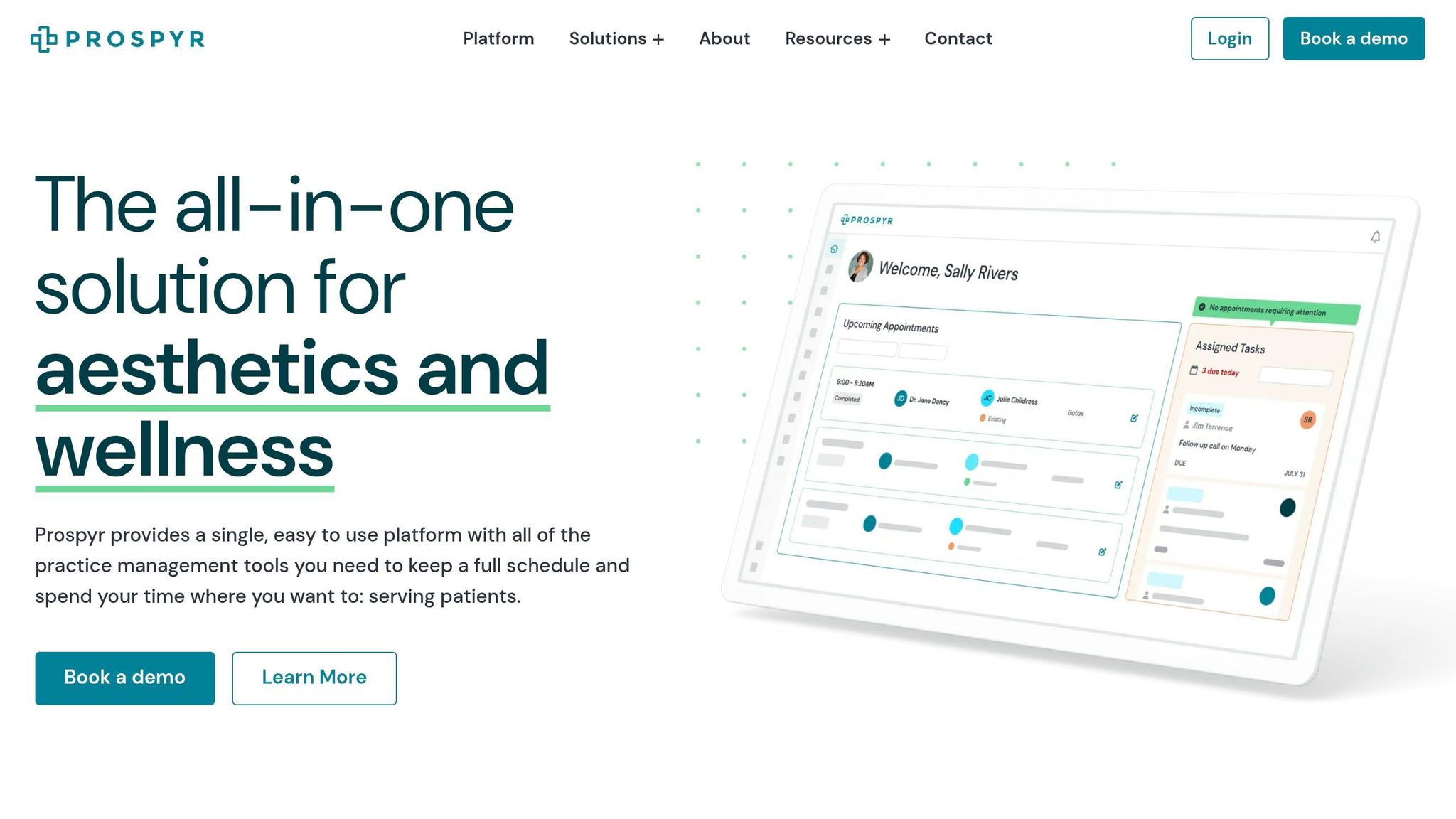
Once you've identified opportunities, executing strategies across multiple channels can feel overwhelming. Prospyr simplifies this process by offering an all-in-one solution that integrates social media scheduling, HIPAA-compliant client management, email and SMS automation, and practice analytics. This connects your content performance directly to bookings and revenue.
Prospyr’s social media management tools allow you to schedule posts across various platforms while monitoring engagement metrics and patient inquiries in real time. Automated email and SMS campaigns ensure you maintain consistent communication throughout the customer journey - from educational content at the awareness stage to appointment reminders focused on conversions. Lead capture tools sync with your website and social profiles, funneling potential clients directly into your CRM for targeted follow-ups.
Additionally, Prospyr’s practice analytics highlight which channels and message types drive the most bookings and revenue. This data-driven approach eliminates guesswork, letting you adapt successful competitor strategies - like using visual before-and-after content - into tactics that lead to actual appointments instead of just likes or comments.
Conclusion
Understanding content distribution, combined with a thorough competitor analysis, is key to achieving targeted growth. This isn't about copying what others do; it's about using data to craft a strategy that resonates with your audience. Businesses that actively analyze their competition grow 3.2 times faster than those that don’t, and 77% of successful marketing campaigns are built on competitive insights. The numbers speak for themselves - this approach drives real results.
Focus on impact, not just frequency. By identifying content gaps, zeroing in on the platforms your audience prefers, and prioritizing engagement metrics over vanity numbers, you can strategically position yourself where competitors fall short.
"Content is king, but distribution is queen. And she wears the pants".
Even the most compelling content needs a smart distribution plan to reach the right audience at the right time. Use the tools and frameworks from this guide to analyze competitor strategies, measure your performance, and uncover opportunities to refine your approach.
Here’s a practical starting point: audit 5–10 competitor accounts, including direct competitors, content leaders, and aspirational brands. Calculate engagement rates with the formula (Likes + Comments) / Views * 100, track their posting schedules, and analyze comment sentiment to uncover audience pain points. These insights can help you fine-tune your content strategy for better engagement.
For execution, Prospyr’s all-in-one practice management platform can transform these insights into action. With features like social media scheduling, HIPAA-compliant client management, and automated campaigns, you can focus on strategy while the platform handles the heavy lifting. Stop guessing and start growing with a streamlined, data-driven approach.
FAQs
Which competitor channels should I prioritize first?
When it comes to reaching your target audience in the aesthetics industry, stick to where they spend their time. Platforms like Instagram, TikTok, and Facebook are crowd favorites among potential clients. But don’t just stop at being present - craft strategies tailored to each platform.
Dive into engagement metrics and advertising data to figure out which channels are delivering the best results. Instead of trying to be everywhere at once, focus your resources on a few platforms that perform well. This way, you can maximize impact without spreading yourself too thin.
What metrics best show if a channel drives bookings (not just likes)?
Metrics that show a channel is driving bookings include conversion rate, time on page, bounce rate, and social shares. These numbers give insight into how well your audience is engaging with your content and whether their actions are leading toward bookings. Pay close attention to how users interact with your site and if their behavior matches your booking objectives.
How can Prospyr help turn competitor insights into a repeatable distribution workflow?
Prospyr turns competitor insights into actionable workflows with its robust analysis and automation tools. Clinics can monitor competitor strategies, pinpoint opportunities, and seamlessly incorporate these findings into Prospyr’s marketing automation and analytics features. On top of that, its social media and review management tools ensure continuous monitoring, helping practices fine-tune content distribution and stay ahead in the aesthetics industry.