Ultimate Guide to Staff Competency in Infection Control
Role-based infection control competencies keep clinics safe and audit-ready with training, audits, and documented sign-offs.
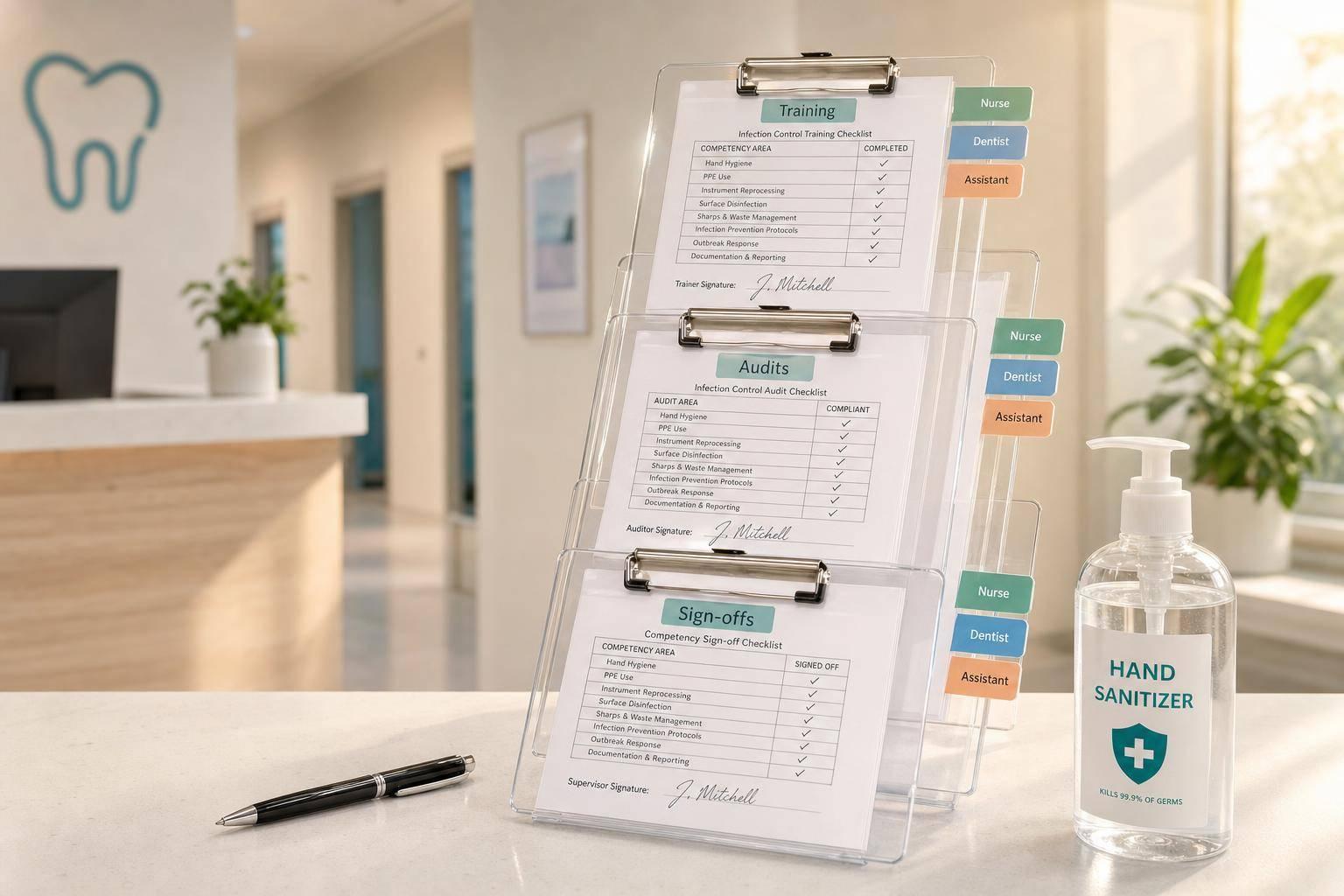

One missed step in hand hygiene, sharps handling, or room cleaning can lead to an infection, an exposure event, or a failed inspection. In aesthetics and wellness clinics, infection control is not just annual training. It means each staff member can do the right tasks for their role, at the right time, and the clinic can prove it with records.
Here’s the short version:
- Training alone is not enough. Staff need observation, return demos, and repeat checks.
- Rules come from four main sources: CDC, OSHA, CMS, and Joint Commission.
- Each role needs different checks. Providers, support staff, and front desk teams do not face the same risks.
- Each service needs different checks. Injectables, microneedling, IV therapy, lasers, and minor procedures all carry different infection risks.
- Records matter. OSHA bloodborne pathogen training records must be kept for at least 3 years.
- Risk review should not wait for annual training. A needlestick, a new device, or a policy update should trigger retraining.
- Audits show what staff do, not just what they remember. That matters because one review cited baseline hand hygiene compliance of 47.5% across eight hospitals.
If I were setting this up in a clinic, I’d focus on five things first:
- Define role-based skills
- Observe staff doing the work
- Document sign-offs and due dates
- Retrain after changes or incidents
- Review audit and infection data on a set schedule
This article explains how to build that system in a U.S. clinic without turning it into a paperwork exercise.
Regulatory Foundations and Leadership Responsibilities
CDC, OSHA, CMS, and the Joint Commission each cover a different part of infection-control competency in outpatient clinics. On paper, that can sound straightforward. In practice, it only works when those rules are turned into role-based competencies people are expected to show on the job.
CDC, OSHA, CMS, and Joint Commission Requirements in Practice
The CDC lays out the core infection-prevention practices staff need to know and perform. It also expects leaders to verify that staff are competent based on their specific roles.
The OSHA Bloodborne Pathogens Standard (29 CFR 1910.1030) sets the legal floor. If staff face bloodborne-pathogen exposure risk, they must receive training when hired and at least once a year after that. That training must be given at no cost, during work hours, and records must be kept for at least 3 years.
CMS goes a step further. It expects a documented, ongoing infection-control program, not a stack of one-off training sessions. For Medicare-certified ambulatory surgical centers, the absence of a program or a qualified leader can put Medicare participation at risk under 42 CFR 416.51. Even if a clinic is not CMS-certified, this is still a solid benchmark: written policies, active surveillance for post-procedure infections, and infection control tied into quality improvement work.
The Joint Commission adds another layer: regular review and documented competency. Its 2024 updates include a national performance goal on preventing and controlling infection, along with training and competencies for staff who handle high-consequence diseases or special pathogens. Clinics without accreditation can still use these standards as a benchmark.
A simple way to think about it:
- Use CDC for clinical practice
- Use OSHA for exposure-risk training
- Use CMS for program structure
- Use the Joint Commission for regular review
Roles of Medical Directors, Infection Control Designees, and Managers
This is where leadership comes in. A clinic can't just post policies and hope they stick. Someone has to own the work.
Most aesthetics and wellness clinics do not have a full-time Infection Preventionist. So the job has to be split on purpose across the people already in the building.
The medical director is usually the top clinical authority for the infection-control program. That includes approving policies, setting competency expectations for high-risk procedures, reviewing incident reports, post-procedure infections, exposure events, and audit findings, and signing off on corrective action plans. Just as important, the medical director has to set the tone by following the same standard expected of everyone else.
The Infection Control Designee - often a nurse, practice manager, or experienced clinician - runs the day-to-day side of the program. Competency domains such as leadership, quality improvement, operations, and data tracking can help define the role. In most clinics, this person coordinates the training calendar, leads safety meetings, tracks audit results, and brings gaps to the medical director's attention.
Practice managers connect clinical standards with daily operations. They make sure training records stay current, new hires finish onboarding before taking on exposure-risk tasks, and the Exposure Control Plan is reviewed and updated each year.
A strong program shows up in what staff do, not just in what the clinic files away. Once oversight is assigned, the next move is to define the skills each role must be able to show.
Reading about the problem? See how Prospyr solves it in one platform.
Book a DemoCore Infection Control Competencies by Role and Procedure Type
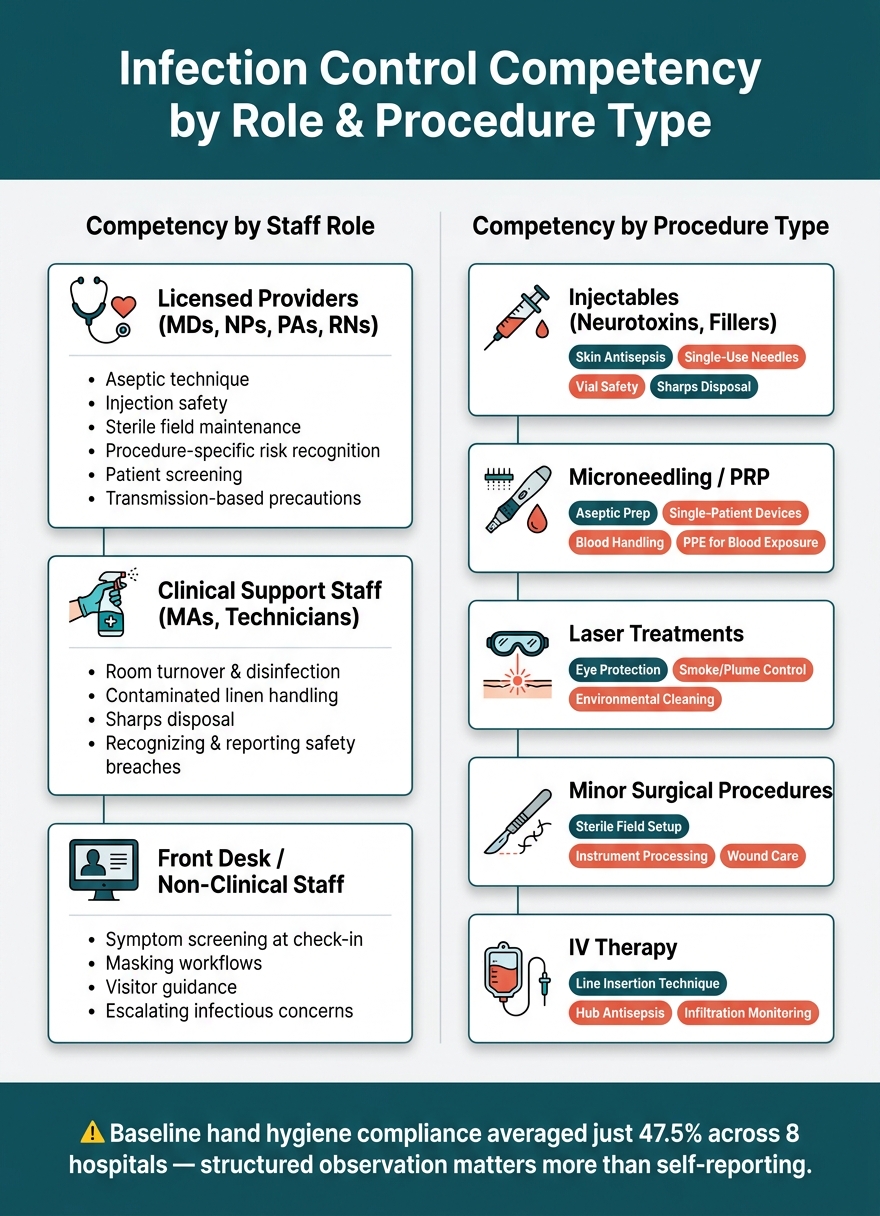
Infection Control Competency by Role & Procedure Type
Once leadership is in place, the next step is simple: spell out what each role must be able to do.
Skills Every Clinical Team Member Must Be Able to Demonstrate
The CDC lists a core set of infection prevention and control practices that apply across healthcare settings, including aesthetics and wellness clinics. These are the baseline skills every clinical staff member should be able to carry out every day.
Hand hygiene sits at the center of all of it. Staff should use alcohol-based hand rub at five key moments: before patient contact, before an aseptic task like an injection or IV insertion, after contact with a patient or their surroundings, after exposure to blood or body fluids, and after removing PPE. If hands are visibly soiled, or after caring for patients with Clostridioides difficile or norovirus, soap and water is required.
That’s just the start. Every clinical team member should also know how to choose the right PPE for the task - gloves, gown, mask, and eye protection - and put it on and take it off without contaminating themselves. Safe injection practices matter just as much: use single-use needles and syringes, handle multi-dose vials safely, and prep aseptically every single time. Staff should also be able to clean the care area, dispose of sharps the right way, and report exposures right away.
From there, those baseline skills need to be tied to each role and each procedure.
How Competency Differs for Providers, Support Staff, and Front Desk Teams
Not everyone in the clinic handles the same infection control duties. Training and competency checks should reflect that.
| Role | Core Competency Focus |
|---|---|
| Licensed providers (MDs, NPs, PAs, RNs) | Aseptic technique, injection safety, sterile field maintenance, procedure-specific risk recognition, patient screening, when to use transmission-based precautions |
| Clinical support staff (MAs, technicians) | Room turnover, surface and equipment disinfection, contaminated linen handling, sharps disposal, recognizing and reporting safety breaches |
| Front desk / non-clinical staff | Symptom screening at check-in, masking workflows, visitor guidance, escalating infectious concerns to clinical leadership |
A front desk team member should know what to do if a patient shows up with fever, rash, vomiting, or respiratory symptoms. That means following the clinic’s entry or rescheduling protocol without hesitation. It may not look like a clinical task, but it’s still infection control, and it still matters.
On the clinical side, a medical assistant should be able to turn over a treatment room without contaminating clean supplies. A licensed provider should be able to set up and complete a procedure using proper aseptic technique from beginning to end.
OSHA’s Bloodborne Pathogens, Personal Protective Equipment, and Respiratory Protection standards apply to all three groups, not just the people doing procedures. So the employer’s duty to train and protect staff reaches far beyond the treatment room.
The baseline stays the same. What changes is the level of control needed for the service being performed.
Service-Specific Infection Risks in Aesthetics and Wellness Settings
Role-based competency is the floor. The procedure sets the bar. Generic infection control training isn’t enough when a clinic offers injectables, laser treatments, microneedling, minor procedures, and IV therapy under one roof. Each service comes with its own risk profile, so competency validation should match that reality.
In 2018, a CDC investigation linked HIV transmission to PRP microneedling performed at an unlicensed spa - the first documented case of HIV transmission associated with nonsterile cosmetic injection procedures in the U.S.. That case shows, in blunt terms, why bloodborne pathogen precautions and aseptic technique can’t be treated like box-checking.
Here’s a practical way to map services to the skills that matter most:
| Service | Key Competency Areas |
|---|---|
| Injectables (neurotoxins, fillers) | Skin antisepsis, single-use needle/syringe handling, vial contamination prevention, sharps disposal |
| Microneedling / PRP | Aseptic prep, single-patient-use devices and supplies, blood handling, PPE for blood exposure |
| Laser treatments | PPE and eye protection, skin prep when applicable, smoke/plume control, environmental cleaning between patients |
| Minor surgical procedures | Sterile or clean technique, instrument processing, sterile field setup, wound care |
| IV therapy | Line insertion technique, hub and port antisepsis, monitoring for infiltration and adverse reactions |
A procedure-to-skill matrix helps keep training role-specific and measurable. It also makes gaps easier to spot before they turn into problems.
How to Build, Assess, and Document a Competency Program
A procedure-to-skill matrix tells you what staff need to know. A competency program shows how you verify they can do it safely - and gives you a record when someone asks for proof.
Training Structure for New Hires, Annual Refreshers, and Practice Changes
The easiest way to frame training is around three triggers: hire, calendar, and change.
For new hires, infection control orientation should happen before any independent clinical work. Start with the basics: hand hygiene, PPE, sharps safety, standard precautions, and post-exposure protocols that match CDC and OSHA bloodborne pathogen rules. Then move into clinic-specific procedures based on the services that person will perform. Staff should only work on their own after supervised practice and a formal competency sign-off.
The calendar trigger keeps training from slipping. OSHA requires annual bloodborne pathogen training for staff with occupational exposure, and Joint Commission standards also expect ongoing education and training to maintain or increase competency, with participation documented. In many clinics, a simple setup works well: one annual core safety session that covers hand hygiene, PPE, sharps safety, and policy updates, plus short quarterly micro-trainings lasting 15–30 minutes. Those shorter sessions can focus on audit findings or seasonal risks, like respiratory virus season.
Then there’s the change trigger. If you bring in a new device, add a service like platelet-rich plasma or PDO threads, or need to follow updated CDC guidance, staff need focused training before using the new process. The same applies after incidents. A needlestick, contamination event, or suspected post-procedure infection should lead to documented remedial training for the staff involved, followed by a competency check to confirm the gap was fixed.
The sequence is simple: knowledge → supervised practice → observed competency.
Assessment Methods That Show Real Proficiency
A quiz score can tell you whether someone remembers a policy. It can't tell you whether they can set up a sterile field without cutting corners.
That’s why competency assessment should use more than one method, based on the skill being tested.
Direct observation is the main tool for procedural skills. A supervisor watches the staff member perform the task in a real clinic setting - hand hygiene, PPE donning and doffing, injection technique - using a standard checklist. This shows actual behavior, not just what someone says they would do. The downside is obvious: it takes time, a trained assessor, and the right moment in the workflow. One multi-hospital review found that baseline hand hygiene compliance averaged 47.5% across eight hospitals, which helps explain why structured observation matters more than self-reporting.
Simulation and scenario-based assessments help when direct observation isn't enough. A mock blood exposure drill, a case involving a suspected communicable disease in the waiting room, or a tabletop exercise on outbreak response can test judgment and response in a controlled setting. Written tests are useful for policy knowledge and regulatory rules, but they do not show hands-on skill.
| Method | Strengths | Limitations | Best Use Cases |
|---|---|---|---|
| Direct Observation | Captures real-world behavior; allows immediate coaching; validates procedural skills in actual workflow | Resource-intensive; performance may be influenced by being observed | Hand hygiene, PPE use, injection technique, cleaning/disinfection routines, sharps handling |
| Simulation/Scenarios | Tests judgment, teamwork, and response to uncommon events; safe environment to practice high-risk situations | Requires planning, space, and sometimes equipment | Exposure incident response, outbreak management, managing ill patients in waiting areas, device failure or contamination scenarios |
| Written Tests | Efficient for large groups; good for assessing knowledge of policies, regulations, and rationales | Does not demonstrate physical skill or real behavior | Policy comprehension, CDC/OSHA requirements, pre- and post-training knowledge checks |
For high-risk work - like injections, IV therapy, and device reprocessing - a blended model is the norm. Staff should pass a written test and at least one practical assessment before they are signed off as competent.
Documentation Systems That Support Compliance and Follow-Up
Good documentation does more than satisfy an auditor. It helps you spot an expired competency before it turns into a patient safety problem.
Each staff member should have a retrievable competency file that includes:
- Orientation completion records with modules, dates, facilitators, and scores
- Annual training logs with content outlines and signed or electronic attendance
- Competency checklists signed by the assessing supervisor
- Policy acknowledgments showing staff read and understood current protocols
- Corrective action records that connect incidents to remedial training and follow-up assessments
OSHA requires bloodborne pathogen training records to be kept for at least three years, while a common best-practice standard for broader training documentation is at least five years. HIPAA-related records must be kept for at least six years under federal rules.
At a minimum, each record should include four fields: the employee identifier, the course or competency title, the completion timestamp, and the policy version tied to that training. That last item matters more than people think. It lets an auditor confirm that the training matched the standard in effect at that time.
A HIPAA-compliant platform like Prospyr can keep all of this in one place. Clinics can schedule recurring annual trainings, automate email and SMS reminders before due dates, store digital competency checklists in each staff profile, and use task tools to flag renewals before they expire. Practice analytics can help teams track completion rates by role and spot departments where training is overdue before an inspection does. There’s also a practical safety check here: if competencies are tied to service permissions, staff cannot be scheduled for certain procedures unless their sign-offs are current.
| Competency Domain | Recommended Assessment Tool(s) | Review Frequency |
|---|---|---|
| Hand hygiene & PPE use | Direct observation audit | Quarterly |
| Injection technique & sharps safety | Observation checklist + written test | Annually (or after incident) |
| Device reprocessing & environmental cleaning | Observation audit + return demonstration | Quarterly audit; annual full reassessment |
| IV therapy & line management | Structured observation checklist | Annually (or after incident) |
| Outbreak response & exposure management | Simulation/tabletop exercise | Annually + after real events or new guidance |
| Policy & regulatory knowledge | Written pre/post-test | At hire + annually |
It also helps to audit the training program itself once a year, not just each employee file. That review should be documented, and any changes or fixes should be tracked so the program doesn’t drift over time.
Sustaining Competency Through Culture, Risk Review, and Preparedness
Using Audits, Incidents, and Risk Assessments to Improve Performance
Once competency is documented, the work shifts to keeping it in shape. Audit results should lead to action right away, not just sit in a file as proof of compliance. After each hand hygiene or PPE observation round, review the findings, share role-based compliance rates with staff, and assign clear fixes. That might mean adding alcohol-based hand rub dispensers in a high-traffic area, adjusting room turnover checklists, or setting up short micro-trainings for a team that needs help. Share role-level results and assign specific fixes.
Use that same follow-up approach for incidents and near-misses. A needlestick during a PRP procedure, a break in aseptic technique, or a missed step in device reprocessing points to a gap in training, supervision, or workflow. A designated review team can look at what led to the event, assign corrective action, and then check whether the fix actually worked. When those lessons are shared back with staff in huddles, using de-identified examples, people are more likely to speak up early instead of staying quiet.
An annual risk review should also be part of the routine, with another review any time services, devices, or workflows change. A clinic that adds IV vitamin infusions is dealing with different exposure risks than one focused on laser treatments. That means competency priorities need to change too, not just the written policies. CDC and APIC outpatient infection prevention frameworks can help structure that review.
Preparing Staff for Outbreaks, Policy Changes, and New Public Health Guidance
When a respiratory virus surge hits, clinics that already treat infection control as part of daily work can move faster. The tools are already there: huddles, job aids, and digital communication channels. What changes is the pace and the message. Staff need fast updates on revised screening questions, new masking or respirator rules, adjusted room turnover steps, and how to explain policy changes to patients in a calm, clear way.
A HIPAA-compliant platform like Prospyr can send updates by email or SMS and store staff acknowledgments and surge records for post-event reviews.
During outbreaks, the same competencies move from occasional review to daily use. The table below shows the difference between routine competency work and what clinics need during a surge or outbreak:
| Activity | Routine Operations | Surge / Outbreak Conditions |
|---|---|---|
| Training format | Annual e-learning and periodic micro-trainings | Daily shift huddles, just-in-time demonstrations, posted visual job aids |
| Screening protocols | Standard intake questions | Enhanced symptom and exposure screening at booking and arrival |
| PPE requirements | Standard precautions per procedure type | Expanded masking, eye protection, or respirators based on current guidance |
| Environmental cleaning | Scheduled room turnover per service | Increased cleaning frequency for high-touch surfaces and modified room turnover procedures |
| Audit focus | General adherence across all competency domains | Outbreak-specific behaviors such as respirator use and symptom screening compliance |
| Communication cadence | Monthly policy updates | Daily alerts and real-time staff notifications when guidance changes |
| Documentation | Standard competency records | Dedicated outbreak logs and surge-specific acknowledgment records |
Conclusion: Key Elements of a Strong Infection Control Competency Program
A competency program that protects patients and staff needs to be role-specific, observable, documented, and reviewed on a regular basis. Audit data, incident reports, and risk assessments should keep feeding back into training and policy over time.
Leadership is what holds the whole thing together. The medical director and infection control designee should have clear responsibility for reviewing performance data at set intervals and acting on what they see. When leaders visibly model hand hygiene, talk about infection control in staff meetings, and fix practical problems like empty PPE supplies or confusing workflows, staff adherence tends to improve across the board. The systems used for routine competency - training platforms, documentation systems, and audit processes - should be the same ones used during a surge. That way, infection control stays part of daily operations instead of turning into a once-a-year exercise. Strong competency programs are reviewed, corrected, and updated continuously.
FAQs
Who owns infection control competency in a clinic?
Infection control competency is a shared responsibility.
Medical directors oversee clinical protocols, regular chart reviews, and compliance with hygiene standards. At the same time, an Infection Control Lead handles staff training and facility-specific standard operating procedures.
That means this work doesn't sit with one person alone. Each team member must complete required training and follow safe work practices every day.
Prospyr can help by keeping training records organized and supporting compliance documentation.
How often should staff competency be reassessed?
Staff skill in infection control should be reassessed at least once a year. New hires must finish initial training within 10 calendar days of their start date.
Retraining should happen right away if procedures, equipment, or exposure risks change. Clinics should also keep documented proof of training and skill checks so they're ready for audits and can meet regulatory requirements.
What should be included in infection control competency records?
Include documented proof of all infection control training and skill assessments. That means keeping records like:
- completion certificates for bloodborne pathogen and OSHA safety training
- annual refresher records
- signed skills checklists from hands-on training
- device-specific education and complications management training
You’ll also want to keep logs of emergency response drills, along with copies of professional licenses, certifications, and delegation agreements. Those records help show that each staff member is authorized for their clinical duties.