California Telehealth Rules for Med Spas
California med spa telehealth checklist: verify CA licenses, confirm patient location, document consent, secure privacy, and chart fully.
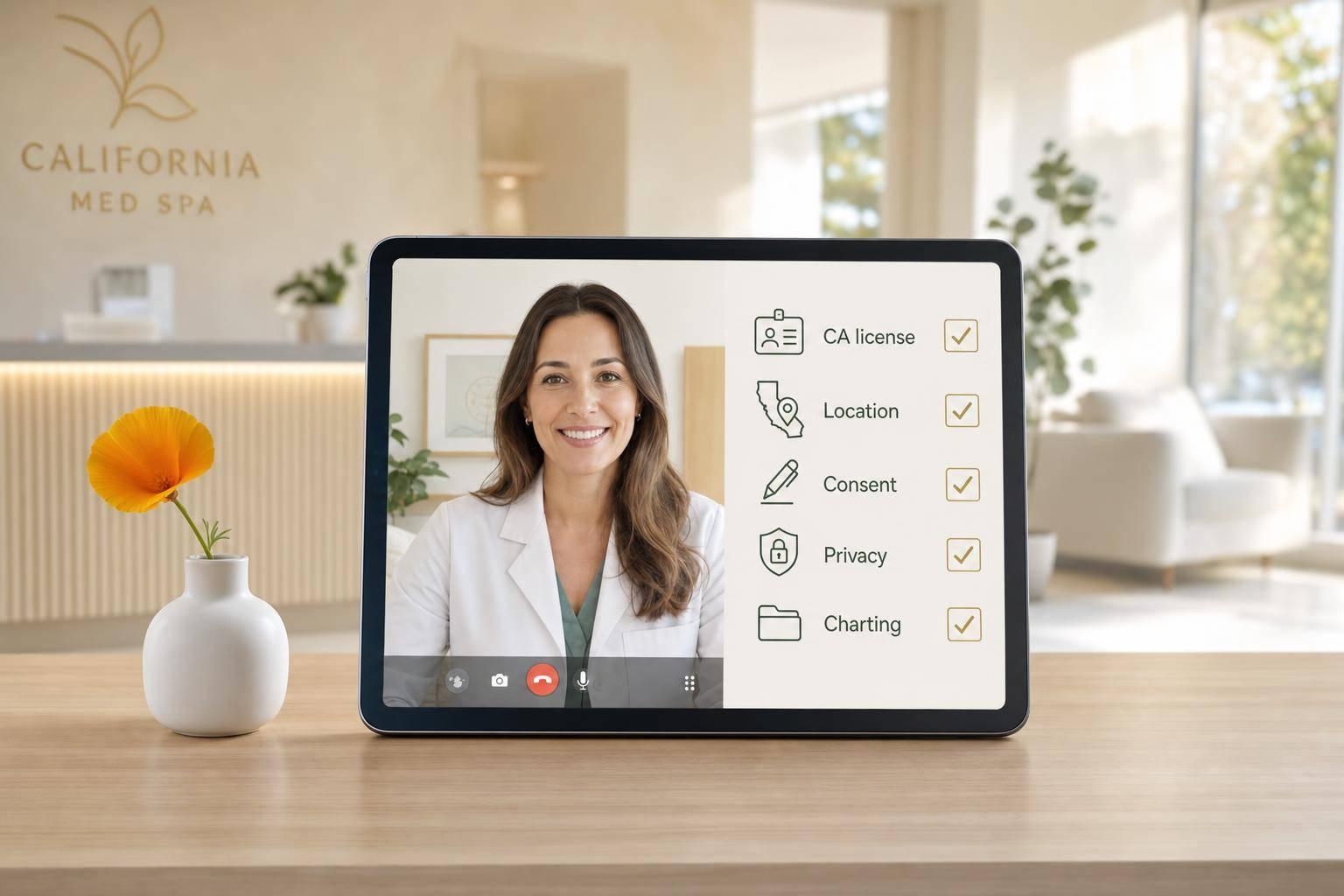

If you run telehealth in a California med spa, the rule is simple: remote care has to meet the same standard as in-person care. That means you need a California-licensed clinician, the patient must be in California at the time of the visit, telehealth consent must be documented, privacy tools must be secure, prescriptions must be based on an individual clinical visit, and the chart has to show exactly what happened.
Here’s the short version:
- License first: If the patient is in California, the treating clinician needs an active California license.
- Check location every visit: Telehealth is tied to where the patient is physically located during the call.
- Get consent before care starts: California law requires telehealth consent and chart documentation.
- Use secure tools: Scheduling, intake, messaging, and video all need to protect patient data.
- Don’t prescribe from a form alone: A questionnaire by itself is not enough for treatment decisions.
- Chart like it was in person: Note consent, location, visit type, findings, plan, follow-up, and any limits of the remote exam.
A few points stand out. California Business and Professions Code § 2290.5 treats telehealth as medical practice, not a side channel. Federal controlled-substance rules can add extra limits. And state boards have taken action where clinics used template-based approvals instead of a live, patient-specific evaluation.
Bottom line: if your team uses one fixed pre-visit process for licensure, location, consent, privacy, prescribing, and charting, you cut the risk of missed steps and keep telehealth visits in line with California rules.
Verify Provider License and Scope Before the Visit
Before you book a telehealth visit, check the first thing that matters most: does the clinician have an active California license for this service? If the patient is in California, the clinician who diagnoses, treats, or prescribes must hold an active California license for that profession.
An out-of-state license alone does not work for routine med spa telehealth. An out-of-state physician may consult under §2060, but that physician may not direct care or make the primary diagnosis for a California patient. For routine med spa telehealth, don’t lean on that exception.
Telehealth doesn’t change scope of practice either. It’s still the same lane rules, just through a screen. Physicians may diagnose, create treatment plans, prescribe, and supervise delegated tasks within the standard of care. NPs may diagnose and prescribe within their advanced practice authority, based on their certification and practice setup. PAs may conduct telehealth assessments and prescribe only under physician supervision. RNs may provide tele-nursing support, education, and protocol-based triage, but they cannot independently diagnose or prescribe.
After licensure and scope are confirmed, verify the patient’s location and get consent before the visit starts.
Who May Deliver Telehealth in a California Med Spa
Use the table below to set scheduling permissions before staff open a telehealth visit.
| Provider Type | California License Required | Telehealth Scope | Supervision / Delegation Notes |
|---|---|---|---|
| Physician (MD/DO) | Active California medical or osteopathic license | May independently diagnose, create treatment plans, and prescribe | May supervise delegated tasks and oversee PAs and RNs under proper protocols |
| Nurse Practitioner (NP) | California RN license plus NP certification | May diagnose and prescribe within NP authority | May practice independently or under standardized procedures, depending on the arrangement |
| Physician Assistant (PA) | California PA license | May conduct telehealth assessments and prescribe within the supervising physician's scope | Must work under a California-licensed supervising physician under a written supervision agreement |
| Registered Nurse (RN) | California RN license | May provide tele-nursing support, education, and protocol-based triage | Cannot independently diagnose or prescribe; needs standing orders or physician/NP supervision for clinical acts beyond basic nursing care |
Use license checks to set booking rules, not just chart review. In plain English, your scheduling system should only show telehealth visit types that match the clinician’s California license and scope. If a license has expired, or the provider role doesn’t match the visit type, that appointment shouldn’t be bookable. Prospyr can enforce those permissions in scheduling.
It also helps to recheck licenses on a fixed cadence, such as quarterly, through the Medical Board of California, the BRN, or the PA Board. Spotting an expired license before the visit is a lot easier than cleaning up the mess after.
Reading about the problem? See how Prospyr solves it in one platform.
Book a DemoConfirm Patient Location, Get Consent, and Protect Privacy
After licensure and scope, pin down the visit details before care starts. For every telehealth visit, handle three things first: confirm where the patient is physically located, get and document telehealth consent, and make sure the tools you use protect privacy.
Document the Patient's Physical Location at the Time of Care
California treats a telehealth visit as taking place where the patient is physically located, not where your clinic sits. That point matters. If the patient is outside California, the provider may be practicing in that state without a license.
Confirm the patient's current address before the visit and again at check-in. At check-in, verbally confirm the patient's full name and present address. Then record the confirmed location in the visit note. For example: Patient located in Los Angeles, CA, during telehealth visit. If the patient is outside California, pause the encounter, explain the licensure limit, offer to reschedule when the patient is back in state, and document that the visit was deferred and why.
Once location is confirmed, the next step is consent.
Get and Record Telehealth Consent Before the First Visit
California Business and Professions Code §2290.5 requires that, before telehealth services begin, the provider tells the patient that telehealth will be used, gets verbal or written consent, and documents that consent in the medical record. Get and record consent before the first telehealth visit.
Your consent process should explain:
- What telehealth is
- Its limits
- Privacy protections
- The option of in-person care
- Recording rules, which need separate explicit consent
Verbal consent is allowed under California law as long as you document it clearly in the chart.
Record who obtained consent, that person's name and role, and when consent was obtained. Make consent status easy to see in the EMR before the visit. If you later add audio-only visits or bring in new telehealth tools, create a new consent entry for that type of visit.
With consent in place, turn to privacy controls for intake and the visit itself.
Use Private, HIPAA-Compliant Intake and Communication Tools
Privacy covers the whole workflow: scheduling, intake, reminders, messaging, and the visit itself. Under §2290.5, telehealth encounters must follow all state and federal confidentiality laws, and patient privacy rights stay the same as they are for in-person care.
In practice, that means using encrypted intake, avoiding PHI in unsecured SMS or email, and running visits on platforms with encryption, access controls, and a BAA. Providers should conduct visits in a private room. Patients should also be asked to use headphones and private internet.
It helps to keep all of this in one place so staff can see the status at a glance. Prospyr supports secure intake, scheduling, EMR documentation, and centralized consent records in one HIPAA-compliant system.
sbb-itb-02f5876
Prescribing Limits and Required Charting for Telehealth Visits
Once location, consent, and privacy are covered, the next issue is simple: did the telehealth visit give you enough clinical detail to treat safely? Telehealth does not change California’s standard of care. The Medical Board of California states that the standard is the same whether care is delivered in person or through telehealth.
Prescribe Only When the Evaluation Supports It
A telehealth visit can support prescribing, but only when the evaluation is medically appropriate for that patient. California law requires more than a form before issuing a prescription. In plain terms, that means a live visit where you review the patient’s medical history, allergies, current medications, and any labs that matter, and complete a focused visual assessment that fits the treatment under review.
Some med spa treatments may be prescribed through telehealth only after a patient-specific evaluation. Controlled substances usually require an in-person evaluation under federal law, with only limited exceptions. If the telehealth format doesn’t let you gather the clinical detail needed for a safe call, the patient should be scheduled for an in-person visit.
One pattern that draws Medical Board scrutiny is questionnaire-only or template-based approval. That’s the kind of setup where every patient gets pushed through the same protocol without an individualized assessment. California enforcement actions have recently focused on GLP-1 programs that relied on static intake forms instead of a live clinical encounter. Each order needs to connect to that patient’s own findings, not a generic standing order or boilerplate protocol.
If the evaluation supports treatment, spell out the clinical basis in the chart.
Chart Consent, Findings, Decisions, and Follow-Up
Telehealth charting should track what you’d document for an in-person visit, with a few telehealth-specific items added to the note. A defensible record for a California med spa should include the following:
| Chart Element | What to Include |
|---|---|
| Patient identity and confirmed location | Confirmed city/state or full address at time of visit |
| Modality and platform | Audio-video or audio-only; platform used; any technical limitations |
| Consent documented | Date, time, and method of consent obtained |
| Chief complaint and visit reason | Requested or ongoing treatment |
| History and review of systems | Past procedures, complications, chronic conditions, current medications |
| Visual findings | Skin condition, injection sites, visible symptoms; note any exam limitations |
| Assessment and plan | Clinical impression, treatment decision, dosage, route, frequency, duration |
| Prescribing rationale | Clinical basis for the specific order and why the telehealth evaluation was sufficient |
| Aftercare and follow-up | Complication signs to watch for, emergency contact steps, next visit interval |
| In-person visit decision | Whether telehealth was adequate - or why an in-person exam is required |
For higher-risk treatments, add a risk note that lists contraindications considered, labs reviewed, and the specific risks discussed with the patient.
These charting fields should be built into your standard pre-visit checklist.
Build a California Telehealth Workflow for Your Med Spa
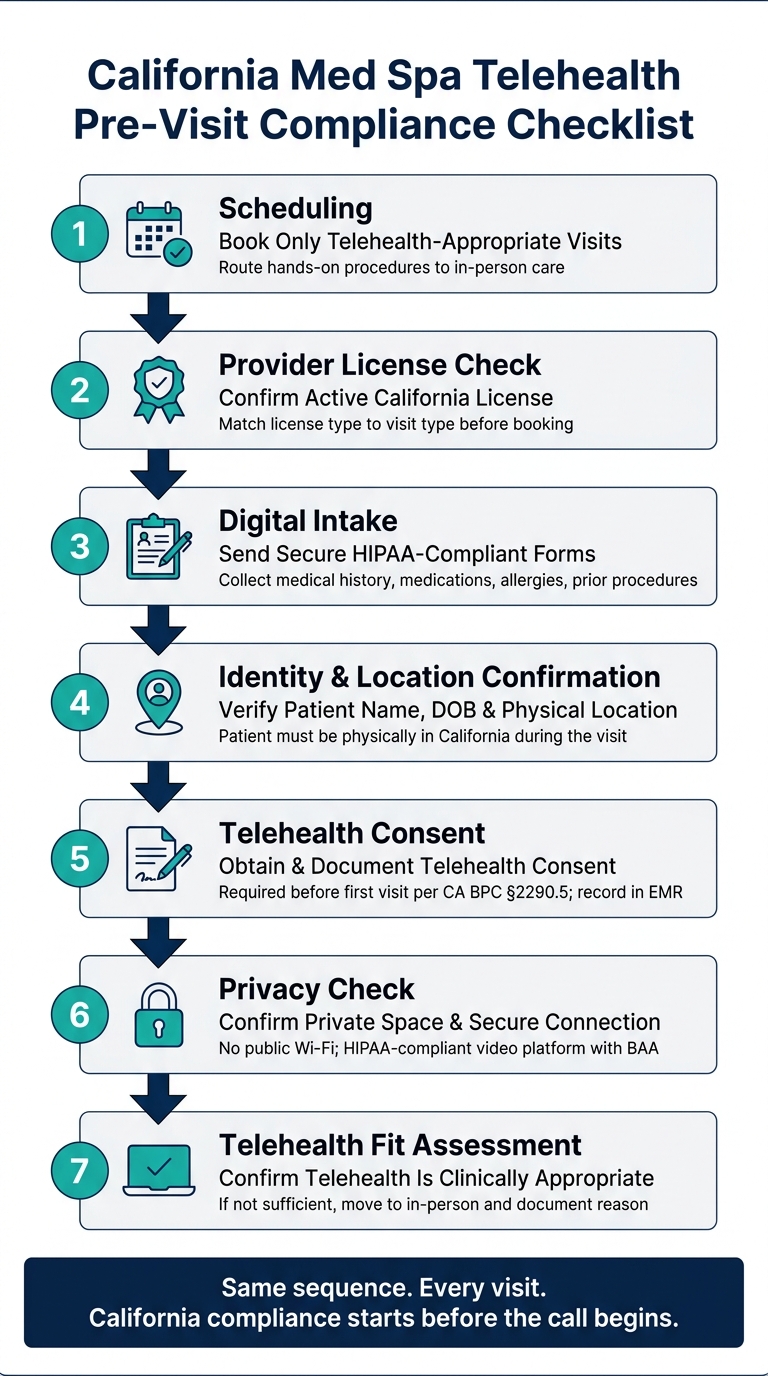
California Med Spa Telehealth Compliance: Pre-Visit Checklist
Take those charting and compliance steps and turn them into one pre-visit SOP. Rules on paper don't do much if the team handles them differently from one visit to the next. A written SOP turns licensure, location, consent, privacy, prescribing, and charting rules into clear tasks that people can own. And when the workflow is short and fixed, your front desk, clinical team, and providers stay on the same page.
Pre-Visit Checklist Clinics Can Standardize
Use the same sequence for every visit:
- Scheduling: Book only visit types that work for telehealth. If a patient needs a hands-on procedure or the evaluation won't be enough by video, route them to in-person care.
- Provider license check: Confirm the clinician has an active California license for that visit type.
- Digital intake: Send secure, HIPAA-compliant forms before the visit to collect medical history, medications, allergies, prior aesthetic procedures, and treatment goals.
- Identity and location confirmation: Have patients confirm their full name, date of birth, and current physical location before the visit starts.
- Telehealth consent: Collect telehealth consent before the first visit and keep it documented in the EMR.
- Privacy check: Ask patients to join from a private space and stay off public Wi-Fi. Then confirm privacy again at the start of the visit.
- Telehealth fit: Check again at the start of each visit that telehealth still makes sense. If it doesn't, move the patient to in-person care and document the reason.
Prospyr supports this workflow with HIPAA-compliant scheduling, digital intake forms, e-sign consent, communication tools, and EMR features in one system. When scheduling, intake, consent, and charting all connect, fewer steps slip through the cracks.
Conclusion: Key California Telehealth Rules to Put Into Practice
Compliant telehealth in a California med spa comes down to six things done the same way every time: use California-licensed clinicians for patients located in California, verify patient location at every visit, obtain and document telehealth consent before care begins, protect patient privacy through HIPAA-compliant tools, prescribe only when the clinical evaluation supports it, and chart every visit as fully as an in-person encounter. A standardized workflow turns compliance into a repeatable process instead of a judgment call.
FAQs
Can telehealth replace every med spa consult in California?
No. California allows virtual Good Faith Exams, but they have to meet the same standard of care as an in-person visit.
That means a virtual exam isn't a shortcut. The clinician still needs to make the same level of medical judgment they would during an office visit.
There’s another limit too: medical procedures must happen at a registered location. So a fully remote model doesn’t work in California.
A few other rules matter here:
- Only a qualified prescriber may perform a virtual GFE.
- Clinics must document consent and clinical need.
In plain English, California permits telehealth for the exam itself, but not as a way to run the entire process remotely.
What if a patient joins the visit from another state?
If a patient joins a telehealth visit from another state, the provider has to follow that state’s licensing rules.
That’s why clinics should confirm and document the patient’s physical location at the start of every visit. They also need to make sure the provider has the required active license in that state. If not, the visit may be noncompliant.
When should a telehealth visit be converted to in-person care?
A telehealth visit should be converted to in-person care when a virtual visit doesn’t allow for a full clinical evaluation. The provider should note the specific clinical reason in the patient’s medical record.
In-person care is also required in some cases, such as:
- prescribing certain controlled substances
- state rules that require a physical exam
- payer-required follow-ups that call for an in-person exam
Patients should also be told that in-person care is always an option. That choice should be documented during consent.